




We may not have the course you’re looking for. If you enquire or give us a call on 01344203999 and speak to our training experts, we may still be able to help with your training requirements.
History of Psychology: A-Level Psychology
ByVishnu SankarLast updated on: 22 September 2026
Explore the Origins of Psychology, from ancient Greek philosophy to modern science. Learn about key theories, influential thinkers, and the evolution of the field. This blog will explore key milestones, influential figures, and pivotal movements that shaped the field over centuries. Let’s delve into the fascinating evolution of Psychology!
Psychology has evolved from philosophical roots to a recognised scientific discipline. Its development reflects changing views on human behaviour, thought, and emotion. Key figures and movements have shaped the way we understand the mind today. In this blog, we explore the History of Psychology and its major milestones.
What is Psychology?
Psychology, as defined via the American Psychological Association (APA), is the exam of the human mind and behaviour. This area encompasses the observe of the thoughts, its functioning, and its impact on human behaviour. The APA similarly states that Psychology incorporates everything of the human experience, from information brain capabilities to analysing movements of countries, from Child Development to providing take care of the elderly. It mostly encompasses the following:
It mostly encompasses the following:
1) Scientific Study: Psychology is a scientific discipline that uses empirical research and systematic methods to investigate and understand human behaviour and the mind.
2) Mind and Behaviour: It focuses on two core elements – the human mind and behaviour. The mind refers to mental processes such as cognition, emotion, and perception. In contrast, behaviour pertains to observable actions and reactions.
3) Broad Scope: Psychology includes a considerable range of topics, from individual concept strategies to institution dynamics and from child development to elder care.
4) Multidisciplinary: It integrates knowledge and concepts from diverse fields, along with Biology, Sociology, Philosophy, and Neuroscience to provide a comprehensive expertise of human behaviour.
5) Understanding Motivation: Psychology examines what drives human behaviour. It seeks to understand the motivations, desires, and factors that influence how people think, feel and act.
6) Cultural Influence: It recognises the position of culture in shaping human behaviour and the way cultural variations can have an effect on intellectual strategies and actions.
7) Mental Health: A big part of Psychology entails the study and treatment of intellectual fitness troubles, inclusive of tension, despair, and different psychological issues.
8) Developmental Stages: It explores human improvement throughout the lifespan, from infancy to antique age, and how people change and grow in their cognitive and emotional capabilities.
9) Social Behaviour: Psychology delves into how people engage with each other. It includes to have a look at the aspects like relationships, prejudice, and organisation dynamics.
10) Applied Psychology: Psychology has many practical applications in fields like Clinical Psychology (remedy and counselling), Organisational Psychology (workplace behaviour), Educational Psychology (learning and teaching) and more.

Introduction to the Ancient Foundations of Psychology
The roots of Psychology can be traced back to ancient civilisations, where early thinkers explored the mysteries of the human mind and behaviour. In ancient Egypt, the concept of the soul and its influence on mental health was significant, with healers attributing mental disorders to supernatural forces and treating them through rituals and spiritual practices. Meanwhile, in ancient Greece, philosophers like Socrates, Plato, and Aristotle laid the groundwork for Western psychological thought, emphasising self-examination, the tripartite soul, and empirical observation.
In ancient China, Confucius and Laozi contributed to the understanding of human nature and behaviour through their philosophical teachings. Confucianism emphasised social relationships and moral development, while Daoism explored the balance between mind and body. These early ideas laid the groundwork for the Features of Science Psychology, offering initial frameworks for understanding the complexities of the human mind. Their influence helped shape subsequent developments in the field and contributed to the diverse perspectives seen today.
Background: Philosophy and Physiology
The History of Psychology started as an aspect of philosophy; early thoughts first appeared in ancient Egypt, Greece, China, Persia, and India. Dualism was proposed by René Descartes in the 17th century and implies the existence of a connection between the mind and the body, though they are not one. This idea formed the basis of upcoming arguments in psychology.
These early traditions form the basis of questions such as nature versus nurture. Psychologists apply scientific techniques to examine behaviour, contrary to philosophers. Towards coming up with a formal scientific discipline, research in the field of physiology also contributed to the shaping of psychology.
Learn practical strategies for a more fulfilling life – Sign up for our Positive Psychology Course today!
The Evolution of Modern Psychology
Here is a list of checkpoints in the history of Modern Psychology, discussed in detail:
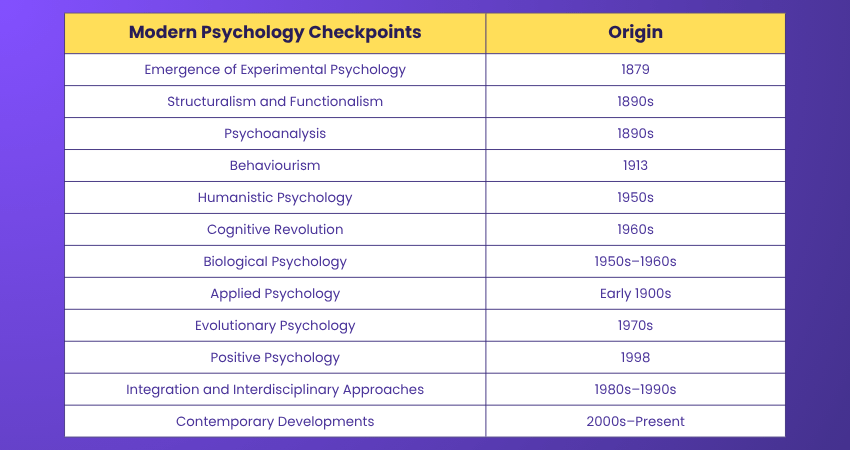
a) Emergence of Experimental Psychology: The emergence of current Psychology is regularly attributed to Wilhelm Wundt, who set up the first Psychology laboratory in Leipzig, Germany, in 1879. This marked an extensive shift from philosophical speculation to empirical remark and experimentation.
b) Structuralism and Functionalism: Two early schools of idea emerged in the late 19th century. Structuralism, led by means of Edward Titchener, it is aimed to analyse the shape of the thoughts through introspection. Functionalism, championed by William James, is centered on know-how the reason and feature of intellectual processes in adapting to the surroundings.
c) Psychoanalysis: Sigmund Freud revolutionised Psychology along with his Psychoanalytic concept in the early 20th century. He explored the unconscious mind, dream evaluation, and they have an impact on the early youth studies on personality development.
d) Behaviourism: The upward thrust of behaviourism, spearheaded by John B. Watson and later B.F. Skinner, shifted the point of interest of Psychology to observable behaviour in place of internal mental strategies. Behaviourists emphasised the role of conditioning and reinforcement in shaping human actions.
e) Humanistic Psychology: Humanistic Psychology emerged as a response to behaviourism and Psychoanalysis. Figures like Carl Rogers and Abraham Maslow emphasised the significance of individual development, self-realisation, and subjective reviews in understanding human behaviour.
f) Cognitive Revolution: In the mid-20th century, the Cognitive revolution introduced a renewed focus on intellectual tactics. Psychologists along with Jean Piaget and Ulric Neisser explored Cognitive improvement, reminiscence, language, and problem-solving, ushering inside the Cognitive Psychology generation.
g) Biological Psychology: The study of the organic underpinnings of behaviour and intellectual procedures became prominent. Researchers investigated the role of genetics, brain structures, neurotransmitters, and physiological processes in understanding psychological phenomena.
h) Applied Psychology: Various branches of Applied Psychology developed to cope with practical sessions of understanding psychological. Clinical Psychology, Counselling Psychology, Educational Psychology, Industrial-organisational Psychology, and others emerged to apply psychological principles in real-life settings.
i) Evolutionary Psychology: The 1980s noticed the upward thrust of Evolutionary Psychology, which focused on comprehending human behaviour and cognition within the context of evolutionary strategies and model. It explores how natural choice has shaped the psychological developments and behaviours.
j) Positive Psychology: Positive Psychology emerged in the overdue 20th century, moving the focus from pathology to well-being and effective aspects of human functioning. It explores topics including happiness, flourishing, resilience, and strengths.
k) Integration and Interdisciplinary Approaches: Modern Psychology has witnessed expanded collaboration and integration with other disciplines, along with Neuroscience, Sociology, and Anthropology. This interdisciplinary method has enriched the understanding of the complexities of human behaviour.
l) Contemporary Developments: Psychology continues to evolve with ongoing research and technological advancements. Areas consisting of Cognitive Neuroscience, Social Neuroscience, Cultural Psychology, and Cross-cultural Psychology can enhance the understanding of the human mind and behaviour.
Discover strengths, boost wellbeing, and thrive with positive psychology with our Personal Development Courses – Join now!
Women in Psychology History
Women were long excluded from formal academic training in psychology’s early years. Despite this, many made lasting contributions to the field. Their work is now recognised as foundational to modern psychological thought. Notable women in psychology include:
Mary Whiton Calkins: Completed doctoral studies at Harvard but was denied her degree due to gender. She studied under William James and became the first female president of the American Psychological Association.
Anna Freud: Expanded psychoanalytic theory and pioneered child psychoanalysis. She identified key defence mechanisms and influenced later thinkers like Erik Erikson.
Mary Ainsworth: Made major contributions to developmental psychology and attachment theory. She developed the “Strange Situation” method to study child-caregiver bonds.Learn how to influence and inspire positive change in communities – Join our Social Psychology Training now!
Father of Modern Psychology
In 1879, Wilhelm Wundt established the first-ever Psychology laboratory in Leipzig, Germany, earning him the title “Father of Psychology.” His influential work, “Principles of Physiological Psychology,” published in 1873, laid the groundwork for his objective investigation of the human mind. Wundt developed the method of introspection, which involves the impartial observation of one’s thoughts and emotions
By training individuals in introspection and conducting repeated tests, he aimed to dissect the elements of the human mind and understand how these components collectively give rise to conscious experiences, shaping the early foundations of Psychology.
While Wundt is often credited with founding Psychology, some researchers argue that Gustav Fechner also deserves recognition for his groundbreaking work. In 1850, Fechner made a profound connection between the mind and body, leading to his notable contribution known as “Fechner’s Law.” This principle explains the direct relationship between the perception of a stimulus and its intensity, opening new avenues for measuring behaviours within Psychology.
Start your journey towards self-discovery and transformation – Join our Psychology of Personal Growth Training.
Criticism and Controversies in Psychology
Let’s have a look back at some of the significant discoveries in the History of Psychology:
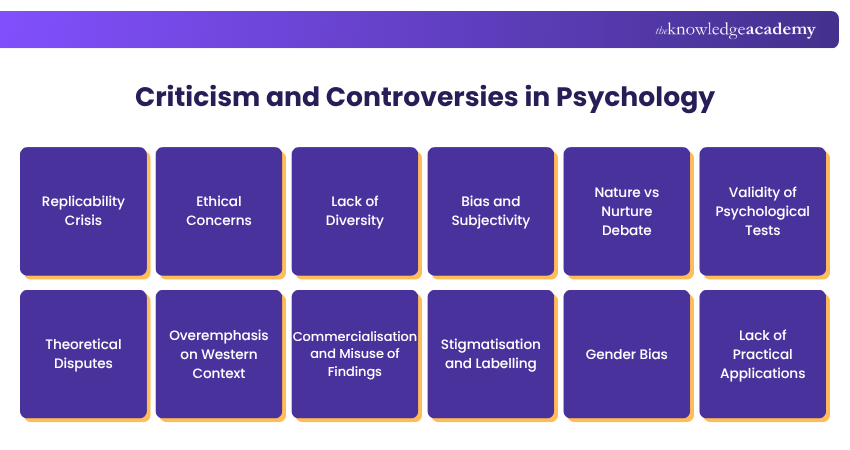
a) Replicability Crisis
Many psychological studies have failed to replicate reliably. This has raised concerns about research transparency and methodological rigour.
b) Ethical Concerns
Issues like informed consent and participant protection have drawn criticism. Ethical guidelines and review boards now help ensure responsible research.
c) Lack of Diversity
Psychological studies often lack diverse samples. This limits how well findings apply across different populations.
d) Bias and Subjectivity
Research may be influenced by personal or theoretical bias. This affects study design, data interpretation, and publication.
e) Nature vs Nurture Debate
The balance between genetics and environment remains contested. Conflicting findings continue to fuel this long-standing debate.
f) Validity of Psychological Tests
Tests like IQ and personality assessments face scrutiny. Critics question their accuracy and cultural fairness.
g) Theoretical Disputes
Different schools of thought often clash. These disputes highlight the need for more empirical evidence.
h) Overemphasis on Western Context
Psychology has historically focused on Western theories and populations. This limits its relevance to non-Western cultures.
i) Commercialisation and Misuse of Findings
Psychological insights are used in marketing and persuasion. This raises ethical concerns about manipulation and harm.
j) Stigmatisation and Labelling
Diagnostic labels may lead to stigma and over-pathologising. Critics also question the reliance on medication-based treatments.
k) Gender Bias
Findings from male-dominated samples are often generalised. This calls for more inclusive and gender-aware research.
l) Lack of Practical Applications
Some studies lack real-world relevance. Critics urge for more research that addresses everyday challenges.
Learn to manage anxiety and regain control of your life with our Anxiety Course - Join now!

Vishnu Sankar is a Senior Content Writer with 5+ years of experience across content development, software development, web development and system administration. His technical background and professional training support his expertise in IT and Tech, while his extensive research and writing experience covers Project Management and Health and Safety.
View Detail

 If you wish to make any changes to your course, please


