




We may not have the course you’re looking for. If you enquire or give us a call on 01344203999 and speak to our training experts, we may still be able to help with your training requirements.
What is a Business Process: Everything You Need to Know
William Brown 16 July 2026A Business Process is a structured set of activities that helps organisations achieve goals, streamline operations, and consistently deliver value to customers. It explains how work moves from start to finish, keeping teams organised, reducing errors, improving efficiency, and delivering consistent results across operations.

BCS Practitioner Certificate in Modelling Business Processes Training
 Top Rated Course
Top Rated Course
Exclusive 40% OFF
Training Outcomes Within Your Budget!
We ensure quality, budget-alignment, and timely delivery by our expert instructors.
Table of Contents

Have you ever wondered why some organisations run smoothly while others struggle with delays, confusion, and recurring mistakes? The difference lies in how structured their work is. From approving a leave request to delivering a product before the deadline, every activity follows a structured set of steps. That is where understanding What is a Business Process becomes crucial since it shows how work gets completed behind the scenes.
If you have ever followed a checklist, filled out a form, or moved a task from one stage to another, you have experienced a process in action. To put it simply, learning What is a Business Process helps you get an overview of how tasks, people, and systems connect. In this blog, you will learn about Business Process, its types, benefits, importance, and more!
Table of Contents
1) What is the Business Process?
2) Why are Business Processes Important?
3) Key Types of Business Processes
4) Business Process Mapping
5) Business Process Lifecycle
6) Benefits of Using Business Process Software
7) Business Process Example
8) Conclusion
What is the Business Process?
Business Process is a systematic group of activities that collaborate in achieving a specified organisational aim. There might be several processes within a company operating in various departments, with each one adding to the general efficiency and consistency.
Sometimes, when the internal capacity is not enough, businesses will hand over some functions, e.g. payroll or HR, to external parties in order to ensure that the business operations continue smoothly.

Why are Business Processes Important?
Business Process is the foundation of how an organisation functions. Here is some key importance of the same:
1) They create standard ways of doing things so that results are predictable
2) These efficiently cut out unnecessary steps, saving time and money
3) With clear processes, quality can be monitored and improved
4) With this, everyone knows their role and what’s expected of them
5) Businesses can build a reputation for reliability and high-quality delivery
6) They can reduce human error and make audits or inspections easier to handle
7) They can gift your business with happy customers and loyal customers
Step into the mind of a Business Analyst – join our BCS Practitioner Certificate in Requirements Engineering today!
Key Types of Business Processes
Business Processes are generally classified into four main categories based on their purpose and contribution to organisational goals. Each type plays a distinct role in maintaining efficiency, productivity, and overall business success. Let’s look at them below:
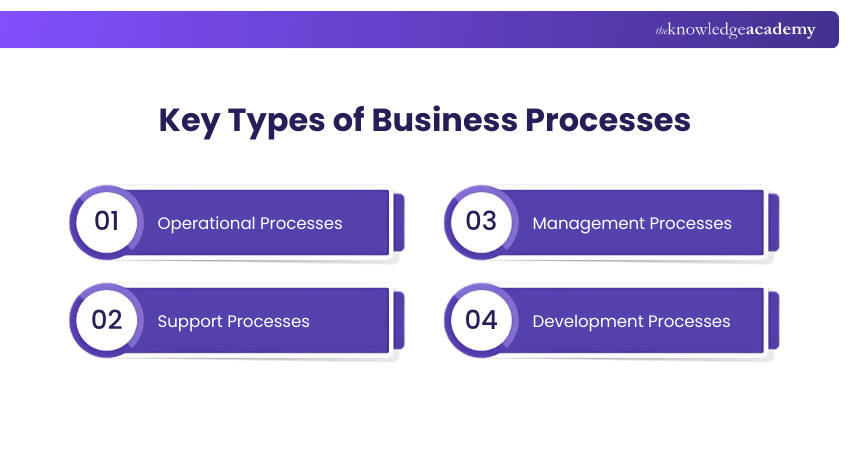
1) Operational Processes
Also known as primary Business Processes, these are the core activities that deliver value directly to customers. Through Business Processes Management, organisations streamline these processes to improve efficiency and output.
Examples include:
1) Taking customer orders
2) Processing product payments
3) Managing bank accounts
2) Support Processes
Also called secondary processes, these functions maintain internal stability and operational support. By applying Business Processes management techniques, businesses enhance coordination across departments such as accounting, HR management, and workplace safety to ensure consistent performance.
Examples include:
1) Workplace safety management
2) Accounting and bookkeeping
3) Payroll processing and IT support
3) Management Processes
Management processes focus on overseeing, measuring, and optimising overall business performance. With the help of Business Process Management, organisations align daily operations with strategic goals, ensuring long-term growth and sustainability through effective planning, governance, and budgeting.
Examples include:
1) Infrastructure and capacity management
2) Governance and compliance
3) Internal communications
4) Development Processes
Development processes focus on improving products or services based on customer needs and real-world feedback. After launch, businesses gather insights through surveys, support interactions, or feedback tools to refine performance and enhance user experience. This continuous loop ensures better quality, innovation, and long-term customer satisfaction.
Examples include:
1) Product improvement cycles
2) Customer feedback collection and analysis
3) Feature updates and optimisation
Learn core analysis skills and boost your career with BCS Foundation Certificate in Business Analysis now!
Business Process Mapping
Business Process Mapping is a visual way to show how a Business Process works systematically, using flowcharts and diagrams. It helps teams understand task sequence, decision points, and responsibilities. This makes it simpler to analyse, improve, and standardise workflow across the organisation. It is commonly broken into three formats:
1) Sequential Business Process: It follows a fixed, step-by-step path with a clear start and end point. Tasks are completed in a specific order within a set timeline. Here, each step must be finished before the next one begins.
2) Status-driven Business Process: Here, it does not always have a strict start or finish. The flow changes based on status updates, conditions, or events. Steps can repeat depending on need, making this model flexible.
3) Parallel Business Process: In this model, multiple activities happen simultaneously. Different branches of work run at the same time, but all must be completed before moving to the next main steps.
Business Process Lifecycle
The working process cannot be improved randomly without a strong goal set. You can follow the Business Process lifecycle with the following steps:
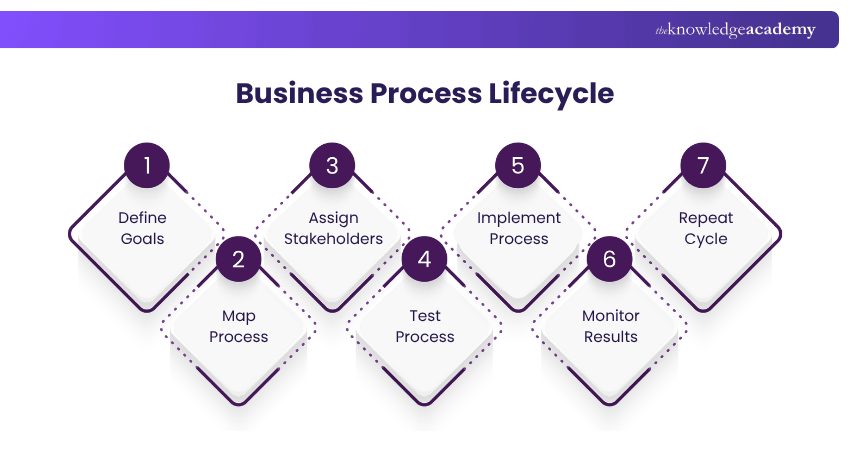
1) Define Goals
When you set your goals, you recognise the purpose of the procedure plus the result you want, like cutting down time, increasing customer satisfaction, enhancing precision, or lessening expenses.
2) Map Process
Picture the current process and the future state you want to achieve. List every step, assign a person, and determine the order. Use flowcharts, swimlane diagrams, or process-mapping software to reveal dependencies and handoffs.
3) Assign Stakeholders
By designating owners, contributors and reviewers to certain tasks, it clarifies who is responsible for each part of the process. The clear accountability makes sure that every step is done precisely and punctually.
4) Test Process
Verification of the process confirms the logical sequence of actions, the seamless integration of tools and the satisfaction of expectations with the final product. Furthermore, it assists in identifying vulnerabilities, blockages or redundant phases prior to full implementation.
5) Implement Process
When you are done with the above steps, you should implement the process on the whole team, department or organisation. It involves the delivery of the training and granting of access to the necessary tools. Effective communication is the key to getting acceptance and making sure that all people are aware of the workflow.
6) Monitor Results
It is necessary to track the process performance to know if your Business Process is getting more efficient. Verify if the objectives are being reached, point out the unforeseen difficulties, and scrutinise data from significant KPIs like the time, cost, error rate, and customer feedback.
7) Repeat Cycle
This final step focuses on refining and enhancing the Business Process based on performance results and feedback. Improve workflows by removing bottlenecks, automating repetitive tasks, or strengthening communication.
Learn the art of analysing and improving Business Processes with our expert-led Business Analysis Courses.
Benefits of Using Business Process Software
Using Business Process Software offers several powerful advantages that can significantly enhance efficiency and overall performance:
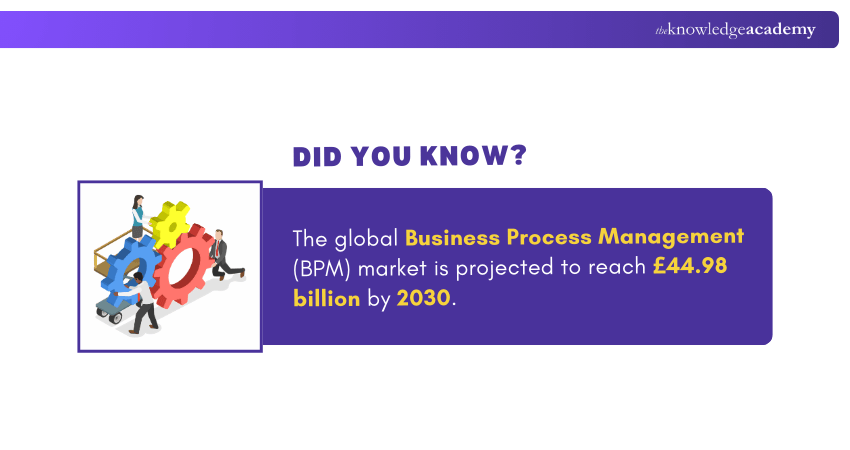
1) Reducing Time Spent on Tasks: Reduces time spent on tasks by automating repetitive activities and freeing up valuable hours.
2) Saving Money on Payroll: Cuts payroll costs by minimising manual work and reducing the need for additional staffing or overtime.
3) Making Tasks Easier: Simplifies complex tasks with AI-driven features that streamline workflows without compromising goals.
4) Improving Collaborative Efforts: Enhance collaboration by enabling seamless communication and teamwork across departments.
5) Heightening Organisational Control: Improves organisational control with real-time data, reporting, and monitoring features for better oversight.
Business Process Example
One of the effective ways to understand What is a Business Process is to look at vendor and supply chain management. It includes selecting and onboarding vendors, raising purchase orders, receiving goods, and processing supplier invoices. Each step follows a clear sequence to make purchasing, and payments occur in a controlled manner.
These activities are often split across departments such as procurement, finance, and accounting, which can sometimes create delays or errors if coordination is weak. Because many of these tasks are repetitive and rule-based, they are well suited to automation and continuous improvement. With well-designed processes and the support of Business Process Management (BPM) tools, workflows become clearer, faster, and more efficiently connected across the organisation.
Conclusion
Understanding What is a Business Process helps you see daily work turn into measurable results. When tasks are clearly defined, mapped, and improved, organisations reduce errors, save time, and deliver consistent value. From operational workflows to management controls, reviewing Business Processes regularly supports better business decisions and builds a scalable way of working.
Acquire the skills to design seamless, and user-friendly experiences – join the BCS Foundation Certificate in User Experience now!
Frequently Asked Questions
What is Business Process Management (BPM)?

Business Process Management (BPM) is a structured method for analysing, improving, and controlling workflows. It uses data, automation, and digital tools to optimise tasks, align processes with goals, and support better business decisions. It turns Business Processes into a measurable, improvable system.
What Makes a Business Process Successful?
A Business Process is successful when it has clear objectives, a streamlined design, and structured steps that are easy to follow. It must use accurate data, align with stakeholder needs, and include consistent performance tracking to ensure the process is reviewed, measured, and improved.

William Brown


Senior Business Analyst and Strategic Advisor
William Brown is a senior business analyst with over 15 years of experience driving process improvement and strategic transformation in complex business environments. He specialises in analysing operations, gathering requirements and delivering insights that support effective decision making. William’s practical approach helps bridge the gap between business goals and technical solutions.
View Detail

 If you wish to make any changes to your course, please


