


 Top Rated Course

We may not have the course you’re looking for. If you enquire or give us a call on 01344203999 and speak to our training experts, we may still be able to help with your training requirements.
Operational Efficiency: A Complete Guide for Business
William Brown 16 July 2026Operational Efficiency is a business’s ability to maximise output while minimising waste, using streamlined processes and resources without reducing quality. This is highly valuable for organisations to deliver better results with minimal effort, cutting costs, and providing a higher quality experience to their customers.

Training Outcomes Within Your Budget!
We ensure quality, budget-alignment, and timely delivery by our expert instructors.
Table of Contents
Businesses want to achieve more while spending less time, money, and effort. But as companies expand, their processes become slower, communication gets complex, and inefficiencies start to create problems. This is why Operational Efficiency is valuable to help organisations simplify how they work, remove wasteful activities, and deliver better value to customers.
In today’s dynamic and fast-moving world, efficiency is necessary to give organisations a competitive edge in the market. From large businesses to smaller ones, teams look to adopt smarter methods and tools to improve workflow. In this blog, you will learn about Operational Efficiency, its strategies, benefits, and other essential elements to enhance your business performance.
Table of Contents
1) What is Operational Efficiency?
2) How Do You Measure Operational Efficiency?
3) Strategies to Enhance Operational Efficiency
4) Benefits of Operational Efficiency
5) Comparing Productivity and Operational Efficiency
6) What are the Three Factors of Operational Efficiency?
7) Operational Efficiency Examples
8) Conclusion
9) Difference Between Operational Efficiency and Productivity
10) Conclusion
What is Operational Efficiency?
Operational Efficiency means to improve the way businesses utilise their people, money, and technology to deliver better outcomes. Its focus lies on streamlining processes, cutting unnecessary costs, and improving productivity. When daily business operations run smoothly, organisations can deliver quality products and services with fewer resources.
As the market keeps becoming competitive, every industry is under pressure to ensure operations run efficiently. Stakeholders expect organisations to reduce waste, increase profitability, and offer reasonable value to customers. This is why Operational Efficiency is a top priority for businesses worldwide.

How Do You Measure Operational Efficiency?
To understand how a business is performing, it is essential to measure its Operational Efficiency. It is measured through the Operational Efficiency ratio. This ratio shows how a company is using its costs to generate revenue. It is calculated by adding Operating Expenses and Cost of Goods Sold (COGS), divided by Net Sales.

A lower ratio means the business is spending less to make profits, which indicates better efficiency. Organisations can also view other financial performance metrics, such as
1) Accounts Payable Turnover: How fast a company pays its suppliers
2) Accounts Receivable Turnover: How fast customer payments are collected
3) Inventory Turnover: How efficiently the stock is sold and replaced
By using Operational Efficiency metrics over time, businesses understand how efficiently money, resources, and goods are flowing through daily operations.
Strategies to Enhance Operational Efficiency
Improving Operational Efficiency is vital for any organisation that's looking to reduce costs, improve productivity, and maintain competitiveness. The following strategies can help them achieve these goals:

Embracing Automation
Leveraging automation technology to handle tasks such as data entry or reporting can save time, reduce mistakes, and give room for employees to focus on more important work. It helps to standardise processes, ensuring consistent results and faster delivery.
Utilising Predictive Maintenance
Predictive maintenance employs real-time data to monitor the condition of equipment and infrastructure. By checking equipment, companies can fix issues before they cause breakdowns, thus saving time and money.
Conducting Process Mapping
Process mapping is about creating visual representations of workflows to identify areas for improvement. Creating a clear picture of how work gets done helps spot delays and unnecessary steps, allowing for process improvement.
Improving Inventory Management
Effective Inventory Management entails tracking the goods throughout their journey from manufacturing to the point of sale. Better Inventory Management ensures that products are always available when needed while avoiding extra storage costs.
Adopting Business Process Outsourcing (BPO)
BPO is about contracting external providers to handle business functions, such as invoicing and payment processing. Hiring outside companies to handle certain tasks, like billing, can be greatly cost-effective and help businesses focus on their main goals.
Focusing on Energy Management
Energy Management refers to the proactive monitoring, control and optimisation of energy use. This is done to reduce consumption and costs. Watching and controlling energy use can help you lower costs and support eco-friendly efforts.
Providing Employee Training
Investing in employee training and development increases skills and productivity. This contributes to greater Operational Efficiency. Teaching the employees new skills keep them productive, boosts job satisfaction and helps reduce turnover.
Learn the art of harmonising personal ambitions and team aspirations - Sign up for our Performance Management Training now!
Benefits of Operational Efficiency
From lower operational costs and increased profit margins to support for sustainability, Operational Efficiency brings plenty of benefits. Let’s explore them in detail
Lower Operational Costs
a) Optimising the production processes helps you lower the overall business expenses. In the case of service industries, it means matching the availability of resources with project demand.
b) The goal is to maintain a balanced utilisation rate, so the employees are neither overworked nor underutilised.
c) Knowing which projects bring in the most profit is vital for intelligent decision-making.
d) Managing resources effectively allows businesses to prioritise high-value projects.
e) Strategic project selection can result in higher profitability and better use of time and effort.

Increased Profit Margins
a) Streamlined processes need fewer resources like time, labour, and materials, lowering overall expenses.
b) Efficient systems help cut down on wasted effort and materials.
c) Better processes lead to higher-quality products or services. This reduces rework and returns.
d) The value generated per labour hour can be increased because employees can do more in less time.
e) Resources are used where they bring the most value. This is a proven way to avoid unnecessary spending.
f) Faster operations can ensure repeat business by reducing lead times and improving customer satisfaction.
Optimal Resource Utilisation
a) Streamlined processes reduce duplicated tasks and make better use of time and manpower.
b) Efficient planning helps you make sure that employees and equipment are neither overused nor underused.
c) Smart scheduling helps you allocate resources to the right tasks at the right time.
d) By removing bottlenecks, Operational Efficiency keeps the resources consistently engaged.
Explore how to build strong supplier relationships for business success with Introduction to Supplier Management Training – Register today!
Streamlined Manual Processes
a) Streamlining manual tasks means simplifying or automating workflows to reduce the need for manual effort.
b) It creates quicker and more accurate processes with fewer chances of errors.
c) For instance, automating a budgeting report to send on a set schedule ensures timely and consistent delivery.
d) It frees up employees from repetitive tasks, allowing them to focus on more strategic work.
e) Automation reduces the risk of forgetting tasks or sharing incorrect information.
Enhanced Customer Satisfaction
a) Streamlined operations reduce the possibility of delays and make sure that customers receive the desired products or services more quickly.
b) Efficient processes result in fewer errors and defects and lead to more reliable and consistent offerings.
c) Thanks to efficient operations, cost savings can be passed on to customers, offering more competitive pricing.
d) Efficient systems can help your business respond quickly to customer needs, feedback, or issues.
Support for Sustainability
a) Efficient systems often use less electricity, fuel, and other resources. This goes a long way to reduce environmental footprint.
b) Using only what’s needed helps conserve raw materials and prevents overproduction.
c) Shifting from paper-based or manual methods to digital tools reduces paper waste and emissions.
d) Efficient operations often include steps to reuse materials or recycle waste. This supports circular economy practices.
e) Operational efficiency supports green supply chains, which can include choosing eco-friendly suppliers and transport methods.
Boosted Employee Satisfaction
a) Operational efficiency can improve the work-life balance by reducing unnecessary workloads.
b) Automation and streamlined processes free up time for more meaningful, engaging tasks for your employees.
c) Employees feel more valued when they can focus on work that demands their skills and talents.
d) Lower attrition and reduced turnover costs are some of the best results of increased job satisfaction.
e) A motivated workforce is the foundation of overall business success.
Your business deserves the best! Understand the art of creating internal controls, tools, and metrics in our Business Process Improvement Training – Register now!
Comparing Productivity and Operational Efficiency
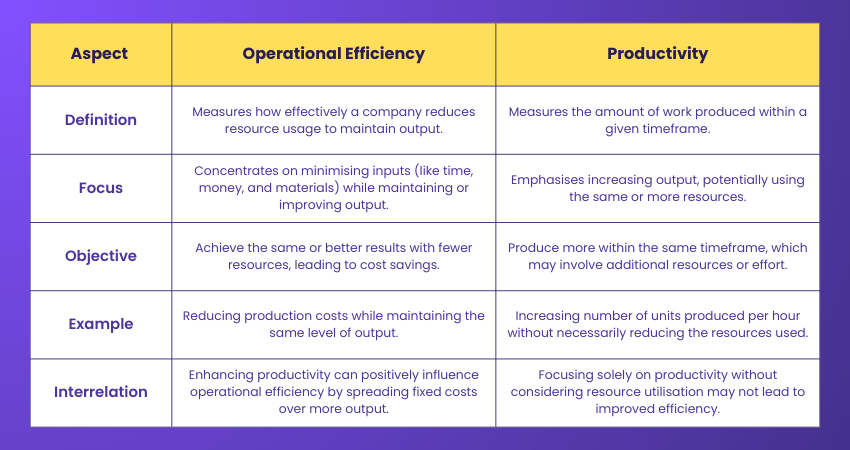
Productivity refers to how much output is produced in each time. Its focus lies on quantity. Operational Efficiency measures how cost-effective the output is, aiming to reduce waste and lower expenses. Let’s look at their differences with more insight.

What are the Three Factors of Operational Efficiency?
Operational Efficiency is dependent on three core factors, which include:
1) Cost: Means to reduce unnecessary spending. Businesses must manage their resources wisely, such as labour, materials, or technology, to lower operating expenses.
2) Time: Refers to improving workflow and reducing delay for faster product or service delivery. This leads to building a happier customer base and a seamless workflow for teams.
3) Quality: Emphasises the reliability of the output and meeting customer expectations. This means maintaining high-quality outputs to reduce rework, waste, and complaints.
Operational Efficiency Examples
Some examples of Operational Efficiency are listed below:
1) Marketing Agency: Centralising creative assets and client feedback in one location to save time and increase project delivery time.
2) Website Development Company: Standardising processes and utilising templates for faster project launch and consistent outcomes.
3) Consulting Firm: Providing teams with versatile skills and utilising software for quicker resource allocation.
4) Creative Agency: Using an end-to-end project management tool to improve collaboration, communication, and transparency.
Conclusion
Operational Efficiency is a smart way of thinking for businesses. When organisations simplify their workflows, utilise resources wisely, and adopt modern strategies, they build a strong core for sustainable growth. From automation and data-driven planning to motivated and skilled teams, small improvements can lead to efficient and long-term results.
Difference Between Operational Efficiency and Productivity
Here are the key differences between Operational Efficiency and Productivity:
Conclusion
More than just a business goal, Operational efficiency is a mindset. By streamlining processes, maximising resources, and embracing smart strategies, you can create a foundation for lasting growth. Whether it’s through automation, better planning, or empowered and happy teams, small changes can lead to big results.
Unlock your management skills and lead your team to sustained excellence – Sign up for our Management Courses now!
Frequently Asked Questions
What is an Example of Operational Efficiency?

Automation is one of the biggest examples of Operational Efficiency. Here's how automation can elevate efficient operations:
a) Drones for Inventory Management, deliveries, and inspections.
b) Self-serve kiosks for certain customer-facing processes.
c) Order-fulfilment robots for warehouses and distribution centres.
What is the Meaning of Operational Performance?
Operational performance refers to how effectively and efficiently a business executes its day-to-day activities to achieve its goals. It covers various aspects of the business's operations, including:
a) Production
b) Service delivery
c) Supply Chain Management
d) Resource allocation

William Brown


Senior Business Analyst and Strategic Advisor
William Brown is a senior business analyst with over 15 years of experience driving process improvement and strategic transformation in complex business environments. He specialises in analysing operations, gathering requirements and delivering insights that support effective decision making. William’s practical approach helps bridge the gap between business goals and technical solutions.
View Detail

 If you wish to make any changes to your course, please


