


 Top Rated Course

We may not have the course you’re looking for. If you enquire or give us a call on +800 312616 and speak to our training experts, we may still be able to help with your training requirements.
What is Requirements Engineering: A Complete Guide
The Knowledge Academy 22 August 2026Understand Requirements Engineering, its key processes, tools and how it helps ensure project requirements meet stakeholder and business needs.

Training Outcomes Within Your Budget!
We ensure quality, budget-alignment, and timely delivery by our expert instructors.
Table of Contents

KEY TAKEAWAYS
1. Requirements Engineering helps teams identify, analyse, document, validate, and manage requirements throughout a project.2. Requirements can include functional, non-functional, domain, business, user, stakeholder, and system requirements.3. Effective requirements should be clear, specific, measurable, testable, and traceable to reduce ambiguity and rework.4. A structured Requirements Engineering process improves stakeholder alignment, project clarity, risk management, and solution quality.5. Requirements Engineering uses management, modelling, collaboration, traceability, and AI-assisted tools.
“Make the checkout process faster.”
It sounds like a straightforward requirement. But how much faster? For which users? On which devices? And how will the team know when the requirement has actually been met?
Questions like these are exactly why Requirements Engineering matters. It helps teams move from broad ideas and assumptions to requirements that are clear, testable and aligned with what stakeholders genuinely need.
Read on this blog as we break down Requirements Engineering and explore how to develop requirements that are practical and effective.
What is Requirements Engineering?
Requirements Engineering is the structured process of identifying, analysing, documenting and validating the needs and expectations of stakeholders for a system, product or project. It helps teams understand what needs to be built, why it is needed and what the final solution should achieve before significant development begins.
Stakeholders may include customers, end users, business managers, and technical teams, each contributing to different needs and constraints. Bringing these perspectives together helps ensure that the proposed solution is relevant, feasible, and aligned with project objectives.

Types of Requirements
Requirements describe what a system must achieve, how it should perform, and the conditions it must satisfy. Different requirement types help teams separate business needs, user expectations, system behaviour, and quality standards. The main types are outlined below:
1) Functional Requirements
Functional requirements define what the system must do. They describe specific features, actions, or behaviours that users and other systems should be able to perform.
Example: The system shall allow users to reset their password through a verified email link.
2) Non-functional Requirements
Non-functional requirements define how well the system should perform. They cover quality attributes such as security, performance, reliability, usability, scalability, and accessibility.
Example: The system shall respond to user requests within two seconds under normal operating conditions.
3) Domain Requirements
Domain requirements arise from the specific industry, environment, or regulatory context in which the system operates. They may include legal obligations, industry standards, technical constraints, or specialist business rules.
Example: A healthcare system must handle patient information in line with applicable data protection requirements.
4) Business Requirements
Business requirements describe the high-level goals or outcomes an organisation expects the solution to support. They explain why the project is needed and what business value it should deliver.
Example: The new platform should reduce the average time required to process customer applications.
5) Stakeholder Requirements
Stakeholder requirements capture the needs and expectations of people or groups affected by the solution. These can include customers, employees, managers, regulators, and technical teams.
Example: Customer service teams need access to a complete record of previous customer interactions.
6) User Requirements
User requirements describe what end users need to achieve when interacting with the system. They are often expressed through user stories, scenarios, or use cases.
Example: As a customer, I want to track my order so that I know when it will arrive.
7) System Requirements
System requirements translate higher-level needs into detailed specifications for the complete system. They can include functional, technical, operational, interface, and quality requirements.
Example: The system shall integrate with the organisation's existing payment platform through a secure interface.
Test Your Understanding So Far
Which requirement is non-functional?A) Users can reset passwordsB) Pages load within two secondsC) Users can export reports
Functional vs Non-functional Requirements
Functional and non-functional requirements work together to define both what a system does and how well it does it. The table below highlights the main differences:
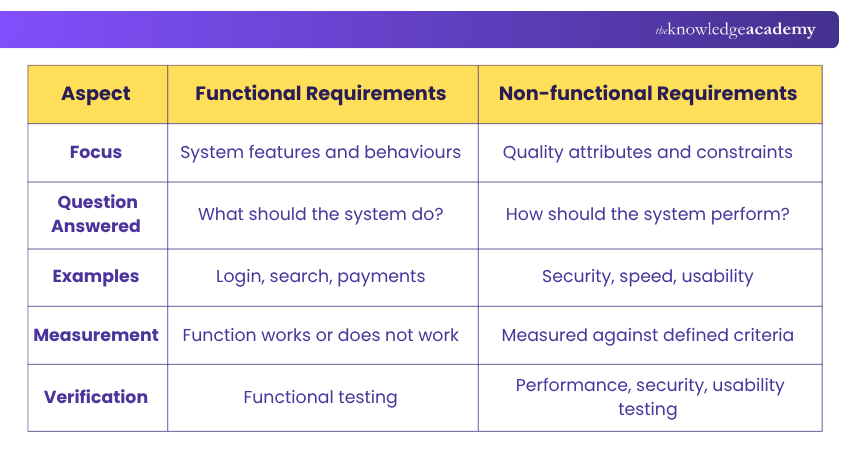
Both types are essential. Functional requirements define the required capabilities, while non-functional requirements establish the standards those capabilities must meet.
Requirements Engineering Process
Now that you’ve understood what Requirements Engineering is, let us explore its processes. The RE process encompasses several distinct phases, each critical to the project's success:
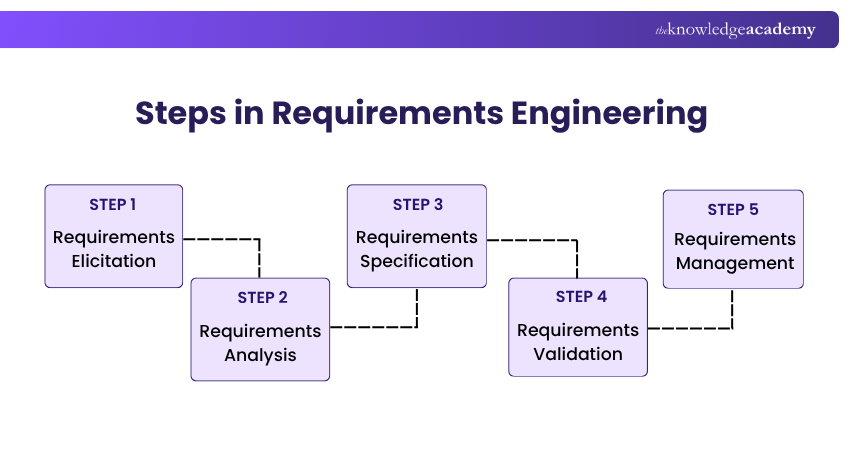
1) Requirements Elicitation: Requirements elicitation focuses on gathering information from stakeholders to understand their expectations and constraints.
2) Requirements Analysis: Requirements Analysis examines the collected requirements to make sure that they are consistent, clear and achievable.
3) Requirements Specification: Requirements specification documents the analysed requirements in an unambiguous format.
4) Requirements Validation: Requirements validation confirms that the documented requirements accurately reflect stakeholder needs.
5) Requirements Management: Requirements management makes sure that the requirements remain controlled and aligned as the project evolves.
Trainer’s Pro Tip: When reviewing requirements, ask stakeholders to walk through a real scenario rather than simply approving the wording. This can reveal hidden assumptions, missing conditions, and conflicting expectations early.
Build strong Business Analysis foundations with the BCS Foundation Certificate in Business Analysis Training - Sign up now!
How to Write Effective Requirements?
Effective requirements should communicate exactly what a system or solution needs to achieve without leaving room for conflicting interpretations. The following practices can help teams write stronger requirements:
1) Be Specific and Clear: Use precise language that communicates exactly what is expected and avoids unnecessary ambiguity.
2) Make Requirements Testable: Define measurable criteria so teams can verify whether each requirement has been successfully met.
3) Keep One Requirement per Statement: Avoid combining several needs into one requirement, as this can make implementation and testing difficult.
4) Use Consistent Terminology: Apply the same terms throughout requirement documents to prevent different interpretations among stakeholders.
5) Avoid Vague Language: Replace words such as “fast”, “flexible”, or “user-friendly” with specific and measurable expectations.
6) Define Acceptance Criteria: Establish the conditions that must be satisfied for a requirement to be considered successfully implemented.
7) Maintain Traceability: Link each requirement to its source, business objective, design element, or test case where appropriate.
For Example: Instead of writing “The system should load quickly,” specify “The system shall display the requested page within two seconds under normal operating conditions.”
Benefits of Requirements Engineering
Requirements Engineering helps teams establish clear expectations, reduce uncertainty, and improve project outcomes. Key benefits include:
1) Provides clear direction and structure throughout the project lifecycle
2) Identifies risks and inconsistencies before they become costly problems
3) Aligns stakeholder expectations with project goals and deliverables
4) Reduces rework caused by unclear, incomplete, or misunderstood requirements
5) Improves solution quality by keeping development focused on actual user needs
6) Supports better planning, testing, and decision-making across project teams
Myth: Requirements Engineering is only needed at the start of a project.Fact: Requirements often evolve throughout the lifecycle and need ongoing management.
Challenges of Requirements Engineering
While Requirements Engineering offers significant benefits, teams may encounter several challenges when gathering, analysing and managing requirements. Those include:
1) Gathering complete requirements from multiple stakeholders can be time-consuming.
2) Changing requirements can affect project scope, timelines, and resources.
3) Conflicting stakeholder priorities can make agreement difficult.
4) Ambiguous requirements can lead to misunderstandings and incorrect solutions.
5) Maintaining traceability becomes harder as requirements increase or evolve.
6) Effective Requirements Engineering can require considerable time, expertise, and stakeholder involvement.
Tools Used in Requirements Engineering
Requirements Engineering relies on different types of tools to capture, document, validate, and manage requirements throughout the project lifecycle. Common categories include:
a) Requirements Management Tools: Help teams capture, organise, track, and manage requirements from initial definition through delivery.
b) Modelling and Visualisation Tools: Represent requirements visually using use cases, process models, data flow diagrams, and other structured diagrams.
c) Documentation Tools: Support the structured recording of requirements through specification documents, user stories, functional descriptions, and related documentation.
d) Collaboration and Communication Tools: Enable stakeholders, analysts, developers, and other teams to share feedback, discuss requirements, and stay aligned.
e) Prototyping Tools: Allow teams to create early visual or interactive representations of a solution to clarify and validate requirements.
f) Testing and Validation Tools: Help verify that requirements are complete, consistent, and aligned with test cases and expected outcomes.
g) Traceability Tools: Link requirements to their sources, design elements, test cases, and deliverables. A Requirements Traceability Matrix (RTM) is commonly used to track these relationships throughout the lifecycle.
h) AI-assisted Requirements Engineering Tools: AI and Natural Language Processing (NLP) capabilities can help identify ambiguous wording, analyse requirement documents, and support traceability.
Before approving a requirement, ask:
✓ Is it clear?✓ Is it necessary?✓ Is it feasible?✓ Is it measurable?✓ Is it testable?✓ Is it traceable?✓ Does it conflict with another requirement?
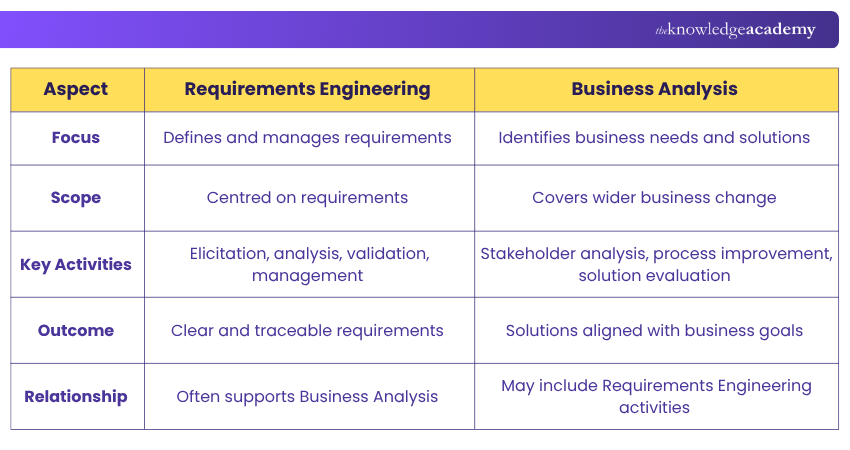
Requirements Engineering vs Business Analysis
Requirements Engineering focuses on defining and managing requirements, while Business Analysis addresses broader business needs, problems, and change. The table below highlights the key differences:
Prerequisites for Requirements Engineering
Before beginning Requirements Engineering, teams should establish enough context to gather and evaluate requirements effectively. Three key considerations are:
1) Stakeholder Identification: Identify the people and groups whose needs, expectations, and expertise should inform the requirements.
2) Project Scope: Establish the project's objectives, boundaries, and expected outcomes to keep requirements relevant and controlled.
3) Resources and Constraints: Understand available time, budget, expertise, and other limitations that may influence the requirements process.
Conclusion
Great solutions often begin with one thing: understanding exactly what is needed. Requirements Engineering turns stakeholder expectations into clear, testable, and manageable requirements that can guide a project from idea to delivery. We hope this blog has helped you understand the process and how stronger requirements can lead to better project outcomes.
Turn any business challenge into a future-ready breakthrough with Business Analysis Courses - Register now!
Frequently Asked Questions
How Do You Know When Requirements are Complete?

Requirements are considered complete when they cover all stakeholder and business needs, are clear, consistent, feasible and testable, and contain no significant gaps or conflicts. They should also be reviewed and approved by relevant stakeholders before development or implementation moves forward.
How Much Detail Should a Requirement Include?
A requirement should contain enough detail to be understood, implemented, and tested without prescribing unnecessary design decisions. The right level of detail depends on the project, delivery approach, risk, and audience.
Can AI Replace Requirements Engineering?
AI can support tasks such as analysing documents, identifying ambiguous wording, and generating draft requirements, but it cannot fully replace stakeholder judgement and contextual understanding. Human validation remains essential when deciding priorities, resolving conflicts, and confirming intent.

The Knowledge Academy


Global Training Provider
The Knowledge Academy is a world-leading provider of professional training courses, offering globally recognised qualifications across a wide range of subjects. With expert trainers, up-to-date course material, and flexible learning options, we aim to empower professionals and organisations to achieve their goals through continuous learning.


 If you wish to make any changes to your course, please


