




We may not have the course you’re looking for. If you enquire or give us a call on 01344203999 and speak to our training experts, we may still be able to help with your training requirements.
Requirement Elicitation: A Comprehensive Guide
ByNilotpal SarmahLast updated on: 26 September 2026
Requirement elicitation involves collecting and understanding the demands of stakeholders for the project. The process includes interviews, surveys, and workshops to ensure the product meets user needs. This blog dives into what requirement elicitation is, its importance, its process, some key features, benefits, and drawbacks.

What You Should Know
1. Requirement elicitation is an ongoing activity that can continue as requirements evolve.2. Different stakeholders may have different or conflicting expectations that need clarification.3. Both explicit and underlying stakeholder needs may emerge during elicitation.4. Clear documentation and confirmation of findings help reduce misunderstandings and rework.5. Effective elicitation relies on communication, collaboration, active listening, and careful analysis.
Effective software development begins with a clear understanding of what the end-users and stakeholders need. Requirement elicitation is the process of gathering, analysing, and clarifying those needs to ensure the final product aligns with expectations. It involves engaging with stakeholders, uncovering hidden requirements, and addressing potential conflicts early in the project life cycle. This crucial phase lays the foundation for building a solution that meets both business goals and user expectations.
Requirement elicitation goes beyond simply collecting information; it involves collaboration, communication, and critical thinking. Techniques such as interviews, workshops, surveys, and observation are used to extract both explicit and implicit requirements. This blog provides a comprehensive overview of the process, best practices, and techniques involved, helping you master the art of gathering accurate, actionable requirements for successful project delivery. elicitation goes beyond simply collecting information—it involves collaboration, communication, and critical thinking. Techniques such as interviews, workshops, surveys, and observation are used to extract both explicit and implicit requirements. This blog provides a comprehensive overview of the process, best practices, and techniques involved, helping you master the art of gathering accurate, actionable requirements for successful project delivery.
What is Requirement Elicitation?
Requirement elicitation is an ongoing Business Analysis activity that can take place throughout an initiative as needs, assumptions, and requirements are discovered and refined.
This can happen either by directly communicating with stakeholders or by carrying out research and experiments. Events can be either planned, unplanned, or a mix of both.
Planned activities could involve organised workshops and controlled experiments, while unplanned activities may occur spontaneously, without warning. For example, conducting unexpected discussions during a visit to a client's location can be a successful method of uncovering information.
Common Elicitation Trap
Assuming stakeholders always know exactly what they need can lead to gaps. Good elicitation uses probing questions, observation, and clarification to uncover hidden requirements.
The key tasks involved in requirement elicitation include:
a) Get Ready for Elicitation: This involves grasping the scope of the elicitation tasks, selecting suitable techniques, and organising the required resources.
b) Perform Elicitation: The objective is to explore and identify information related to the change, need, or initiative being analysed.
c) Confirm Elicitation Results: Verify the findings of the elicitation process by reviewing the collected information for accuracy and thoroughness.

Why is Requirement Elicitation Important?
Here are some of the reasons for the importance of requirements elicitation.
a) Alignment with Business Objectives: Elicitation helps ensure that requirements and proposed solutions align with the organisation's wider objectives. Understanding the business context helps teams identify needs that support desired business outcomes.
b) User Satisfaction: Involving users during development helps ensure that requirements reflect their needs and can improve user acceptance of the final product.
c) Time and Money Savings: A clear, well-defined specification protects from miscommunication and rework during development, resulting in cost-effectiveness and timely project completion.
d) Compliance and Regulation Requirements: For projects in regulated industries, requirement elicitation helps identify and capture applicable legal, regulatory and standards-related requirements, which is particularly important in sectors such as healthcare, finance and aerospace.
e) Traceability and Documentation: Well-documented elicitation results provide a foundation for requirements traceability, helping teams connect requirements with related design, development, testing, and validation activities.
Key Features of Requirement Elicitation
Requirement elicitation features facilitate the effective collection and acknowledgement of stakeholder’s needs. Here are some of the features:
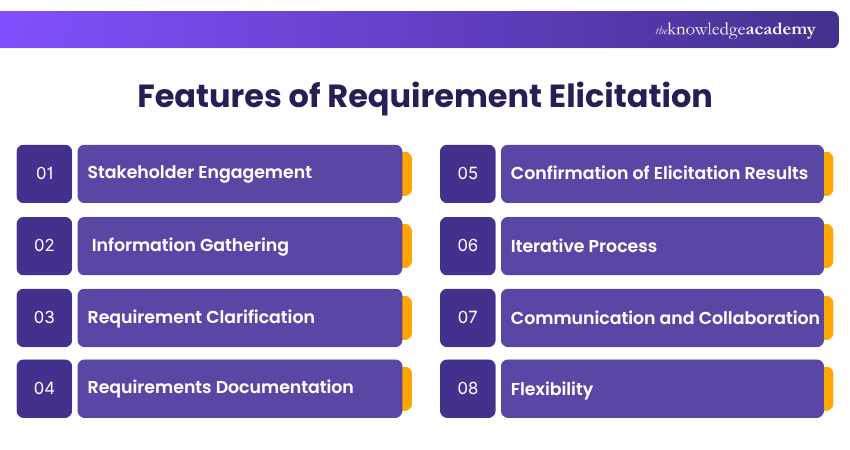
a) Stakeholder Engagement: Requirements Elicitation demands involvement from multiple stakeholders like project sponsors, end users and subject matter experts (SMEs).
b) Information Gathering: It collects data related to the end product and the business activities it will support.
c) Requirement Clarification: Elicitation helps uncover, explore, and clarify stakeholder needs, assumptions, constraints, and expectations before they are analysed and prioritised further.
d) Requirements Documentation: Simple and easy-to-understand documentation helps the development team to communicate effectively.
e) Confirmation of Elicitation Results: Collected information is reviewed with relevant stakeholders and compared with other available information to check its accuracy, consistency, completeness, and shared understanding.
f) Iterative Process: An iterative process is an ongoing process that facilitates continuous updates based on stakeholder feedback.
g) Communication and Collaboration: Effective communication with project team members and stakeholders ensures the expectations of end users are understood well.
h) Flexibility: The requirement of the elicitation process is the flexibility to respond to the progressing needs of stakeholders.
Steps in the Requirement Elicitation Process
Here is a five-step process for requirement elicitation to facilitate the product development process.
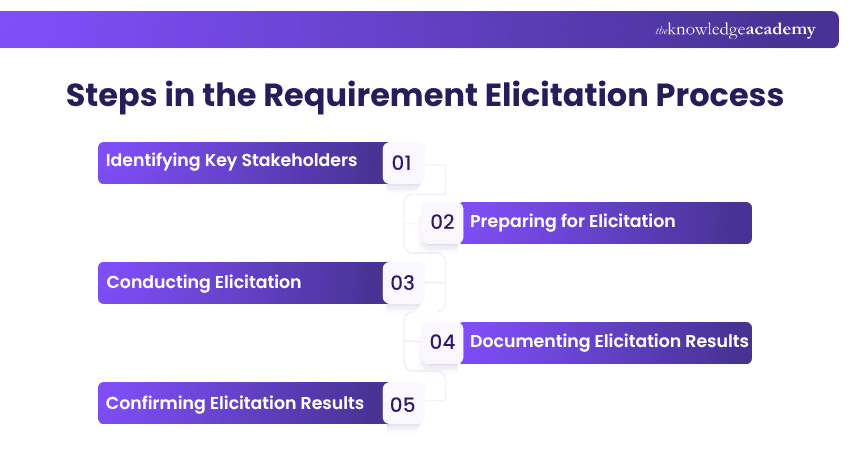
1) Identifying Key Stakeholders
Identifying key stakeholders at the beginning helps ensure that the right people are involved in the elicitation process. Stakeholders may include project sponsors, end users, subject matter experts and other individuals who influence or are affected by the initiative.
2) Preparing for Elicitation
Before conducting elicitation activities, Business Analysts review existing information such as documents, system interfaces, previous requirements and available user feedback to understand the current context. They also determine suitable elicitation techniques and prepare the resources needed for the activity.
3) Conducting Elicitation
At this stage, Business Analysts use suitable requirement elicitation techniques to gather and clarify information from relevant stakeholders. Techniques such as interviews, workshops, brainstorming, observation and surveys may be selected based on the project's needs and stakeholder involvement.
4) Documenting Elicitation Results
The information gathered during elicitation is recorded clearly so that it can be reviewed and analysed. Documentation may include requirement documents, models, notes, spreadsheets or requirements management tools, depending on the needs of the project.
5) Confirming Elicitation Results
After the elicitation results are documented, they are reviewed with relevant stakeholders to check their accuracy, completeness and consistency. Any gaps, misunderstandings or conflicting information can then be clarified before the requirements are further analysed and refined.
Elicitation Flow
Identify Stakeholders → Gather Needs → Clarify Requirements → Document → Validate
Master key skills to confidently support and deliver successful business transformations with the Business Analysis Courses – Join now!
Methods for Requirements Elicitation
Methods of requirements elicitation consist of various techniques to gather and define stakeholder needs for a successful project outcome. Let’s explore some of them
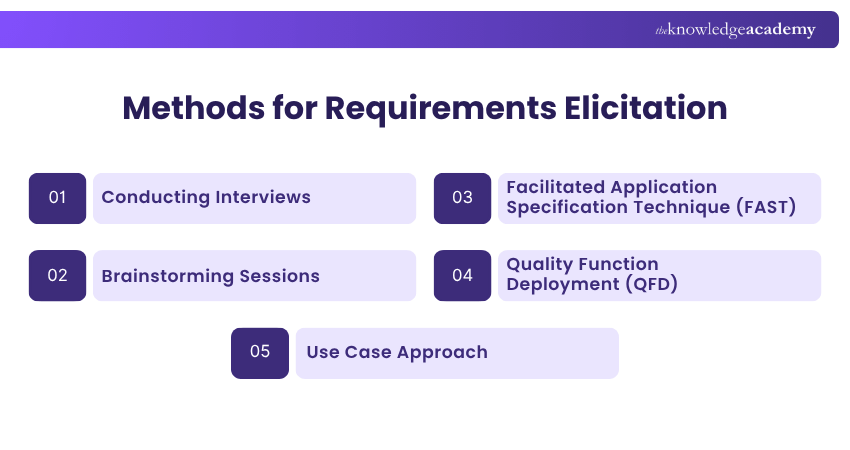
1) Conducting Interviews
The main objective of interviewing is to understand the user's expectations for the software. Because interviewing all stakeholders is not feasible, representatives are chosen based on their knowledge and trustworthiness.
Interviews may either be unstructured or structured. Unstructured interviews do not have a predetermined list of questions and enable the opportunity for open-ended inquiries to delve further into the issue.
On the other hand, structured interviews follow a predetermined set of questions asked consistently across interviewees. These questions may be open-ended, closed-ended, or a combination of both.
2) Brainstorming Sessions
Brainstorming sessions are a collaborative method designed to produce fresh ideas and encourage the exchange of viewpoints. In the context of requirements engineering, a skilled facilitator is crucial for effectively managing group bias and conflicts, ensuring the process remains productive.
In these sessions, all ideas are recorded to make sure everyone can see the contributions. At the end of the session, the ideas and potential requirements are documented for further analysis, refinement, and prioritisation.
3) Facilitated Application Specification Technique (FAST)
The goal is to minimise the gap between developers' vision and customers' expectations. During requirements gathering, a team-oriented method involves each participant identifying items in the system's environment, produced by the system, or used by it.
After merging the lists and removing duplicates, the team divides into smaller groups to develop mini specifications. In short, a draft is created that includes all the input received during the meeting.
4) Quality Function Deployment (QFD)
QFD is a structured method used to translate customer needs into specific product or service requirements. It helps teams prioritise customer expectations and relate them to technical or operational characteristics, often using tools such as the House of Quality.
5) Use Case Approach
The use case technique enhances understanding requirements through a combination of text and visuals, focusing on the "what" of a system rather than the "how." Its main components include:
a) Actor: An external agent interacting with the system, represented as a stick figure. Actors can be primary or supporting. A primary actor initiates an interaction with the system to achieve a goal, while a supporting actor provides a service or information needed by the system.
b) Use Cases: Descriptions of interactions between actors and the system, outlining all possible usage scenarios.
c) Use Case Diagram: A graphical representation illustrating actor-system interactions, with stick figures for actors, ovals for use cases, and lines for relationships.
The technique's effectiveness depends on the maturity of the analysts, developers, users, and customers involved.
Method Match-Up
1. Interviews: Detailed individual insights2. Workshops: Collaborative discussion3. Brainstorming: Idea generation4. Use Cases: Interaction-based requirements5. QFD: Translating customer needs into requirements
Benefits of Requirements Elicitation
Let’s move on and explore some of the major benefits of requirements elicitation that lead to the successful development of the product.
a) Clear Requirements: Clarifies and refines customer requirements effectively.
b) Improved Communication: Boosts communication and collaboration among stakeholders.
c) Quality Software: Quality software enhances the chances of creating software that satisfies customer requirements.
d) Prevents Misunderstandings: Minimises confusion and sets clear expectations efficiently.
e) Risk Identification: Helps in the early identification of possible risks and issues during the development phase.
f) Accurate Planning: Helps in developing a detailed and accurate project schedule.
g) User Confidence: Increases trust of users and stakeholders in the Software Development process.
h) Business Opportunities: Assists in finding new business opportunities and sources of income.
Drawbacks of Requirement Elicitation
Given below are some of the drawbacks associated with requirements elicitation. These challenges can impact the development phase.
a) Time-consuming: The process of requirements elicitation can be time-consuming.
b) Specialised Skills Needed: Specific skills and qualifications are needed for effective execution.
c) Influenced by Changing Needs: Elicitation may be impacted by changing business needs and expectations.
d) Political and Organisational Factors: It can be affected by political and organisational dynamics.
e) Lack of Stakeholder Commitment: Lack of commitment from stakeholders can slow down the engagement.
f) Conflicting Priorities: Competing interests and priorities can disrupt the elicitation process.
g) Potential for Inaccuracies: Without proper management, elicitation may result in incomplete or inaccurate requirements.
h) Increased Development Costs: Poorly defined requirements can increase development costs and decrease efficiency.
Drive stakeholder engagement forward with our BCS Professional Certificate In Stakeholder Engagement Training today!

Nilotpal Sarmah is a Senior Content Writer with 11+ years of overall experience spanning engineering, operations and content development. His technical knowledge and extensive writing experience enable him to simplify specialised topics across IT and Tech, Business Skills, Project Management, Health and Safety, and ISO and Compliance.
View Detail

 If you wish to make any changes to your course, please


