




We may not have the course you’re looking for. If you enquire or give us a call on + 1-866 272 8822 and speak to our training experts, we may still be able to help with your training requirements.
Divisional Structure: Pros, Cons, and Examples Explained
ByNaveena VenkatesanLast updated on: 18 September 2026
A divisional structure organises a company into semi-independent divisions, each dedicated to a particular product line, market segment, or geographic region. Each unit manages its own resources and goals aligned with the strategy. This setup can enhance responsiveness, support innovation and make it easier to scale across diverse offerings.

At a Glance
1. Divisions can have their own leadership, budgets and functional teams.2. Performance can be measured separately for each division.3. Some functions may remain centralised or shared across the organisation.4. Clear decision-making authority helps divisions operate effectively.5. Coordination is important to prevent duplicated resources, higher costs and organisational silos.
As companies grow, complexity grows with them. Different parts of the business may face different customer expectations, competitive pressures, and operational priorities, making a single centralised approach harder to manage effectively. A divisional structure can help businesses respond to these varied demands while maintaining focus across different areas.
By organising operations into semi-autonomous units, businesses gain flexibility, speed, and focus, while working towards broader strategic goals. In this blog, we’ll break down how divisional structure works, when to use it, what makes it powerful, and what pitfalls to watch out for. Understanding these can help determine whether this structure suits your organisation. Read on!
What is a Divisional Structure?
A divisional structure is one in which a company groups operations around products, markets, customer groups or geographic regions rather than organising the entire business primarily around job functions. Individual divisions may have their own functional teams while some functions or services remain centralised.
This structure is particularly useful for larger or more complex companies that need relatively independent teams. Such businesses often have the following characteristics:
1) Sell a wide range of products
2) Provide both B2C and B2B services
3) Target different customer groups
4) Operate in multiple regions
5) Serve big clients with tailored support

Characteristics of a Divisional Organisational Structure
A divisional structure allows large organisations to operate more efficiently by creating smaller, focused units. Below are the key characteristics that define how this structure works:
1) Autonomous Units
Each division operates as a self-contained entity with its own leadership, goals, and day-to-day operations. This autonomy allows teams to make decisions quickly and implement strategies tailored to their specific area without relying heavily on central approval.
2) Market Focus
Divisions are aligned to specific market segments such as products, customers, or regions. It enables them to better understand and respond to local demands, competition, and preferences. This sharp focus can improve customer satisfaction and market penetration.
3) Profit Centres
Divisions may operate as individual profit centres, with responsibility for their income, costs, and financial performance. This fosters a culture of ownership, drives performance, and makes it easier to measure the profitability of different areas within the organisation.
4) Business Scalability
The structure can make it easier to scale operations by allowing organisations to establish divisions for new regions, products or markets. However, adding divisions may also require additional management, resources and supporting functions.
5) Dedicated Resources
Divisions may have their own staff, budgets, tools and systems, although some resources and services can remain centralised or shared across the organisation. This reduces competition for shared resources and ensures that each unit can operate with a high degree of independence and focus.
6) Custom Strategies
Each division can design and execute strategies specific to its market, product, or customer base. This flexibility allows divisions to innovate, adapt faster, and remain competitive within their niche.
7) Parent Oversight
While divisions operate independently, they still report to a central corporate office. The parent company provides strategic direction, financial oversight, and ensures all divisions align with the organisation’s overall mission and values.
Learn transformation, strategy, and stakeholder engagement with the BCS Foundation Certificate in Digital Business Change Training – Register now!
Types of Divisional Structures
A divisional structure can be organised in different ways depending on what the business needs to manage. Let's look at them below:
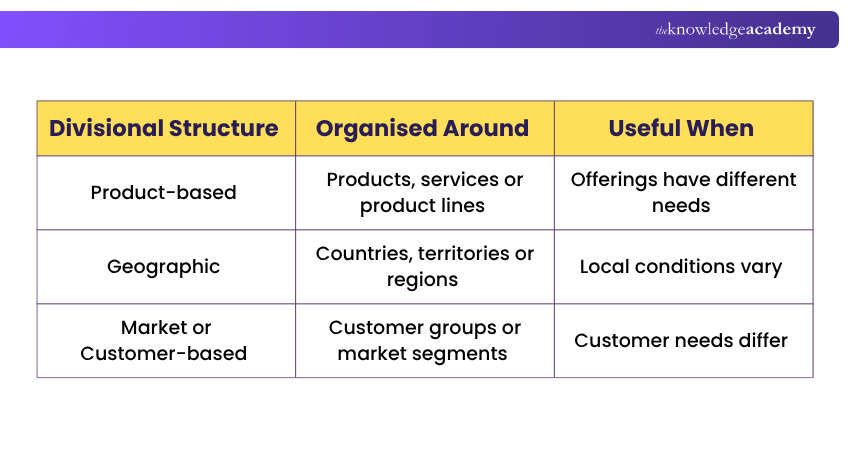
1) Product-based Divisional Structure
A product-based divisional structure organises the business around particular products, services or product lines. Each division concentrates on the operations and requirements associated with its offering.
For example, a manufacturer with substantially different product categories could establish separate divisions for each major product line. This allows teams to develop strategies around the needs, customers and competition associated with those products.
2) Geographic Divisional Structure
A geographic divisional structure organises operations according to locations, such as countries, territories or regions.
This approach can be useful when customer preferences, regulations, competition or operating conditions differ significantly between locations. Regional divisions can adapt their operations to local requirements while remaining part of the wider organisation.
3) Market or Customer-based Divisional Structure
A market or customer-based divisional structure groups operations according to customer groups or market segments.
For example, a company may have separate divisions serving individual consumers, small businesses and large enterprise customers. This allows each division to concentrate on the requirements and expectations of its customer group.
Put Your Knowledge Into Practice
Scenario: A company operates across several countries where customer preferences, regulations and operating conditions vary significantly. Which type of divisional structure could be suitable?
Think about it: Would organising divisions around products, geographic regions or customer groups best address these differences?
Answer: A geographic divisional structure could be suitable because it allows individual regional divisions to adapt to local market and operating conditions.
Hone your skills in refining and validating business needs with the BCS Practitioner Certificate in Requirements Engineering Training - Sign up now!
Benefits of a Divisional Structure
A divisional structure offers several practical advantages that support growth, responsiveness, and performance in large or complex organisations. Let's look at them below:
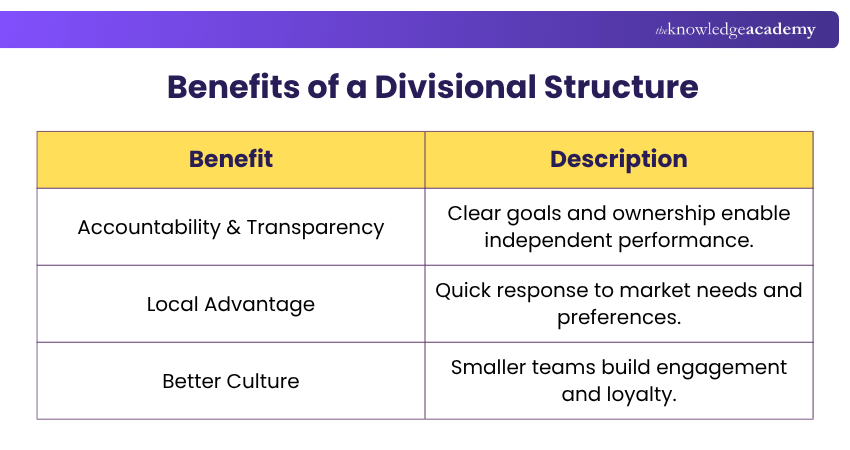
1) Accountability & Transparency
This structure promotes clarity in roles and results across divisions.
1) Each division has clear goals, budgets, and responsibilities
2) Performance can be tracked and evaluated independently
3) Encourages ownership and clarity across teams
2) Local Advantage
Divisions can operate closer to the products, customers or markets they serve, enabling quicker adaptation.
1) Divisions can quickly respond to local market needs and customer preferences
2) Enhances competitiveness in specific regions or sectors
3) Supports region-specific marketing, compliance, and service models
3) Better Culture
Focused teams within divisions help build stronger internal cultures.
1) Smaller teams foster stronger identity and cohesion
2) Can increase employee engagement and collaboration
3) Encourages team loyalty and a sense of shared purpose
4) Efficient Offerings
Divisions deliver more tailored and relevant solutions to their target audiences.
1) Divisions tailor products or services to suit their market
2) Can support faster innovation and customisation
3) Can improve customer satisfaction and operational efficiency
Trainer’s Insight
Greater autonomy does not mean complete independence. A divisional structure works more effectively when each division understands which decisions it can make independently and which require coordination with the wider organisation. Clear responsibilities can help maintain flexibility without losing strategic alignment.
Architect the future of your business and bring your vision to life. Sign up for the BCS Professional Certificate in Business Architecture Training now!
Drawbacks of a Divisional Structure
While the divisional structure offers many advantages, it also comes with certain limitations that organisations must carefully manage. Let's learn about them below:
1) Higher Costs
Operating separate divisions can lead to increased expenses.
1) Duplicated resources such as human resources, IT, or finance in each division
2) Requires more management layers and administrative support
3) This can increase overhead costs across the organisation
2) Reduced Economies of Scale
Divisions may miss out on cost-saving opportunities.
1) Less centralised purchasing may reduce opportunities for bulk discounts and supplier leverage
2) Duplicate functions may prevent process standardisation
3) Inefficiencies in shared services like training or logistics
3) Competitive Rivalries
Internal competition can weaken overall collaboration.
1) Divisions may compete for resources, budgets or recognition
2) Conflicting divisional priorities can make cooperation more difficult
3) Divisions may prioritise their own performance over company-wide goals
4) Silo Effect
Lack of integration between divisions can hinder efficiency.
1) Teams may become isolated from the broader organisation
2) Poor communication across units can reduce knowledge sharing
3) Limited cross-divisional collaboration can restrict innovation and strategic alignment
Bonus Tip
Before duplicating a function across every division, consider whether it genuinely needs divisional control. Some activities may benefit from dedicated divisional teams, while others can remain centralised or shared across the organisation. Finding the right balance can help maintain divisional focus while controlling unnecessary duplication and costs.
Divisional Organisational Structure Example
Each division may have its own functional departments like marketing, finance, and customer service, helping support focus, flexibility, and accountability. Below is a simplified example of how a divisional structure may look.
Example:
Consider a large company that manufactures and sells multiple product lines. The organisation is split into four main divisions:
1) Division 1: Manages Product Line A
2) Division 2: Oversees Product Line B
3) Division 3: Handles Product Line C
4) Division 4: Focuses on Product Line D
In this example, each division has its own core functions:
1) Sales & Marketing: Promotes and sells the division’s products
2) Accounting & Finance: Manages budgets, expenses, and financial planning
3) Customer Service: Supports customers and resolves product-related issues
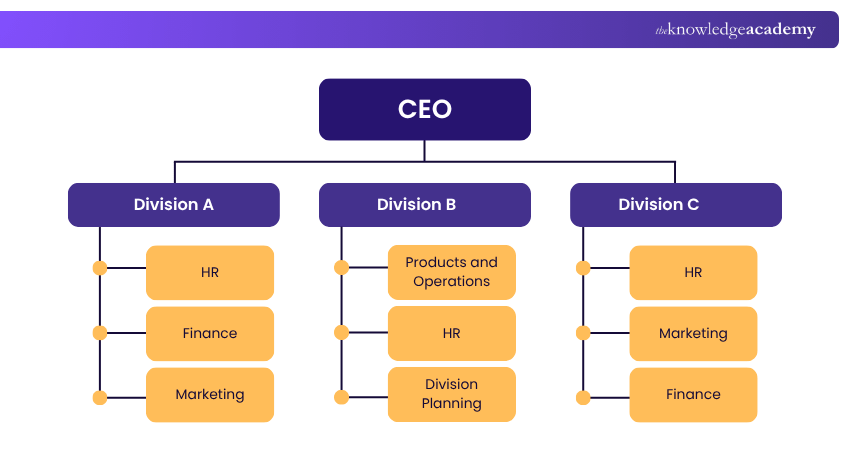
In this simplified example, all four divisions report directly to the CEO, but they operate semi-independently, with their own dedicated teams. This allows for greater specialisation, quicker decision-making, and a clearer focus on specific market needs.
How to Set Up a Divisional Structure?
To set up a divisional structure, first assess your organisation’s goals, products, and markets. Then choose a model that fits best. It could be based on product, geographic region, market or customer group. Each division should operate with enough independence to focus on its area while still aligning with overall company objectives.
Organisations should also determine which responsibilities will sit within individual divisions and which functions will remain centralised or shared. Clear reporting relationships, decision-making authority, budgets and performance measures can help divisions operate independently without losing alignment with wider organisational goals.
Quick Check
If your organisation were divided into separate units, what would be the most logical basis?
A. Different product linesB. Different geographic regionsC. Different customer or market groupsD. None of these - centralised functions still meet the organisation's needsThink About: The best basis for division should reflect meaningful differences in how each part of the organisation operates, competes, or serves its customers.
Which Company Has a Divisional Structure?
Large organisations can use divisional elements alongside functional or other organisational structures. McDonald’s, for example, reports its global business through three major segments: the U.S., International Operated Markets, and International Developmental Licensed Markets & Corporate.
Its corporate operations also include central functions such as finance, human resources, information technology, legal, marketing and supply chain. This provides a useful example of how a large organisation can combine market-based business segments with central corporate functions.
Build the skills to analyse, improve, and transform business with the Business Analysis Courses – Join now!

Naveena Venkatesan is a Content Editor with 2+ years of experience in content writing, editing and linguistic quality assurance. Her research, fact-checking and editorial experience enable her to develop accurate, accessible resources across Business Skills, Human Resources, and Accounting and Finance.
View Detail

 If you wish to make any changes to your course, please


