




We may not have the course you’re looking for. If you enquire or give us a call on 01344203999 and speak to our training experts, we may still be able to help with your training requirements.
What is Innovation: A Complete Guide for Organisations
ByNilotpal SarmahLast updated on: 19 September 2026
Innovation is the process of creating and implementing new or improved ideas to deliver value, solve problems, boost growth, efficiency, and social impact. It turns creative thinking into practical solutions that enhance products, services, and processes. As organisations adapt to change, they remain competitive and relevant.

Quick Overview
1. Innovation turns new or improved ideas into practical solutions that create meaningful value.2. It can involve products, services, processes, business models, or new ways of working.3. Customer needs, emerging technologies, market changes, competition, and new opportunities can drive innovation.4. The innovation process often involves ideation, development, testing, implementation, and continuous improvement.5. Successful innovation can support growth, efficiency, adaptability, customer value, and social progress.
Why do some ideas change the world while others quietly fade away? The answer starts with understanding what is innovation and how it influences everything around us. From the way you order food online to how businesses deliver faster services, innovation is woven into daily life. It can take many forms, from small everyday improvements to developments that transform entire industries.
In a fast-moving world, knowing what is innovation gives you an edge. It encourages businesses, professionals, and students to challenge familiar approaches and identify new possibilities. Those who embrace new ideas are better prepared to respond to evolving needs and opportunities. If you want to stay relevant and ahead, innovation is not optional; it is essential. Let's learn more about it in the blog!
What is Innovation?
Innovation involves creating fresh ideas, techniques, products, services, or answers that result in meaningful and valuable outcomes. It translates innovative ideas into tangible outcomes that improve productivity and performance or meet unrecognised requirements.
Although innovation is typically linked to technological advancement, it also encompasses new methods of addressing problems, procedures, organisational strategies, and business structures. At its core, innovation questions the current state, promotes creative thinking and accepts calculated risks to advance and achieve transformative results.
Innovation arises from curiosity, originality, and a thirst for progress. Innovative people welcome change, encourage brainstorming, and support trial and error. It can happen in different areas such as business, science, technology, social sectors, or public services and result in economic expansion, social progress, enhanced quality of life, and lasting development.
Key Components of Innovation:
a) Culture of Creativity: Promotes trying new things and appreciates a variety of viewpoints.
b) Leadership Support: Offers resources and direction for new initiatives.
c) Collaborative Teams: Teams that collaborate with different functions promote diverse perspectives.
d) Resource Allocation: Allocates funds towards researching, developing, and utilising technology to promote innovation.
e) Customer-centric Approach: Encourages innovation through understanding the needs of customers.
f) Flexibility and Agility: Allows for rapid responses to evolving market needs.
g) Risk Management: Supports experimentation while identifying, assessing, and managing uncertainty and potential downsides.
h) Feedback Mechanisms: Feedback mechanisms involve employees and customers providing regular input to refine ideas.
i) Strategic Vision: Aligning innovation initiatives with company objectives.

What is the Importance of Innovation?
Innovation is crucial for businesses and organisations, as it can provide them with various benefits, such as:
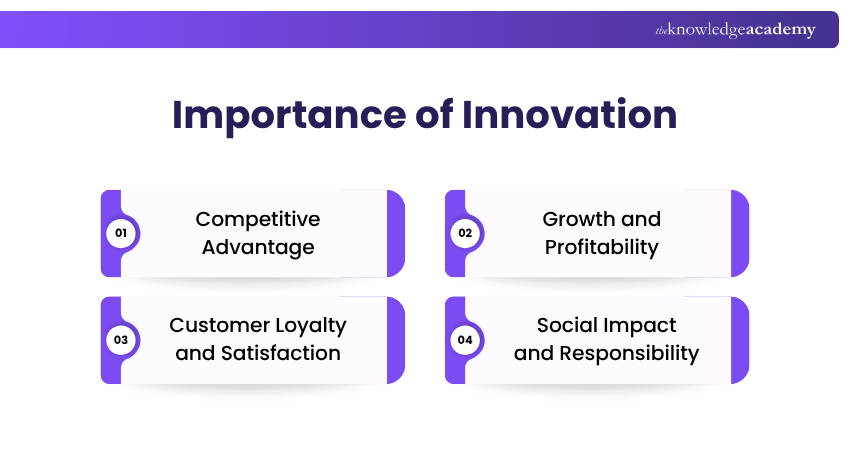
a) Competitive Advantage: Innovation allows companies to differentiate themselves by providing unique products or services. It assists businesses in remaining ahead by adjusting to changing customer demands, market trends, and industry disruptions.
b) Growth and Profitability: Innovation can support increased revenue and market growth by introducing new products and services to the market. It additionally enhances productivity and reduces expenses by streamlining processes and managing resources effectively.
c) Customer Loyalty and Satisfaction: Innovation can help businesses meet or exceed customer expectations by providing improved solutions and experiences. Involving customers in the innovation process helps establish trust and long-lasting loyalty.
d) Social Impact and Responsibility: Innovation enables businesses to address social and environmental issues, producing beneficial advancements. It also enhances alignment with stakeholder values, advocating for ethical and eco-friendly business practices.
Bonus Tip
Avoid pursuing innovation simply because a technology, idea, or trend is gaining attention. Start by identifying a genuine customer need, business challenge, or opportunity. A clear problem gives innovation a purpose and makes it easier to evaluate whether the resulting solution creates meaningful value.
Stages of Innovation
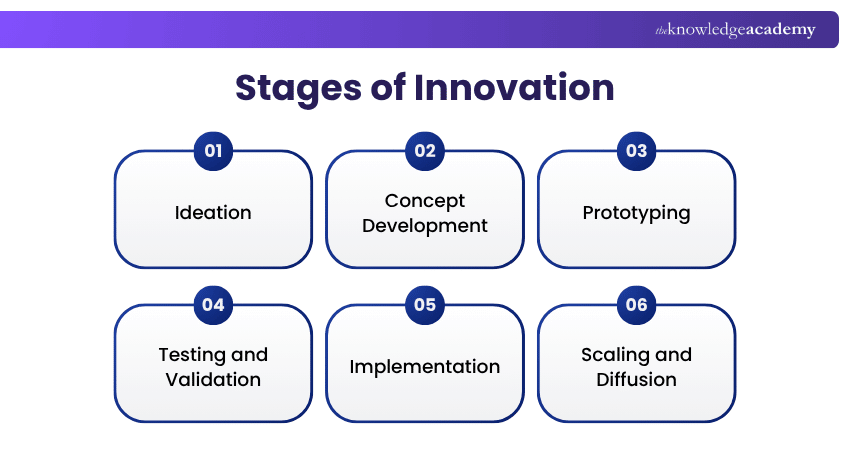
These stages work together to guide innovation from idea to impact. Let us now explore each stage in detail to understand how the process unfolds and how organisations can manage it effectively:
1) Ideation
This is the starting point where creative ideas are generated. Through brainstorming, research, and collaboration, organisations identify problems and imagine possible solutions. The focus is on exploring opportunities and encouraging fresh thinking.
2) Concept Development
At this stage, raw ideas are refined into clear and practical concepts. Teams assess feasibility, align the idea with customer needs, and outline how it will function in real situations. Only the most viable concepts move forward.
3) Prototyping
Here, early versions or models of the idea are created. Prototypes allow teams to experiment, test functionality, and identify weaknesses. This stage encourages learning from mistakes before large-scale investment.
Trainer's Insight
A prototype does not need to be a polished version of the final solution. Its purpose is to test important assumptions quickly and reveal what works, what does not, and what needs improvement before greater resources are committed.
4) Testing and Validation
The innovation is tested with users and evaluated for technical and market readiness. Feedback is collected to improve performance, usability, and value. Adjustments are made to ensure the solution meets expectations.
5) Implementation
Once validated, the innovation is introduced to its intended users, customers, or internal teams. This may involve operational planning, resource allocation, communication, training, distribution, or market launch depending on the type of innovation.
6) Scaling and Diffusion
After implementation, organisations monitor performance, gather feedback, refine the solution, and expand its use where appropriate. Continuous improvement helps the innovation remain relevant and effective over time.
Bonus Tip
Repeated complaints, delays, unnecessary steps, rising costs, and unmet customer needs can all signal opportunities for innovation. Instead of starting with "What can we invent?", try asking, "What keeps causing problems?"
Learn to use creative and analytical thinking to solve critical problems successfully with the Creative and Analytical Thinking Training – Register today!
Different Types of Innovation
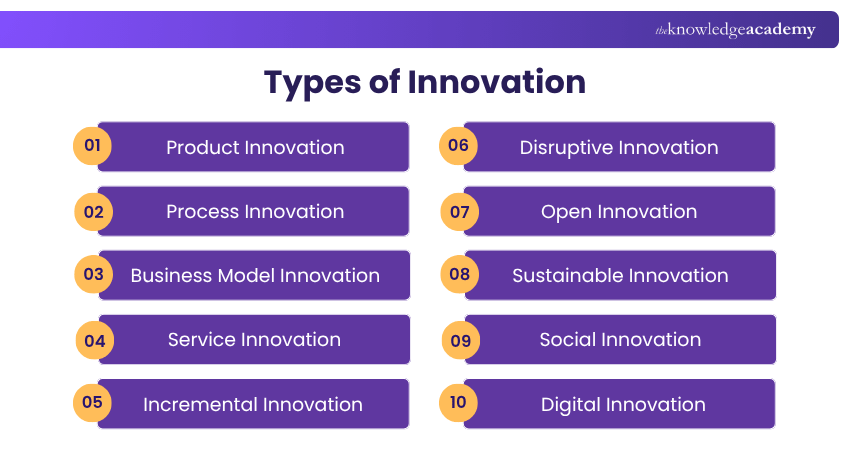
Innovation can be classified in different ways depending on what changes, how significant the change is, how it is developed, or the purpose it serves. Here are some of the common types of innovation:
1) Product Innovation
Product innovation encompasses developing new products or enhancing current ones to satisfy evolving market requirements and customer expectations. It involves improvements in features, functionality, performance, design, materials, or user experience.
2) Process Innovation
Process innovation is centred on improving internal processes, systems, and technologies to make operations more efficient, reduce costs, and streamline workflows. Its objective is to enhance the organisation's agility and competitiveness.
3) Business Model Innovation
Business model innovation changes how businesses generate, provide, and benefit from value. It examines fresh ways to generate income, manage costs, form partnerships, and enhance customer involvement to bring about market change and distinctiveness.
4) Service Innovation
Service innovation involves creating new services or significantly improving how existing services are designed, delivered, accessed, or experienced by users. The aim is to surpass customer expectations and enhance brand loyalty.
5) Incremental Innovation
Incremental innovation refers to continuous enhancements and adjustments to current products, services, or processes. It promotes continuous improvements in effectiveness, excellence, and customer satisfaction, ensuring continued market relevance.
6) Disruptive Innovation
Disruptive innovation describes a process in which a new entrant initially serves overlooked low-end customers or creates a new market for non-consumers, often with a simpler or more accessible offering. Over time, the entrant may improve and move into mainstream markets, challenging established providers.
7) Open Innovation
Open innovation involves working with third-party entities, including customers, suppliers, and research institutions, to create innovative solutions jointly. This strategy utilises outside knowledge and assets to speed up innovation processes and enhance industry dominance.
8) Sustainable Innovation
Sustainable innovation is centred on creating environmentally friendly products, services, and business models that reduce environmental harm and uphold social responsibility. It addresses worldwide issues such as climate change and resource preservation.
9) Social Innovation
Social innovation focuses on developing and implementing new ideas, services, models, or approaches that address social needs and challenges. It aims to improve people's well-being and create positive social outcomes in areas like education, healthcare, employment, community development, and social inclusion.
10) Digital Innovation
Digital innovation uses the power of digital technologies such as Artificial Intelligence (AI), Internet of Things (IoT), and blockchain to transform products, services, and operational processes. It improves efficiency, supports data-driven decision making, and accelerates digital transformation.
Trainer's Insight
Innovation categories are not always mutually exclusive. A new digital service, for example, could involve digital, service, and business model innovation at the same time. Identify the primary purpose of the initiative rather than forcing it into a single category.
Improve negotiation and communication skills to navigate deals and partnerships with the Business Development Training – Register today!
What is an Innovation Portfolio?
An innovation portfolio is a thoughtfully selected grouping of possible projects, each with specific objectives and necessary resources. Effectively managing this portfolio is important for discovering new opportunities and deciding on the best combination of initiatives, such as determining the right number and mix.
a) Assessing Portfolio Value: Evaluate the expected strategic, financial, customer, or social value of the portfolio as a whole.
b) Review Existing Initiatives: Assess projects based on expected value, risk, strategic alignment, evidence, and resource requirements.
c) Saying "No": Pause or discontinue projects that no longer justify further investment based on evidence, strategic fit, or expected value.
d) Reallocating Resources: Shifting abilities and expertise towards new or current projects that could use extra assistance.
e) Identifying Gaps: Recognising deficiencies in the portfolio and developing new strategies to fill those gaps.
Ways to Measure Innovation
There are various ways to measure innovation, depending on the measurement's purpose, context, and perspective. Some of the common ways to measure innovation are:
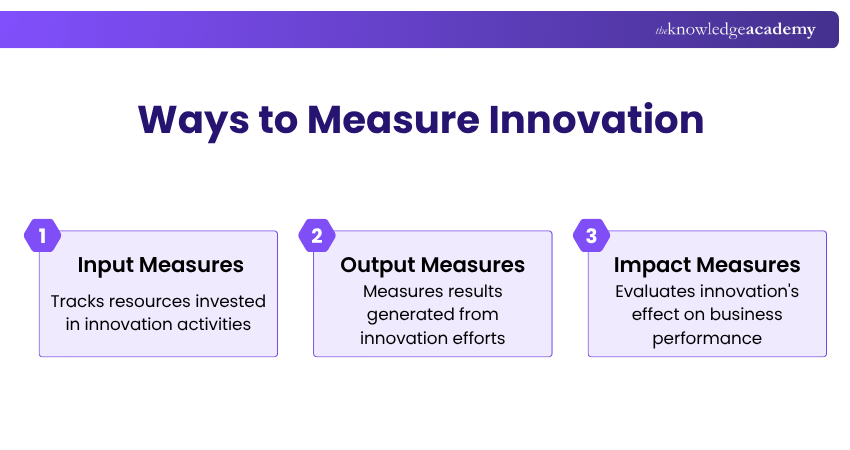
a) Input Measures: They monitor the resources committed to innovation endeavours, including expenditures on Research and Development (R&D), time allocated to brainstorming, and the volume of newly launched projects. These measures assist in assessing a company's dedication and endorsement of innovation.
b) Output Measures: It assesses the tangible outcomes of innovation, such as the quantity of new products introduced, patents submitted, or process enhancements. These indicators show how productive and efficient innovation activities are.
c) Impact Measures: It evaluates the effects and consequences of innovation on business performance and market success. Key metrics include increased profits from newly launched products, customer happiness level, the portion of the market captured, and total impact on the sustained competitive edge.
Empower your team to be at their best by creating a positive business environment. Join the Leadership and Management Course now!
How Can Organisations Foster Innovation?
Organisations can foster innovation by creating a culture where employees feel safe to share ideas and take calculated risks. When organisations distinguish responsible experimentation from avoidable mistakes and use unsuccessful experiments as learning opportunities, employees may be more willing to test new ideas.
Key strategies include empowering employees with autonomy instead of micromanagement, building diverse and cross-functional teams, and encouraging collaboration. Organisations should also allocate dedicated time, tools, and resources for experimentation, promote rapid testing and learning, and ensure leaders actively support and model innovative thinking.
What are the Barriers to Innovation?
Barriers to innovation are challenges that prevent organisations from developing and applying new ideas effectively. These obstacles may stem from culture, structure, leadership gaps, limited resources, or external pressures, ultimately slowing growth and adaptability.
Cultural barriers include fear of failure and resistance to change. Organisational barriers involve siloed teams and rigid processes. Leadership issues such as unclear vision or short-term focus can weaken Innovation. Limited time, funding, or skills, along with regulations or market resistance, can also slow progress.
Innovation Culture Checklist
Ask these questions to assess whether your organisation supports innovation:
□ Do employees have opportunities to suggest new ideas?□ Can teams experiment without being discouraged by every unsuccessful attempt?□ Are employees given sufficient time and resources to test promising ideas?□ Do different teams and departments collaborate?□ Does leadership actively support innovation?□ Is customer and employee feedback used to improve ideas?□ Are successful experiments given opportunities to scale?

Nilotpal Sarmah is a Senior Content Writer with 11+ years of overall experience spanning engineering, operations and content development. His technical knowledge and extensive writing experience enable him to simplify specialised topics across IT and Tech, Business Skills, Project Management, Health and Safety, and ISO and Compliance.
View Detail

 If you wish to make any changes to your course, please


