




We may not have the course you’re looking for. If you enquire or give us a call on 01344203999 and speak to our training experts, we may still be able to help with your training requirements.
Home
 Resources
IT Security & Data Protection
CISM vs CISSP: Which Security Certification Is Best for You in 2026
Resources
IT Security & Data Protection
CISM vs CISSP: Which Security Certification Is Best for You in 2026
Resources
IT Security & Data Protection
CISM vs CISSP: Which Security Certification Is Best for You in 2026
CISM vs CISSP: Which Security Certification Is Best for You in 2026
ByNilotpal SarmahLast updated on: 03 October 2026
Are you confused about choosing the right certification for you? Read this blog on CISM vs CISSP to learn the differences between the two to make the right choice.
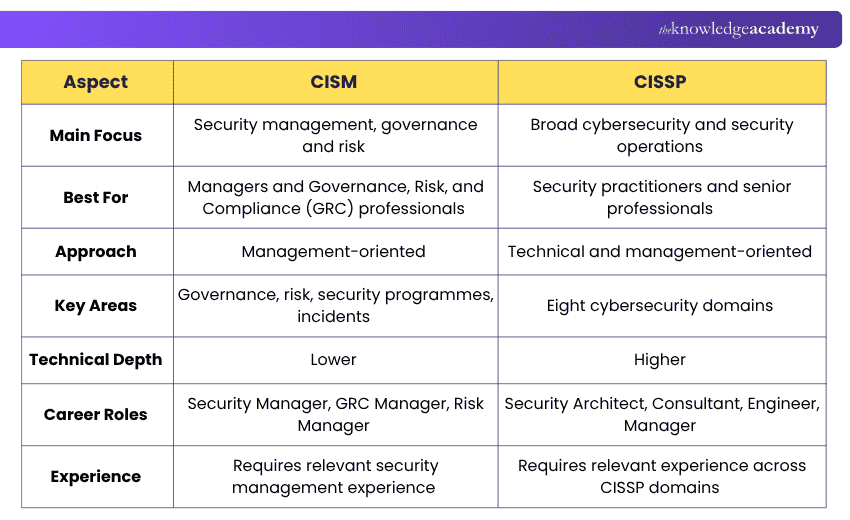
If you are already working in cybersecurity or the IT sector, you must have heard about the Certified Information Security Manager (CISM) and Certified Information Systems Security Professional (CISSP) certifications.Professionals often compare CISM vs CISSP based on their focus, experience requirements, exam structure, career paths, and certification maintenance. Both credentials can support professional development, but they are designed around different areas of information security.
CISM and CISSP are both established cybersecurity credentials, but they validate different areas of knowledge and professional experience. CISM has a stronger information security management focus, while CISSP covers a broader range of security domains. Read this blog to understand the key differences between CISM and CISSP and decide which certification better aligns with your experience and career direction.
What are CISM and CISSP?
Certified Information Security Manager (CISM) is a cybersecurity certification the Information Systems Audit and Control Association (ISACA) offers. This certification indicates your experience in information security, incident and risk management and program development and management. CISM is a highly sought certification because of the benefits and opportunities it provides, and you also learn how to assess information security risks, implement effective management and respond to incidents proactively.
The Certified Information Systems Security Professional (CISSP) is a cybersecurity certification offered by ISC2. It validates broad security knowledge and experience across eight domains, including security and risk management, architecture and engineering, network security, identity and access management, security operations, and software development security. CISSP is designed for experienced professionals whose responsibilities span technical and managerial areas of cybersecurity.

Key Differences Between CISM and CISSP
While CISM and CISSP are certifications awarded in cybersecurity, they have several differences. The differences aren't just about the professional body but also about the different domains.
Let’s take a detailed look at the differences between CISM vs CISSP.
1) Work Experience Required
Both CISM and CISSP are targeted at professionals who have some work experience. Naturally, to qualify for the certification, both require you to have a certain amount of practical work experience.
To become CISM certified, you need at least five years of professional information security management experience across at least three of the four CISM domains. The required experience must fall within the applicable period defined by ISACA, and candidates must apply for certification within five years of passing the CISM exam.
CISSP requires a minimum of five years of cumulative full-time experience in two or more of the eight domains in the current CISSP Exam Outline. A relevant post-secondary degree or an approved credential can satisfy up to one year of the required experience. Only one year of experience can be waived.
Part-time work and paid or unpaid internships can also count towards the experience requirement. For full-time experience, ISC2 requires at least 35 hours per week for four weeks to accrue one month of experience. Part-time experience must be between 20 and 34 hours per week.
a) 1040 hours of part-time = 6 months of full-time experience
b) 2080 hours of part-time = 12 months of full-time experience
Learn the key processes involved in information security management and get certified with CISSP-ISSAP Training.
2) Domains
The four domains in the CISM are given below, along with the weightage for its exam. To qualify for the certification, you must have work experience in any of the following three domains.
a) Information Security Governance (18%)
b) Information Security Risk Management (20%)
c) Information Security Program (33%)
d) Incident Management (29%)
The CISSP Domains and the corresponding weightage for its exam are given below. To qualify for this certification, you must have work experience in two or more domains from this.
a) Security and Risk Management (16%)
b) Asset Security (10%)
c) Security Architecture and Engineering (13%)
d) Communication and Network Security (13%)
e) Identity and Access Management (13%)
f) Security Assessment and Testing (12%)
g) Security Operations (13%)
h) Software Development Security (10%)
3) Exam Details
To earn either certification, candidates need to pass the relevant exam and meet the remaining certification requirements. The CISM and CISSP exams also differ in their format and scoring.
The CISM exam is four hours long and contains 150 multiple-choice questions. Candidates need a scaled score of at least 450 to pass.
The CISSP exam uses Computerised Adaptive Testing (CAT) and lasts up to three hours. Candidates receive between 100 and 150 items, including multiple-choice and advanced item types. A scaled score of 700 out of 1,000 is required to pass.
4) Job Roles and Titles
Even though both certifications are cybersecurity certifications, the job roles might differ because of the emphasis. CISM focuses on the managerial aspect of information security, while CISSP focuses on technical and managerial aspects.
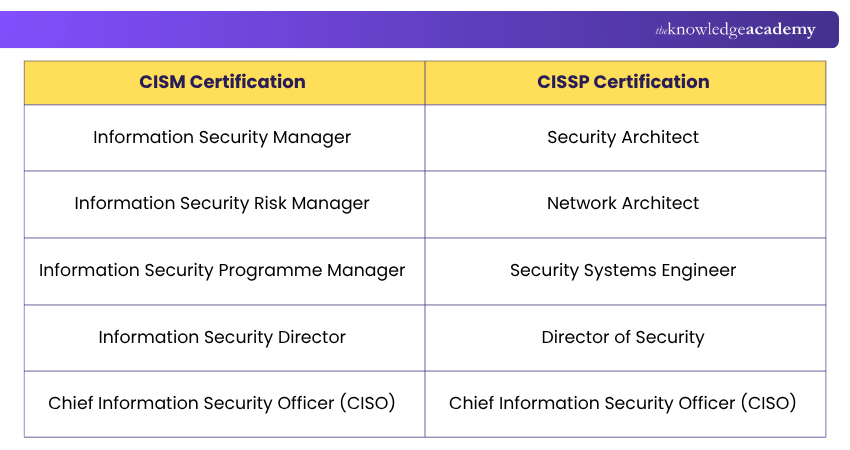
The main difference lies in emphasis. CISM is strongly focused on information security governance, risk management, security programmes, and incident management, making it particularly relevant to management-focused responsibilities.
CISSP covers a broader range of security domains and combines managerial knowledge with areas such as security architecture, engineering, network security, operations, and software security.
The more suitable certification therefore depends on the type of responsibilities you currently hold or want to develop rather than simply classifying one certification as technical and the other as managerial.
Get to the top-level position of CISO with our Chief Information Security Officer Training and learn how to implement information security framework.
5) Salary and Earning Potential
Earning potential for CISM and CISSP holders varies according to factors such as job role, professional experience, location, employer, industry, and existing responsibilities. Holding either certification does not guarantee a salary increase by itself.
Both credentials can support access to roles where recognised information security expertise is valued, but compensation ultimately depends on the position and organisation. When comparing CISM vs CISSP from a salary perspective, it is therefore more useful to consider the roles each certification supports rather than assuming one will automatically lead to higher pay.
6) Certification Maintenance Requirements
CISM and CISSP both require ongoing professional development to keep the certification active, but their maintenance requirements differ.
CISM holders must earn and report at least 20 Continuing Professional Education (CPE) hours each year and a minimum of 120 CPE hours over a three-year reporting period. They must also pay an annual maintenance fee, which is currently US$45 for ISACA members and US$85 for non-members.
CISSP holders must earn 120 CPE credits during each three-year certification cycle. ISC2 members holding CISSP currently pay an annual maintenance fee of US$135, with one ISC2 membership fee covering eligible ISC2 certifications held by the same member.
These ongoing requirements should also be considered when comparing the long-term commitment involved in maintaining CISM and CISSP.
7) Training Required
Both CISM and CISSP cover substantial bodies of knowledge, so preparation should reflect your existing experience and familiarity with the relevant domains. CISM covers four management-focused domains, while CISSP covers eight broader security domains. This does not automatically make one exam easier than the other, as difficulty depends on the candidate’s background and experience.
Candidates can prepare through self-study, official review materials, instructor-led training, online courses, or a combination of these approaches. ISACA publishes the CISM Exam Content Outline and preparation resources, while ISC2 provides the CISSP Exam Outline and official training resources. Reviewing the current official outline before beginning your preparation helps ensure that your study plan reflects the topics assessed in the exam.
Which Certification Should You Choose: CISM or CISSP?
There is no single choice that suits every cybersecurity professional. CISM is more closely aligned with information security management, governance, risk, security programme development, and leadership responsibilities. It can therefore be particularly relevant to professionals whose work centres on managing an organisation’s information security function.
CISSP covers a wider range of security domains, including security architecture and engineering, network security, identity and access management, security operations, and software development security, alongside governance and risk. It can suit professionals whose responsibilities span broader technical and managerial areas of cybersecurity.
Your choice should depend on your existing experience, current responsibilities, and the type of role you want to pursue. Some experienced security professionals also choose to hold both credentials because their areas of emphasis can complement one another.
Build leadership-level security management expertise with the CISM Training – Join now!
Keep This in Mind
1. CISM focuses more on information security governance, risk, programme management and leadership.2. CISSP covers a broader range of security domains, combining technical knowledge with management responsibilities.3. Both certifications require relevant professional experience, but their eligibility requirements differ.4. Choosing between them should depend on your current role, experience and career direction, rather than viewing one as universally better.5. Exam formats, domain weightings and certification requirements can change, so always check the latest official ISACA and ISC2 guidance before applying.

Nilotpal Sarmah is a Senior Content Writer with 11+ years of overall experience spanning engineering, operations and content development. His technical knowledge and extensive writing experience enable him to simplify specialised topics across IT and Tech, Business Skills, Project Management, Health and Safety, and ISO and Compliance.
View Detail

 If you wish to make any changes to your course, please


