




We may not have the course you’re looking for. If you enquire or give us a call on +44 1344 203 999 and speak to our training experts, we may still be able to help with your training requirements.
Home
 Resources
IT Security & Data Protection
What is Information Security: Definition, Policy, and Principles
Resources
IT Security & Data Protection
What is Information Security: Definition, Policy, and Principles
Resources
IT Security & Data Protection
What is Information Security: Definition, Policy, and Principles
What is Information Security: Definition, Policy, and Principles
ByVishnu SankarLast updated on: 18 September 2026
Information security, also known as Infosec, is the practice of protecting information and systems from unauthorised access, use, disclosure, and modification. It uses policies, processes, and technologies to protect data integrity, confidentiality, and availability, keeping information secure across digital and physical settings.
Information moves faster than ever, but with speed comes risk. From personal data leaks to major company legal breaches, security failures can be costly and damaging. That is why it leads to the one important question: What is Information Security, and why does it matter to everyday work and life?
It is about safeguarding your data wherever it lives or travels, protecting sensitive information using clear policies, strong controls, and practical security principles. These measures keep data secure and private. In this blog, you will explore What is Information Security, its types, principles, and more.
What is Information Security?
Information Security is the practice of protecting important information from unauthorised access, disclosure, misuse, alteration, or disruption. It ensures that sensitive data is only seen and used by the authorised people, remains accurate, and is available when needed. Its primary focus is to keep organisational and personal data confidential, intact, and accessible.
Information assets can include financial records, personal details, confidential business data, paper documents, digital files, and more, covering the entire data lifecycle. As threats keep rising and hybrid and multi-cloud systems grow, InfoSec continues to evolve, requiring teams, tools, and processes to work together.

Principles of Information Security
The principles of Information Security provide a structured foundation for protecting data and systems against misuse, loss, and tampering. Let’s look at the three major principles used in practice below:
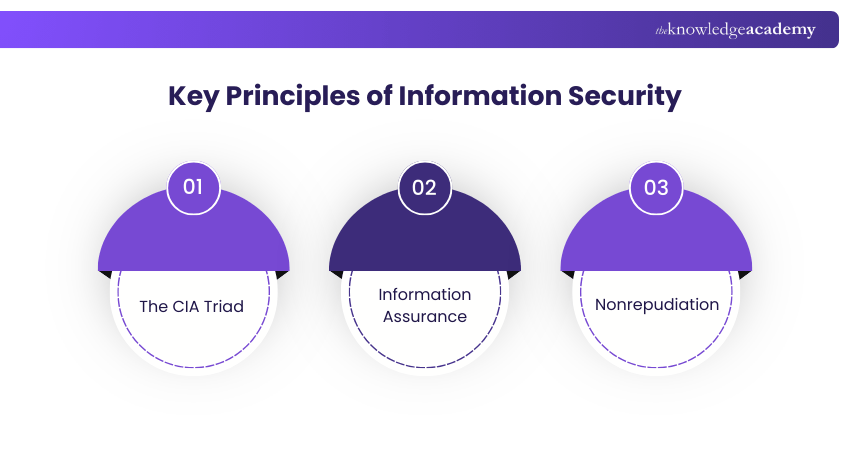
1) The CIA Triad
The CIA Triad stands for confidentiality, integrity, and availability. These three pillars of the CIA triad form the foundation of most security systems and controls. It helps organisations identify vulnerabilities and build targeted safeguards. Usually, when people ask about What is Information Security, these three pillars sit at the centre of the answer. Let's explore them below:
1) Confidentiality
Confidentiality ensures that information is accessed only by authorised users. It protects sensitive data from unauthorised viewing or disclosure through controls such as encryption, strong passwords, access permissions, and authentication mechanisms.
2) Integrity
Integrity ensures that information remains accurate, complete, and unaltered unless modified through authorised actions. It is supported by validation checks, audit logs, hashing techniques, and version control methods that detect or prevent unauthorised changes.
3) Availability
The third pillar ensures information and systems are accessible when needed by authorised users. It is maintained through backups, redundancy, and reliable infrastructure and recovery plans.
2) Information Assurance
Information Assurance (IA) primary focus is to protect and manage risks to information and information systems. It is based on five key pillars: confidentiality, integrity, availability, authenticity, and non-repudiation. It requires layered security controls that protect data during processing and transmission, whether stored in physical systems or cloud environments.
1) Authenticity
Authenticity ensures that information, systems, and users are genuine and not impersonated by unauthorised parties. It verifies the identity of individuals and confirms that data truly comes from a trusted source. Methods such as digital signatures, authentication protocols, and secure certificates help maintain authenticity and protect against identity spoofing.
2) Non-repudiation
Nonrepudiation ensures that a person or system cannot deny performing a digital action or transaction. It provides verifiable proof of origin and activity through mechanisms such as digital signatures, certificates, and audit logs. This is essential for maintaining trust and accountability in digital communications and transactions.
Advance your security architecture skills and design robust enterprise security solutions with CISSP-ISSAP Training now!
Types of Information Security
Information Security encompasses a range of specialised disciplines designed to protect systems and data from various threats. Each type focuses on unique risks and defence strategies to safeguard digital assets effectively.

1) Network Security
This area protects the integrity and usability of your network infrastructure. It includes measures to prevent unauthorised access, misuse, or denial of service attacks, using firewalls, intrusion prevention systems, and encryption.
2) Endpoint Security
Endpoint security secures devices like laptops, desktops, and mobile phones. With the rise of remote work, protecting endpoints against malware, ransomware, and unauthorised access has become crucial.
3) Internet Security
This type focuses on protecting data exchanged online. Measures include secure web gateways, browser protection, and monitoring tools to block phishing sites and malicious downloads. It reduces the risk of users being exposed to harmful websites and online threats.
4) Cloud Security
Cloud security safeguards data and applications hosted in cloud environments. It uses encryption, identity and access management, and security controls tailored to shared responsibility models.
5) Application Security
Application security involves designing software that resists attacks. Practices like secure coding, code reviews, and testing help eliminate vulnerabilities that could be exploited. Security is built into the application lifecycle instead of adding it after deployment.
6) Identity and Access Management (IAM)
IAM ensures only authorised individuals can access systems and data. It incorporates strong authentication, role-based access controls, and privileged account management. Also, it tracks and audits access to reduce misuse and insider threats.
7) Data Security
Data security protects information at rest, in transit, and in use. Encryption, tokenisation, and data masking help prevent data breaches and leaks. It focuses directly on protecting data itself, regardless of where it is stored.
8) Mobile Security
Mobile security safeguards smartphones and tablets against threats such as malware, unauthorised access, and device loss. Mobile device management tools enforce security policies remotely.
9) Disaster Recovery and Business Continuity
These practices ensure systems remain available during disruptions. Strategies include backups, recovery plans, and failover solutions to minimise downtime. They help organisations restore operations quickly after cyber incidents or outages.
10) Operational Security (OpSec)
Operational security focuses on protecting sensitive processes and activities. It includes policies to control how data is handled and shared across the organisation. These types of Information Security work together to create layered protection against evolving cyber threats and help maintain the confidentiality, integrity, and availability of critical systems.
Strengthen your Information Security management expertise and lead security programmes with confidence with ISSMP Training now!
Difference Between Cybersecurity and Information Security
Cybersecurity and Information Security are often used together, but they are not identical. Understanding their differences helps organisations design clearer policies and stronger protection strategies. Let’s look at the differences in the table below:
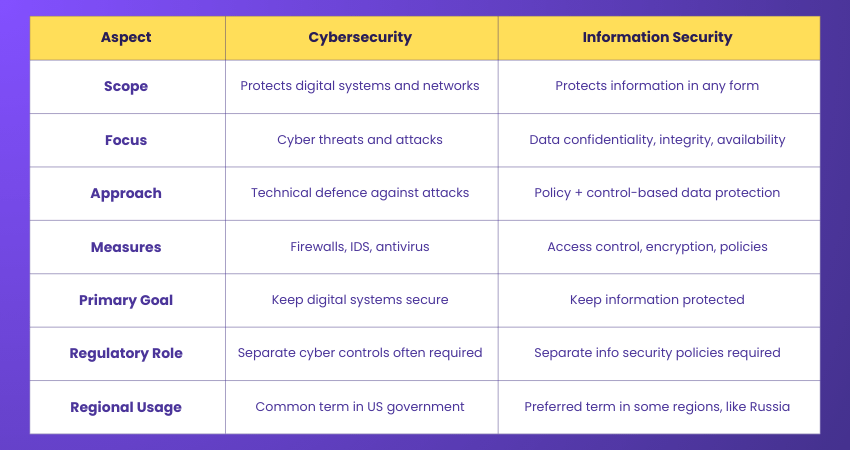
Cybersecurity concentrates on protecting systems from digital attacks that operate in cyberspace, such as networks, servers, or applications. Information Security takes a broader view by protecting information itself in any format, including paper records, verbal communication, and stored media. It uses both technical and administrative controls.
Another key difference lies in governance and terminology. Many regulators expect organisations to maintain separate Cyber Security and Information Security policies, particularly in highly regulated sectors. There are also regional differences in preferred terminology, with some countries and institutions favouring one term over the other. In practice, organisations achieve the strongest protection when both disciplines are applied together.
Policies of Information Security
An Information Security policy is a critical document that outlines an organisation's approach to Information Security. It serves as a foundational framework for defining the rules, responsibilities, and procedures related to safeguarding an organisation's data, information systems, and technology resources.
The policy's primary goal is to make sure the confidentiality, availability and integrity of information assets and to establish a security-conscious culture within the organisation. Here are the key elements typically found in an Information Security policy.
1) Purpose and Scope: Clearly define the purpose of the policy and its scope, indicating the boundaries of the policy's application. It should specify which information and systems are covered.
2) Policy Statement: Present a clear and concise statement of the organisation's commitment to Information Security and the importance of safeguarding information assets.
3) Roles and Responsibilities: Outline the key responsibilities of individuals and teams involved in Information Security, including top management, IT staff, and end-users.
4) Information Classification: Define a classification scheme for categorising information based on its sensitivity and explain how different classifications should be handled and protected.
5) Access Control: Detail access control mechanisms, including user authentication, authorisation, and the principle of least privilege.
6) Data Encryption: Specify when and how data encryption should be used to safeguard sensitive information, both in transit and at rest.
7) Incident Response: Describe procedures for detecting, reporting, and responding to security incidents and breaches.
8) Password Management: Set password policies and guidelines, including password complexity requirements, expiration, and best practices.
9) Physical Security: Address physical security measures such as access control, surveillance, and visitor policies for securing facilities and hardware.
10) Network Security: Define network security measures, including the usage of firewalls, intrusion detection and prevention systems, and secure configurations.
Elevate your cybersecurity career with CISSP Training. Join now to become a certified expert in Information Security!
Measures of Information Security
Organisations must implement a combination of technical, administrative, and physical measures to protect sensitive data and maintain robust Information Security. Effective measures include enforcing strong access controls to ensure only authorised individuals can view or modify critical information. Regular data backups and secure storage practices help organisations recover quickly from data loss or breaches, while endpoint protection and patch management reduce vulnerabilities in devices and systems.
Monitoring tools such as audit logs and real-time threat detection further strengthen defences by identifying unusual activity before it causes damage. Additionally, employee training and clear security policies are vital for promoting awareness and ensuring that everyone understands their role in safeguarding information. Encryption, multi-factor authentication, and incident response plans also play key roles in building a resilient security posture.
What is Information Security in a Nutshell?
Information security (InfoSec) deals with protecting all forms of information, whether digital or physical. Cybersecurity specifically focuses on safeguarding computer systems and digital information, excluding non-digital assets. Network security is a branch of cybersecurity dedicated to securing networks and their components.

Vishnu Sankar is a Senior Content Writer with 5+ years of experience across content development, software development, web development and system administration. His technical background and professional training support his expertise in IT and Tech, while his extensive research and writing experience covers Project Management and Health and Safety.
View Detail

 If you wish to make any changes to your course, please


