


 Top Rated Course

We may not have the course you’re looking for. If you enquire or give us a call on 01344203999 and speak to our training experts, we may still be able to help with your training requirements.
What is the CISSP ISSAP? A Complete Overview
The Knowledge Academy 15 July 2026The CISSP-ISSAP Certification, designed for security architecture professionals, validates expertise in governance, compliance, and risk management. In this blog, we'll cover the six key domains and provide a guide on preparing for and passing the exam. Join us to discover how it can elevate your career in Information Security!

Training Outcomes Within Your Budget!
We ensure quality, budget-alignment, and timely delivery by our expert instructors.
Table of Contents
Have you ever wondered what it takes to become a top-tier security architect? In Cyber Security, standing out requires more than just technical skills; it demands recognised certifications that validate your expertise and commitment. The CISSP-ISSAP Certification could be the key to unlocking new career heights.
The CISSP-ISSAP Certification, covering governance, compliance, and risk management, paves the way for career advancement and continuous growth. Let’s explore what makes this certification so valuable and how you can embark on the journey to achieve it.
Table of Contents
1) What is CISSP-ISSAP?
2) What Domains are Covered by CISSP- ISSAP?
3) What Makes the CISSP-ISSAP Certification Valuable to Pursue?
4) How to Sign up for a CISSP- ISSAP Examination?
5) What Does Taking the CISSP- ISSAP Exam Entail?
6) Which Abilities Does the CISSP- ISSAP Examination Assess?
7) What are the Top Study Materials for the CISSP-ISSAP?
8) Guide to Successfully Passing the CISSP-ISSAP Exam
9) Conclusion
What is CISSP-ISSAP?
The Certified Information Systems Security Professional - Information Systems Security Architecture Professional (CISSP-ISSAP) is a specialised information from (ISC)². It targets professionals dedicated to designing robust security solutions and offering management strategic, risk-based advice to achieve organisational objectives.
This certification emphasises expertise in Security Architecture and is ideal for those responsible for creating and implementing comprehensive security frameworks. Covering six domains, the CISSP-ISSAP certifies individuals with essential knowledge and skills for effective security architecture and risk management. This certification enhances their career prospects and professional credibility.

What Domains are Covered by CISSP- ISSAP?
The CISSP-ISSAP Certification covers six key domains, each focusing on different aspects of Cyber Security Architecture. These domains collectively ensure that certified professionals have a well-rounded understanding of security practices and principles.
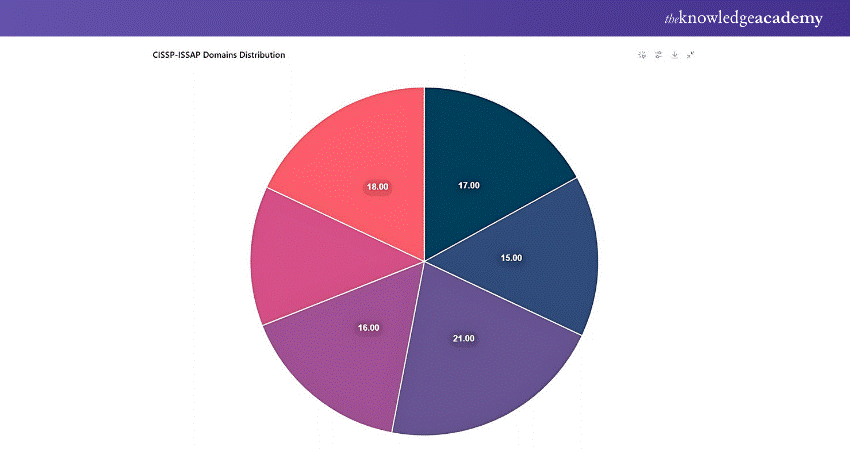
Domain 1: Architect for Governance, Compliance, and Risk Management (17%)
a) Determine Requirements: Identify legal, regulatory, organisational, and industry requirements.
b) Manage Risk: Identify, assess, and manage risks.
Domain 2: Security Architecture Modelling (15%)
a) Security Architecture Approach: Identify the appropriate security architecture approach.
b) Design Verification: Verify and validate designs (e.g., Functional Acceptance Testing (FAT), regression testing).
Domain 3: Infrastructure Security Architecture (21%)
a) Security Requirements: Develop infrastructure security requirements.
b) Defense-in-Depth: Design a defense-in-depth architecture.
c) Secure Shared Services: Secure shared services (e.g., wireless, email, VoIP, Unified Communications (UC)).
d) DNS and NTP: Secure Domain Name System (DNS) and Network Time Protocol (NTP).
e) Technical Security Controls: Integrate technical security controls.
f) Infrastructure Monitoring: Design and integrate infrastructure monitoring solutions.
g) Cryptographic Solutions: Design infrastructure cryptographic solutions.
h) Secure Communication: Design secure network and communication infrastructure (e.g., VPN, IPsec, TLS).
i) Physical and Environmental Security: Evaluate physical and environmental security requirements.
Domain 4: Identity and Access Management (IAM) Architecture (16%)
a) Identity Management: Design identity management and lifecycle processes.
b) Access Control Management: Design access control management and lifecycle.
c) Identity and Access Solutions: Design identity and access solutions.
Domain 5: Architect for Application Security (13%)
a) SDLC Integration: Integrate the Software Development Life Cycle (SDLC) with application security architecture (e.g., Requirements Traceability Matrix (RTM), security architecture documentation, secure coding).
b) Security Capability Requirements: Determine application security capability requirements and strategy (e.g., open-source, Cloud Service Providers (CSP), SaaS/IaaS/PaaS environments).
c) Proactive Controls: Identify standard proactive controls for applications (e.g., OWASP).
Domain 6: Security Operations Architecture (18%)
a) Operations Requirements: Gather security operations requirements (e.g., legal, compliance, organisational, and business requirements).
b) Security Monitoring: Design Information Security monitoring solutions (e.g., SIEM, insider threat, threat intelligence, user behaviour analytics, Incident Response (IR) procedures).
c) Business Continuity and Resiliency: Design Business Continuity (BC) and resiliency solutions.
d) BCP/DRP Validation: Validate Business Continuity Plan (BCP) and Disaster Recovery Plan (DRP) architecture.
e) Incident Response Management: Design incident response management.
Enhance your Cyber Security expertise with CISSP Training – Register now and secure your future!
What Makes the CISSP-ISSAP Certification Valuable to Pursue?
The CISSP-ISSAP Certification offers numerous benefits, making it a valuable pursuit for professionals seeking to advance their careers in Information Security architecture.
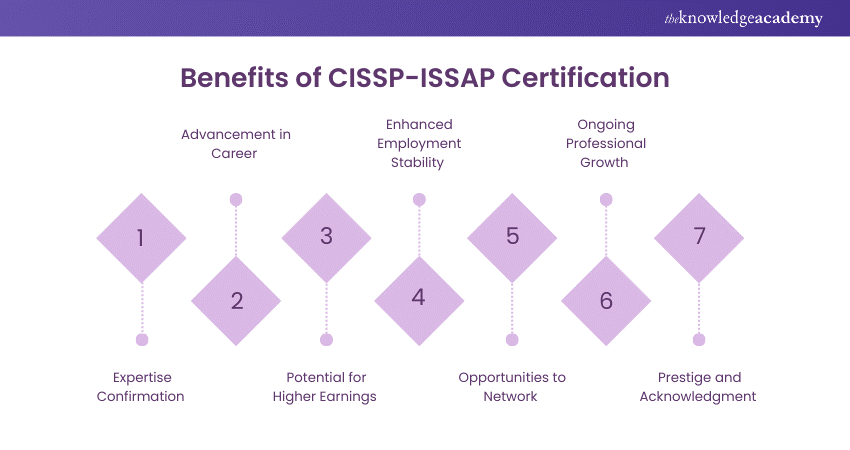
1) Expertise Confirmation
Earning the CISSP-ISSAP Certification confirms a professional's expertise in Information Security architecture, demonstrating a deep understanding of security principles and practices. This validation enhances credibility and signifies advanced proficiency in the field.
2) Advancement in Career
Holding a CISSP-ISSAP Certification significantly enhances career prospects. It often serves as a prerequisite for senior-level positions in Cyber Security and Information Security architecture, paving the way for leadership roles.
3) Potential for Higher Earnings
Certified professionals typically command higher salaries due to their validated expertise. The CISSP-ISSAP Certification signifies advanced knowledge and skills, making certified individuals more valuable to employers and justifying increased compensation.
4) Enhanced Employment Stability
With the growing demand for Cyber Security professionals, those holding advanced certifications like CISSP-ISSAP are more likely to enjoy job stability and security. Their skills are crucial for protecting organisational assets.
5) Opportunities to Network
CISSP-ISSAP Certification holders join a global community of (ISC)² members, offering opportunities to network with other professionals. This community allows them to share knowledge and stay updated with industry trends, fostering continuous learning and professional connections.
6) Ongoing Professional Growth
Maintaining the CISSP-ISSAP Certification requires Continuing Professional Education (CPE) credits. This ensures that professionals keep their skills and knowledge current, promoting ongoing professional growth and adaptation to new security challenges.
7) Prestige and Acknowledgment
The CISSP-ISSAP Certification is highly regarded in the industry, bringing prestige and recognition to certified individuals. It marks them as experts in security architecture, respected by peers and employers alike.
Transform into a Cyber Security leader with Chief Information Security Officer Training – Sign up today!
What Does Taking the CISSP- ISSAP Exam Entail?
The following are the key details and eligibility requirements you need to know for the CISSP-ISSAP exam.
1) Exam Details
a) Length: 3 hours
b) Format: Multiple-choice questions
c) Number of Questions: 125
d) Passing Grade: 700 out of 1000 points
e) Language: English
e) Testing Center: Pearson VUE
2) Eligibility Requirements
a) Prerequisite: Must be a CISSP in good standing.
b) Experience: At least two years of cumulative, paid work experience in one or more of the six domains.
Boost your professional growth by registering in Information Systems Security Management Training today!
Which Abilities Does the CISSP- ISSAP Examination Assess?
The CISSP-ISSAP exam assesses a wide range of abilities, including:
a) Understanding of security architecture principles and practices
b) Ability to design and implement secure infrastructures
c) Knowledge of governance, risk management, and compliance
e) Proficiency in identity and access management
f) Skills in application security architecture
g) Expertise in security operations and incident response
Guide to Successfully Passing the CISSP-ISSAP Exam
Embarking on the journey to obtain your CISSP-ISSAP certification can be challenging, but with the right approach and resources, you can achieve success.
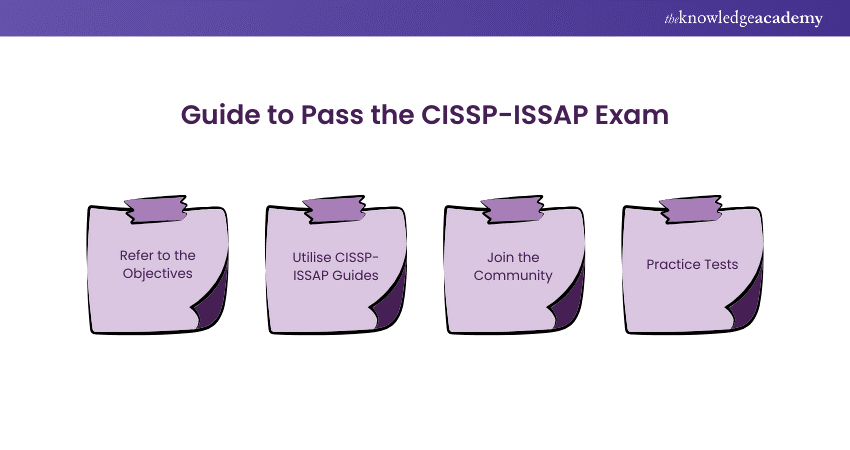
1) Preparatory Steps
Refer to the Objectives: Focus on key areas such as Governance, Compliance, and Risk Management; Security Architecture Modelling; Infrastructure Security Architecture; Identity and Access Management (IAM) Architecture; Application Security; and Security Operations Architecture.
2) Architecture Security
Guide to Qualify CISSP-ISSAP: Utilise resources like CISSP-ISSAP guides, fast facts, and benefits of certification. Understand the exam overview, official training, and the pathway to certification. Take advantage of free Continuing Professional Education (CPE) opportunities.
3) Professional Community
Join the Community: Engage with experts, gather knowledge, and clear doubts by joining CISSP-ISSAP forums and attending training sessions.
4) Practice Testing
Practice Tests: Attempt free practice tests to prepare and get certified as a CISSP Information Systems Security Architecture Professional.
Conclusion
The CISSP-ISSAP Certification is your ticket to elite status in security architecture, opening doors to career advancement, higher earnings, and continuous professional growth. Mastering its diverse domains equips you to design robust security systems. By understanding CISSP vs CISMP, and with dedication and the right preparation, you’ll join the ranks of top-tier security architects.
Sign up for our CISSP Training to enhance your Cyber Security skills and advance your career in Information Security!
Frequently Asked Questions
What is the Difference Between CISSP and ISSAP?

The Certified Information Systems Security Professional (CISSP) is a broad cybersecurity certification covering security management, risk, and operations. The Information Systems Security Architecture Professional (ISSAP) is an advanced CISSP concentration focused specifically on security architecture, design, and enterprise-level security solutions.
Does CISSP Require Coding?
No, the CISSP Certification does not require coding skills. While understanding basic programming concepts can be helpful, the focus of the CISSP exam is on a broad range of security topics, including risk management, access control, and network security.

The Knowledge Academy


Global Training Provider
The Knowledge Academy is a world-leading provider of professional training courses, offering globally recognised qualifications across a wide range of subjects. With expert trainers, up-to-date course material, and flexible learning options, we aim to empower professionals and organisations to achieve their goals through continuous learning.


 If you wish to make any changes to your course, please


