




We may not have the course you’re looking for. If you enquire or give us a call on +44 1344 203 999 and speak to our training experts, we may still be able to help with your training requirements.
What is Business Process Analysis: A Complete Guide
ByNilotpal SarmahLast updated on: 03 October 2026
Business Process Analysis helps organisations understand how existing processes work, identify inefficiencies, and determine where improvements can be made. By examining workflows, performance data, stakeholder input, and process dependencies, organisations can make informed decisions to improve business performance.

Overview
Business Process Analysis helps organisations examine how existing processes work, identify inefficiencies, and determine where improvements can be made. By reviewing workflows, performance data, stakeholder input, and dependencies, organisations can make informed decisions that improve efficiency, quality, customer experience, and operational performance.
In modern business, where competition is as sharp as ever, organisations are on a quest for the golden trifecta: efficiency, effectiveness, and perpetual evolution. Enter Business Process Analysis: BPA is the practice of dissecting and evaluating business operations with a fine-tooth comb, revealing opportunities for optimisation, streamlining, and stronger performance.
Furthermore, Business Process Analysis equips organisations with deeper insights, helping them make informed decisions, encourage innovation, and adapt to market changes. It involves systematically examining and evaluating business processes to identify opportunities for optimisation, streamlining, and improvement.
Learn how Business Process Analysis identifies opportunities for optimisation and equips businesses with the insights needed to thrive in a competitive market.
Understanding Business Process Analysis (BPA)
Business Process Analysis is a systematic approach to examining your company’s workflows. These workflows consist of repetitive tasks that aim to achieve specific outcomes, such as onboarding new employees or evaluating quarterly objectives. BPA also extends to more comprehensive organisational procedures, such as those used in strategic planning.
As a subset of Business Process Management (BPM), BPA involves scrutinising and assessing your current processes to ensure they are still serving their intended purpose efficiently. A Business Analyst typically conducts this analysis to decide whether to maintain the status quo or to implement necessary modifications for improvement.
Business Process Analysis vs Business Analysis
Business Process Analysis and Business Analysis differ mainly in their scope and focus. Business Analysis can explore areas such as organisational structure, stakeholder requirements, technology, strategic goals, and business needs to support broader decision-making.
BPA focuses more specifically on how individual business processes operate and where they can be improved. Let’s consider a practical example to better understand their differences:
Let’s say you want to refine your organisation's financial tracking process; BPA would help you examine how information moves through that process, where delays occur, and which steps could be improved.
However, if you want to examine the wider business need behind the system, stakeholder requirements, or broader financial objectives, Business Analysis techniques would provide a wider perspective.

Importance of Business Process Analysis
In this section, we will explore the importance of Business Process Analysis:
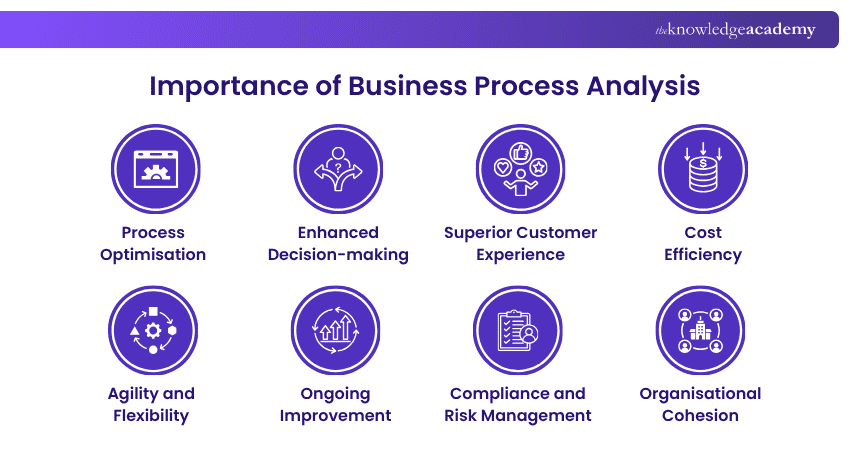
a) Process Optimisation: BPA helps in identifying and addressing inefficiencies and redundancies in business workflows. Streamlining these processes through business process improvement can eliminate unnecessary steps, reduce process durations, enhance productivity, lower costs, and improve customer satisfaction.
b) Enhanced Decision-making: BPA equips organisations with deep insights into their operational workflows, facilitating informed decision-making. With a clear grasp of the sequence of operations and interdependencies, organisations can make strategic choices, efficiently allocate resources, and foster innovation.
c) Superior Customer Experience: BPA allows organisations to tailor their processes to meet customer expectations better. Analysing customer interaction points reveals areas for enhancement, leading to a more seamless customer experience, fewer mistakes, and faster service, thereby bolstering customer contentment and loyalty.
d) Cost Efficiency: Through BPA, organisations can identify and eliminate wasteful activities, leading to significant cost reductions. This process also promotes optimal resource use, workforce efficiency, and better technology deployment, culminating in improved financial outcomes.
e) Agility and Flexibility: BPA empowers organisations to swiftly adapt to changes in the business landscape. By thoroughly understanding their processes, organisations can quickly adjust to market shifts or regulatory demands, ensuring they remain competitive and proactive.
f) Ongoing Improvement: BPA serves as a driving force for perpetual enhancement within organisations. Regular process evaluation helps spot trends, measure performance, and instigate necessary changes, nurturing an environment where continuous improvement is valued and innovation thrives.
g) Compliance and Risk Management: BPA is instrumental in helping organisations adhere to industry norms and manage risks. Organisations can establish strong internal safeguards, evaluate potential threats, and devise effective risk mitigation tactics by delineating processes and pinpointing control points.
h) Organisational Cohesion: BPA fosters unity and cooperation across different organisational departments. Engaging stakeholders from diverse areas breaks down barriers and cultivates a unified approach to understanding and managing business processes, which enhances overall organisational efficacy.
Build confidence in requirements analysis with our BCS Certificate in Requirements Engineering Course - Join now!
Steps to Conduct Business Process Analysis
BPA is a systematic and data-driven approach to assessing and improving Business Processes within an organisation. Follow these essential steps to conduct a successful BPA:
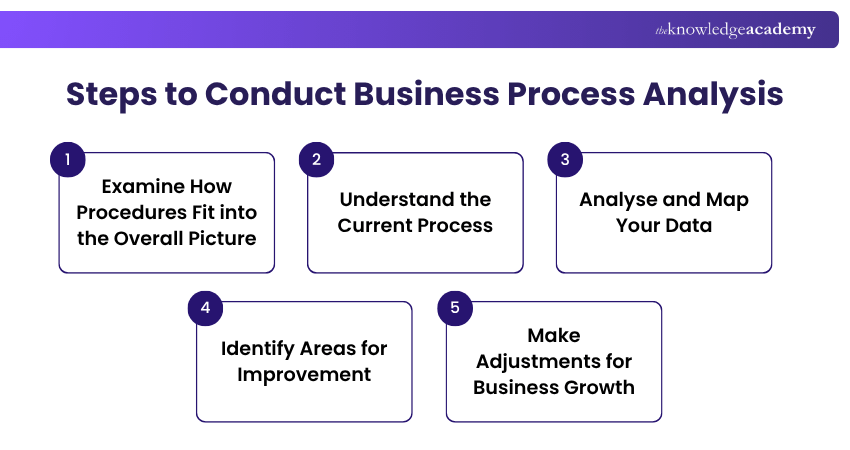
1) Examine How Procedures Fit into the Overall Picture
All your operational procedures should ultimately align with broader objectives and the overarching business mission. These procedures essentially define the "how" in your business operations, serving as the means to attain our goals. However, they should always be intertwined with the "why."
For instance, if your organisation's vision is to enhance global healthcare accessibility, every process you establish should contribute to this vision. Each process should support a clear purpose and connect back to the wider organisational goal.
The initial phase of your BPA involves evaluating current procedures and assessing their integration within workflows, departments, and, most importantly, the long-term objectives that uphold your company's overarching mission.
2) Understand the Current Process
This stage involves collecting data. Before delving into business process analysis, it's crucial to comprehend precisely how these processes operate. The most effective approach is to engage with those who use these processes extensively.
Conduct interviews with key stakeholders, develop surveys, and scrutinise relevant Key Performance Indicators (KPIs) and metrics. Although this step may demand more time compared to others, it's essential to understand the process comprehensively before initiating any modifications.
For instance, you should interview the developers responsible for this task when examining how your product team manages and prioritises their product backlogs. Additionally, assess the Key Performance Indicators related to existing processes, such as the number of items that remain in the backlog after completing an Agile sprint.
3) Analyse and Map Your Data
Now, it's time to proceed with the analysis phase. During this stage, you'll need to consolidate all of your gathered data, which should encompass:
a) Documenting each step involved in the processes under examination.
b) If available, include any process diagrams that illustrate the workflows.
c) Identifying and listing the team members involved in these processes.
d) Compiling the existing success metrics and Key Performance Indicators that measure the effectiveness of these processes.
To facilitate this analysis, you can employ business process mapping techniques. These techniques entail creating visual representations, like flowcharts or other diagrams, that lay out your processes' current sequences and steps. These visual layouts simplify the process of understanding and evaluating workflows, aiding in identifying patterns and gaps within the process flow.
4) Identify Areas for Improvement
During the analysis phase, the focus is on pinpointing redundancies and gaps within the processes, as these are key areas ripe for improvement. For instance, consider a scenario where your analysis reveals that developers are dedicating three days to plan a sprint backlog.
After conducting interviews with stakeholders and examining meeting schedules, it becomes evident that time zone differences are causing this delay. In such a case, exploring new technological solutions that facilitate asynchronous communication can streamline team collaboration and significantly reduce the time spent on communication tasks. This highlights how identifying and addressing these issues can lead to more efficient processes
5) Make Adjustments for Business Growth
Business Process Improvement (BPI) is the phase where you implement your insights. Following the business process analysis, BPI initiatives modify and enhance processes, aiming to improve efficiency, quality, customer experience, cost performance, or other business outcomes.
BPA serves as an exploration guide, providing a comprehensive understanding of your business procedures. The final step involves using this information to implement changes that enhance existing processes or enable the creation of improved ones. It's the practical application of knowledge gained through analysis to achieve more efficient and effective business operations.
Pro Tip: Prioritise improvements based on impact and effort. Fixing a small number of high-impact bottlenecks can often deliver better results than trying to redesign the entire process at once.
Techniques for Business Process Analysis
BPA involves using various tools and techniques to analyse and improve Business Processes. Here are some commonly used tools and techniques in BPA:
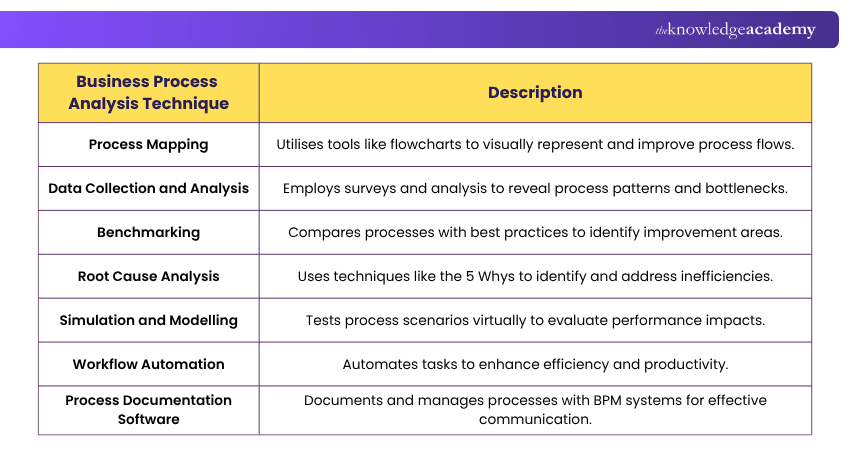
a) Process Mapping: Process mapping tools, such as flowcharts, and value stream maps, visually represent the sequence of activities, decision points, and interactions within a process. These visual representations help stakeholders understand the process flow and identify areas for improvement.
b) Data Collection and Analysis: Data collection methods, such as surveys, interviews, and observation, are used to gather information about the process. Data analysis techniques, including statistical analysis and process mining, help uncover patterns, trends, and bottlenecks.
c) Benchmarking: Benchmarking involves comparing the organisation's processes against industry best practices or competitors' processes. This business analysis technique helps identify performance gaps and areas for improvement.
d) Root Cause Analysis: Root Cause Analysis techniques, such as the 5 Whys and fishbone diagrams, identify the underlying causes of process inefficiencies or problems. This helps address the root causes and prevent the recurrence of issues.
e) Simulation and Modelling: Simulation and modelling tools enable organisations to create virtual models of processes and test different scenarios to evaluate their impact on process performance. These business analysis tools help simulate process changes before implementation, reducing the risk associated with process improvement initiatives.
f) Workflow Automation: Workflow automation tools automate manual tasks, streamline approvals, and enforce process compliance. These tools improve process efficiency, reduce errors, and enhance overall productivity.
g) Process Documentation Software: Process documentation software, such as process modelling tools or Business Process Management (BPM) systems, helps organisations document, manage, and communicate their processes effectively.
h) DMAIC Framework: DMAIC provides a structured approach to process improvement through five stages: Define, Measure, Analyse, Improve, and Control. It can help organisations identify process issues, assess performance, implement improvements, and monitor results.
Understand employee motivation, leadership, and communication techniques with the BCS Foundation Certificate In Organisational Behaviour – Join now!
When Should Business Process Analysis Be Used?
The BPA journey often starts by examining an existing process that needs greater clarity, consistency, or improvement. Business process mapping can serve as a useful visual aid and reference document, helping teams understand the current workflow before identifying potential changes.
BPA can be applied wherever a repeatable business process needs to be understood or improved. This can include operational, customer-facing, administrative, financial, HR, marketing, or technology-related workflows, depending on the organisation’s needs.
Here are some instances where BPA can be applied:
a) Refining the employee onboarding process to better reflect the company’s culture and improve engagement.
b) Evaluating marketing strategies to ensure alignment with Key Performance Indicators (KPIs), such as customer conversion rates and the engagement level of qualified leads.
c) Identifying and rectifying inefficiencies in the adoption of new technologies.
Challenges of Business Process Analysis
While business process analysis offers numerous benefits, it is crucial to be aware of the challenges and limitations that organisations may encounter during the process. These challenges are as follows:
a) Data Availability and Quality: One of the primary challenges in BPA is data availability and quality. Inaccurate or incomplete data can lead to flawed analysis and inaccurate insights. Organisations must ensure access to reliable and relevant data to support the analysis.
b) Resistance to Change: Implementing process improvements identified through BPA may face resistance from employees and stakeholders who are accustomed to existing ways of working. Overcoming resistance and driving change management efforts effectively can be a significant challenge.
c) Limited Resources: Conducting a thorough BPA requires time, expertise, and resources. Organisations with limited resources may struggle to allocate sufficient personnel or technology to conduct the analysis comprehensively.
d) Dynamic Business Environment: Business processes operate within a dynamic and evolving environment. External factors such as regulatory changes, market shifts, or technological advancements can impact the effectiveness of analysed processes. It is important to consider the dynamic nature of the business environment when conducting BPA.
e) Lack of Standardisation: In organisations where processes lack standardisation or have variations across departments or locations, conducting a consistent BPA becomes challenging. Harmonising processes and aligning stakeholders' understanding can be time-consuming and complex.
f) Complexity and Scope: BPA can become complex, particularly in organisations with numerous interdependent processes and extensive process documentation. Managing complexity and scoping the analysis appropriately can be challenging, requiring careful planning and coordination.
g) Tool Selection and Complexity: Choosing the right BPA tools and software that suit the organisation's needs can be challenging. Implementing and managing these tools may require additional training and expertise.
Here’s a table summarising the advantages and disadvantages of Business Process Analysis:

Who is Responsible for Business Process Analysis?
In the case of Small and Medium-sized Enterprises (SMEs) where resources can be limited, BPA may be handled internally by managers or employees who understand the process, or organisations may choose to work with an external Business Analyst Consultant. At the enterprise level, businesses may also employ professionals such as Business Process Analysts or Process Architects to conduct BPA.
These titles may vary, but their roles are quite similar. These experts often collaborate with business architects, executives, and division leaders to facilitate the analysis.
Furthermore, the success of Business Process Analysis heavily relies on the expertise of Subject Matter Experts. This can encompass a range of individuals, including employees, stakeholders, and consultants like Analysts, Data Scientists, Quantitative Experts, IT Specialists, Administrators, and employees closely associated with the processes in question. Their collective insights are invaluable in conducting comprehensive BPA.
BPA and Automation
Automation can support organisations by reducing repetitive manual work and helping processes operate more consistently. BPA can help identify which activities are suitable for automation by revealing bottlenecks, repeated tasks, manual errors, and areas where technology could improve process performance.
To embark on the journey toward automated processes, your organisation should consider the following:
a) What areas do you intend to automate, and what are the reasons behind these choices? Identifying key automation targets is crucial to maximise efficiency and productivity.
b) Are manual errors or policy misapplications common in your operations? Pinpointing areas with frequent human errors or policy deviations can guide your automation efforts.
c) Where do you encounter expensive and high-volume processes? Prioritising processes that are both costly and high in volume can yield substantial benefits.
d) Have you identified evident process issues within the organisation? Addressing glaring process problems is a fundamental step toward improvement.
e) What aspects lead to customer dissatisfaction? Understanding customer pain points enables you to enhance your experience through automation.
How Can Small and Medium-sized Businesses Use BPA?
Small and Medium-sized Enterprises (SMEs) can effectively apply Business Process Analysis without needing complex tools or large specialist teams. A focused approach can help them understand important workflows and prioritise practical improvements:
a) Identify Critical Processes: Begin by identifying mission-critical processes that have the most significant impact on your business. These are the processes that, if improved, can yield substantial benefits.
b) Map the Current Process: Once you've identified these critical processes, map them in enough detail to understand how they currently operate. This gives you a clear view of the steps, responsibilities, delays, and dependencies involved.
c) Standardise Documentation: Standardisation of documentation is key. Ensure that process information follows consistent formats across teams so that employees can understand responsibilities, identify issues, and communicate improvements clearly.
d) Prioritise Practical Improvements: Focus first on changes that offer meaningful value without placing unnecessary strain on limited time, budgets, or staff. Smaller improvements can often provide a strong starting point before larger process changes are introduced.

Nilotpal Sarmah is a Senior Content Writer with 11+ years of overall experience spanning engineering, operations and content development. His technical knowledge and extensive writing experience enable him to simplify specialised topics across IT and Tech, Business Skills, Project Management, Health and Safety, and ISO and Compliance.
View Detail

 If you wish to make any changes to your course, please


