




We may not have the course you’re looking for. If you enquire or give us a call on 01344203999 and speak to our training experts, we may still be able to help with your training requirements.
What is Business Analysis? A Beginner's Guide
ByNilotpal SarmahLast updated on: 18 September 2026
Business Analysis involves understanding an organisation’s requirements and using specialised methods to define and address those needs effectively. It helps improve processes and decision-making across teams and departments. It also ensures solutions align with business goals and deliver clear, measurable value consistently.

Running a business today means making constant decisions, improving workflows, and adapting to change. Understanding What is Business Analysis can help organisations uncover gaps, streamline operations, and turn ideas into practical solutions that actually work.
From reducing costs to improving customer experience, the right insights guide smarter strategies and better outcomes. In this blog, we will explore how it works, why it matters, and how it supports long term success. Let’s get started.
Table of Contents
1) What is Business Analysis?
2) Why Business Analysis Matters
3) Key Phases in Business Analysis
4) Popular Business Analysis Techniques
5) Business Analysis Tools
6) Examples of Business Analysis
7) Business Analytics vs Business Analysis
8) Conclusion
What is Business Analysis?
Business Analysis is a professional discipline focused on identifying business needs, analysing problems, and recommending solutions that create value. It helps organisations understand requirements, document them clearly, and improve processes. It also acts as a bridge between stakeholders and technical teams, ensuring solutions support strategic goals and organisational change.

Why Business Analysis Matters
Business analysis plays a key role in validating organisational changes and project implementations through their assessment of actual business value. It enables teams to create precise requirements which help them decrease project risks while developing solutions that meet their business goals.
a) Identifies Hidden Problems: Business analysis finds out the bottom causes rather than superficial ones. Problems are addressed appropriately and eliminated by teams through reviewing processes and workflows.
b) Turns Ideas Into Clear Requirements: Strong ideas need structure. Business analysts translate them into detailed requirements that are easy to comprehend by the teams in order to develop effective solutions.
c) Keeps Projects on Track: Clearly spelt out requirements minimise confusion and delays. There is no scope creep or projects going off track.
d) Supports Better Decision-making and Risk Control: Business analysis makes an appraisal of options at the initial stages and assists the leaders in assessing risk and making sound decisions.
e) Improves Collaboration: Business analysts bridge stakeholders, users and technical teams, hence maintaining mutual understanding and better communication within the organisation.
Key Phases in Business Analysis
Business analysis is usually a systematic sequence of steps that determine the way in which issues can be comprehended and solutions can be provided. Though the organisations can go between steps, these phases give a clear map toward an effective analysis.
a) Initiation: It is a stage of identifying the problem or opportunity and determining the scope of the project. The review of data and circumstances is done by analysts to make sure that the work is devoted to meaningful outcomes.
b) Requirement Gathering: The business analyst relates to stakeholders to gather the needs, expectations and constraints. Interviews and surveys are some of the methods that assist in capturing the right information.
c) Analysis: The information gathered is looked into in order to find patterns, gaps, and priorities. The goal is to have a clear picture of what is really needed by the stakeholders.
d) Solution Recommendation: Potential solutions are suggested and contrasted. The analysts deliberate with decision-makers regarding trade-offs and alternatives to choose the most appropriate strategy.
e) Implementation: The selected solution is implemented with the assistance of analysts. This will make sure that requirements are adhered to and the solution delivered accordingly.
f) Evaluation: Lastly, outcomes are compared with pre-determined goals. This verifies either the solution value and actual realisation of the targeted business objectives.
Boost your expertise with the BCS Practitioner Certificate in Requirements Engineering and strengthen your professional impact today.
Popular Business Analysis Techniques
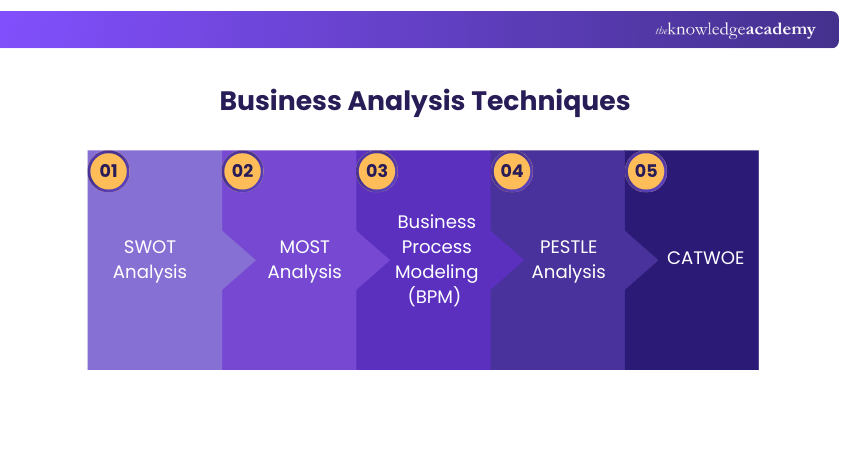
Business Analysis is pivotal in guiding organisations through change and improving processes. Here are five key techniques:
1) SWOT Analysis
SWOT is an abbreviation of Strengths, Weaknesses, Opportunities, and Threats. It examines internal factors and external conditions to give a clear view of a business’s current position and future direction.
2) MOST Analysis
MOST Analysis emphasises Mission, Objectives, Strategies and Tactics. It starts with the organisation’s purpose and then breaks it into goals, approaches, and actionable steps, ensuring daily activities support long-term strategy
3) Business Process Modeling (BPM)
Business Process Modeling presents the workflow as a graphical representation of a process, including all the steps (and their outputs or inputs). It assists in the detection of inefficiencies, the elimination of bottlenecks, and enhances communication between teams.
4) PESTLE Analysis
The PESTLE Analysis takes into consideration the external factors, including Political, Economic, Social, Technological, Legal, and Environmental factors. It assists organisations to foresee the changes in the market and change proactively rather than reactively.
5) CATWOE
CATWOE is an acronym that is used to denote Customers, Actors, Transformation, Worldview, Owners and Environmental constraints. It looks at complex issues in various aspects and aids the decision-makers to gain insight into the effects before introducing solutions.
Want to know more about the Architecture techniques used in Business Analysis? Register for our BCS Foundation Certificate In Architecture Concepts And Domains Course now!
Business Analysis Tools
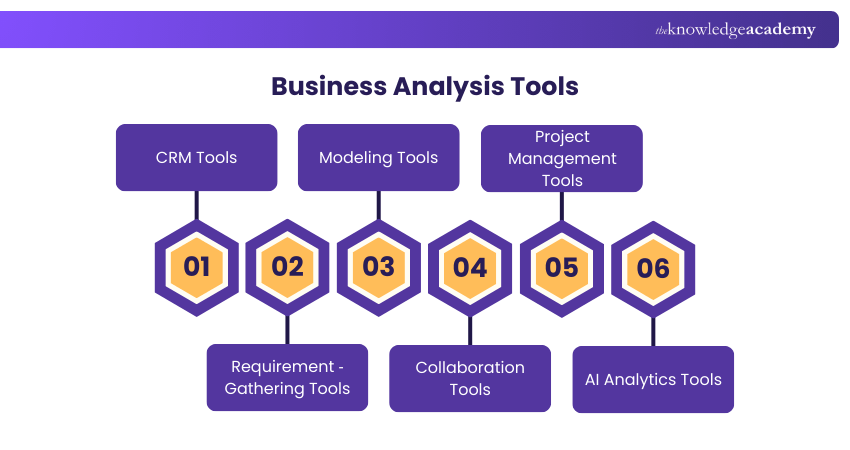
The tools you choose can make a big difference in whether your business analysis work feels smooth and effective or slow and overwhelming. The right mix of tools helps analysts capture requirements, visualise data, collaborate better, and keep projects moving in the right direction.
a) CRM Tools: Pro Suite is a customer relationship management platform that assists in linking customer insights and business processes. They simplify the process of tracking performance and getting an idea of how performance in teams is impacted by changes.
b) Requirement‑Gathering Tools: These tools facilitate gathering and monitoring of the stakeholder requirements to ensure that all changes are planned and there is no misalignment between the development, QA and the business. They are the basis of definite and steady requirements.
c) Modeling Tools: Modelling tools convert raw information into images, which include diagrams, workflow, and process maps. This assists non-technical teams to grasp complicated systems and gain insight into information more assertively.
d) Collaboration Tools: Applications such as Slack enhance conversations since they make them visible and structured. They assist in making decisions transparent and keeping the stakeholders on track during the project.
e) Project Management Tools: Though it does not always form the main focus, project management tools can assist analysts in monitoring dependencies, progress, and results, particularly with large projects needing the involvement of multiple teams.
f) AI Analytics Tools: Predictive analytics and natural language processing are examples of AI-powered capabilities that are able to detect trends, raise risks, and suggest actions. These tools will minimise manual effort and assist analysts in their work on interpretation and strategy.
Interested in Business Analysis Training? Try our BCS International Diploma in Business Analysis!
Examples of Business Analysis
Business Analysis is a versatile field encompassing various techniques and practices. Here are five Business Analysis Examples:
a) Strategic Planning: A Business Analyst evaluates a company’s strategic direction and identifies initiatives to achieve business goals. For example, they might analyse market trends using Business Analytics Tools to guide the company’s product development strategy.
b) Requirements Management: Analysts gather and manage stakeholder requirements for a new software system. They ensure the final product aligns with user needs and business objectives, often using tools like case models.
c) Process Design: Business Analysts redesign an organisation’s workflow to improve efficiency. They might map out current processes and suggest improvements, such as automating manual tasks.
d) Data Analysis: Analysts use data to drive business decisions. For instance, they might analyse customer data to identify buying patterns and inform marketing strategies.
e) Change Management: When a company implements a new technology, Business Analysts help manage the transition. They plan and oversee the change process, ensuring minimal disruption and aligning new systems with business strategies.
These examples illustrate how Business Analysis can optimise operations, drive growth, and facilitate organisational change.
Business Analytics vs Business Analysis
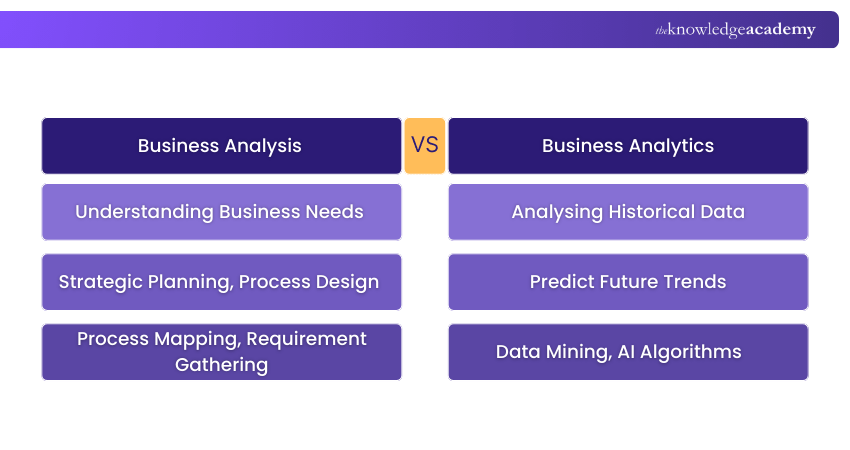
Business Analysis defines business needs, requirements, specifications, and solution recommendations for process and system improvements. The process focuses on stakeholders who need solutions to problems while verifying that proper alterations are executed.
Business Analytics investigates data through its power to generate reports and present statistical information and visual content to discover patterns and forecast future results. In simple terms Business Analysis asks what the business needs while Business Analytics explains what the data shows.
Here’s the key differences between Business Analytics vs Business Analysis:
Conclusion
Understanding What is Business Analysis helps organisations make informed decisions, improve processes, and achieve meaningful results. It connects business goals with practical solutions and clearer strategies. Hope this helped you gain a clearer picture and confidence to explore it further.
Check out our BCS Foundation Certificate in Business Change if you wish to become a Certified Business Analysis Professional.

Nilotpal Sarmah is a Senior Content Writer with 11+ years of overall experience spanning engineering, operations and content development. His technical knowledge and extensive writing experience enable him to simplify specialised topics across IT and Tech, Business Skills, Project Management, Health and Safety, and ISO and Compliance.
View Detail

 If you wish to make any changes to your course, please


