


 Top Rated Course

We may not have the course you’re looking for. If you enquire or give us a call on 01344203999 and speak to our training experts, we may still be able to help with your training requirements.
Brand vs Performance Marketing: Key Differences
James Smith 16 July 2026Performance Marketing drives quick, measurable results like sales, while Brand Marketing builds long-term awareness, loyalty, and a strong brand image. It's important to learn the key differences between long-term and short-term results. One shapes perception, the other delivers action. Together, they create a powerful, balanced strategy.

Training Outcomes Within Your Budget!
We ensure quality, budget-alignment, and timely delivery by our expert instructors.
Table of Contents
Imagine launching a brand-new product. Do you tell a compelling story that builds trust over time or run targeted ads that deliver instant clicks? That’s the classic tug-of-war between brand and performance marketing. While one nurtures relationships, the other drives results. The truth? You need both.
In this blog, we will learn Brand Marketing vs Performance Marketing, what they are, how they work, and when to use each. Whether you’re launching a new business, scaling fast, or just refining your strategy, understanding this balance is essential. Let’s simplify the buzzwords and help you build a smarter marketing game plan.
Table of Contents
1) What is Brand Marketing?
2) What is Performance Marketing?
3) Brand vs Performance Marketing: Key Differences
4) When to Use Performance Marketing?
5) When to Use Brand Marketing?
6) Combining Brand Marketing & Performance Marketing
7) What is Considered Performance Marketing?
8) What does Brand Marketing do?
9) Conclusion
What is Brand Marketing?
Brand marketing aims to create a lasting impression in the minds of customers. It focuses on telling your brand story, building emotional connections, and maintaining a consistent identity. Unlike short-term sales tactics, brand marketing aims to shape how people comprehend and remember your business over time. Here are the importances and strategies that this type of marketing offers:

Importance of Brand Marketing
Let's look at the importances:
1) Builds Long-term Trust: People buy from brands they know and believe in.
2) Improves Customer Retention: Strong brands keep customers coming back.
3) Creates Emotional Connection: Branding influences how people feel about your business.
4) Supports All Marketing Channels: A good brand lifts performance marketing results too.
5) Drives Word-of-mouth: Trusted brands are more likely to be recommended
Lead the market, don’t follow - Start learning with Web Analytics Course today!
Brand Marketing Strategies
Here are some of brand marketing strategies:
1) Consistent Visual Identity: Use the same colors, logos, and tone across platforms.
2) Storytelling Campaigns: Share your brand’s mission, values, and journey.
3) Content Marketing: Create helpful blogs, videos, and resources.
4) Social Media Engagement: Engage audiences with relatable, value-driven posts.
5) Influencer Collaboration: Partnership with influencers to build brand credibility.
6) Emotional Advertising: Use ads that connect with feelings and aspirations.
What is Performance Marketing?
Performance marketing is a data-driven approach that focuses on achieving specific, measurable outcomes. Some of the examples are clicks, sign-ups, or sales. Unlike traditional branding, it emphasises ROI and uses real-time data to optimise results. These are done across paid channels like search, social, and affiliate networks. Here are some of the importances and strategies of this type of marketing:
Importance of Performance Marketing
Let's look at some of the importances of performance marketing:
1) Measurable Results: Every click, lead, or sale is tracked in real time.
2) High ROI: Budgets are spent efficiently based on what performs best.
3) Targeted Campaigns: Reach specific audiences using data and behavior insights.
4) Fast Results: Generate immediate traffic, leads, or sales.
5) Easy Optimisation: Adjust campaigns on the go for better outcomes.
6) Scalable Growth: Successful strategies can be expanded quickly.
Performance Marketing Strategies
Here are some of the strategies that this marketing offers:
1) PPC Advertising: Pay only when users click.
2) Social Media Ads: Run targeted ads on platforms like Facebook or Instagram.
3) Affiliate Marketing: Reward partners for bringing in sales.
4) Email Campaigns: Send personalised emails to convert leads.
5) Influencer Collaborations: Pay influencers based on performance.
6) SEO & Content Marketing: Drive organic traffic through valuable content.
Brand vs Performance Marketing: Key Differences
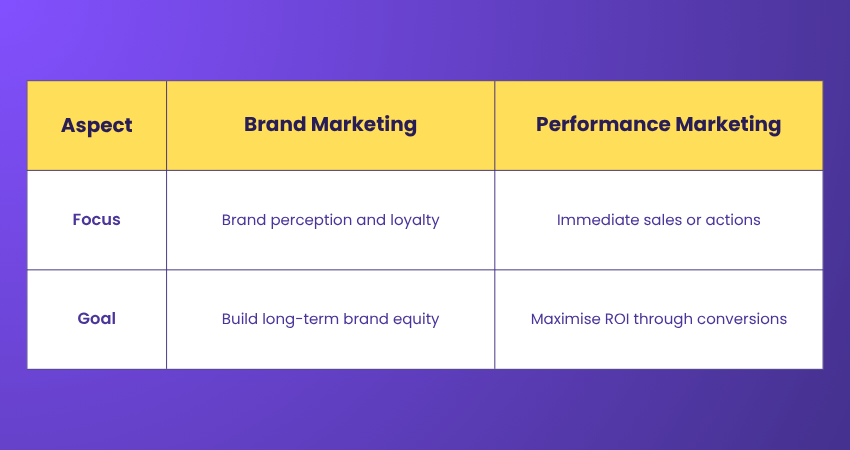
Brand and performance marketing serve different but complementary purposes. Brand marketing focuses on long-term perception and loyalty, while performance marketing is centered around driving quick, trackable actions. Here’s how they differ from each other:
Focus and Goal
Brand marketing focuses on developing a strong brand identity, building awareness, trust, and emotional connection with the audience. Its goal is to influence long-term behavior and perception. Performance marketing, on the other hand, focuses on quick wins, driving leads, sales, or traffic through targeted campaigns. It’s transactional and conversion-driven.
Measurement and Metrics
Brand marketing is often measured through soft metrics such as brand awareness, sentiment, and reach. These are harder to calculate but crucial for long-term growth. On the other hand, Performance marketing relies on clear, quantifiable KPIs like CPC, CPA, and ROAS to evaluate and optimise campaigns quickly.
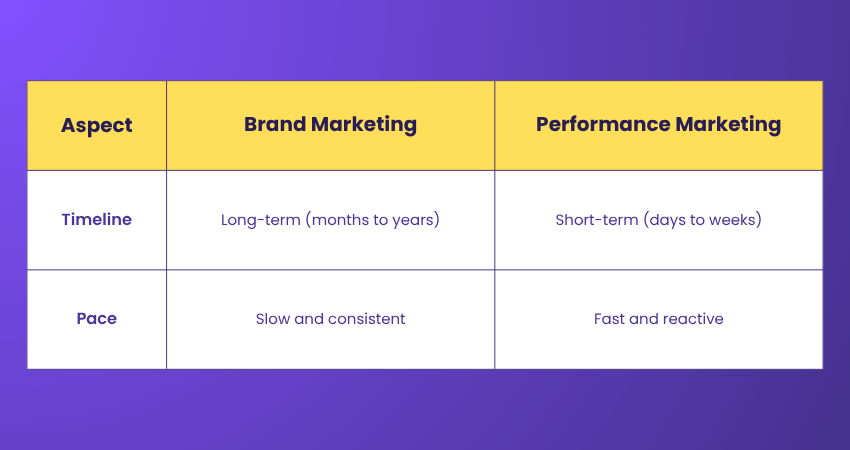
Strategy Duration
Brand marketing takes months or years to build a solid brand presence. The effects are long-lasting but take time to develop. Whereas Performance marketing is agile and immediately focused on rapid experimentation, optimisation, and fast results within a short timeframe.
Channels Used
Brand marketing works with platforms that allow storytelling and emotion, such as television, PR, organic social media, and content marketing. On the other hand, Performance marketing focuses on digital channels where you can track user behavior and conversion, like Google Ads, Facebook Ads, affiliate links, and emails.
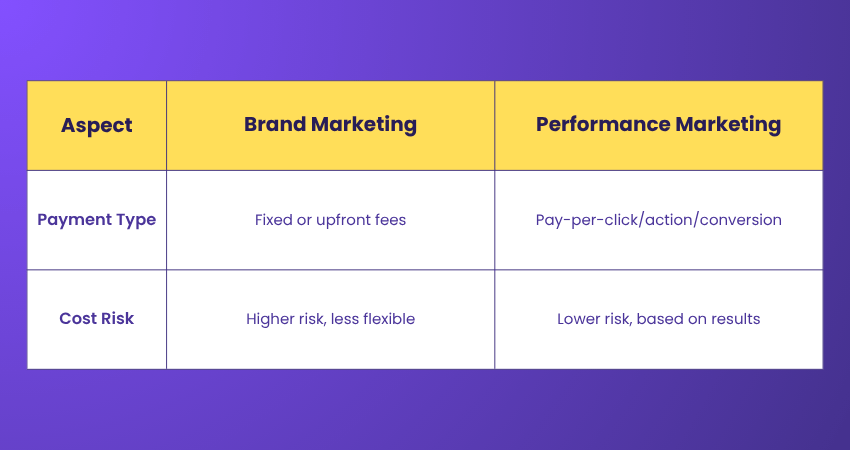
Payment Models
Brand marketing typically involves fixed budgets or upfront investments, regardless of campaign outcomes. Whereas Performance marketing works on a pay-for-result basis, you only pay when the desired action like a click or sale happens, reducing upfront risk.
When to Use Performance Marketing?
Performance marketing is ideal when your goal is to drive fast, measurable results and make every part of your budget accountable. It’s best suited for businesses looking to scale, test new offerings, or generate leads quickly.
It lets you target specific audiences, track every action, and adjust strategies on the fly. The financial risk is reduced when you pay for actual results, making it ideal for growth-focused and data-driven campaigns.
Here Are Key Situations Where Performance Marketing Shines:
1) New Launches: Promote products/services for instant visibility and action.
2) Lead or Sales Generation: Drive conversions with trackable ROI.
3) Small Budgets: Pay only for actual results.
4) Market Testing: Test audiences, creatives, and offers fast.
5) Time-Sensitive Campaigns: Perfect for seasonal sales or limited-time promotions.
Speak your brand’s language - Learn Video Marketing Course with us!
When to Use Brand Marketing?
Brand marketing is essential when your goal is to build a strong, lasting connection with your audience. It helps shape how people perceive your business and creates emotional trust over time.
While it doesn’t always deliver immediate results, it lays the foundation for long-term loyalty, recognition, and preference, in crowded or competitive markets.
1) New Brand Building: Create awareness and define your identity in the market.
2) Entering Competitive Markets: Differentiate through storytelling and emotional appeal.
3) Long-term Growth: Establish a foundation that supports future expansion.
4) Customer Trust & Loyalty: Foster relationships that go beyond transactions.
5) Support for Performance Campaigns: Increase ROI by boosting brand recall and confidence.
Combining Brand Marketing & Performance Marketing
After learning Performance Marketing vs Brand Marketing, we see both of the marketing strategies create a powerful, full-funnel strategy. While brand marketing builds long-term awareness and trust, performance marketing drives immediate actions and conversions.
When integrated, they reinforce each other; strong branding improves click-through rates and lowers acquisition costs. Performance data guides future brand storytelling. Together, they deliver both emotional connections and measurable ROI.
Content Marketing
Content marketing bridges the gap between brand and performance efforts. Brand-wise, it builds authority, trust, and engagement through valuable storytelling. Performance-wise, it supports SEO, drives traffic, and encourages conversions through CTAs and lead magnets.
1) Brand Role: Shares your mission, values, and expertise to build recognition. Examples include thought-leadership blogs or brand videos.
2) Performance Role: Drives traffic through keywords, ranks on search engines, and includes CTAs. Examples include a blog post that ranks for “best CRM tools” and links to your product.
Retargeting with Branding
Retargeting is typically a performance tactic, but when infused with brand elements, it becomes even more effective. Instead of just pushing discounts or offers, retargeting ads can reinforce your brand identity, values, or story to warm up cold leads.
Brand Role: Reinforces your look, tone, and message with each ad view. Examples include targeting testimonials or storytelling-style videos.
Performance Role: Converts users who’ve shown interest but didn’t act. Examples include showing a dynamic ad with branded visuals and a limited time offer to cart abandonment.
Performance Campaigns with a Brand Spin
Blending branding into performance campaigns adds emotional depth and consistency, helping users not only convert but also remember your brand. Instead of using generic copy or plain CTAs, brand-led performance ads carry your tone, story, and identity—making them more engaging and trustworthy.
Brand Role: Strengthens emotional connection and trust through visuals, voice, and messaging. Examples include a Google ad that highlights not just a product discount, but your mission (e.g., “Sustainable Style at 20% Off”).
Performance Role: Drives actions like clicks, downloads, or sales using trackable, conversion-focused formats. Examples include an Instagram ad with branded imagery, strong CTA, and UTM tracking for purchases.
Fuel your marketing future – Learn from Strategic Marketing Course that makes your brand shine!
What is Considered Performance Marketing?
Performance marketing includes digital strategies where advertisers pay only when a specific action occurs, like a click, sign-up, or sale. It’s highly data-driven and focuses on measurable ROI.
Common performance channels include pay-per-click (PPC) ads, affiliate marketing, social media ads, email marketing, and SEO campaigns. The goal is to drive fast, trackable results and optimise spending for the best return.
What does Brand Marketing do?
Brand marketing builds long-term awareness, trust, and emotional connection with your audience. It focuses on shaping how people perceive your business through storytelling, consistent messaging, and visual identity.
Rather than driving immediate sales, it lays the foundation for customer loyalty, brand recognition, and lasting value over time.
Conclusion
Brand Marketing vs Performance Marketing isn’t about choosing one over the other; it’s about finding the right balance. Brand marketing builds trust and identity, while performance marketing brings in results you can measure. When you combine both, you create a powerful strategy that connects with people and drives growth. Don’t choose one, mix them to get the best of both worlds and grow with confidence.
Boost your business on LinkedIn – Secure your spot in our LinkedIn Marketing Course now!
Frequently Asked Questions
How Does the Budget Allocation Differ Between Performance and Brand Marketing?

Budget allocation differs as Performance Marketing focuses on measurable outcomes like conversions and ROI, often leading to short-term spending on PPC ads and lead generation. Brand marketing prioritises long-term growth and awareness, investing in content, storytelling, and campaigns that build brand identity and recognition.
Can Performance Marketing Alone Sustain a Brand's Growth?
Performance Marketing alone cannot sustain a brand's long-term growth. While it drives short-term results like conversions and sales, it cannot build brand recognition, trust, and customer loyalty. Sustainable growth requires balancing performance and brand marketing to create a strong, lasting brand presence.

James Smith


Digital Marketing Manager and Trainer
James Smith is a digital marketing professional with over a decade of experience in SEO, content strategy, paid media and analytics. He has supported both SMEs and global brands in transforming their digital presence. James’s writing and training are rooted in results-driven tactics and the latest marketing trends.
View Detail

 If you wish to make any changes to your course, please


