




We may not have the course you’re looking for. If you enquire or give us a call on 01344203999 and speak to our training experts, we may still be able to help with your training requirements.
Types of Negotiation Techniques: A Detailed Explanation
ByThe Knowledge AcademyLast updated on: 18 September 2026
Explore the different types of negotiation, including distributive, integrative, team, multiparty, compromising and power-based negotiation. Learn how these approaches work and how choosing the right one can help you achieve effective outcomes in different negotiation situations.

The Rundown
1. Different negotiation types suit different goals, relationships and situations.2. Distributive negotiation focuses on dividing limited value, while integrative negotiation seeks mutual gains.3. Team and multiparty negotiations require greater coordination among participants.4. Interests, resources, relationships and bargaining power can influence the approach you choose.5. Effective negotiators adapt their approach as circumstances and priorities change.
While closing business deals, resolving conflicts or making important decisions, the type of negotiation approach used can greatly impact the outcome. Therefore, it’s crucial to understand the different types of negotiation.
Choosing an appropriate negotiation approach sets the foundation for effective communication and helps parties navigate different situations more effectively. It can also contribute to more positive relationships. Understanding when and how different approaches can be used can help you adapt your negotiation strategy across various domains of life. Let's get started!
Types of Negotiation
A comprehensive understanding of the various negotiation types can empower individuals to adapt their strategies and tactics to specific contexts. Negotiation can be classified in different ways depending on the context, number of parties and approach used. Here are some common types and approaches to negotiation:
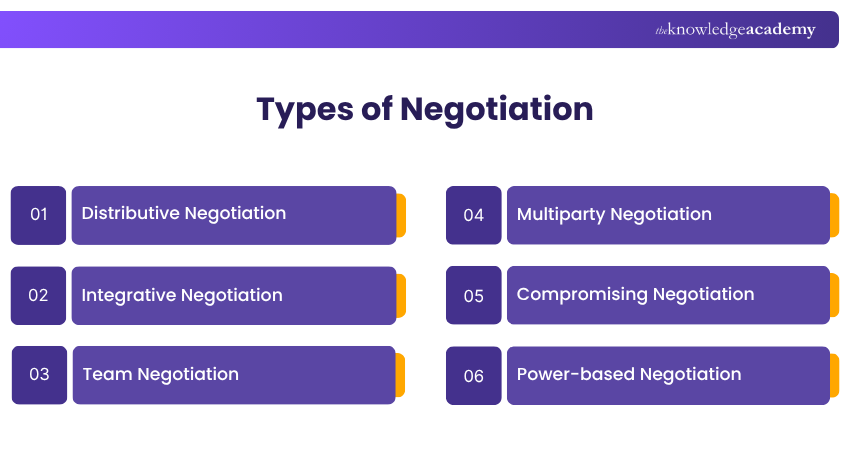
1) Distributive Negotiation
Distributive negotiation, also known as positional or competitive negotiation, is typically viewed as a win-lose approach. This is where the parties involved in the negotiation perceive the situation as a limited amount of value. They aim to claim the largest possible share for themselves. Each party tries to maximise their gains while minimising their concessions.
Additionally, distributive negotiation typically involves bargaining over a fixed amount of value, often around a single dominant issue such as price. In a purely distributive situation, one party’s gain generally comes at the other party’s expense.

2) Integrative Negotiation
Integrative negotiation, also referred to as interest-based or collaborative negotiation, seeks win-win outcomes. Parties seek mutually beneficial solutions by identifying shared and differing interests, exploring creative options and making trade-offs across issues.
Unlike distributive negotiation, this type looks for opportunities to create additional value, aiming for outcomes that address the requirements and interests of the parties involved. This approach emphasises collaboration, problem-solving, and effective communication. Skilled negotiators in integrative negotiation focus on active listening and empathy. They also aim to generate value to create sustainable and positive outcomes.
Quick Example
Imagine a supplier and retailer negotiating a contract. If they focus only on dividing a fixed budget, the negotiation is largely distributive. If they also discuss delivery schedules, order volumes and payment terms to create value for both sides, it becomes more integrative.
3) Team Negotiation
Team negotiation involves two or more people negotiating together on behalf of the same organisation, group or interest. Team members may bring different areas of expertise, responsibilities and perspectives to the negotiation.
Effective team negotiation requires coordination before and during discussions. Team members should understand their objectives, responsibilities and decision-making authority so that they can communicate consistently and avoid conflicting messages. This approach is useful in complex business negotiations where legal, financial, technical or operational expertise may be required.
4) Multiparty Negotiation
Multiparty negotiation involves more than two parties participating in the same negotiation. Unlike a two-party discussion, multiple stakeholders may have different priorities, interests and levels of influence.
These negotiations can become more complex because parties may form coalitions, support different proposals or disagree about both the outcome and the negotiation process. Effective communication, stakeholder coordination and clear decision-making procedures can therefore become particularly important.
5) Compromising Negotiation
Compromising negotiation involves both parties making concessions to reach a mutually acceptable agreement. It is a give-and-take approach that focuses on finding an acceptable solution rather than maximising individual gains.
Compromising negotiation can be useful when time is limited. It can also be useful when parties have relatively balanced bargaining power and reaching a timely, workable agreement is more important than maximising every individual interest.
Turn every client conversation into a sales opportunity with the Sales Client Meeting Skills Training now!
6) Power-based Negotiation
Power-based negotiation relies on the use of power, influence, and advantage to shape the negotiation process and outcomes. Negotiators with greater bargaining power may use their leverage to advance their interests and seek favourable terms. Power can come from various sources, such as position, expertise, or access to resources.
However, relying solely on power-based negotiation can strain relationships and lead to suboptimal outcomes. Skilled negotiators understand the dynamics of power and use it judiciously. They combine it with effective communication and relationship-building strategies.

The Importance of Negotiation
Negotiation plays a significant role in various aspects of life, including personal relationships, business transactions, and international diplomacy. A comprehensive understanding of the importance of negotiation can empower individuals to navigate complex situations and achieve desired outcomes. Parties can engage in open and respectful discussions. As a result, they can work towards solutions that address their respective needs and interests.
Furthermore, collaborative and integrative negotiation can encourage creativity and problem-solving. By exploring different interests and possible trade-offs, parties may identify solutions that would otherwise be overlooked. This process promotes out-of-the-box thinking and consideration of multiple perspectives, creating opportunities for more mutually beneficial outcomes.
Moreover, negotiation strengthens skills such as conflict resolution and effective communication. These skills have wider applications in personal relationships, teamwork and professional collaboration.
How to Choose Your Negotiation Type?
Understanding the different types and approaches to negotiation and selecting the most suitable one can significantly impact the process and results. Here are some steps to help a person choose their negotiation type:

a) Assess Your Position: Understand your objectives, priorities, alternatives, strengths and limitations before deciding how to approach the negotiation.
b) Identify the Situation: Consider the nature and context of the negotiation. Determine whether there are opportunities to create mutual value or whether the parties are primarily competing over a limited resource.
c) Research and Prepare: Gather information about the other party, their interests, goals and possible priorities. Understand the issues, evaluate your options and identify your BATNA (Best Alternative to a Negotiated Agreement). This preparation can help you determine which negotiation approach is most suitable.
d) Look for Opportunities to Create Value: If several issues are negotiable and parties value them differently, consider an integrative approach that allows trade-offs and mutual gains.
e) Recognise Fixed-value Situations: If the negotiation mainly concerns a limited resource or single issue and the parties’ interests are directly opposed, a more distributive approach may be appropriate.
f) Be Flexible: A successful negotiator must be adaptable and know when to switch between different negotiation styles. Therefore, being able to transition from a competitive to a collaborative approach or vice versa can be a valuable skill.
From interested prospect to paying customer, learn how to close sales by joining the Closing Sales Training today!
Tips for Effective Negotiation
Here are some tips that you can use in your next negotiation:
1) Use Numbers Strategically
Research suggests that precise opening offers can sometimes create stronger anchors because they may signal that the offer is informed. However, excessive or unjustified precision can also make an offer seem inflexible, so figures should be supported by credible research or reasoning.
2) Ask Open-ended Questions
Ask open-ended questions to encourage the other party to share more information about their needs, priorities and available options. For example, asking, “What services can you offer for this price?” can reveal more useful information than a simple yes-or-no question.
Bonus Tip
Follow an open-ended question with a short pause instead of immediately filling the silence. Giving the other party time to respond can encourage them to share more detail.
3) Consider Your Timing
Timing can influence how requests, offers and concessions are received. Consider the other party's circumstances and your bargaining position, and make important proposals when they are most likely to support your negotiation objectives.
4) Evaluate and Learn
After the negotiation, assess the results and your chosen negotiation style. Identify areas for improvement and learn from the experience to enhance your future negotiation skills.
Understand customer psychology and buying behaviour with our Sales Training – Join now!

The Knowledge Academy develops accessible learning content across Project Management, IT, Cybersecurity, Data Science, Business Analysis, HR, Accounting and Finance, Leadership and Health and Safety. Its resources combine subject research with clear explanations to help professionals build practical knowledge across a wide range of disciplines.
View Detail

 If you wish to make any changes to your course, please


