


 Top Rated Course

We may not have the course you’re looking for. If you enquire or give us a call on 01344203999 and speak to our training experts, we may still be able to help with your training requirements.
What is Brand Trust? A Complete Overview
James Smith 24 February 2026Brand Trust is the confidence and emotional connection customers have in a brand's ability to deliver quality products and fostering loyalty and respect. It builds through consistent experiences, quality products or services, and transparent communication. When trust is strong, customers are more loyal and likely to recommend the brand to others.

Training Outcomes Within Your Budget!
We ensure quality, budget-alignment, and timely delivery by our expert instructors.
Table of Contents

Are you a business owner who wants to build a loyal and satisfied customer base? Or maybe you want to differentiate your brand from your competitors and increase your sales. Perhaps you are curious about how to create a positive and ever-lasting impression on your Target Audience. Then you must know What is Brand Trust.
The benefits of Brand Trust extend much beyond all the previously mentioned outcomes. Want to know more about these benefits? Keep Reading. This blog will provide an overview of What is Brand Trust, and also explore why it matters, how to measure it, and how to improve it, along with some helpful tips.
Table of Contents
1) What is Brand Trust?
2) Importance of Brand Trust
3) How do you Build Brand Trust?
4) Factors Influencing Customer Trust in a Brand
5) Measuring Brand Trust
6) Conclusion
What is Brand Trust?
Brand trust is the confidence consumers place in a brand's ability to consistently deliver on its promises. It is built over time through positive experiences, reliable products or services, transparent communication, and ethical behaviour.
When customers trust a brand, they are more likely to stay loyal, recommend it to others, and forgive occasional mistakes. Brand trust is essential for long-term success as it strengthens customer relationships, enhances reputation, and gives businesses a Competitive Advantage in the market.

Importance of Brand Trust
Here are some key reasons why Brand Trust is important for businesses:
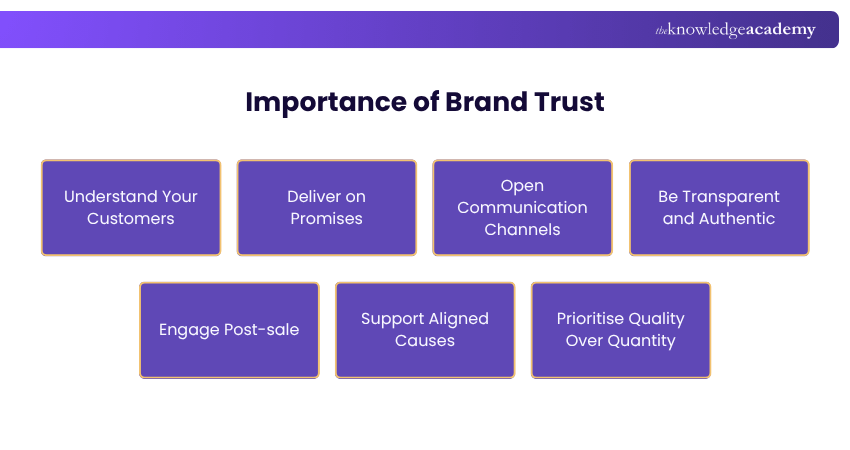
a) Understand Your Customers: It is important to spend a certain amount of time to learn the customer's needs and expectations. Surveys, feedback, and other analytics to make sales or rather sell what they want but rather to address the customers’ concerns.
b) Deliver on Promises: Be specific about what your brand can offer and ensure that all this promise is delivered to the customer most of the time. Assure you that your product or service is what its price indicates and is as good as it portrays itself to be.
c) Open Communication Channels: It must constantly provide customers with fast and efficient service. Make sure there are ways in which individuals can give feedback, answer questions quickly, and engage in dialogue.
d) Be Transparent and Authentic: Disclose information concerning the product sources and supply, management and preservation of data, and business operations. Fix mistakes and never attempt to justify them.
e) Engage Post-sale: Subsequently, contracts with clients can be signed, and consumers can be contacted regularly for feedback and then provided with recommendations for products and services which are valuable for them in the long term.
f) Support Aligned Causes: Engage in philanthropic activities that depict or share the company’s vision and mission, and goals. Demonstrate various customers and employees regarding organisational society.
g) Prioritise Quality Over Quantity: Concentration on the quality of services or products being produced for the market. Understand how to tackle problems with effective returns and refund approaches.
Enhance your understanding of improving your skills in Email Copywriting with our Web and Email Copywriting Course – Join now!
How do you Build Brand Trust?
Building Trust is a strategic business decision and a moral commitment to customers. Trust is fragile, and it can be challenging to regain once broken. Here are some pivotal methods Brands can employ to build Brand Trust amongst the masses:
1) Establish Clear Expectations
Building brand trust begins with being transparent and communicating clearly. Make sure the information provided about your products, services, and company values is accurate, honest, and easy to understand. Avoid vague descriptions that could confuse customers or create unrealistic expectations.
Transparency builds confidence, while unclear communication can lead to doubt and mistrust. Always ensure product descriptions, service details, and policies are fully explained.
2) Fulfill Commitments
Trust is built on reliability, and fulfilling commitments is crucial. Whether it's delivering products on time, providing excellent Customer Service, or maintaining product quality, brands must consistently meet or exceed customer expectations.
Customers feel secure when they know a brand will consistently deliver on its promises. Make sure your products and services meet the expected standards. Be quick to resolve problems, honour delivery timelines, and follow through on return policies and customer support assurances.
Enhance your understanding of Business Marketing with our Business Marketing Strategies Training – sign up now!
3) Amplify Positive Impressions
Positive experiences are powerful trust builders. Brands should actively seek ways to create positive experiences for their customers. This could involve going the extra mile in customer service, crafting high-quality products, or engaging in philanthropic activities that resonate with the brand's values.
Showcasing positive customer reviews and testimonials can strengthen trust through social proof. Social proof is a crucial way to build trust by showing examples of happy customers. Talking to customers on social media, replying to their comments, and openly dealing with any issues shows that you really care about making customers happy.
4) Continuously Reinforce Trust-building Efforts
Building trust is a continuous process that needs constant work. It's not a one-time task but a commitment to fostering a positive and reliable brand image. Regularly evaluate customer feedback, adapt to changing consumer needs, and evolve with market trends.
Consistent, transparent communication is essential. Brands should keep customers informed about company updates, improvements, and changes. This transparency fosters a sense of connection and inclusivity. It's equally important to acknowledge and rectify mistakes promptly. Admitting errors and taking corrective actions can enhance trust by demonstrating accountability.
Become a professional in Copywriting with our Copywriting Course – register now!
Factors Influencing Customer Trust in a Brand
Customer trust in a brand is influenced by factors that collectively shape perceptions and expectations. Building and maintaining trust is essential for establishing strong, long-lasting customer relationships. Here are key factors that play an important role in influencing customer trust:
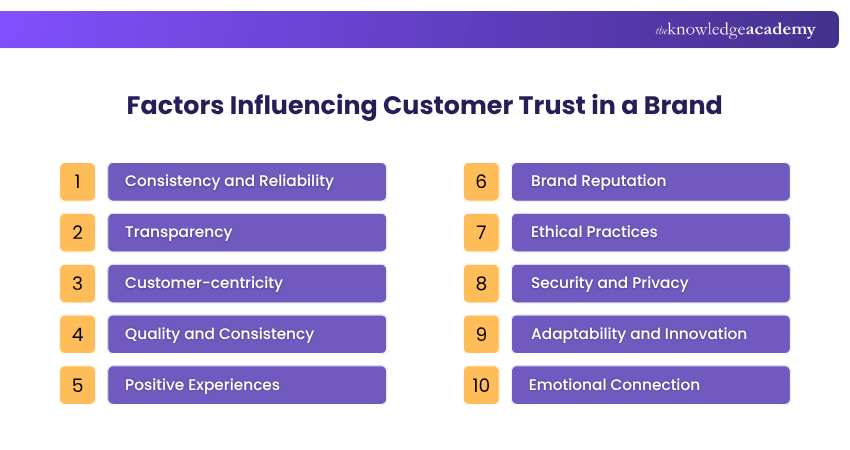
a) Consistency and Reliability: Consistency of service delivery across the customer touchpoints is a way of honouring the sales promises made and building the organisation’s reputation of being reliable.
b) Transparency: The information is open to other companies, hence enhancing credibility in addition to transparency in expressing values, policies, and challenges.
c) Customer-centricity: Customer needs, customer feedback, and customer experiences are the best ways of showing that you care and that you are trustworthy.
d) Quality and Consistency: Speaking of ensuring confidence and reliability, keeping a high standard for products and services keeps them strong.
e) Positive Experiences: Thus, the confidence-building experiences include efficiency, prompt and consummated exchanges, and client care before, during, and after the acquisition.
f) Brand Reputation: Endorsements, recommendations, node Name, build credibility and appeal to trust.
g) Ethical Practices: Dependability is another dimension of values since brands that have good labour conditions, are environmentally friendly and contribute to society are trusted.
h) Security and Privacy: The clarity of both policies and data security reduces customers concerns about the safety of their information.
i) Adaptability and Innovation: Innovation and market shifts demonstrate the reliability of satisfying new customer needs and expectations.
j) Emotional Connection: Engaging customer’s values and hopes creates strong loyalty-based Customer relations.
Understand how to get self-promoted to improve your professional standing with our Personal Branding Course – Sign up now!
Measuring Brand Trust
It is necessary to evaluate brand trust in order to grasp the level of customer reception and to strengthen the bond. Here are key methods to measure it:
1) Customer Surveys and Feedback:
Do direct questions in surveys to customers about the level of trust they place in your brand. They can be aimed at credibility, clarity and trust, consumer satisfaction and even outcomes of brands and goods.
2) Net Promoter Score (NPS):
Assess customer patronage using the question how likely would you recommend this brand? From experience, it has been realised that a high score on NPS may suggest high levels of trust.
3) Social Media Sentiment Analysis:
Monitor Social Medial network to read the mentions, comments and reviews for the assessment of the level of trust of the public.
4) Customer Retention Rates:
Follow the repurchase rate and the subscription renewal rate. Higher retention always speaks volumes about the fact that your customers trust your brand and that the information that you provide to them is credible and of good value.
5) Brand Perception Studies:
Encourage outside research organisations or local focus groups in an effort to determine how unethical your brand is viewed in the light of reliability and propriety.
6) Reviews and Testimonials:
It’s important to learn more when customers give their opinions about the brand through online reviews and testimonials as these insights are an indication of trust which includes positive experiences and recommendations
Conclusion
We hope through this blog we were able to answer your queries about What is Brand Trust and its various aspects. Building Brand Trust begins by setting clear expectations. Transparency is key in communication, and brands should be explicit about their values, products, and services. This involves providing accurate information about what customers can expect from the brand.
Become an expert in retaining customers with our Customer Retention Training today!
Frequently Asked Questions
How can Businesses Actively Build and Maintain Brand Trust?

Brand trust is built by delivering quality products, providing clear and accurate information, and prioritising customer needs. Businesses should actively seek feedback, uphold ethical practices, protect customer data, and foster emotional connections through a genuine vision and shared values to maintain long-term trust.
In What Ways Does Brand Trust Contribute to a Company's Resilience During Challenges or Crises?
Brand trust helps companies remain resilient during challenges or crises by encouraging customer loyalty, forgiveness of mistakes, and continued support. Trusted brands often retain their market position and benefit from positive word of mouth, even in difficult situations.
How do you Calculate Brand Trust?
Brand trust is calculated using customer surveys, feedback scores, Net Promoter Score (NPS), online reviews, social media sentiment, and repeat purchase rates to measure customer confidence, satisfaction, and loyalty towards the brand.
What are the Other Resources and Offers Provided by The Knowledge Academy?
The Knowledge Academy takes global learning to new heights, offering over 3,000+ online courses across 490+ locations in 190+ countries. This expansive reach ensures accessibility and convenience for learners worldwide.
Alongside our diverse Online Course Catalogue, encompassing 17 major categories, we go the extra mile by providing a plethora of free educational Online Resources like Blogs, eBooks, Interview Questions and Videos. Tailoring learning experiences further, professionals can unlock greater value through a wide range of special discounts, seasonal deals, and Exclusive Offers.
What is The Knowledge Pass, and How Does it Work?
The Knowledge Academy’s Knowledge Pass, a prepaid voucher, adds another layer of flexibility, allowing course bookings over a 12-month period. Join us on a journey where education knows no bounds.
What are the Related Courses and Blogs Provided by The Knowledge Academy?
The Knowledge Academy offers various Digital Marketing Courses, including Business Branding Course, Personal Branding Course and Customer Acquisition Training. These courses cater to different skill levels, providing comprehensive insights into Brand Identity.
Our Digital Marketing Blogs cover a range of topics related to Brand Trust, offering valuable resources, best practices, and industry insights. Whether you are a beginner or looking to advance your Digital Marketing skills, The Knowledge Academy's diverse courses and informative blogs have got you covered.

James Smith


Digital Marketing Manager and Trainer
James Smith is a digital marketing professional with over a decade of experience in SEO, content strategy, paid media and analytics. He has supported both SMEs and global brands in transforming their digital presence. James’s writing and training are rooted in results-driven tactics and the latest marketing trends.
View Detail
Upcoming Digital Marketing Resources Batches & Dates
Date
 Digital Marketing Course
Digital Marketing Course
Fri 24th Apr 2026
Digital Marketing Course
Fri 17th Jul 2026
Digital Marketing Course
Fri 13th Nov 2026

 If you wish to make any changes to your course, please


