


 Top Rated Course

We may not have the course you’re looking for. If you enquire or give us a call on 01344203999 and speak to our training experts, we may still be able to help with your training requirements.
PPC Techniques: Strategies to Improve Campaign Performance
The Knowledge Academy 05 September 2026PPC Techniques help advertisers improve campaign targeting, bidding, ad relevance, landing-page performance, and measurement. Explore practical strategies to reduce wasted spend, strengthen conversions, and make paid advertising decisions more effective.

Training Outcomes Within Your Budget!
We ensure quality, budget-alignment, and timely delivery by our expert instructors.
Table of Contents
Key Takeaways
1. Clear campaign objectives and accurate conversion tracking provide the foundation for meaningful optimisation.2. Keyword, search-term, and negative keyword analysis help improve traffic relevance and control unnecessary spend.3. Bidding strategies should reflect the campaign objective rather than being selected purely for automation.4. Strong adverts need relevant landing pages and appropriate audience targeting to convert attention into action.5. PPC performance should be reviewed continuously using metrics that connect advertising activity with business outcomes.
A PPC campaign can attract plenty of clicks and still fail to deliver meaningful results. Traffic alone does not guarantee leads, sales, bookings, or other valuable actions.
Successful campaigns require the keyword, bid, advert, audience, landing page, and measurement setup to work together. Effective PPC Techniques help advertisers strengthen these connections, reduce wasted spend, and make optimisation decisions based on what genuinely supports campaign performance.
What are PPC Techniques?
PPC Techniques are methods used to plan, manage, and improve Pay-per-Click advertising campaigns. They can influence targeting, bidding, advert delivery, conversion measurement, and what happens after someone interacts with an advert.
Effective PPC optimisation considers the entire campaign journey rather than treating individual tactics in isolation. Understanding where performance is being lost makes it easier to decide which part of the campaign needs attention.
PPC Optimisation Chain
Goal → Measurement → Targeting → Advert → Landing Page → Conversion → Review
Each stage influences the next. Improving one part of the campaign may have limited impact if another stage continues to create friction.
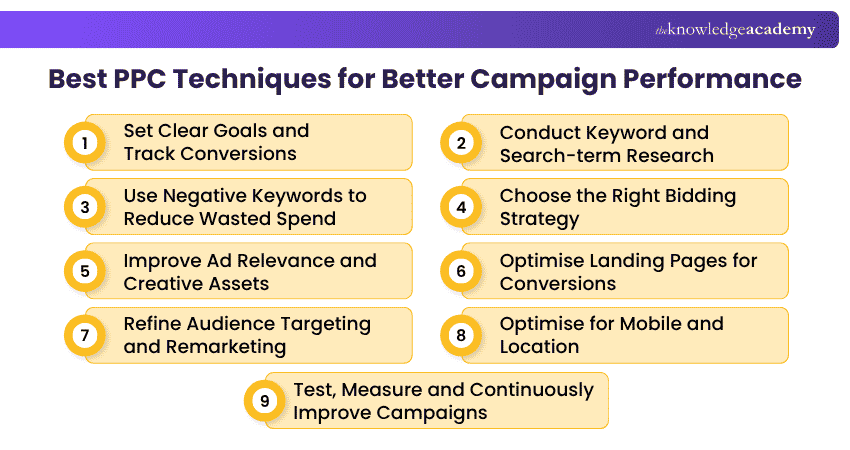
Best PPC Techniques for Better Campaign Performance
No single PPC technique guarantees stronger results. The most effective approach is to understand what the campaign needs to achieve and optimise the areas that most directly influence that objective.
1) Set Clear Goals and Track Conversions
Begin by defining the business action the campaign should generate rather than focusing only on clicks or impressions. Depending on the campaign, the desired outcome may be a sale, qualified lead, booking, phone call, download, or another measurable action.
Conversion tracking then connects advertising activity with these outcomes. Where some actions have greater commercial value than others, assigning appropriate conversion values can also provide a more meaningful picture of performance.
Example: A brochure download and a completed purchase may both count as conversions, but they do not necessarily contribute the same business value. Measuring them appropriately helps prevent campaign decisions from being based purely on conversion volume.
Improve conversions with Conversion Rate Optimisation Training and turn more website visitors into valuable customers.
2) Conduct Keyword and Search-term Research
Keyword research helps identify searches that are relevant to the organisation's products, services, and campaign goals. Selection should consider search intent, commercial importance, competition, estimated cost, and how closely the query reflects the offer.
Search volume should not be the only consideration. A specific lower-volume term with strong buying intent can sometimes be more valuable than a broad phrase attracting large amounts of loosely relevant traffic.
Advertisers should also review the actual search terms generating traffic. Search-term analysis can reveal promising queries, unexpected user intent, and irrelevant searches that require further optimisation.
Practical Check
When evaluating a keyword, do not ask only:
“Is this keyword relevant?”Also consider:“What is the person using this search likely trying to accomplish?”
Understanding the intent behind the search can help determine whether the keyword fits the campaign objective.
3) Use Negative Keywords to Reduce Wasted Spend
Negative keywords help prevent adverts from appearing for searches that do not match the organisation's offer or campaign objective. They can be particularly useful when relevant keywords also trigger queries with clearly unsuitable intent.
For example, a business selling paid professional training may want to review searches containing terms such as “free” if it does not provide free courses. Excluding unsuitable queries can help direct more budget towards relevant traffic.
Negative keywords should nevertheless be used carefully. Excessive exclusions can restrict potentially useful searches, so decisions should be based on actual query relevance rather than assumptions.
Search-term Decision Check
Use the following questions when reviewing search-term performance:
Relevant and valuable? Keep it and continue evaluating performance.Relevant but underperforming? Review the advert, bid, match type, and landing page first.Clearly irrelevant? Consider an appropriate negative keyword.New high-value query? Consider targeting it deliberately.
This makes search-term optimisation more purposeful than simply adding or removing keywords.
4) Choose the Right Bidding Strategy
Bidding determines how campaign budget is used when competing for advertising opportunities. The right approach should therefore reflect what the campaign is expected to achieve.
Conversion-focused strategies can prioritise different objectives, such as generating more conversions, working towards a target acquisition cost, increasing conversion value, or aiming for a particular return on advertising spend.
Automation does not remove the need for good campaign inputs. If conversion tracking is inaccurate or the wrong actions are prioritised, an automated bidding system may optimise effectively towards an outcome that provides little business value.
Trainer's Insight
Before changing bids, confirm that the campaign is measuring the right conversion. Better bidding cannot compensate for poor measurement.
5) Improve Ad Relevance and Creative Assets
A strong PPC advert should connect the user's need with a clear and relevant offer. The message should explain what is available, why it matters, what differentiates it, and what the user should expect after clicking.
Where the advertising platform allows multiple headlines, descriptions, or additional assets, use that space to provide genuinely different information rather than repeating the same message.
For example:
Headline 1: PPC Training for Professionals
Headline 2: Build Practical Campaign Skills
Headline 3: Learn Keyword, Bidding and Ad Strategies
Each headline contributes a different reason to engage while remaining connected to the same offer.
6) Optimise Landing Pages for Conversions
The PPC journey continues after the click. The landing page should match the intent and expectations created by the advert so visitors can quickly understand the offer and complete the intended action.
A useful landing page should communicate the offer clearly, make the next action obvious, minimise unnecessary friction, and work effectively across relevant devices.
Consider this example:
1) Search: PPC training for beginners
2) Advert: Beginner PPC Training Course
3) Landing Page: General digital marketing homepage
The advert may match the query, but the landing page forces the visitor to search again for the promised content. Sending the user directly to the relevant training page creates a more consistent journey.
7) Refine Audience Targeting and Remarketing
Audience targeting allows advertisers to refine campaigns around people whose characteristics or previous behaviour may be relevant to the offer.
Remarketing focuses on users who have already interacted with the organisation, subject to platform rules and applicable privacy requirements. However, previous visitors should not automatically receive the same message.
Useful segmentation could distinguish between:
1) Product or service viewers
2) Form abandoners
3) Previous customers
4) Repeat visitors
5) People who engaged with particular content
Different behaviours can indicate different levels of intent, so messaging should reflect where the user may be in their decision-making process.
8) Optimise for Mobile and Location
Campaign performance can vary considerably depending on the device and location of the user. Advertisers should review whether the complete experience remains practical across the environments that matter to the campaign.
Useful questions include:
1) Does the landing page perform effectively on mobile devices?
2) Are key actions easy to complete on smaller screens?
3) Does campaign performance differ significantly between devices?
4) Are adverts being shown only in locations the business can realistically serve?
Location targeting should reflect genuine business capability. Advertising too broadly can waste budget, while targeting too narrowly can unnecessarily restrict useful reach.
9) Test, Measure and Continuously Improve Campaigns
PPC optimisation is an ongoing process because audience behaviour, competition, costs, offers, and platform conditions can change over time.
Campaigns should therefore be reviewed using metrics that reflect their actual objective. Common measures can include:
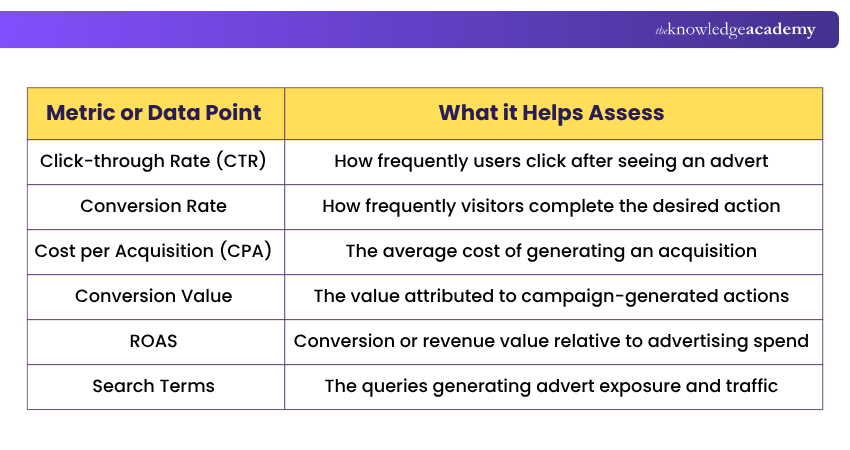
Metrics should not be interpreted independently. For example, a rising CTR may appear positive, but its business impact is limited if the additional traffic does not convert.
Testing can cover advert messaging, Calls To Action, targeting, offers, landing pages, audiences, and bidding approaches. Avoid making too many significant changes simultaneously, as this can make it difficult to determine what actually influenced performance.
Common PPC Mistakes to Avoid
Even well-funded campaigns can underperform when basic PPC principles are overlooked. The following mistakes can make campaign performance harder to control or evaluate:
| Mistake | Why It Can Hurt Performance |
| Optimising only for clicks | Traffic may increase without producing valuable actions |
| Using inaccurate conversion tracking | Campaigns may optimise towards misleading signals |
| Ignoring search-term data | Irrelevant |
| Overusing negative keywords | Potentially valuable traffic may be excluded |
| Making frequent major changes | Performance becomes harder to assess reliably |
| Relying blindly on automation | Business judgement and accurate inputs are still required |
Avoiding these mistakes helps keep optimisation focused on meaningful campaign outcomes rather than isolated platform metrics.
Conclusion
Strong PPC performance rarely comes from one isolated adjustment. It comes from identifying where a campaign is losing relevance, efficiency, or value and improving that area deliberately. Keep decisions connected to measurable business outcomes, test changes carefully, and allow reliable performance data to guide what you optimise next.
Strengthen your marketing approach with our Strategic Marketing Course and make smarter, insight-driven business decisions.
Frequently Asked Questions
What is the Difference Between PPC and CPC?

PPC is an advertising model in which advertisers pay when someone clicks their advert, while CPC refers specifically to the amount paid for each click. CPC is therefore a pricing method and performance metric commonly used within PPC advertising.
How Long Does It Take for a PPC Campaign to Produce Useful Data?
There is no fixed timeframe because it depends on factors such as budget, traffic volume, audience size, conversion frequency, and campaign objective. Advertisers generally need enough meaningful activity before drawing reliable conclusions from performance patterns.
Can PPC Work for Small Businesses?
Yes. PPC can support smaller businesses when targeting, location, budget, and campaign goals are carefully controlled. Effective campaigns depend more on relevance and efficient use of available spend than simply having the largest advertising budget.
What is the Difference Between PPC and SEO?
PPC provides paid visibility through advertising platforms, while SEO focuses on improving unpaid visibility in organic search results. Businesses may use both approaches because they support different parts of a wider search marketing strategy.

The Knowledge Academy


Global Training Provider
The Knowledge Academy is a world-leading provider of professional training courses, offering globally recognised qualifications across a wide range of subjects. With expert trainers, up-to-date course material, and flexible learning options, we aim to empower professionals and organisations to achieve their goals through continuous learning.


 If you wish to make any changes to your course, please


