


 Top Rated Course

We may not have the course you’re looking for. If you enquire or give us a call on 01344203999 and speak to our training experts, we may still be able to help with your training requirements.
What are Negotiation Skills and How to Improve Them?
Charlotte Wilson 02 September 2026Explore how Negotiation Skills support effective communication, decision-making, and conflict resolution, along with practical ways to develop them.

Training Outcomes Within Your Budget!
We ensure quality, budget-alignment, and timely delivery by our expert instructors.
Table of Contents
Key Takeaways
1. Negotiation Skills combine active listening, communication, preparation, emotional intelligence, analytical thinking and problem-solving.2. Thorough preparation helps you define your objectives, limits, and alternatives before entering a negotiation.3. Knowing your BATNA helps you evaluate an offer and recognise when walking away could be the better option.4. Negotiation Skills are valuable in professional and everyday situations, including workplace discussions, contracts, purchases, and resolving disagreements.5. Negotiation ability can be strengthened through preparation, practice, reflection, and active engagement with negotiation techniques.
You make a proposal. The answer is “No.” What happens next? Do you push harder, walk away, ask questions, or look for another option?
That moment captures what Negotiation is really about. It is not simply about winning an argument, but about understanding priorities, exploring alternatives, and working towards an acceptable outcome. In this blog, we will explore key Negotiation Skills and how you can strengthen them. Let's get started!
What are Negotiation Skills?
Negotiation Skills are the abilities used to discuss different interests, communicate priorities and work towards an acceptable agreement. They help people understand the needs and concerns of other parties while clearly presenting their own position.
Strong Negotiation Skills help individuals manage disagreements, build productive relationships, and reach practical agreements in the workplace, business, and everyday situations.
10 Essential Negotiation Skills
It is necessary to learn Negotiation Skills for various aspects of life. This section covers 10 essential Negotiation Skills that will help you handle discussions effectively.
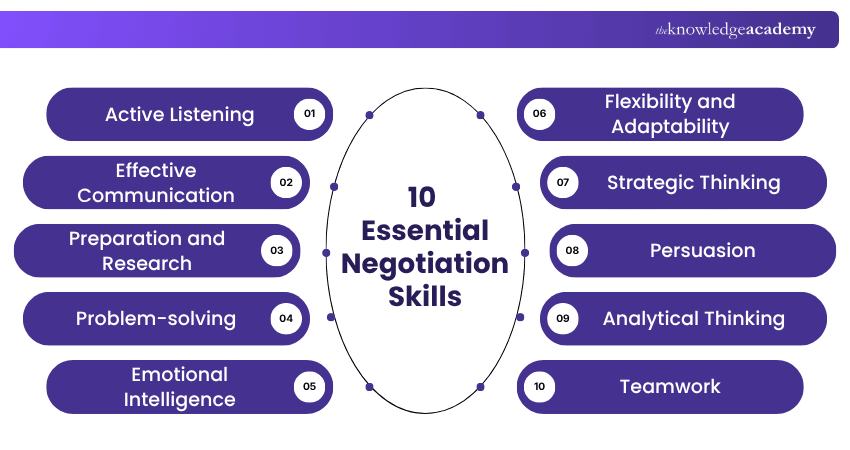
1) Active Listening
Active listening is one of the fundamental Negotiation Skills. It engages the speaker and fosters understanding of their point of view. It includes giving your full attention, noticing non-verbal cues, and showing that you understand the speaker's message and perspective.
2) Effective Communication
Effective communication helps negotiators express priorities, proposals, and concerns clearly. Using appropriate language and precise questions reduces misunderstandings and helps all parties work towards an agreement.
3) Preparation and Research
Preparation gives negotiators a clearer understanding of their objectives, priorities, and limits before a discussion begins. Researching relevant facts, market conditions, and the interests of the other party can also help identify potential areas of agreement.
4) Problem-solving
Effective negotiators possess strong problem-solving skills, enabling them to identify creative and mutually beneficial solutions. Problem-solving involves analysing complex issues, thinking critically, and exploring various alternatives.
Trainer’s Insight:
Decide your ideal outcome, acceptable outcome, and walk-away point before the discussion begins. Clear limits can help you evaluate proposals without making unnecessary concessions under pressure.
5) Emotional Intelligence
Emotional intelligence plays a significant role in Negotiations. It refers to the ability to recognise, understand, and manage emotions both in oneself and others. Negotiators can navigate sensitive situations with greater sensitivity and effectiveness by being aware of emotions and employing empathy.
6) Flexibility and Adaptability
Flexibility and adaptability are fundamental Negotiation Skills in a fast and dynamic environment. By staying open to newer perspectives, ideas and methods, negotiators adapt their strategies. This openness fosters creativity, helping them discover solutions and reach an agreement to meet the interests of both parties.
7) Strategic Thinking
Strategic thinking helps negotiators plan how they will approach a discussion and respond to different scenarios. Before negotiating, identify your priorities, preferred outcomes, acceptable limits and possible alternatives. It is also useful to consider the other party's interests, constraints and likely objectives.
8) Persuasion
Persuasion helps you to influence other people’s viewpoints and guide discussions toward mutual agreement. Skilled negotiators use persuasion to help others see situations from a new perspective. By presenting well-supported arguments that align with shared interests, they make it easier to reach fair and beneficial compromises.
9) Analytical Thinking
Analytical thinking helps negotiators evaluate facts, interests, risks, and potential outcomes objectively. It enables them to compare proposals, identify important trade-offs, and anticipate the possible consequences of different decisions.
Watch Out!
Avoid immediately lowering your offer or making another concession simply because the other party remains silent. Give them an opportunity to respond before changing your position.
10) Teamwork
Teamwork becomes particularly important when negotiations involve multiple colleagues, departments, or stakeholders. Effective negotiation teams coordinate their objectives, share relevant information, and maintain a consistent position during discussions.
Gain real-world skills to communicate your thoughts effectively with our Communication Skills Course - Register Now!
How to Improve Your Negotiation Skills?
If you're ready to improve your Negotiation capabilities, consider these recommendations:
a) Practice Regularly: Like any skill, Negotiation improves with practice. If real-life negotiation opportunities are short, you can practise role-play sessions with a friend or mentor. Create diverse scenarios that require different Negotiation approaches to improve your comfort and versatility.
b) Cultivate Confidence: Confidence can help you communicate your position clearly, respond calmly to questions, and avoid making unnecessary concessions. However, it should be supported by preparation and realistic expectations.
c) Define Clear Objectives: Enter Negotiations with a well-defined understanding of your objectives, build an appropriate approach to achieve them, and understand the limits within which you're willing to compromise. This clarity provides you with a roadmap toward your goals and allows you to respond effectively to counteroffers.
d) Understand Anchoring: The first offer can influence the direction of a Negotiation by establishing an initial reference point. However, making the first offer is most useful when you have enough information to set a realistic and well-supported position.
e) Learn From Experience: After each Negotiation, whether it ends successfully or not, you can take time to assess your performance. Reflect on what went well and areas that require improvement. Recognising your weaknesses helps you target them for further improvement through additional Negotiation training.
Worth Knowing: What is BATNA?
BATNA stands for Best Alternative to a Negotiated Agreement. It is the option you can pursue if the current negotiation does not result in an acceptable agreement. Knowing your BATNA can help you evaluate whether an offer is worth accepting.
Four Practical Principles for Effective Negotiation
The following four practical principles can help professionals approach Negotiations with greater preparation, clarity, and mutual respect. Let's check them below:
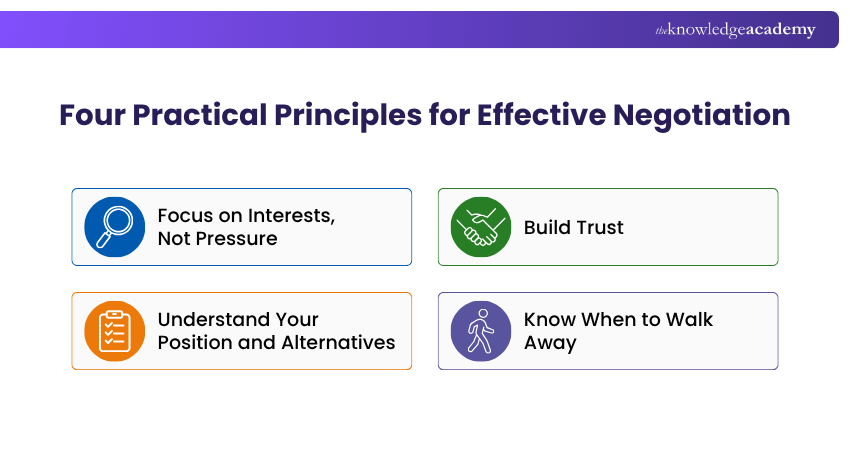
1) Focus on Interests, Not Pressure
Effective Negotiation involves understanding what each side values rather than simply pushing for acceptance of your position. Ask questions, listen carefully and identify underlying needs before proposing solutions.
2) Build Trust
In any successful Negotiation, trust is the core foundation that enables it. It is essential to show integrity, remain honest, and bring realistic expectations. By remaining transparent about your terms and assuring the decision-makers are on board, you develop a trusted partnership.
3) Understand Your Position and Alternatives
Enter Negotiations with a clear understanding of your priorities, limits, and available alternatives. Knowing what you will accept, what you can concede, and what you will do if no agreement is reached can help you make more considered decisions.
4) Know When to Walk Away
Not every Negotiation should end in an agreement. If the available terms do not meet your minimum requirements or a better alternative exists, ending the Negotiation may be the more appropriate decision.
Learn how culture influences your perspective with our Cross Cultural Communications Training – Join today!
Real-world Examples of Negotiation Skills
Here, we have provided some real-world examples that demonstrate Negotiation Skills.
1) The U.S Mortgage Foreclosure Settlement (2012)
In 2012, the U.S. federal government and 49 state attorneys general reached a $25 billion agreement with five major mortgage servicers over mortgage servicing and foreclosure abuses.
The agreement included financial relief for homeowners and introduced new servicing standards. The case illustrates the complexity of large-scale Negotiations involving multiple organisations, legal requirements, financial interests, and affected consumers.
2) Merge of Disney and Pixar (2006)
In 2006, The Walt Disney Company announced an agreement to acquire Pixar in an all-stock transaction valued at approximately $7.4 billion. Disney described the deal as combining Pixar's creative and technological resources with Disney's entertainment portfolio and other businesses.
The transaction provides a useful example of strategic Negotiation in which organisations must consider valuation, ownership, leadership and long-term business objectives.
3) Brexit Negotiations (2016-2020)
Following the UK's 2016 referendum, formal withdrawal negotiations between the UK and EU began in 2017, followed by negotiations over their future relationship. The process ultimately included agreements concerning areas such as citizens' rights, trade, governance and cooperation, with the UK-EU Trade and Cooperation Agreement reached in December 2020.
The negotiations demonstrate the importance of preparation, managing competing priorities and maintaining communication during complex discussions involving numerous political, economic, and legal interests.
Conclusion
Negotiation Skills empower you to handle challenging discussions confidently and work towards practical, well-considered outcomes. By developing these abilities, you can think strategically, communicate clearly, and strengthen professional relationships. Remember, every successful Negotiation is built on understanding, cooperation, and the willingness to find common ground.
Learn to articulate ideas clearly with our Effective Communication Skills Course – Join today!
Frequently Asked Questions
What are Five Steps to Negotiation Skills?

The five key steps in the Negotiation process are preparation and planning, setting ground rules, clarification and justification, bargaining and problem-solving, and closure and implementation. Following these stages provides a structured path from initial discussion to a clear and workable agreement.
What is the 70/30 Rule in Negotiation?
The 70/30 rule suggests spending around 70% of a Negotiation listening and 30% speaking. The idea is to understand the other party’s needs, concerns, and priorities before responding, helping you ask better questions and identify potential areas of agreement.
What Should be Avoided During Negotiation?
During Negotiation, avoid interrupting, making assumptions, becoming overly emotional, using aggressive language, or focusing only on winning. Also, avoid negotiating without preparation or agreeing to terms you do not fully understand.

Charlotte Wilson


Soft Skills and Business Training Manager
Charlotte Wilson is an expert in soft skills development, with over 14 years of experience helping individuals and teams improve communication, productivity and emotional intelligence in the workplace. Her training content is focused on enhancing interpersonal effectiveness and fostering positive, collaborative environments across all levels of an organisation.
View Detail

 If you wish to make any changes to your course, please


