


 Top Rated Course

We may not have the course you’re looking for. If you enquire or give us a call on 01344203999 and speak to our training experts, we may still be able to help with your training requirements.
What is SCADA (supervisory control and data acquisition)?
The Knowledge Academy 21 February 2026SCADA is a centralised system that monitors and controls industrial processes in real time, helping businesses improve efficiency and safety. It collects data from sensors and equipment, processes it, and allows operators to make decisions or automate responses. SCADA is essential in sectors like energy, water, manufacturing, and transportation.

Training Outcomes Within Your Budget!
We ensure quality, budget-alignment, and timely delivery by our expert instructors.
Table of Contents

Curious about how industries keep their operations running smoothly? Ever wondered What is SCADA? Well, wonder no more! SCADA, short for Supervisory Control and Data Acquisition, is the secret behind the scenes. It's the technology that helps companies monitor and control their processes, whether they're making cars, treating water, or generating electricity. In this comprehensive overview, we'll dive into the world of SCADA, exploring its evolution, architecture, working principles, and much more. Let's uncover the magic of SCADA together!
Table of Contents
1) What is Supervisory Control and Data Acquisition (SCADA)?
2) Key Features of SCADA Systems
3) Key Components of a SCADA System
4) SCADA Architecture
5) Types of SCADA Systems
6) Why are SCADA Systems Important?
7) What are the Applications of SCADA?
8) Differences Between Scada and Industrial IoT
9) Conclusion
What is Supervisory Control and Data Acquisition (SCADA)?
SCADA, short for Supervisory Control and Data Acquisition, is a crucial technology widely employed in various industries for monitoring and controlling processes, both locally and remotely. It provides real-time data visualisation, analysis, and control capabilities, allowing operators to manage complex systems efficiently.
SCADA systems comprise hardware and software components that gather, process, and present data from remote locations. These systems are pivotal in manufacturing, energy, water treatment, transportation, and more, where monitoring and controlling processes are paramount.
What sets SCADA vs DCS apart is its ability to gather data from sensors and instruments in real time, enabling operators to make informed decisions promptly. This technology significantly optimises operations, enhances safety, and improves overall productivity in industrial settings.

Key Features of SCADA Systems
SCADA systems offer several key features that make them indispensable tools for industrial automation and control:

1) Real-time Monitoring and Control
SCADA systems provide real-time visibility into industrial processes, allowing operators to monitor parameters, trends, and alarms instantly. This enables prompt Decision-Making and intervention to ensure optimal performance and safety.
2) Remote Accessibility
SCADA systems enable remote monitoring and control of processes from centralised locations, eliminating the need for physical presence at the site. This remote accessibility improves operational efficiency and flexibility, especially for geographically dispersed assets.
3) Data Acquisition and Analysis
SCADA systems collect and analyse large amounts of data from sensors and instruments, offering valuable insights into process performance, trends, and anomalies. This data analysis helps optimise operations, predict maintenance needs, and improve efficiency.
4) Customisable Alarming and Reporting
SCADA systems allow operators to configure alarm parameters and define escalation procedures to ensure timely response and resolution of issues. They also offer customisable reporting capabilities for compliance, analysis, and decision support.
5) Integration with Other Systems
SCADA systems can integrate seamlessly with automation and enterprise systems, such as Manufacturing Execution Systems (MES), Enterprise Resource Planning (ERP) software, and data historians. This integration enables data sharing, interoperability, and holistic management of industrial processes.
6) Security and Reliability
SCADA systems employ heavy security measures to protect against data breaches, unauthorised access, and cyber threats. They use encryption, authentication, and access control programs to ensure critical infrastructure's confidentiality, integrity, and availability.
7) Networked Data Communication
Networked data communication is a core feature of SCADA systems, enabling real-time data flow between remote field devices and central control units. This connectivity allows operators to monitor, analyse and respond to system changes instantly, ensuring smooth coordination across complex industrial processes.
Key Components of a Scada System
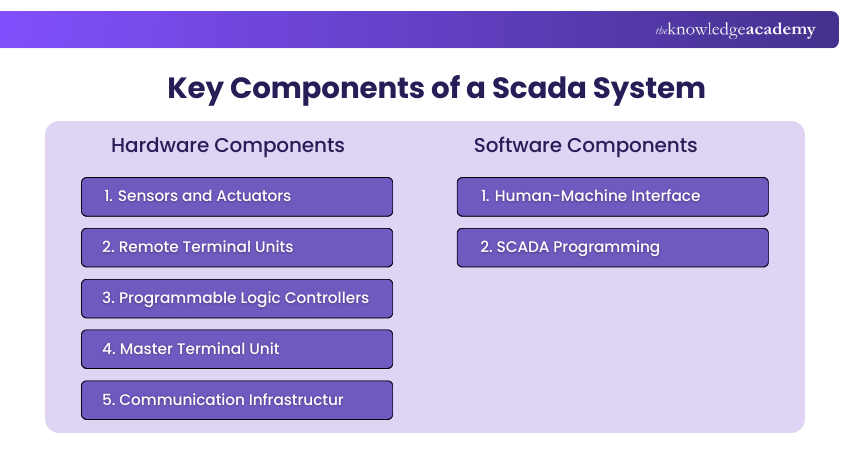
Understanding the key components of a SCADA system is essential to grasp how it monitors and controls complex industrial processes. Here are the key components of a SCADA system:
Hardware Components
When it comes to SCADA systems, the hardware forms the backbone of operations. These physical components are what connect the digital world of control and data processing to the real-world machines, processes and environments they manage. Let’s take a closer look at the key hardware elements that make SCADA systems tick.
1) Sensors and Actuators
It all begins at the ground level with sensors and actuators. These are the eyes and ears of the SCADA system. They measure everything from temperature and pressure to flow rate, voltage or chemical composition depending on the industry.
Without them, the system would be flying blind. They gather real-time data from the physical environment and pass it on for analysis and decision-making.
2) Remote Terminal Units
Remote Terminal Units, or RTUs, act as the messengers. These devices collect the raw data from sensors and transmit it to the central system. RTUs are often placed in distant or hard-to-reach locations such as oil rigs, power substations or water treatment plants.
Built to withstand tough conditions, they serve as reliable intermediaries, making sure the central control centre stays informed about what’s happening on the ground.
3) Programmable Logic Controllers
Programmable Logic Controllers, commonly known as PLCs, are the brainpower behind many automated processes. These rugged, industrial-grade computers are designed to handle real-time operations and respond instantly to changes in the system.
PLCs can process inputs from sensors and send commands to equipment like motors, valves or alarms. Their flexibility and reliability make them a staple in modern SCADA systems, especially in manufacturing and industrial automation.
4) Master Terminal Unit
Sitting at the heart of the SCADA system is the Master Terminal Unit or MTU. Think of it as mission control. It receives data from RTUs and PLCs, processes it and displays the information to human operators in a clear, actionable format.
The MTU is also responsible for sending instructions back out to field devices. This two-way communication allows for real-time monitoring, analysis and control of complex operations across wide geographical areas.
5) Communication Infrastructure
Tying it all together is the communication infrastructure. This is the network that allows all the components to speak the same language and stay in constant contact. It might include wired connections, wireless systems, fibre optics or even satellite links depending on the scope and location of the system.
The key is speed, reliability and security. A robust communication setup ensures that data flows smoothly from the field to the control centre and back again, with minimal delay or disruption.

Software Components
While hardware forms the physical structure of a SCADA system, it’s the software that brings it all to life. Think of it as the brain behind the operation, interpreting data, guiding decisions and presenting information in a clear, actionable way. From intuitive dashboards to complex control logic, software is what allows human operators and machines to work together seamlessly.
1) Human-Machine Interface
The Human-Machine Interface, often called the HMI, is where people and technology meet. It provides operators with a visual representation of the system, displaying real-time data through graphs, charts, alarms and control panels.
A well-designed HMI makes it easy to monitor the health of an entire plant or process at a glance, highlighting any issues that need attention and allowing quick responses. It transforms raw data into insights, making it easier to manage operations without being overwhelmed by complexity.
2) SCADA Programming
SCADA programming is the behind-the-scenes logic that tells the system how to behave. This includes configuring how data is collected, setting up alarms, defining user access levels and writing scripts for automation.
Good programming ensures the system runs smoothly, adapts to changing conditions and responds intelligently to faults or anomalies. It is highly customisable, allowing engineers to tailor the system to suit the specific needs of a site or process.
Are you ready to drive innovation? Our Product Management Training gives you the tools to lead with confidence.
Scada Architecture
The architecture of a SCADA system typically consists of four main components: supervisory computers, remote terminal units (RTUs) or programmable logic controllers (PLCs), communication infrastructure, and human-machine interface (HMI) software.
Supervisory computers serve as the central control hub of the SCADA system, where operators monitor processes, analyse data, and issue commands. These computers have specialised software to communicate with remote devices and collect real-time data.
RTUs or PLCs are deployed in the field to interface with sensors, actuators, and other devices. They collect data from these devices and transmit it to the supervisory computers for processing. Industrial Control Systems use RTUs in remote locations where wired communication may not be feasible, while PLCs are more common in industrial settings with structured wiring systems.
The communication infrastructure facilitates data exchange between the supervisory computers and remote devices. This infrastructure may include wired Ethernet, serial communication (RS-232/RS-485), radio frequency (RF), and cellular networks.
Types of SCADA Systems
SCADA systems have evolved significantly over the years, and today they come in various forms depending on the complexity of the operation and the scale of deployment. Generally, they can be grouped into four main types:

1) Monolithic SCADA
Monolithic systems were the earliest versions, built as standalone units with minimal connectivity. They were designed for simple tasks within a single site.

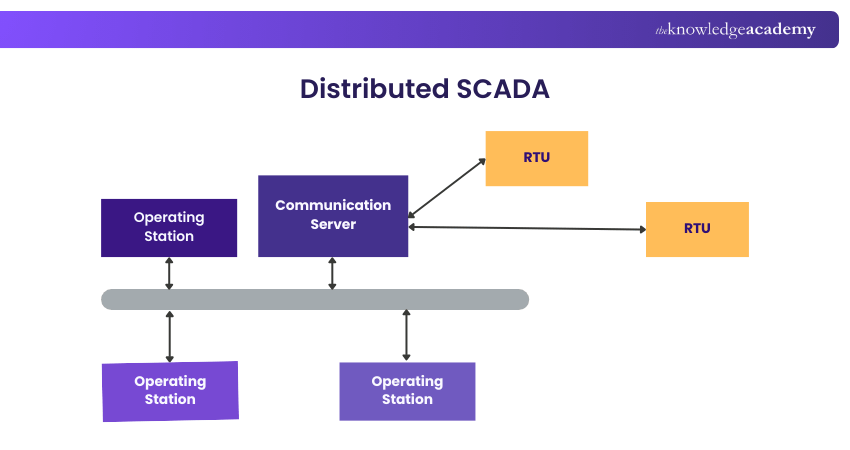
2) Distributed SCADA
Distributed systems introduced a more flexible structure, with multiple components such as controllers, servers, and interfaces spread across a local area network. These offered greater efficiency and reliability.
3) Networked SCADA
Networked SCADA systems brought in internet-based communication, allowing for remote monitoring and more scalable operations. These are widely used in industries that span large geographical areas.
4) “Internet of things” SCADA
Cloud-based SCADA is the latest evolution, harnessing the power of the cloud to provide access anytime, anywhere. This model reduces the need for heavy on-site infrastructure while offering real-time analytics, storage, and collaboration tools.
Acquire the understanding of forensics management by signing up for our SCADA Training now!
Why are SCADA Systems Important?
SCADA systems play a vital role in ensuring industrial processes run safely, efficiently and with minimal downtime. They provide the tools needed to monitor, control and optimise operations in real time. Let us have a look at the importance of SCADA Systems:
1) Enable real-time monitoring and control of industrial processes, ensuring smooth and efficient operations.
2) Improve productivity by automating tasks and optimising system performance.
3) Enhance safety by detecting faults or irregularities early, allowing for rapid response.
4) Reduce operational costs through better resource management and preventative maintenance.
5) Provide valuable data insights that support smarter, faster decision-making.
6) Support complex industries such as energy, water, transportation and manufacturing, where manual control would be inefficient or hazardous.
7) Act as the unseen backbone of critical infrastructure, ensuring everything runs reliably behind the scenes.
What are the Applications of SCADA?
SCADA systems are fundamental in maintaining the efficiency and safety of various industries by providing continuous monitoring and control. Here are the Applications of SCADA:
1) Energy and Utilities: Monitor power grids, manage load distribution, and detect faults to prevent outages.
2) Water Treatment Plants: Track flow rates, chemical levels, and pump performance, ensuring safe and clean water.
3) Manufacturing: Oversee machinery performance, streamline production lines, and reduce downtime by identifying issues early.
4) Transportation Networks: Manage railway systems, traffic lights, and airport logistics for smoother operations.
5) Oil and Gas: Ensure safety, efficiency, and real-time monitoring of drilling and production processes.
6) Food Processing: Monitor conditions to maintain product quality and ensure regulatory compliance.
7) Telecommunications: Support network management and fault detection to ensure continuous service.
Differences Between SCADA and Industrial IoT
SCADA and Industrial IoT (IIoT) both aim to monitor and manage industrial processes, but they differ in architecture, approach and capabilities. SCADA is a well-established technology focused on control systems and real-time data monitoring, typically within a closed network. It offers reliability and security but can be limited in terms of scalability and data analytics.
Industrial IoT, on the other hand, expands the possibilities by connecting machines, sensors and systems to the internet, enabling large-scale data collection and advanced analytics. IIoT often incorporates cloud computing, machine learning and artificial intelligence to provide deeper insights and predictive capabilities.
In essence, SCADA is the foundation, while IIoT is the evolution. Many modern systems now blend both, using SCADA’s trusted control structure alongside IIoT’s advanced connectivity and intelligence to create smarter, more agile industrial operations.
Conclusion
SCADA might seem complex at first, but at its core, it’s all about helping industries run more smoothly and safely. If you’ve ever wondered What is SCADA, just think of it as the system that keeps everything connected, controlled and under watch from energy grids to factory floors. As technology evolves, SCADA continues to play a key role in making industrial automation smarter, more efficient and more reliable than ever before.
Improve your Facilitation skills with our Facilitation Skills Training – Sign up today!
Frequently Asked Questions
What are the advantages of modern SCADA?

Modern SCADA systems offer real-time monitoring, improved data accuracy, remote access, and predictive maintenance. They help reduce downtime, boost efficiency, and enhance safety. With advanced analytics and cloud integration, they support smarter, faster decision-making across industries.
What are the Limitations of Modern SCADA?
Despite their benefits, modern SCADA systems can be costly to implement and maintain. They may also be vulnerable to cyber threats if not properly secured. Complex setups can require specialised training, and integration with legacy systems might pose challenges for some organisations.
What are the Other Resources and Offers Provided by The Knowledge Academy?
The Knowledge Academy takes global learning to new heights, offering over 3,000+ online courses across 490+ locations in 190+ countries. This expansive reach ensures accessibility and convenience for learners worldwide.
Alongside our diverse Online Course Catalogue, encompassing 19 major categories, we go the extra mile by providing a plethora of free educational Online Resources like Blogs, eBooks, Interview Questions and Videos. Tailoring learning experiences further, professionals can unlock greater value through a wide range of special discounts, seasonal deals, and Exclusive Offers.
What is The Knowledge Pass, and How Does it Work?
The Knowledge Academy’s Knowledge Pass, a prepaid voucher, adds another layer of flexibility, allowing course bookings over a 12-month period. Join us on a journey where education knows no bounds.
What are the Related Courses and Blogs Provided by The Knowledge Academy?
The Knowledge Academy offers various Industry Training including Facilitation Skills Training, SCADA Training, and Import and Export Masterclass. These courses cater to different skill levels, providing comprehensive insights into the Product Lifecycle.
Our Business Skills Blogs covers a range of topics related to online Businesses, offering valuable resources, best practices, and industry insights. Whether you are a beginner or looking to advance your Business skills, The Knowledge Academy's diverse courses and informative blogs have you covered.

The Knowledge Academy


Global Training Provider
The Knowledge Academy is a world-leading provider of professional training courses, offering globally recognised qualifications across a wide range of subjects. With expert trainers, up-to-date course material, and flexible learning options, we aim to empower professionals and organisations to achieve their goals through continuous learning.

Upcoming Business Skills Resources Batches & Dates
Date
 Supervisor Training
Supervisor Training
Fri 10th Apr 2026
Supervisor Training
Fri 10th Jul 2026
Supervisor Training
Fri 2nd Oct 2026

 If you wish to make any changes to your course, please


