




We may not have the course you’re looking for. If you enquire or give us a call on +49 8000101090 and speak to our training experts, we may still be able to help with your training requirements.
What is SCADA: Meaning, Components, Applications and Benefits
ByShristi RoyLast updated on: 18 September 2026
SCADA is a centralised system that monitors and controls industrial processes in real time, helping businesses improve efficiency and safety. It collects data from sensors and equipment, processes it, and allows operators to make decisions or automate responses. SCADA is essential in sectors like energy, water, manufacturing, and transportation.

Imagine managing hundreds of pumps, valves, switches or sensors spread across several kilometres.
Would you visit every location to check whether each device is operating correctly?
For many industrial and infrastructure systems, that would be impractical. Instead, operators need a way to collect information from remote equipment, view conditions centrally and respond when something changes.
That is where SCADA comes in.
It connects field operations with central supervision, helping operators understand what is happening across a system without being physically present at every site. So, what is SCADA, and how does it turn field data into useful operational information? Let's explore.
What is SCADA?
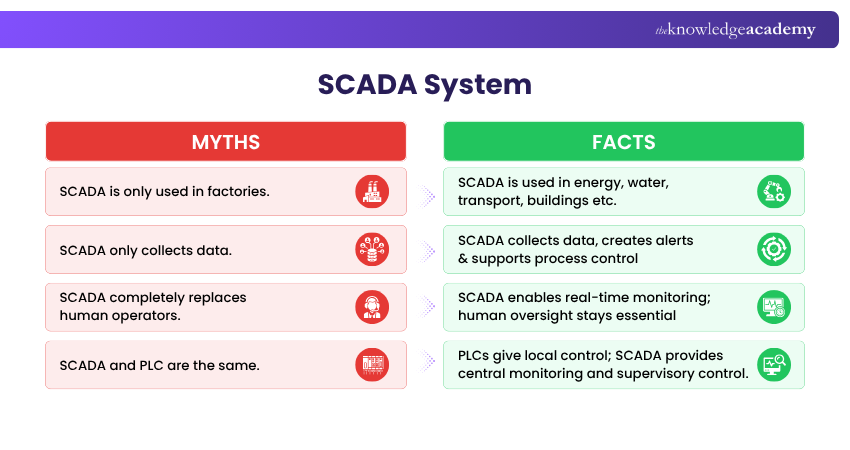
SCADA stands for Supervisory Control and Data Acquisition. It is a computer-based system used to collect operational data from distributed equipment and provide centralised monitoring and supervisory control. It is commonly used in environments where equipment may be located across different sites or large geographical areas.
A SCADA system collects information from sensors and controllers, transfers it through communication networks and presents it to operators through a Human-Machine Interface (HMI). Depending on the system design, it can generate alarms, support automated responses and allow operators to send supervisory commands to field equipment.

How Does a SCADA System Work?
A SCADA system connects field equipment with a central monitoring environment. Information generally moves from sensors and controllers towards the control centre, while supervisory commands can travel back to field equipment.
Here is how the process works:
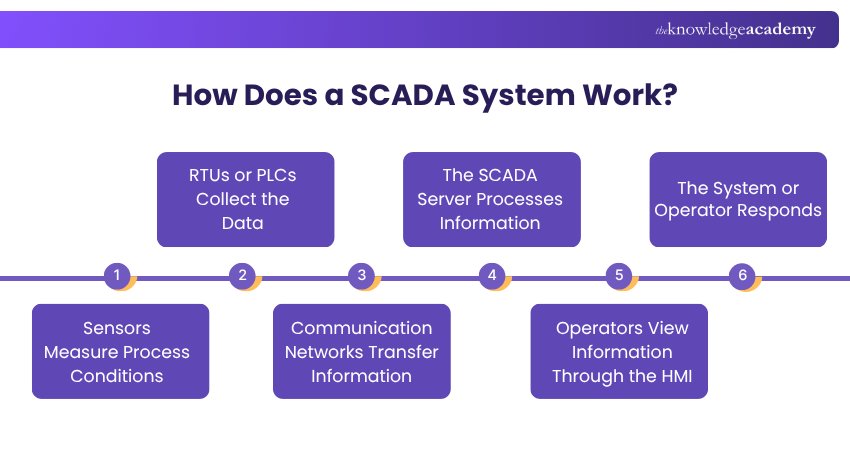
1) Sensors Measure Process Conditions
Sensors and instruments collect information about physical or operational conditions, such as:
a) Temperature
b) Pressure
c) Flow
d) Liquid level
e) Equipment status
d) Electrical measurements
This information represents what is happening within the physical process.
2) RTUs or PLCs Collect the Data
Remote Terminal Units (RTUs) and Programmable Logic Controllers (PLCs) receive information from field devices.
They can process inputs, perform local control functions and communicate relevant operational data to the SCADA system.
3) Communication Networks Transfer Information
The collected information is transmitted between field locations and the supervisory system through communication infrastructure.
Depending on the application, this may include:
a) Fibre-optic networks
b) Wired Ethernet
c) Radio communication
d) Cellular networks
e) Microwave links
f) Satellite communication
Communication is often bidirectional, allowing data to travel to the control centre and supervisory commands to travel back to field equipment.
4) The SCADA Server Processes Information
At the control centre, the SCADA server receives and processes information from RTUs, PLCs and other connected devices.
It can support functions such as:
a) Alarm management
b) Event detection
c) Data logging
d) Reporting
e) Trend analysis
5) Operators View Information Through the HMI
An HMI presents operational information in a graphical format.
Operators may use it to view equipment status, measurements, alarms, trends and process diagrams.
6) The System or Operator Responds
When operating conditions change, the SCADA environment may:
a) Generate an alarm
b) Adjust a configured setpoint
c) Start or stop equipment
d) Open or close a valve
e) Request operator intervention
The exact response depends on the process, local control logic and system configuration.
Key Components of a SCADA System
A SCADA system combines hardware, software and communication technologies. Each component performs a specific role in collecting, transferring, processing or displaying operational information.
1) Field Devices
Field devices interact directly with the physical process.
They include:
Sensors: Measure conditions such as temperature, pressure, flow, level and equipment status.
Actuators: Carry out physical actions through devices such as valves, motors, pumps, relays and switches.
2) Remote Terminal Units (RTUs)
RTUs collect information from field devices and communicate it to the supervisory system.
They are particularly useful in geographically dispersed environments where equipment is located far from the main control centre.
3) Programmable Logic Controllers (PLCs)
PLCs are industrial controllers that execute programmed control logic.
They can receive sensor inputs, control machinery or actuators and exchange operational information with the SCADA system.
4) Communication Infrastructure
Communication networks connect field controllers with the central SCADA environment.
Depending on the architecture, SCADA systems may use protocols such as:
a) Modbus TCP
b) DNP3
c) IEC 60870-5-104
d) OPC UA
e) EtherNet/IP
f) MQTT
The protocols used depend on the equipment, application and system design.
5) SCADA Server
The SCADA server acts as the supervisory layer of the system.
It collects information from field controllers, processes data, manages alarms and makes operational information available to HMIs and other authorised systems.
6) Human-Machine Interface (HMI)
The HMI provides operators with graphical displays representing the physical process.
It allows them to review equipment conditions, recognise alarms, analyse trends and perform permitted supervisory actions.
7) Data Historian
A historian stores historical operational data collected by the SCADA system.
This information can support:
a) Trend analysis
b) Troubleshooting
c) Performance assessment
d) Reporting
e) Operational reviews
Applications of SCADA
SCADA is particularly useful where equipment and processes need to be monitored across distributed locations. Here are some common applications:
1) Electric Power Systems
SCADA is widely used in electricity transmission and distribution networks.
Operators can use it to monitor electrical measurements, equipment status and substations while supporting supervisory control across different parts of the network.
This helps provide greater visibility into power system conditions and enables operators to identify abnormal situations more quickly.
2) Water and Wastewater Systems
Water utilities can use SCADA to monitor and supervise:
a) Pumps
b) Reservoirs
c) Tank levels
d) Flow rates
e) Valves
f) Treatment processes
g) Water quality measurements
Centralised monitoring is particularly valuable when pumping stations, reservoirs and treatment facilities are located across large areas.
3) Oil and Gas Pipelines
Oil and gas pipelines may extend across hundreds or thousands of kilometres.
SCADA systems can collect operational information from remote stations and equipment, allowing operators to monitor conditions such as pressure, flow and equipment status from central locations.
Learn practical, job-ready skills that help you stand out in today's competitive industries. Sign up for our Industry Training now!
4) Manufacturing and Process Industries
SCADA can also support industrial and manufacturing environments by providing supervisory monitoring across equipment and production processes.
It can help operators view process conditions, receive alarms, analyse operational data and supervise equipment controlled by PLCs or other industrial controllers.
Expert Tip: Don't Monitor Everything Equally
Prioritise parameters that directly affect safety, reliability and production. Too many low-value alarms can make critical events harder for operators to identify.
5) Transportation and Railway Systems
SCADA can be used within transportation infrastructure, particularly railway systems.
Applications may include monitoring:
a) Traction power
b) Electrical equipment
c) Signalling infrastructure
d) Stations
e) Remote facilities
Centralised supervision helps operators maintain visibility across geographically distributed transportation infrastructure.
EXTRA INSIGHT:
The global SCADA market size is projected to grow from £10.25 billion in 2026 to £19.6 billion by 2034.
Benefits of SCADA Systems
SCADA provides several operational advantages, let's discuss them in detail:
1) Centralised Monitoring
SCADA enables operators to view operational information from multiple field locations through a central supervisory environment.
This reduces the need to physically inspect every remote asset simply to understand its current condition.
2) Faster Detection of Abnormal Conditions
Alarms and event notifications can alert operators when monitored values move outside configured limits.
This can help teams identify potential problems earlier and take appropriate action.
3) Remote Supervision
SCADA allows authorised operators to supervise equipment located at remote or difficult-to-access sites.
This is particularly useful for utilities, pipelines and transportation infrastructure.
4) Historical Data Analysis
Stored operational data enables organisations to analyse past conditions, identify trends and investigate previous events.
Historical information can also support troubleshooting and performance reviews.
5) Better Data-driven Decision-making
Real-time and historical operational data can help operators assess system conditions, investigate events and make more informed operational decisions.
Challenges of SCADA Systems
SCADA systems also come with challenges, including cybersecurity risks, ageing infrastructure, communication failures, integration complexity and data quality issues.
1) Cybersecurity Risks
SCADA systems are part of Operational Technology (OT) environments and may control or supervise important physical processes.
Greater connectivity can increase cybersecurity exposure if networks, accounts and remote access are not appropriately protected.
2) Legacy Technology
Industrial equipment often remains operational for many years.
Older SCADA devices and systems may lack modern security capabilities or may be difficult to update without affecting operations.
3) Communication Reliability
SCADA depends on communication between field equipment and supervisory systems.
Network failures, interference or damaged communication infrastructure can affect the availability or timeliness of operational information.
4) Integration Complexity
SCADA environments may contain equipment from different manufacturers and generations.
Integrating controllers, communication protocols, servers and software can therefore require careful planning and specialist knowledge.
5) Data Quality and Maintenance
Operators rely on information collected from sensors and field devices.
Incorrect calibration, failed sensors or configuration problems can result in inaccurate information being presented to operators.
Regular testing and maintenance are therefore important for maintaining reliable operational data.
Gain the skills to improve project efficiency and reduce costs by registering for our Systems Engineering Training now!

Shristi Roy is a Content Writer with experience in journalism, article writing and web content development. Her experience researching and writing about Business Skills and Accounting and Finance enables her to communicate specialised information through clear, engaging narratives.
View Detail

 If you wish to make any changes to your course, please


