


 Top Rated Course

We may not have the course you’re looking for. If you enquire or give us a call on 01344203999 and speak to our training experts, we may still be able to help with your training requirements.
What are Content Pillars: Types and Why They are Important?
The Knowledge Academy 16 July 2026Curious about What are Content Pillars? They are core topics that structure your content strategy, ensuring consistency and engagement. By organising content around key themes, they boost SEO, improve audience engagement, and streamline marketing efforts. Mastering Content Pillars drives impactful and high-performing content.

Training Outcomes Within Your Budget!
We ensure quality, budget-alignment, and timely delivery by our expert instructors.
Table of Contents
Creating content without a clear strategy is like throwing darts in the dark—you might hit the target, but most of the time, you’ll miss. That’s where Content Pillars come into play. But What are Content Pillars? They act as the foundation of your content strategy, helping you stay organised, relevant, and engaging. Instead of scattered posts, Content Pillars allow you to structure your ideas around key themes, making your brand more visible and valuable.
So, What are Content Pillars, and why are they important? They’re the backbone of a successful content plan, ensuring consistency, better SEO, and a deeper connection with your audience. By using them, you can create impactful content that drives traffic, builds authority, and keeps your readers coming back for more.
Table of Contents
1) What are Content Pillars?
2) Why are Content Pillars Important?
3) Types of Content Pillars
4) How to Develop a Winning Content Pillar Strategy?
5) How AI Can Help You Develop Powerful Content Pillars?
6) Conclusion
What are Content Pillars?
Content Pillars are the core themes or topics that shape a brand’s content strategy. They act as the foundation for creating consistent, relevant, and engaging Evergreen Content across different platforms. Each pillar represents a broad subject that aligns with the brand’s goals, audience interests, and industry trends.

By understanding Content Pillars, brands can make sure that their messaging remains cohesive, valuable, and targeted. These pillars help inplanning content effectively, improving audience engagement, and boosting SEOby covering key areas of interest.
For example, if you're a fitness brand, your Content Pillars might be:
a) Workout Tips: How to exercise effectively
b) Nutrition Advice: Healthy eating habits and meal plans
c) Mental Well-being: The importance of mindset in fitness
Why are Content Pillars Important?
Without Content Pillars, your strategy can feel chaotic, and your audience might struggle to understand what you stand for. Let’s break down why they matter:
1) Establishing a Clear Content Direction
A strong content strategy requires structured planning. Content Pillars serve as a guiding framework, ensuring that every piece of content aligns with the brand’s overall messaging.
a) They provide strategic focus. Instead of publishing content randomly, Content Pillars help maintain a clear and purposeful narrative.
b) They help establish industry expertise. By concentrating on specific themes, a brand can position itself as an authority in its domain. For instance, a Digital Marketing agency may focus on:
i) SEO Strategies
iii) Email Marketing
2) Data-driven Content Performance Evaluation
A structured content strategy allows for better performance tracking and informed decision-making. Identifying high-performing content. Analysing engagement metrics across Content Pillars helps determine which topics resonate most with the audience.
Example: An eco-friendly e-commerce brand producing content on:
a) Sustainable living tips
b) Product reviews
c) DIY upcycling ideas
Boost your brand awareness with our Video Marketing Course - Join now!
3) Enhancing Brand Consistency and Recognition
A consistent content strategy strengthens brand identity. When a brand adheres to well-defined Content Pillars, it becomes more recognisable and trustworthy.
For example, Nike maintains a clear focus on:
a) Performance
b) Motivation
c) Innovation By maintaining thematic consistency, brands can establish a strong market presence and reinforce their messaging.
4) Content Diversification and Multi-format Adaptation
Content Pillars allow brands to present information across multiple formats while maintaining thematic consistency. A structured approach enables diverse content creation:
For a Project Management Content Pillar, a brand can:
a) Write a Blog Post: "Top 5 Project Management Tools."
b) Publish a LinkedIn Carousel: "Common Project Management Mistakes."
c) Create a Video: "The Difference Between Agile and Waterfall."
d) Host a Podcast: "How to Manage Remote Teams Effectively?"
By leveraging different formats, brands can engage with a broader audience while reinforcing key messaging.
Types of Content Pillars
Here the following are the types of Content Pillar:
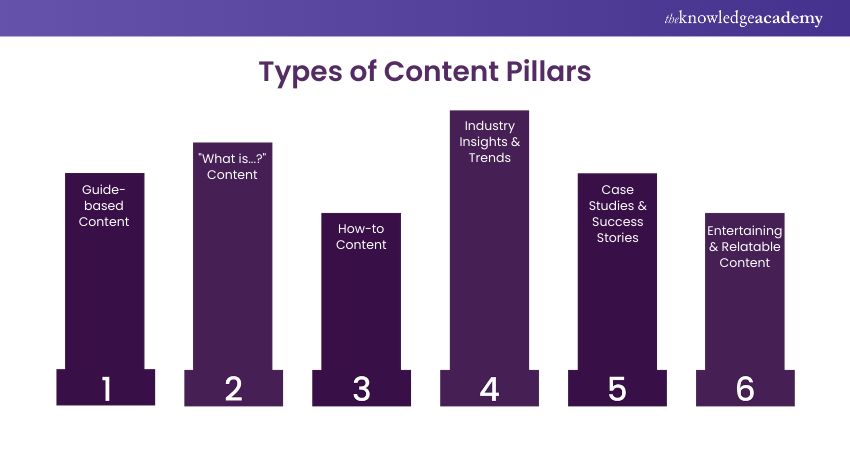
1) Guide-based Content
These are detailed, in-depth resources that educate your audience on a particular topic. They provide step-by-step guidance, expert insights, and practical knowledge.
Why It’s Important:
a) Establishes authority and credibility
b) Helps audiences understand a topic thoroughly
c) Provides evergreen content that remains relevant over time
Best Formats:
a) Comprehensive blog posts or eBooks
b) Step-by-step tutorials
c) Whitepapers or reports
Example:
A skincare brand could create a guide titled "The Ultimate Beginner’s Guide to Building a Skincare Routine." This will explain skin types, product recommendations, and step-by-step skincare routines.
2) "What is...?" Content
This type of content simplifies complex topics and breaks them down into easy-to-understand explanations. It’s perfect for educating your audience and positioning your brand as an expert.
Why It’s Important:
a) Makes complex topics more accessible
b) Increases brand credibility
c) Helps improve search rankings for "what is" queries
Best Formats:
a) Blog posts answering common industry questions
b) Short-form social media posts explaining a concept
c) Infographics breaking down definitions visually
Example:
A cybersecurity company might create a blog titled "What Is Phishing and How Can You Stay Safe?", explaining phishing scams, how they work, and ways to prevent them.
Learn to create content to the best with our Content Marketing Course - Register now!
3) How-to Content
How-to content provides step-by-step solutions to common problems, making it actionable and valuable for your audience.
Why It’s Important:
a) Offers practical and immediate value
b) Encourages audience engagement and sharing
c) Boosts SEO with "how-to" searches
Best Formats:
a) Blog posts with step-by-step instructions
b) Video tutorials demonstrating solutions
c) Checklists and quick guides
Example:
A Digital Marketing agency might publish a post titled "How to Optimise Your LinkedIn Profile for Networking," covering profile setup, keyword optimisation, and networking tips.
4) Industry Insights & Trends
This content keeps your audience updated on the latest developments in your field. It positions your brand as a thought leader and helps you stay relevant.
Why It’s Important:
a) Builds trust and authority in your industry
b) Keeps your audience informed and engaged
c) Encourages discussions and thought leadership
Best Formats:
a) Trend reports and data-backed articles
b) Industry expert interviews
c) Opinion pieces on future trends
Example:
A technology firm could publish a report titled "The Future of AI in Business Operations," discussing AI advancements and their impact on industries.
5) Case Studies & Success Stories
Case studies showcase real-world success stories, highlighting how your products or services have helped customers achieve results.
Why It’s Important:
a) Builds credibility through real-life examples
b) Provides social proof that influences decision-making
c) Strengthens customer trust and brand reputation
Best Formats:
a) Detailed blog posts sharing client success stories
b) Video testimonials featuring customer experiences
c) Before-and-after case studies with measurable results
Example:
A SaaS company could publish a case study titled "How Our CRM Helped a Startup Increase Sales by 300%," detailing how the CRM improved customer relationships and sales conversions.
6) Entertaining & Relatable Contents
Not all content has to be serious! Fun, engaging, and relatable content helps your brand connect with audiences on a more personal level.
Why It’s Important:
a) Increases engagement and shareability
b) Makes your brand feel more human and approachable
c) Keeps audiences entertained while still reinforcing your brand message
Best Formats:
a) Social media memes and relatable posts
b) Light-hearted videos and GIFs
c) Interactive polls and quizzes
Example:
A fitness brand could create a social media post titled "Gym Fails We Can All Relate To!" showing funny moments at the gym, making the brand more engaging and relatable.
How to Develop a Winning Content Pillar Strategy?
A well-defined Content Pillar strategy helps create structured, consistent, and audience-focused content. Follow these steps to build your own effective strategy:
1) Conduct In-depth Research
Before developing Content Pillars, understand your audience’s needs, interests, and pain points. Research helps identify relevant and engaging topics.
Key Research Methods
a) Audience Analysis: Identify demographics, preferences, and challenges.
b) SEO & Trend Analysis: Use tools like Google Trends, AnswerThePublic, and SEMrush to explore trending queries.
c) Competitor Research: Analyse successful competitors to identify gaps and opportunities.
d) Community Engagement: Monitor discussions on platforms like Reddit, Quora, and social media groups.
Example: If you run a travel blog, research might reveal that your audience searches for:
a) Budget travel hacks
b) Destination guides
c) Packing tips for different climates
Turn words in passive revenue with our Passive Income Course – Join today!
2) Define Your Core Content Pillars
Based on your research, establish 3-5 primary themes that align with your brand’s expertise and audience interests.
How to Choose Pillars
a) Ensure they are broad enough to generate multiple content ideas.
b) Align them with your brand’s mission and audience needs.
c) Focus on evergreen topics that provide long-term value.
Example: For a personal finance brand, Content Pillars might include:
a) Budgeting Tips: Strategies to save money efficiently.
b) Investing Basics: Simplifying stock market and investment concepts.
c) Debt Management: Techniques for becoming debt-free.
d) Financial Planning: Steps to secure long-term financial stability.
e) Side Hustles & Income Growth: Ways to diversify income streams.
3) Create Content Under Each Pillar
Once you define your pillars, produce diverse content types to cater to different platforms and audience preferences.
Content Formats
a) Blogs: In-depth guides, how-tos, and listicles.
b) Videos: Explainer videos, vlogs, and live Q&A sessions.
c) Infographics: Visual content to simplify complex topics.
d) Podcasts: Audio discussions, interviews, and industry insights.
e) Social Media Posts: Carousels, reels, and stories to engage your audience.
f) Email Newsletters: Deep dives into niche topics.
Example: If one of your pillars is Healthy Eating, you could create:
a) Blog Post: “5 Superfoods for a Stronger Immune System”
b) Instagram Reel: A quick recipe for a healthy breakfast.
c) YouTube Video: A step-by-step meal prep tutorial.
d) Email Newsletter: A detailed guide to balanced meal planning.
4) Distribute Content Strategically
Creating content is just half the battle—effective distribution ensures it reaches the right audience.
Platform-Specific Strategies
a) Website & Blog: Optimise for SEO and integrate CTAs.
b) Social Media: Tailor content for each platform (e.g., LinkedIn for thought leadership, Instagram for visuals, TikTok for short-form videos).
c) Email Marketing: Segment audiences and personalise messaging.
d) Community Platforms: Share insights on Reddit, Quora, and industry forums.
e) Paid Ads & Promotions: Boost high-performing content with targeted ads.
Example: For a B2B audience, focus on LinkedIn articles and industry reports. For a younger audience, prioritise Instagram Reels and TikTok videos.
5) Monitor Performance & Optimise
Regularly track your content’s performance to refine and enhance your strategy.
Key Metrics to Analyse
a) Engagement Metrics: Likes, shares, comments, and watch time.
b) SEO Performance: Keyword rankings, organic traffic, and backlinks.
c) Conversion Rates: Click-through rates, sign-ups, and sales.
d) Audience Feedback: Comments, reviews, and direct messages.
Optimisation Strategies
a) Repurpose high-performing content into different formats (e.g., turn a blog post into an infographic).
b) Identify underperforming content and improve headlines, visuals, or SEO .
c) Experiment with posting schedules and content types for better reach.
Example: If a blog post on “10 Productivity Hacks for Remote Workers” gains traction, you can:
a) Convert it into a LinkedIn post for professional engagement.
b) Create an Instagram carousel with key takeaways.
c) Develop a podcast episode discussing the topic in-depth.
How AI Can Help You Develop Powerful Content Pillars?
Struggling to brainstorm content ideas? You’re not alone! But what if AI could do the heavy lifting for you? Instead of spending hours researching, analysing, and structuring your content strategy, AI-powered tools can streamline the entire process—making it faster, smarter, and more strategic.
How AI Transforms Content Pillar Development
AI is more than just a tool—it’s your content strategy assistant, helping you create, optimise, and distribute high-quality content efficiently. Here’s how AI can revolutionise your Content Pillar strategy:
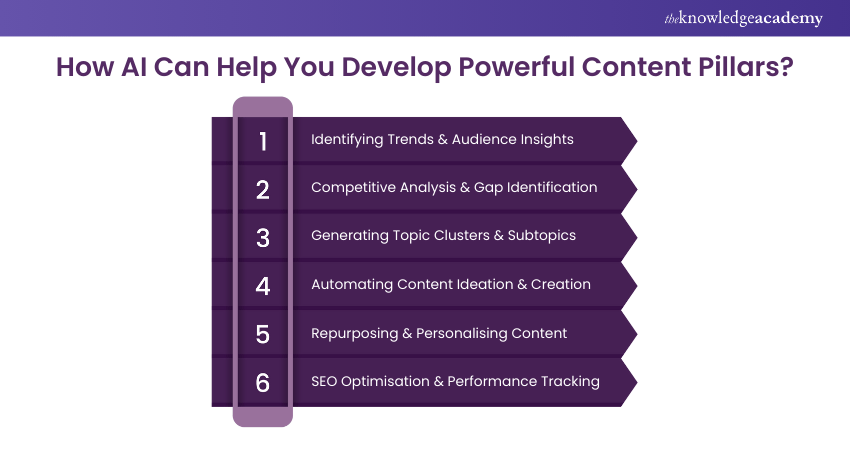
1) Identifying Trends & Audience Insights
AI tools can analyse vast amounts of data in seconds, helping you identify trending topics, audience preferences, and emerging discussions in your industry.
How It Helps:
a) AI tools like BuzzSumo, Google Trends, and ChatGPT track real-time trends and popular content.
b) Analyses social media, forums, and search queries to uncover audience interests.
c) Ensures your content stays relevant and engaging by focusing on what people are already searching for.
Example:
A Digital Marketing agency can use Google Trends to see which SEO strategies are trending and create content around “AI-Driven SEO Tactics for 2025.”
2) Competitive Analysis & Gap Identification
AI can scan and analyse your competitors’ content to identify content gaps and opportunities that your brand can leverage.
How It Helps:
a) AI-powered tools like SEMrush and Ahrefs analyse competitor keywords and content performance.
b) Uncovers high-performing topics and gaps in competitor strategies.
c) Suggests unique angles and content opportunities to make your brand stand out.
Example:
A SaaS company can use Ahrefs to discover that competitors aren’t covering the topic “How AI Can Improve Customer Support,” allowing them to fill the gap and dominate the niche.
Do the research of market strategically for better marketing with our Strategic Marketing Course – Sign up now!
3) Generating Topic Clusters & Subtopics
AI helps organise your content by automatically generating topic clusters based on search intent, making it easier to structure your Content Pillars.
How It Helps:
a) AI tools like Frase and Clearscope suggest related subtopics for pillar pages.
b) Helps structure content silos to improve SEO and User Experience (UX).
c) Builds a logical content framework that connects pillar content with supporting blogs.
Example:
A fitness brand planning a Content Pillar on “Strength Training” can use Frase to generate subtopics like:
a) Best Strength Training Exercises for Beginners
b) How to Track Progress in Strength Training
c) Strength Training vs Cardio: Which is Better?
4) Automating Content Ideation & Creation
AI-powered writing tools can speed up content production by generating ideas, outlines, and even full drafts while maintaining quality.
How It Helps:
a) AI tools like ChatGPT, Copy.ai, and Jasper create engaging blog outlines and content drafts.
b) Assists with headline generation, meta descriptions, and social media posts.
c) Ensures consistent brand voice and tone across multiple content formats.
Example:
A business coach can use Jasper to generate an outline for a leadership training eBook, saving hours of manual brainstorming.
5) Repurposing & Personalising Content
AI allows you to transform a single piece of content into multiple formats and tailor it to different platforms and audiences.
How It Helps:
a) AI tools like Lumen5 and Canva AI can convert blog content into videos and infographics.
b) Generates platform-specific variations (e.g., summarising a blog into LinkedIn posts or Twitter threads).
c) Uses AI-driven personalisation to adapt content for different audience segments.
Example:
A cybersecurity company writes a detailed blog on “Cybersecurity Tips for Remote Workers” and then:
a) Converts it into a LinkedIn carousel post.
b) Creates a short explainer video using Lumen5.
c) Summarise key takeaways in an email newsletter.
6) SEO Optimisation & Performance Tracking
AI-powered SEO tools ensure your content is optimised for search engines and track performance metrics to improve future strategies.
How It Helps:
a) AI tools like SurferSEO, Rank Math, and Clearscope provide keyword suggestions and readability improvements.
b) Helps structure SEO-friendly content with proper headings, meta tags, and internal linking.
c) Monitors engagement, rankings, and conversions for continuous content improvement.
Example:
An e-commerce store using SurferSEO can optimise its product descriptions for better rankings by incorporating AI-recommended LSI keywords and readability enhancements.
Conclusion
Content Pillars aren’t just a fancy marketing term—they're a game-changer for creating a structured, engaging, and sustainable content strategy. By defining clear content themes, diversifying your formats, and tracking performance, you’ll not only build brand authority but also connect with your audience in a meaningful way.
Boost engagement and drive sales with our Optimised Digital Store Training – Register today!
Frequently Asked Questions
How to Create Pillar Content?

To create pillar content, start by selecting a broad topic that is relevant to your audience. Conduct thorough research and structure the information into a comprehensive, long-form piece. Break it down into subtopics and support it with internal links, multimedia, and SEO-friendly elements to enhance visibility and engagement.
What are the Three Pillars of Content?
The three key pillars of content are:
a) Core Content: Provides valuable insights and foundational information
b) Cluster Content: Explores subtopics in greater detail
c) Promotional Content: Amplifies reach through various channels

The Knowledge Academy


Global Training Provider
The Knowledge Academy is a world-leading provider of professional training courses, offering globally recognised qualifications across a wide range of subjects. With expert trainers, up-to-date course material, and flexible learning options, we aim to empower professionals and organisations to achieve their goals through continuous learning.


 If you wish to make any changes to your course, please


