




We may not have the course you’re looking for. If you enquire or give us a call on 01344203999 and speak to our training experts, we may still be able to help with your training requirements.
Value Chain: Definition, How do Work, Benefits and Examples
Sienna Roberts 23 December 2025A Value Chain includes all activities that create value for a product or service, from production to delivery, enhancing efficiency and competitiveness. This process includes primary activities like marketing and logistics and is supported by secondary activities such as Human Resource Management and technology development.

BCS Practitioner Certificate in Modelling Business Processes Training
 Top Rated Course
Top Rated Course
Exclusive 40% OFF
Training Outcomes Within Your Budget!
We ensure quality, budget-alignment, and timely delivery by our expert instructors.
Table of Contents
A Value Chain is the engine that turns ideas into products customers love. It maps every activity that goes into creating and delivering a product, revealing where value is added and where improvements can spark real growth. Understanding how it works can help your business innovate smarter and stay ahead of competitors.
From logistics and operations to marketing and customer service, each step is the key to competitive advantage. In this blog, we explore what is a Value Chain, how they work, their key benefits and real examples. So read on and transform every process into profit!
Table of Contents
1) What is a Value Chain?
2) The Importance of Value Chains
3) How Do Value Chains Work?
4) Benefits of Value Chain
5) Example of a Value Chain
6) Conclusion
What is a Value Chain?
A Value Chain refers to the sequence of activities involved in turning an idea into a final product that reaches the customer. It highlights each stage where value is added, from sourcing materials and manufacturing to marketing and delivery.
With rising competition and pressure to offer better quality at lower costs, organisations must regularly consider how they create value to maintain a competitive edge. Analysing the Value Chain helps identify inefficiencies and develop strategies that streamline operations and boost overall profitability.

The Importance of Value Chains
A Value Chain helps organisations pinpoint the activities that truly generate profit once costs are considered. These points illustrate the importance of Value Chains:
1) Activity Integration
Each stage in the Value Chain influences the others. Improving one activity can strengthen another, giving the organisation a competitive advantage. For example, eco-friendly packaging used during outbound logistics can be highlighted by marketing to showcase responsible business practices.
2) Visibility Enhancement
A clearly defined Value Chain gives teams a complete view of how the business operates and where they can meaningfully add value.
3) Operating Model
Value Chains serve as a blueprint for major organisational changes. Whether it involves rebranding, restructuring or meeting sustainability goals, the Value Chain ensures that all affected activities are properly addressed and aligned.
4) Acquisition Evaluation
Comparing Value Chains is an effective way to assess whether a potential acquisition fits operationally and strategically with the existing business. It helps organisations make informed decisions about compatibility, value and long-term integration.
Bridge strategy and technology and master enterprise architecture. Sign up for our BCS Practitioner Certificate in Enterprise and Solution Architecture now!
How Do Value Chains Work?
A Value Chain groups business activities into primary and secondary functions. It helps organisations understand how these interconnected parts operate as a unified system. Let’s explore these activities in detail:
1) Primary Value Chain Activities
Primary activities directly contribute to creating, selling, delivering and supporting a product or service. These include:
1) Inbound Operations: Managing and organising resources that arrive from external suppliers, such as raw materials and components.
2) Operations: Transforming inputs into finished products or services that can be sold at a price higher than production costs, generating profit.
3) Outbound Logistics: Handling the storage, collection and delivery of finished products to customers through internal and external distribution systems.
4) Marketing and Sales: Activities like advertising, brand positioning and customer outreach designed to increase demand and communicate product value.
5) Service: Post-purchase support and customer care that enhance satisfaction and build long-term relationships.
2) Secondary Activities
Secondary activities underpin and enhance the primary functions. These include:
1) Procurement: Identifying and managing suppliers, negotiating contracts and securing resources required for production.
2) Human Resource Management: Recruiting, training and developing employees, shaping organisational culture and maintaining strong employee relations.
3) Technology Development: Research, IT Management, system maintenance and Cyber Security initiatives that strengthen the organisation’s technological capabilities.
4) Company Infrastructure: Core administrative functions such as legal services, finance, accounting, general management, public relations and quality assurance.
Benefits of Value Chain
Additional advantages of using a Value Chain include:
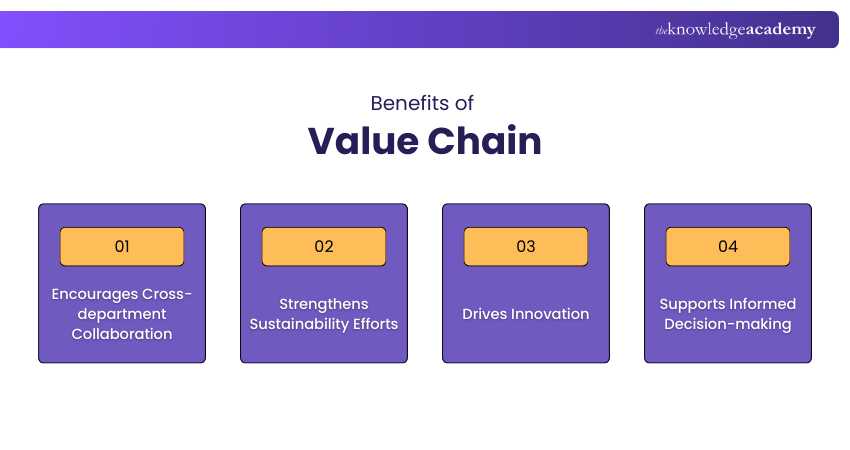
1) Encouraging Cross-department Collaboration: Since a product moves through multiple teams, the Value Chain helps these departments work together with a shared focus on boosting product value.
2) Strengthening Sustainability Efforts: Examining each stage of the chain helps companies identify environmental impacts, reduce waste, improve energy efficiency and promote ethical sourcing.
3) Driving Innovation: By spotlighting opportunities for improvement, such as adopting new technologies or automation, the Value Chain supports innovation that differentiates the business from its competitors.
4) Supporting Informed Decision-making: The insights gained from the Value Chain guide strategic decisions related to product development, resource allocation and future sales planning.
The key to global recognition in Business Analysis awaits! Sign up for our BCS International Diploma in Business Analysis now!
Example of a Value Chain
For an example of a Value Chain, let's consider e-commerce giant Amazon and its primary activities.
1) Inbound Logistics
Amazon’s key inputs include the products it stocks through its extensive fulfilment network and the data centre resources that power Amazon Web Services (AWS). Its scale allows it to negotiate lower per-unit costs with external suppliers, improving efficiency across the supply chain.
2) Operations
At this stage, Amazon converts inputs into outputs. Its online marketplace offers a user-friendly platform that simplifies buying and selling. Fast fulfilment capabilities, including two-day delivery for Prime members, enable Amazon to deliver a superior customer experience and stay competitive on price and convenience.
3) Outbound Logistics
Outbound logistics are at the heart of Amazon’s success, especially as e-commerce and direct-to-consumer models continue to expand. Key elements include:
1) E-commerce and D2C Delivery: Fulfilment centres enable quick delivery directly to consumers.
2) Advanced Fulfilment Centres: Automation and robotics streamline warehousing and reduce delivery times.
3) Fast Shipping: Two-day and same-day delivery options set a benchmark for online retail.
4) Digital Delivery Growth: Services like Prime Video, e-books and AWS show Amazon’s strong shift toward digital products.
5) Physical and Digital Integration: Whole Foods and Amazon Go stores combine in-store retail with online conveniences such as pickups and returns.
6) Cosourcing and Outsourcing: Amazon collaborates with third-party logistics providers to manage peak demand and extend its delivery reach.
7) Customer-focused returns: Simplified return options at partner locations boost convenience and customer loyalty.
4) Marketing and Sales
According to Amazon’s 2024 Annual Report, marketing and sales costs were $1.7 billion for the year ending December 31, 2024. This showcases its role as one of the world’s most recognisable brand.
5) Service
Amazon offers extensive customer service and return support, including in-store and partner-location options. These services help maintain customer loyalty and support long-term relationships.
Conclusion
More than a business model, a well-designed Value Chain is the gateway to stronger performance and lasting competitive advantage. By understanding how each activity brings value, organisations can innovate, reduce waste and create exceptional customer experiences. With the right approach, every link in the chain becomes an opportunity for assured long-term success.
Your roadmap to smarter strategies starts with Business Analysis mastery. Sign up for our range of Business Analysis Courses now!
Frequently Asked Questions
What is the Main Purpose of the Value Chain?

The core purpose of the Value Chain is to help organisations understand how value is created at each stage of their operations. It highlights where efficiencies can be improved, costs can be reduced and competitive advantages strengthened. This ultimately results in better products and higher profitability.
What are the Factors Affecting the Value Chain?
Several factors influence a Value Chain, including:
1) Technology
2) Supplier relationships
3) Workforce skills
4) Market demand
5) Competition
6) Logistics efficiency
7) Economic conditions
8) Regulatory requirements
What are the Other Resources and Offers Provided by The Knowledge Academy?
The Knowledge Academy takes global learning to new heights, offering over 3,000+ online courses across 490+ locations in 190+ countries. This expansive reach ensures accessibility and convenience for learners worldwide.
Alongside our diverse Online Course Catalogue, encompassing 19 major categories, we go the extra mile by providing a plethora of free educational Online Resources like Blogs, eBooks, Interview Questions and Videos. Tailoring learning experiences further, professionals can unlock greater value through a wide range of special discounts, seasonal deals, and Exclusive Offers.
What is The Knowledge Pass, and How Does it Work?
The Knowledge Academy’s Knowledge Pass, a prepaid voucher, adds another layer of flexibility, allowing course bookings over a 12-month period. Join us on a journey where education knows no bounds.
What are the Related Courses and Blogs Provided by The Knowledge Academy?
The Knowledge Academy offers various Business Analysis Courses, including the BCS Practitioner Certificate in Modelling Business Processes, BCS Foundation Certificate in Digital Business Change and the BCS Foundation Certificate in Business Analysis. These courses cater to different skill levels, providing comprehensive insights into Statistical Modeling.
Our Business Analysis Blogs cover a range of topics related to Value Chain, offering valuable resources, best practices, and industry insights. Whether you are a beginner or looking to advance your Business Analysis skills, The Knowledge Academy's diverse courses and informative blogs have got you covered.
Upcoming Business Analysis Resources Batches & Dates
Date
 BCS Practitioner Certificate in Modelling Business Processes Training

 If you wish to make any changes to your course, please


