


 Top Rated Course

We may not have the course you’re looking for. If you enquire or give us a call on 01344203999 and speak to our training experts, we may still be able to help with your training requirements.
What is Service Level Management (SLM)? Explained in Detail
Sienna Roberts 06 February 2026Service Level Management ensures services meet agreed performance standards by defining, monitoring, and managing Service Level Agreements. It is the key to delivering consistent, high-quality services that meet business goals and customer expectations. This typical ongoing process builds trust and stays aligned with customer needs.

Training Outcomes Within Your Budget!
We ensure quality, budget-alignment, and timely delivery by our expert instructors.
Table of Contents
Related Courses
Imagine you are buying an electronic product. But before opening the box, have you ever felt like this item should be in good condition without any damage or faults? Everyone would have been there, feeling the excitement and anxiety in parallel.
To deliver any product or service in any business, especially IT services, it is important to make sure those services are working properly and meeting expectations. That is where Service Level Management comes into action. Let’s get into this blog to know what it is, its principles, and its significance!
Table of Contents
1) What is Service Level Management?
2) Importance of Implementing SLM
3) Core Principles and Concepts of SLM
4) Service Level Management Process
5) Steps to Implement SLM
6) Risks and Challenges in Service Level Management
7) Conclusion
What is Service Level Management?
Service Level Management (SLM) is a way for companies to make sure their IT services (like websites, apps, or support systems) work well and meet customer expectations. It involves setting clear goals for how services should be performed, writing those goals down in agreements, and regularly checking if those goals are being met.
It creates agreements like Service Level Agreements (SLAs) that explain what the customer should get and then make sure those standards are met. Moreover, SLM helps in the following cases:
1) Define what the service includes
2) Set goals like speed, reliability, and support time
3) Track how the service performs
4) Solve problems when things go wrong
SLM isn’t just about fixing issues; it is about preventing them by setting clear rules and checking performance regularly. This builds trust between teams and with customers.
Importance of Implementing SLM
SLM can make a big difference in how well a business runs and how happy its customers are. Here are some important reasons to implement SLM for your business:
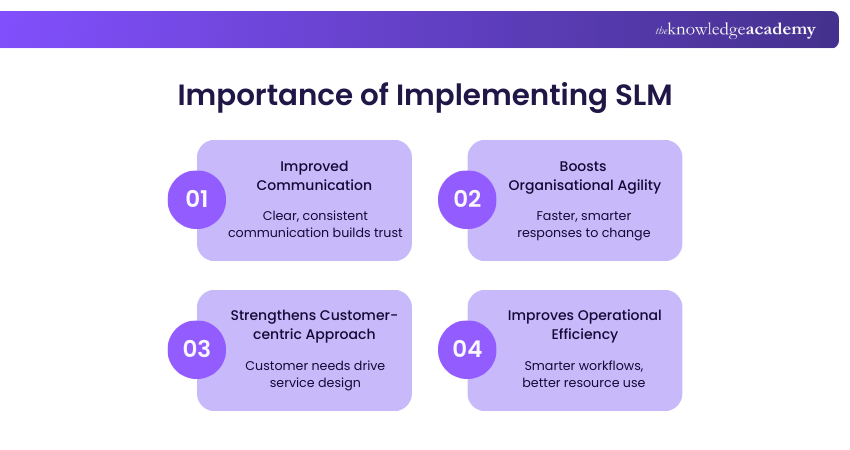
1) Improved Communication
SLM encourages regular, clear communication between service teams and customers. Everyone understands what the service includes and what results to expect. It makes it very clear that customers know what they are getting, and service teams know what they need to deliver. It also includes:
1) Fewer misunderstandings
2) Easy handling of issues
3) Clear roles and responsibilities
2) Boosts Organisational Agility
When service goals are clear and measured, teams are capable of moving faster and responding better to changes like new technology or business needs. It improves your nature of organisational agility. In fast-moving industries, this can be a big advantage. Eventually, this also helps your business to:
1) Make quicker decisions
2) React to problems faster
3) Stay flexible and adaptable
3) Strengthens Customer-centric Approach
SLM is all about making sure the customer is happy. It focuses on placing the customer at the centre of service planning. It helps companies listen to what customers want and ensures that services are designed to meet their real needs instead of just technical specs. Happy customers stick around and help generate more business. As a result, you can see:
1) Customers feel heard and valued
2) Service quality matches business goals
3) Problems get solved faster
Learn best practices in IT Service Management effectively by registering for our ITIL® 4 Foundation Certification immediately!
4) Improves Operational Efficiency
When there is a clear set of rules and goals, it is easier to spot what is working and what is not. SLM helps identify gaps and make improvements. This saves time, reduces costs, and helps teams work better. Efficient services with service level Manager, in turn, save money and keep everyone more productive. These can lead to:
1) Better use of time and resources
2) Less downtime or confusion
3) Smoother workflows
Core Principles and Concepts of SLM
To manage service levels effectively, there are certain core principles and concepts followed in Service Level Management. These include Service Level Requirements (SLRs), Service Level Agreements (SLAs), and SLA Frameworks. Each plays a key role in making sure services meet expectations.
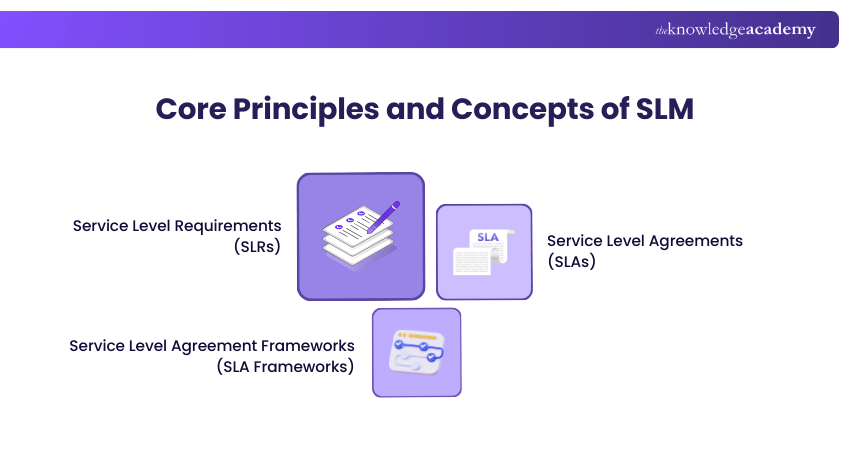
1) Service Level Requirements (SLRs)
Before making any formal agreement, the company must first understand what the customer really needs. These needs are written down as Service Level Requirements (SLRs). They describe what the service should do to make the customer happy. SLRs act as the foundation for building strong and realistic SLAs. They make sure that you are promising something you can deliver or not what you can’t.
Here are some examples of what SLRs might include:
1) Availability: Defines how often the service should work without problems. For example, “the service must work 99.9% of the time each month.”
2) Response and Resolution Times: Says how quickly problems should be fixed. For example, “critical issues must be resolved within 4 hours.”
3) Working Hours: Details of when help or support will be available. For example, “support is available Monday to Friday, 9 am to 6 pm.”
4) Performance: Refers to how fast or reliable the service should be. For example, “the website should load in 3 seconds or less.”
2) Service Level Agreements (SLAs)
A Service Level Agreement (SLA) is a form of written document that clearly says what the service will include, what targets should be met, and how performance will be tracked. It even says how often the service will be available and what happens if it doesn’t meet those goals. It is basically a promise between the service provider and the customer that outlines what the service should look like. Both sides need to agree on it.
SLAs usually include:
1) Service Description: A detailed explanation of what the service includes (e.g. email hosting, IT support, cloud storage).
2) Performance Targets: Such as fast response times, high uptime, or how soon problems will be fixed.
3) Monitoring and Reporting: Both the provider and the customer know if things are working as expected. The performance will be tracked and reported.
4) Consequences for Breach: Such as service credits or fixes if the company doesn’t meet its targets.
3) Service Level Agreement Frameworks (SLA Frameworks)
The Service Level Agreement Framework (SLA Framework) is the way a company organises and manages its SLAs. This is especially important for businesses that deal with many customers or services at once. There are three main types of SLA such as customer-based SLA, service-based SLA and multilevel SLA.
Those three levels can be defined as:
1) Customer-based SLA: This agreement covers all services provided to one customer. It allows flexibility and personalisation for different users or clients.
2) Service-based SLA: This agreement covers one service provided to many customers. It focuses on the quality and reliability of individual services.
3) Multilevel SLA: This type breaks down service agreements into different levels, each tailored to specific needs.
Upgrade how to integrate the practice into the organisational value stream by joining our ITIL® 4 Practitioner: Monitoring And Event Management Training now!
Service Level Management Process
The SLM process isn’t just a one-time thing where you create a document and forget about it. It is an ongoing cycle that ensures services continue to meet expectations. It begins by gathering customer needs to understand their requirements.
Next, an SLA is created to define what will be delivered and how it will be checked. Both sides agree and approve it. After that, you track how the service is doing, review the results often, and share updates. If something isn’t working, you make changes. This ongoing cycle helps keep everyone on the same page and the services aligned, efficient, and customer-focused.
Steps to Implement SLM
Implementing SLM in place is not at all a complicated process. Here are four simple steps to get started:
1) Collect data
Start by learning how services are currently performing. For that, you can talk to customers, look at reports, and gather data. This helps you check what is working and what needs to be improved.
2) Building the Project Plan
After that, you can create a plan that explains what you want to achieve, how long it will take, and who will do what. You also need to make sure everyone involved understands their role. Having a clear plan helps avoid any confusion or delays.
3) Execute the Project Plan
Now, it is time to start implementing or putting it into action. Begin with one or two services and build from there. For that, you need to write realistic SLAs, set up tracking tools, train the employees involved, and create regular reports.
4) Start the Ongoing SLM Work
SLM is not something you do once and forget. You need to keep checking how services are doing, talk to customers, and update SLAs when things change. The goal is to keep getting better over time. This ongoing work is what keeps SLM valuable long-term.
Enhance your skills in Security Management with our ITIL® 4 Practitioner Information Security Management Training – Sign up now!
Risks and Challenges in Service Level Management
While SLM is useful, it is not always easy. It can be tricky if it is not done properly. Here are some common problems to look out for:
1) Too Vague or Unrealistic: If expectations are unclear or the targets are too hard to meet, SLAs fail to be helpful.
2) Not Enough Tools: Without tools to measure service levels or performance, you won’t be able to tell if goals are being met.
3) Resistance to Change: Some team members may resist new processes. They might also feel that SLM adds more work, especially if they don’t see the benefits.
4) Poor Communication: If updates aren’t shared or customers aren’t involved, trust can break down.
You can avoid all these by making SLAs clear and measurable, using the right tools to track results, and having regular talks with customers and team members.
Conclusion
Service Level Management is a powerful way to make sure services meet expectations. It helps set clear goals, keep services on track, and improve how teams work with customers. With SLM, businesses can fix problems before they grow, improve quality, and build stronger relationships. In today’s fast-paced world, reliable service is not just expected; it is essential. SLM helps you deliver just that.
Inbuilt the skills to optimise incident response and minimise disruptions with our ITIL® 4 Practitioner: Incident Management Training – Join today!
Frequently Asked Questions
What is Meant by SLA Management?

SLA Management means creating, monitoring, and updating Service Level Agreements. It is all about making sure services meet agreed goals and taking action when they are not.
What is the Difference Between SLA and SLM?
An SLA is the actual agreement that says what the service should do. On the other hand, SLM is the bigger process that includes creating SLAs, checking performance, and improving services over time.
What are the Other Resources and Offers Provided by The Knowledge Academy?
The Knowledge Academy takes global learning to new heights, offering over 3,000 online courses across 490+ locations in 190+ countries. This expansive reach ensures accessibility and convenience for learners worldwide.
Alongside our diverse Online Course Catalogue, encompassing 19 major categories, we go the extra mile by providing a plethora of free educational Online Resources like Blogs, eBooks, Interview Questions and Videos. Tailoring learning experiences further, professionals can unlock greater value through a wide range of special discounts, seasonal deals, and Exclusive Offers.
What is The Knowledge Pass, and How Does it Work?
The Knowledge Academy’s Knowledge Pass, a prepaid voucher, adds another layer of flexibility, allowing course bookings over a 12-month period. Join us on a journey where education knows no bounds.
What are the Related Courses and Blogs Provided by The Knowledge Academy?
The Knowledge Academy offers various ITIL® Certification Training, including ITIL® 4 Practitioner Service Level Management Training, ITIL® 4 Foundation Certification and ITIL® 4 Practitioner: Monitoring and Event Management Training. These courses cater to different skill levels, providing comprehensive insights into Software Testing.
Our IT Service Management Blogs cover a range of topics related to Service Level Management, offering valuable resources, best practices, and industry insights. Whether you are a beginner or looking to advance your Service Management skills, The Knowledge Academy's diverse courses and informative blogs have got you covered.
Upcoming IT Service Management Resources Batches & Dates
Date
 ITIL® 5 Foundation Certification
ITIL® 5 Foundation Certification
Wed 18th Mar 2026
ITIL® 5 Foundation Certification
Mon 23rd Mar 2026
ITIL® 5 Foundation Certification
Wed 25th Mar 2026
ITIL® 5 Foundation Certification
Mon 30th Mar 2026
ITIL® 5 Foundation Certification
Wed 1st Apr 2026
ITIL® 5 Foundation Certification
Tue 7th Apr 2026
ITIL® 5 Foundation Certification
Wed 8th Apr 2026
ITIL® 5 Foundation Certification
Mon 13th Apr 2026
ITIL® 5 Foundation Certification
Wed 15th Apr 2026
ITIL® 5 Foundation Certification
Mon 20th Apr 2026
ITIL® 5 Foundation Certification
Wed 22nd Apr 2026
ITIL® 5 Foundation Certification
Mon 27th Apr 2026
ITIL® 5 Foundation Certification
Wed 29th Apr 2026
ITIL® 5 Foundation Certification
Tue 5th May 2026
ITIL® 5 Foundation Certification
Thu 7th May 2026
ITIL® 5 Foundation Certification
Mon 11th May 2026
ITIL® 5 Foundation Certification
Wed 13th May 2026
ITIL® 5 Foundation Certification
Mon 18th May 2026
ITIL® 5 Foundation Certification
Wed 20th May 2026
ITIL® 5 Foundation Certification
Tue 26th May 2026
ITIL® 5 Foundation Certification
Mon 1st Jun 2026
ITIL® 5 Foundation Certification
Wed 3rd Jun 2026
ITIL® 5 Foundation Certification
Mon 8th Jun 2026
ITIL® 5 Foundation Certification
Wed 10th Jun 2026
ITIL® 5 Foundation Certification
Mon 15th Jun 2026
ITIL® 5 Foundation Certification
Wed 17th Jun 2026
ITIL® 5 Foundation Certification
Mon 22nd Jun 2026
ITIL® 5 Foundation Certification
Wed 24th Jun 2026
ITIL® 5 Foundation Certification
Mon 29th Jun 2026
ITIL® 5 Foundation Certification
Wed 1st Jul 2026
ITIL® 5 Foundation Certification
Mon 6th Jul 2026
ITIL® 5 Foundation Certification
Wed 8th Jul 2026
ITIL® 5 Foundation Certification
Mon 13th Jul 2026
ITIL® 5 Foundation Certification
Wed 15th Jul 2026
ITIL® 5 Foundation Certification
Mon 20th Jul 2026
ITIL® 5 Foundation Certification
Wed 22nd Jul 2026
ITIL® 5 Foundation Certification
Mon 27th Jul 2026
ITIL® 5 Foundation Certification
Wed 29th Jul 2026
ITIL® 5 Foundation Certification
Mon 3rd Aug 2026
ITIL® 5 Foundation Certification
Wed 5th Aug 2026
ITIL® 5 Foundation Certification
Mon 10th Aug 2026
ITIL® 5 Foundation Certification
Wed 12th Aug 2026
ITIL® 5 Foundation Certification
Mon 17th Aug 2026
ITIL® 5 Foundation Certification
Wed 19th Aug 2026
ITIL® 5 Foundation Certification
Mon 24th Aug 2026
ITIL® 5 Foundation Certification
Wed 26th Aug 2026
ITIL® 5 Foundation Certification
Tue 1st Sep 2026
ITIL® 5 Foundation Certification
Mon 7th Sep 2026
ITIL® 5 Foundation Certification
Wed 9th Sep 2026
ITIL® 5 Foundation Certification
Mon 14th Sep 2026
ITIL® 5 Foundation Certification
Wed 16th Sep 2026
ITIL® 5 Foundation Certification
Mon 21st Sep 2026
ITIL® 5 Foundation Certification
Wed 23rd Sep 2026
ITIL® 5 Foundation Certification
Mon 28th Sep 2026
ITIL® 5 Foundation Certification
Wed 30th Sep 2026
ITIL® 5 Foundation Certification
Mon 5th Oct 2026
ITIL® 5 Foundation Certification
Wed 7th Oct 2026
ITIL® 5 Foundation Certification
Mon 12th Oct 2026
ITIL® 5 Foundation Certification
Wed 14th Oct 2026
ITIL® 5 Foundation Certification
Mon 19th Oct 2026
ITIL® 5 Foundation Certification
Wed 21st Oct 2026
ITIL® 5 Foundation Certification
Mon 26th Oct 2026
ITIL® 5 Foundation Certification
Wed 28th Oct 2026
ITIL® 5 Foundation Certification
Mon 2nd Nov 2026
ITIL® 5 Foundation Certification
Wed 4th Nov 2026
ITIL® 5 Foundation Certification
Mon 9th Nov 2026
ITIL® 5 Foundation Certification
Wed 11th Nov 2026
ITIL® 5 Foundation Certification
Mon 16th Nov 2026
ITIL® 5 Foundation Certification
Wed 18th Nov 2026
ITIL® 5 Foundation Certification
Mon 23rd Nov 2026
ITIL® 5 Foundation Certification
Wed 25th Nov 2026
ITIL® 5 Foundation Certification
Mon 30th Nov 2026
ITIL® 5 Foundation Certification
Wed 2nd Dec 2026
ITIL® 5 Foundation Certification
Mon 7th Dec 2026
ITIL® 5 Foundation Certification
Wed 9th Dec 2026
ITIL® 5 Foundation Certification
Sun 13th Dec 2026
ITIL® 5 Foundation Certification
Mon 14th Dec 2026
ITIL® 5 Foundation Certification
Mon 21st Dec 2026
ITIL® 5 Foundation Certification
Wed 23rd Dec 2026
ITIL® 5 Foundation Certification
Tue 29th Dec 2026

 If you wish to make any changes to your course, please


