




We may not have the course you’re looking for. If you enquire or give us a call on 01344203999 and speak to our training experts, we may still be able to help with your training requirements.
Difference Between Goods and Services: A Detailed Breakdown
ByNaveena VenkatesanLast updated on: 02 October 2026
This blog explores the difference between goods and services, covering key aspects like transferability, ownership, customer engagement, return policy and time efficiency, along with their similarities and how businesses often combine both.
Keep This in Mind
1. Goods are tangible products, while services involve intangible activities or experiences.2. Purchasing goods generally transfers ownership, whereas services provide access to expertise, effort or an experience.3. Goods can usually be produced and stored in advance, while services are generally delivered when required.4. Quality is often assessed differently for goods and services due to their distinct characteristics.5. Many businesses combine goods and services to create a complete customer offering.
Goods and services form the foundation of every economy, shaping our daily experiences as consumers and providers. While goods are concrete products that can be physically owned, services involve intangible actions or performances. Knowing the difference between goods and services is crucial for companies and consumers.
Most purchases actually sit somewhere on a spectrum between the two rather than falling neatly into one category. A car is a good, but the finance plan, warranty and servicing that come with it are services layered on top, and understanding where each element sits can shape how a business prices, markets and supports what it sells.
What are Goods?
Goods are products that can be seen, touched, and transferred from one person to another. They range from everyday items like food and clothing to durable goods like cars and furniture. Goods often come with physical ownership and are typically produced in factories or workshops before being distributed to consumers.
Benefits of Goods
The benefits of goods include:
a) Durability: Goods like furniture and electronics provide long-term value
b) Ownership: Physical possession gives buyers control over usage
c) Standardisation: Mass production ensures consistent quality
d) Resale Value: Goods can often be resold, providing additional financial benefits

What are Services?
Services are intangible actions or experiences offered by one party to another. Examples include medical consultations, haircuts, and financial advice. Unlike goods, services cannot be physically possessed but are consumed at the time of delivery. They rely heavily on customer interaction and the expertise or effort of the service provider.
Benefits of Services
The benefits of services include:
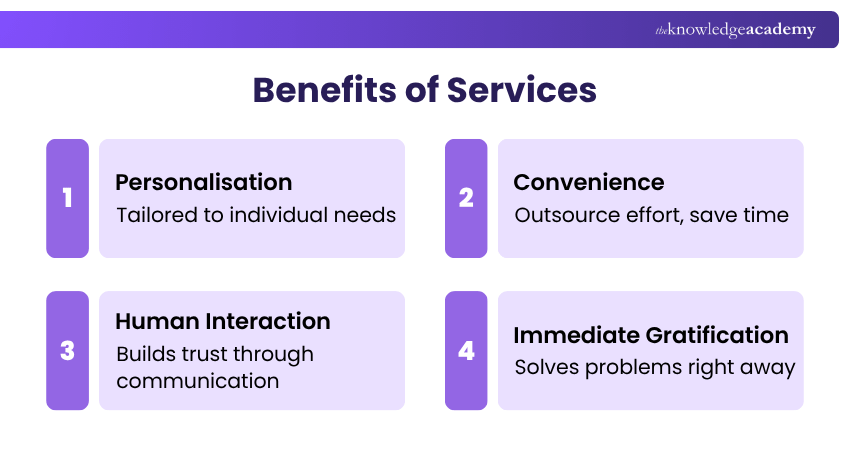
a) Personalisation: Services can be tailored to individual needs. Unlike standardised products, many services can be adjusted according to the customer's situation.
b) Convenience: Services save customers time and effort by allowing them to access specialised skills, knowledge, or assistance without having to perform the task themselves.
c) Human Interaction: Many services involve direct communication and interaction between the service provider and the customer. This interaction can help build trust, understand customer needs, and create a more personalised experience.
d) Immediate Gratification: They often address immediate needs or problems. Customers can access a service when they need assistance rather than having to acquire the skills or resources required to solve the problem themselves
Key Differences Between Goods and Services
Here are the key differences between goods and services:
1) Transferability and Ownership
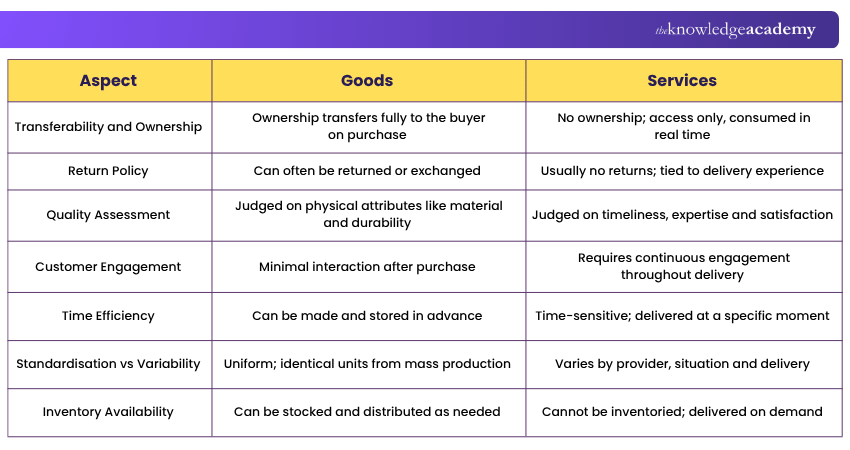
Goods can be transferred from the merchant to the buyer, and ownership passes fully to the customer once purchased, giving them control over usage, resale and disposal. Services, by contrast, cannot be moved or owned; they are consumed in real time and exist only during the performance, providing access to expertise or an experience rather than a transferable asset.
2) Return Policy
Goods can often be returned or exchanged if they don't meet customer expectations. In contrast, services usually do not offer returns, as their value is tied to the experience or outcome at the delivery time.
3) Quality Assessment
The quality of goods is typically assessed based on physical attributes such as material, durability, or design. For services, quality depends on factors like timeliness, expertise, and customer satisfaction, making it more subjective.
Lay the foundation for a successful finance career with the CIMA Certificate in Business Accounting Training — join now!
4) Customer Engagement
Goods require minimal interaction between the buyer and seller once the purchase is complete. Services, however, demand continuous customer engagement and communication to ensure the desired outcome.
Pro Tip
For services, map the key customer touchpoints from booking or enquiry through delivery and follow-up. Each interaction can influence the customer's overall perception of quality.
5) Time Efficiency
Goods can be made in advance and stored for future use, providing flexibility in distribution. Services, by nature, are time-sensitive and must be delivered at a specific moment to retain their value.
6) Standardisation vs Variability
Goods produced through the same process tend to be uniform, two units of the same product are typically identical. Services are far more variable, since the same service can differ depending on the provider, the customer's specific situation, or even the day it's delivered, making consistency a genuine challenge for service-based businesses.
7) Inventory Availability
Goods can be stocked in warehouses and supplied based on demand, whereas services cannot be stored as inventory. They must be prepared and delivered as needed, which makes scaling a service business more complex than scaling the production of a physical product.
Is It a Good or a Service? Quick Checklist
Ask these questions when classifying an offering:
☐ Can the customer physically possess it?☐ Does ownership transfer to the customer?☐ Can it be stored as inventory?☐ Can it be produced before the customer needs it?☐ Can it normally be resold or transferred?☐ Is value mainly created through expertise or performance?☐ Does delivery depend heavily on customer interaction?☐ Is the offering consumed as it is delivered?☐ Does available time or staff capacity limit supply?☐ Does the offering combine both a physical product and a service?
Strengthen your ethical decision-making and legal expertise with our CGMA® Fundamentals of Ethics, Corporate Governance, and Business Law (BA4) Course - join now!
Similarities Between Goods and Services
Despite their differences, goods and services share some commonalities. Both aim to fulfil customer needs and provide value, often combining to enhance user experience.
a) Shared Purpose: Both exist to solve a customer problem or need, whether that's a physical product filling a practical gap or a service addressing a specific requirement.
b) Brand Recognition: Both can be marketed and branded, with businesses building trust around goods and services alike through consistent quality and messaging.
c) Market Competition: Both are subject to competition and pricing pressure, as customers compare goods against other goods and services against other providers based on perceived value.
d) Quality Guarantees: Both can involve quality standards and guarantees, whether through warranties for goods or satisfaction guarantees for services, with the same underlying goal of customer confidence.
e) Feedback Driven: Both often depend on customer feedback to improve, with reviews and repeat business shaping how goods are refined and how services are delivered over time.
f) Frequent Combination: Both frequently combine in a single offering, such as a car (a good) sold with a warranty and maintenance (services), showing how the two complement each other rather than existing in isolation.
Pro Tip
Analyse the complete customer offering rather than separating the product and service too quickly. Installation, support, warranties or after-sales assistance can significantly shape the value of a physical product.
Advance your CIMA journey with our CGMA® Fundamentals of Financial Accounting (BA3) Course — Join now!

Naveena Venkatesan is a Content Editor with 2+ years of experience in content writing, editing and linguistic quality assurance. Her research, fact-checking and editorial experience enable her to develop accurate, accessible resources across Business Skills, Human Resources, and Accounting and Finance.
View Detail

 If you wish to make any changes to your course, please


