




We may not have the course you’re looking for. If you enquire or give us a call on 01344203999 and speak to our training experts, we may still be able to help with your training requirements.
Psychological Concepts: A Complete Guide
ByVishnu SankarLast updated on: 18 September 2026
This blog explores the six main psychological concepts, biological, psychodynamic, behavioural, cognitive, humanistic and sociocultural, along with their definitions and the strengths and limitations of each.
What’s Inside This Blog
1. Human behaviour can be understood through several major psychological perspectives, each offering a different lens.2. The six perspectives covered are biological, psychodynamic, behavioural, cognitive, humanistic and sociocultural.3. Each perspective explains thoughts, emotions and actions in a different way, from brain activity to cultural influence.4. Every perspective has its own strengths and limitations, and none fully explains behaviour on its own.5. Comparing perspectives together often gives a more complete picture than relying on just one.
Ever wonder what makes us love, hate or lie in our beds overthinking at 2 AM? What exactly are the mechanics behind the relentless flow of emotions that makes us tick as people? Psychology holds all the answers. This field takes us on a journey to the world within, decoding the mysteries behind human thoughts and behaviours.
This blog breaks down six of the most influential perspectives in psychology, each offering a different way to explain why people think, feel and act the way they do. Understanding them side by side makes it easier to see human behaviour from more than one angle.
Six Concepts of Psychology
Psychology is the scientific study of the mind and behaviour, but there is no right way to explain why people think, feel, and act the way they do. Different perspectives or approaches in psychology offer different ways to understand human behaviour and mental processes.
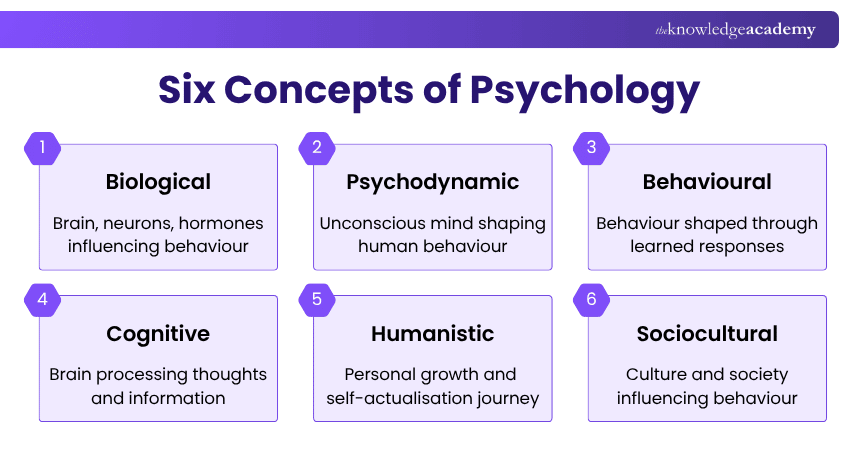
The six significant concepts in psychology are biological, psychodynamic, behavioural, cognitive, humanistic and sociocultural. Each perspective has its own assumptions, methods and applications, but they also complement and contrast each other in various ways. Let's explore these concepts in detail:
1) Biological Concept
The biological concept in psychology is a perspective that focuses on the physical basis of behaviour and mental processes. Researchers studying this perspective use scientific methods, such as experiments, brain scans and genetic analysis, to investigate how brain activity, the nervous system, hormones and genes can explain psychological phenomena.
This approach explores how these biological factors influence human thoughts, feelings and actions. The biological concept also considers how evolution and natural selection have shaped human behaviour and traits over time.
Some of the topics that it covers are:
a) How brain structures and functions affect perception, memory, emotion, language, and cognition.
b) How hormones and neurotransmitters regulate mood, stress, motivation, and behaviour.
c) How genetic variations and inheritance influence personality, intelligence, mental disorders, and diseases.
d) How environmental factors, such as drugs, diet, and toxins, interact with the biological system and affect behaviour and health.
Some of the strengths are:
a) It relies on objective, measurable evidence rather than subjective interpretation.
b) It is empirical, based on data gathered through observation and experimentation.
c) It is empirical, based on data gathered through observation and experimentation.
d) It provides a basis for understanding the link between mind and body
e) It offers a basis for developing treatments for psychological problems
Some of the weaknesses are:
a) It is reductionist
b) It's deterministic
c) It ignores the role of cultural and social factors in psychology.

2) Psychodynamic Concept
The psychodynamic concept is a perspective that focuses on the unconscious forces and conflicts that shape human behaviour and personality. It is based on the theories of Sigmund Freud, who proposed that our childhood experiences, instincts, and desires influence our thoughts, feelings, and actions, often without our awareness. It uses methods such as case studies, dream analysis, free association, and projective tests to explore the hidden aspects of the mind and the reasons behind our behaviour.
The psychodynamic concept also considers how defence mechanisms, such as repression, denial, and projection, protect us from anxiety and guilt. It has contributed to the understanding of personality development, mental disorders, and Psychotherapy. However, it has also been criticised for being unfalsifiable, subjective, and lacking empirical evidence.
Some of the topics that psychodynamic concept studies are:
a) The unconscious mind, which explores how hidden thoughts, memories, and desires may influence behaviour.
b) Early childhood experiences, which examine how relationships and experiences in childhood can shape later personality and behaviour.
c) Defence mechanisms, which explain how people may unconsciously manage anxiety, conflict, or uncomfortable thoughts.
Some of the strengths are:
a) It highlights the influence of unconscious processes on behaviour.
b) It emphasises the importance of early experiences in personality development.
c) It has contributed to the development of talking therapies and psychotherapy.
Some of its weaknesses are:
a) Some of its concepts are difficult to test scientifically.
b) Traditional psychodynamic theories can place too much emphasis on childhood experiences.
c) Some early theories were based on limited case studies, making generalisation difficult.
3) Behavioural Concept
The behavioural concept in psychology is a perspective that focuses on the observable actions and reactions of humans and animals. It assumes that all behaviours are learned through interaction with the environment and that they can be modified by changing the stimuli or the consequences.
The behavioural concept uses scientific methods, such as experiments and observation, to measure and analyse behaviour objectively. It also considers how reinforcement and punishment influence behaviour and how learning can occur through imitation and modelling.
Some of the topics that behavioural concept studies are:
a) Classical conditioning that explains how we learn to associate stimuli and responses.
b) Operant conditioning that explains how we learn to perform behaviours based on their outcomes.
c) Social learning theory which explains how we learn from observing others.
Some of the strengths are:
a) It is based on empirical evidence
b) It has practical applications
c) It can explain a wide range of human behaviours
Some of its weaknesses are:
a) It ignores mental processes
b) It is too simplistic
c) It does not account for individual differences
Trainer’s Tip:
When studying human behaviour, avoid relying on a single psychological perspective. Compare at least two lenses, such as cognitive and sociocultural, to see how thoughts, experiences, and environment may interact.
Understand what drives people at work with Psychology Of Behaviour At Work Training - Join now!
4) Cognitive Concept
The cognitive concept in psychology is a perspective that emphasises the mental processes that underlie human behaviour and cognition. It assumes that people are active and rational agents who use information from the environment and their knowledge to make sense of the world.
This concept uses scientific methods, such as experiments, surveys, and computer simulations, to investigate how people perceive, remember, learn, think, communicate, and solve problems. Additionally, it considers how individual differences, such as intelligence, personality, and culture, affect cognitive performance.
Some of the topics that cognitive concept studies are:
a) How attention, perception, and memory work together to process sensory information and store it for later use.
b) How language and communication enable people to express their thoughts and understand others.
c) Reasoning, judgment, and decision-making involve using logic, heuristics, and biases to draw conclusions and choose actions.
d) How problem-solving and creativity involve using strategies, algorithms, and insight to find solutions and generate new ideas.
e) How metacognition and self-regulation involve monitoring and controlling one’s cognitive processes and behaviours.
Some of the strengths are:
a) It's based on empirical evidence
b) It has practical applications
c) It can explain a wide range of cognitive phenomena
Some of the weaknesses are:
a) It ignores emotional and motivational factors
b) It is too abstract and complex
c) It doesn't account for social and cultural influences on cognition
5) Humanistic Concept
The humanistic concept in psychology is a perspective that focuses on the whole person and their potential for growth, self-actualisation, and free will. It assumes that people are innately good and motivated to achieve their goals, values, and meaning in life.
This concept uses qualitative methods, such as case studies and interviews, to explore the subjective experience of individuals. The Humanistic Concept also considers how self-esteem and self-fulfilment affect psychological well-being.
The humanistic concept explores how:
a) Humanism differs from behaviourism and psychoanalysis, which are seen as dehumanising and deterministic.
b) Maslow’s hierarchy of needs explains the stages of human development and the ultimate goal of self-actualisation.
c) Rogers’ theory of personality and therapy emphasises the importance of unconditional positive regard, unity, and empathy in fostering a healthy self-concept.
Some of the strengths are:
a) Optimistic
b) Holistic
c) Individualistic
d) Provides a basis for understanding human motivation and values
Some of its weaknesses are:
a) Subjective
b) Unscientific
c) Unrealistic
d) Ignores the role of social and biological factors in psychology
6) Sociocultural Concept
The sociocultural perspective in psychology focuses on how social interactions, cultural values, traditions, and environments influence human behaviour and mental processes. It suggests that people develop their thoughts, beliefs, attitudes, and behaviours partly through their relationships with family, peers, communities, and wider society.
This perspective examines how cultural norms and social expectations can shape the way people communicate, make decisions, express emotions, and understand themselves and others. It also considers how factors such as social roles, socioeconomic conditions, education, and group membership can influence psychological experiences.
Some of the areas studied within the sociocultural perspective include:
a) How cultural values and traditions influence behaviour, beliefs, and attitudes.
b) How family, peers, and social groups affect learning, identity, and decision-making.
c) How social norms and expectations influence individual behaviour.
d) How differences in culture and social environment can affect communication, emotions, and relationships.
Some strengths of the sociocultural perspective are:
a) It considers the influence of culture and society on behaviour.
b) It helps explain differences in behaviour across cultures and social groups.
c) It provides a broader understanding of behaviour by considering social context.
Some of its limitations are:
a) It may place less emphasis on biological and individual factors.
b) Cultural influences can be difficult to measure precisely.
c) Findings from one culture may not always apply to another.
Build a positive mindset and strengthen well-being with Positive Psychology Course – Join now!

Vishnu Sankar is a Senior Content Writer with 5+ years of experience across content development, software development, web development and system administration. His technical background and professional training support his expertise in IT and Tech, while his extensive research and writing experience covers Project Management and Health and Safety.
View Detail

 If you wish to make any changes to your course, please


