


 Top Rated Course

We may not have the course you’re looking for. If you enquire or give us a call on 01344203999 and speak to our training experts, we may still be able to help with your training requirements.
Top 10 Portfolio Manager Skills: A Brief Overview
The Knowledge Academy 15 July 2026A Portfolio Manager analyses financial data, strategises investments, manages assets, and ensures optimal performance aligned with clients' goals and risk tolerance. This blog on Portfolio Manager Skills provides invaluable insights to help you hone your skills and excel in the dynamic world of portfolio management.

Training Outcomes Within Your Budget!
We ensure quality, budget-alignment, and timely delivery by our expert instructors.
Table of Contents
In today’s dynamic financial landscape, Portfolio Manager Skills have become as crucial as ever. They are the backbone of successful investment strategies and client relations. Just as cloud computing has transformed Data Management, Portfolio Manager Skills revolutionise how investments are handled, offering a competitive edge in the bustling market.
This blog provides a concise overview of the top 10 Portfolio Manager Skills required to excel in the domain. From analytical prowess to effective communication, we delve into the essentials that define industry leaders. If you’re keen to understand what sets top Portfolio Managers apart, join us as we explore these pivotal attributes. Let’s dive in!
Table of Contents
1) List of Portfolio Manager Skills
a) Strong Emotional Regulation
b) Competitive Mindset
c) Quick Decision-making
d) Analytical Prowess
e) Persistence
f) Forward-thinking
g) Industry Knowledge and Financial Expertise
h) Creative Thinking
i) Modesty
j) Effective Communication
2) Conclusion
List of Portfolio Manager Skills
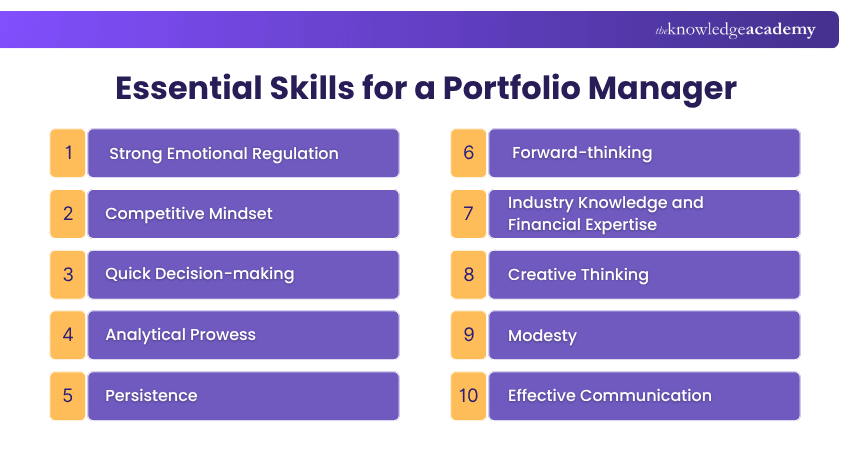
Portfolio Management encompasses a multifaceted role that demands a diverse array of skills to navigate the complexities of the financial markets and optimise Investment outcomes. A well-crafted Portfolio Manager Resume should effectively communicate these skills to potential employers. Let's delve deeper into each of the listed skills:
1) Strong Emotional Regulation
Portfolio Managers need to maintain their composure, exhibit control, and continue making decisions logically, even in highly pressurised conditions characterised by market volatility or unforeseen developments. You must be able to control your emotions such as fear, greed, or even panic will likely cloud your judgment and have you making some very impulsive or unwise decisions in the investment process. Such disciplined adherence to pre-defined investment strategies helps the Portfolio Manager not get caught up in emotional trading and remain focused on the long-term objectives, with the net result that improvement accrues to the investment portfolios in resilience and stability.

2) Competitive Mindset
In the fast-paced world of financial markets, prompt and informed decision-making is essential. Portfolio Managers must, therefore, have the ability to process huge volumes of Data, constantly measure the state of the market, and evaluate the state of underlying investment opportunities relatively quickly for either moving with emerging trends or hedging against possible risks. Those are actually the decisions of very dynamic nature, which create, in a very fast-changing market environment, windows of opportunities and are enabled via technologies and analytical tools.
3) Quick Decision-making
In the swiftly evolving financial markets, the ability to make quick, well-informed decisions is critical. Portfolio Managers are required to sift through vast amounts of data, gauge the market's current status, and quickly appraise potential investment opportunities. This rapid evaluation is necessary to align with new market trends or protect against potential risks effectively. The decisions made by Portfolio Managers are inherently dynamic, opening up opportunities within the rapidly shifting market landscape. This agility is made possible through the application of advanced technologies and analytical tools, which assist in navigating and capitalising on the fluid nature of financial markets
4) Analytical Prowess
Becoming a Portfolio Manager requires a much higher level of analytical acumen, particularly in interpreting financial data, appraising opportunities, and overseeing performance. Portfolio Managers must conduct a quantitative analysis of various factors, including asset valuation, risk metrics, and market trends, to make informed investment decisions and optimise portfolios. Equally, this role involves developing a deep understanding of market dynamics, patterns, and anomalies, enabling managers to enhance the quality and effectiveness of data-driven decisions in portfolio management.
Learn the basics of Project Management, sign up for our Introduction To Project Management Certification Course - Register now!
5) Persistence
The journey of portfolio management is fraught with constant challenges, setbacks, and sometimes volatile market behaviour. Persistence becomes invaluable, helping Portfolio Managers commit to their plans and stay true to their investment strategies and objectives. Maintaining discipline, a long-term view, and patience helps Portfolio Managers navigate through short-term fluctuations and uncertain times with determination, aiming for long-term success and consistent returns for clients or Stakeholders.
6) Forward-thinking
Effective portfolio management involves forecasting future market trends, economic developments, and regulatory changes. Portfolio Managers must adopt a future-focused mindset, continuously scanning for emerging opportunities or potential threats to their investment portfolios. This capability enables them to adapt investment strategies dynamically, proactively optimise portfolio allocations, and position their portfolios to take advantage of changing market conditions. Consequently, this approach not only enhances long-term performance but also helps in mitigating potential downside risks.
7) Industry Knowledge and Financial Expertise
Experience is a treasure trove in Portfolio Management, endowing managers with enriched insights, wisdom, and judgment gleaned from extensive, hands-on experience in the financial markets. Those seasoned in the field boast a profound grasp of market dynamics, asset classes, and investment strategies, equipping them to make astute decisions, forecast market shifts, and adeptly navigate through various market cycles. Their expertise and past experiences empower seasoned Portfolio Managers to adeptly manage risks, unearth opportunities, and achieve superior investment outcomes for their clients or organisations.
Preparing for your PMP exam? Sign up for our PMP® Exam Prep Boot Camp - Register now!
8) Creative Thinking
Innovation and creativity play a crucial role in portfolio management, empowering managers to explore unique investment strategies, tap into unconventional opportunities, and address intricate challenges. Benefits of Portfolio management include fostering creative thinking that goes beyond traditional methods, using fresh ideas and innovative approaches in portfolio construction and oversight. This ability to think differently reveals hidden prospects, fueled by an environment that embraces innovation, leading to improved performance and agile responses to evolving market dynamics.
9) Modesty
Modesty is immensely important in the uncertain world of financial markets. Recognising that nobody has all the answers encourages Portfolio Managers to remain open, value feedback, and be willing to learn from mistakes. This approach fosters a culture of continuous learning and self-improvement, as input from both colleagues and experts is encouraged, and success is met with humility.
Modesty enhances transparency and authenticity in communications, allowing Portfolio Managers to openly discuss their strengths and limitations with clients, stakeholders, and team members, a crucial aspect of Project vs Program vs Portfolio Management. By demonstrating humility and modesty, they cultivate an environment of collaboration, honesty, and respect, contributing to the enduring success of their strategies and portfolios.
10) Effective Communication
Effective Communication is crucial for Portfolio Managers to convey investment strategies, provide updates on performance, and ensure that stakeholders' expectations are aligned. This process includes adapting messages for various audiences, breaking down complex financial concepts into understandable terms, and actively listening to stakeholders' feedback. By establishing open and transparent communication channels, trust is built, collaboration is fostered, and everyone involved is aligned, which results in better decision-making and superior investment outcomes.
Ace your next interview for a Portfolio Manager, check our blog on Portfolio Manager Interview Questions!
Conclusion
Mastering Portfolio Manager Skills is essential for success in overseeing complex projects and aligning them with organisational goals. These skills empower professionals to navigate uncertainty, communicate effectively, and drive strategic decision-making. Whether it’s risk management, stakeholder engagement, or financial acumen, honing these competencies ensures effective portfolio management.
Accelerate your career and become a certified Project Management Professional! Join our PMP Certification Training today and gain the skills to lead successful projects!
Frequently Asked Questions
What Makes You a Good Portfolio Manager?

A good Portfolio Manager should be analytical, possess good decision-making skills, be resilient in markets with ups and downs, and be equipped with excellent communication skills. They should adapt strategies according to market conditions quickly and see to it that the best of results is derived in terms of meeting the client's objectives and managing risks efficiently.
What Qualifications do you Need to be a Portfolio Manager?
To become a Portfolio Manager, one typically needs a bachelor's degree in finance, economics, or a related field, along with relevant work experience in project or programme management. Advanced certifications such as PfMP®, PMP®, or PRINCE2® may enhance career prospects.

The Knowledge Academy


Global Training Provider
The Knowledge Academy is a world-leading provider of professional training courses, offering globally recognised qualifications across a wide range of subjects. With expert trainers, up-to-date course material, and flexible learning options, we aim to empower professionals and organisations to achieve their goals through continuous learning.


 If you wish to make any changes to your course, please


