


 Top Rated Course

We may not have the course you’re looking for. If you enquire or give us a call on 01344203999 and speak to our training experts, we may still be able to help with your training requirements.
Investment Banking Skills: A Detailed Guide
The Knowledge Academy 14 July 2026Discover the top Investment Banking Skills, including analytical, negotiation, and problem-solving abilities needed to succeed in a competitive finance career. Understand how these skills drive decision-making and contribute to successful deals. Explore practical ways to develop them and build a strong, competitive profile.

Training Outcomes Within Your Budget!
We ensure quality, budget-alignment, and timely delivery by our expert instructors.
Table of Contents

You’ve seen the intensity and thrill of Wall Street in films, but what really powers those high-stakes boardroom decisions? It is not just flashing stock tickers or dramatic negotiations. Behind the fast-paced trading floors and billion-pound deals lies a world built on precision, analysis, and strategic thinking. It is the mastery of a unique set of Investment Banking Skills that combine analytical precision, strategic thinking, and emotional intelligence.
In this competitive industry, success depends on more than ambition. You have to interpret markets, build relationships, and make data-driven decisions. In this blog, we’ll break down the key Investment Banking Skills every professional must develop to build a sustainable career in the world of finance. Let's get started!
Table of Contents
1) Who is an Investment Banker?
2) What Skills do You Need for Investment Banking?
3) Why are Investment Banking Skills Important?
4) Developing Efficient Investment Banking Skills
5) How to Showcase Your Skills?
6) Career Routes in Investment Banking
7) Tips on Getting Into Investment Banking
8) Is SQL Used in Investment Banking?
9) Do I Need Python for Investment Banking?
10) Conclusion
Who is an Investment Banker?
An Investment Banker helps companies and governments raise capital by issuing stocks and bonds. They manage major financial deals such as mergers, acquisitions and business sales by offering strategic advice throughout the process. Armed with strong market and regulatory knowledge, they guide clients through complex decisions and help them make the most of financial opportunities.

What Skills do You Need for Investment Banking?
Now, let’s have a closer look at various Investment Banking Skills that you need to possess:
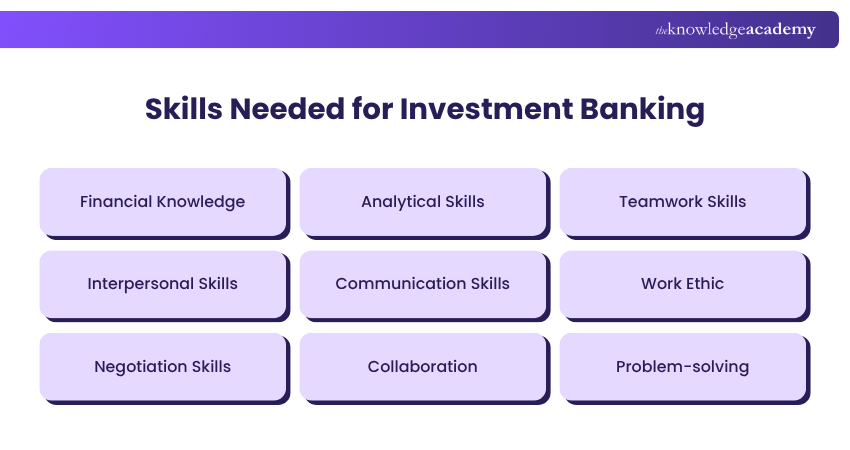
1) Financial Knowledge
A strong knowledge of market forces, asset depreciation, Portfolio Management and other Investment-related concepts is a must-have for an Investment Banker. This makes the Investment Banker a reliable source for organisations to consult about assets and Investment strategies. You can acquire this knowledge through academic programmes or even with sound work experience.
2) Analytical Skills
Investment bankers rely on analytical abilities, which are core Investment Banking Skills, supported by tools such as dashboards and data analytics models. By analysing markets in detail, they understand trends and driving factors, enabling better decisions. As hard skills, they can be developed through specialised training and software-focused tutorials.
3) Teamwork Skills
Teamwork is a key Investment Banking Skill to possess. They work in close proximity with other Investment Bankers and need good communication skills to propagate their ideas and lead the team. If you are to lead a team of other Investment Bankers, you need to excel inLeadership Qualities as well as hone efficient management skills.
4) Interpersonal Skills
If you are an Investment Banker, you have to deal with a wide variety of people. These include clients, team members and Analysts. The finance sector certainly demands fast-paced outputs, and a lot of people who are anxious about the financial market may find it difficult to deal with. Being able to handle difficult conversations regarding the financial market can facilitate Investment strategy planning.
5) Communication Skills
As an Investment Banker, you must be adept at both verbal and non-verbal communication skills. A large part of your day will involve communicating with team members, clients, and potential investors. Additionally, you must possess the ability to communicate by email and phone calls. This gives you the flexibility to establish good relationships with the clients. Having good persuasive skills can make your current clients plan long-term Investment strategies with you.
6) Work ethic
Investment Banking is known for its demanding workload and tight deadlines. A strong work ethic, marked by dedication, reliability, and persistence, is essential for long-term success. Professionals who consistently deliver high-quality results earn the trust of clients and the respect of peers. A solid work ethic not only builds career longevity but also sets the foundation for leadership growth within the firm.
Master portfolio strategies and investment analysis with our Investment Management Course – Register today!
7) Negotiation Skills
Negotiation is one of the essential Investment Banking Skills, influencing outcomes across client agreements, broker pricing, and external partnerships. It involves strong communication and a clear understanding of each situation to reach favourable terms. Effective negotiation helps investment banks minimise fees on portfolio activities while maximising returns through well-structured client agreements and contracts.
8) Collaboration
Collaboration in Investment Banking goes beyond merely working together. It involves combining strengths and expertise to achieve shared goals. Every deal requires input from multiple departments, including legal, compliance, and risk teams. Clear communication, mutual respect, and adaptability are essential to keep projects aligned and on schedule.
9) Problem-solving
Problem-solving is one of the key Investment Banking Skills used to manage portfolios during market fluctuations. It involves identifying underlying issues within a portfolio and spotting opportunities even when markets perform poorly, such as during a bear phase. As a soft skill, it improves with practice and adaptability. You can strengthen it by solving puzzles and reviewing past decisions logically to refine your approach.
Why are Investment Banking Skills Important?
Investment Banking Skills are essential for success in the financial world. Here are some reasons why:
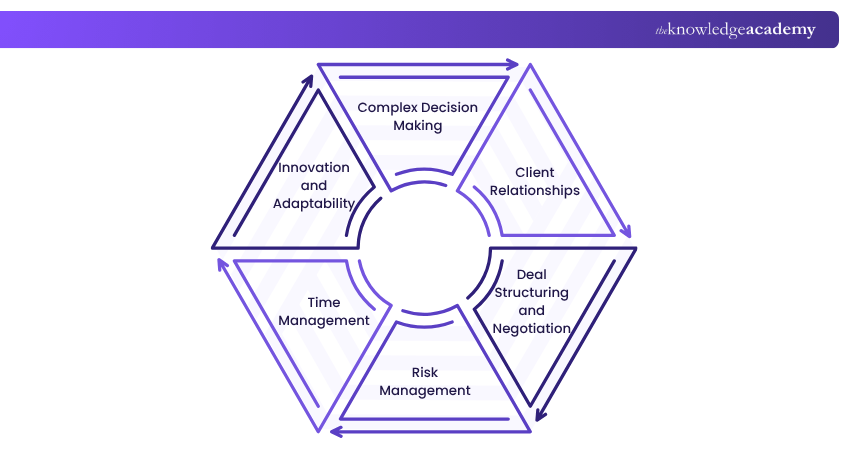
a) Complex Decision Making:Investment Bankers need to understand financial data, evaluate risks, and anticipate market trends. Skills like Financial Analysis and modelling help them navigate the financial landscape.
b) Client Relationships: Investment Bankers must communicate effectively, understand and address clients’ needs, and foster trust and satisfaction. Clients rely on Investment Bankers for their financial goals; strong interpersonal skills are important.
c) Deal Structuring and Negotiation: Investment Bankers must craft deals that benefit all parties. Skills like Negotiation, creativity, and financial knowledge help them ensure that deals are profitable and sustainable.
d) Risk Management: Investment Bankers must assess and manage risks to protect their clients’ investments and assets. Skills like analytical thinking, market awareness, and attention to detail help them identify and mitigate potential risks.
e) Time Management: Investment Bankers need to work within strict timelines. Whether it’s closing a deal, preparing financial reports, or conducting market research, they must balance multiple tasks and meet deadlines. It ensures that opportunities are maximised, and client expectations are met promptly.
f) Innovation and Adaptability: Investment Bankers need to stay at the forefront of an ever-changing financial environment. They must embrace new tools and methodologies and leverage emerging opportunities and challenges. Skills like innovation and adaptability help them do that.
Learn how to analyse markets and build portfolios with our Investment and Portfolio Management Course – Join now!
Developing Efficient Investment Banking Skills
While the Investment Banking industry demands a lifelong learning process, let's look at some of the ways to develop efficient Investment Banking Skills:
1) Education
Many Investment Bankers have degrees in Business Management and Finance. However, a lot of others come from a variety of educational backgrounds. The degree courses offer valuable knowledge of different types of Investment as well as basic Financial Management.
Based on the course that you may choose, you might also get to learn about Project Management and analytical thinking skills. A four-year degree will include regular academic classes, which will help you ace your written communication and quantitative reasoning. If you're aiming for a career in finance or banking, reviewing Letter of Credit Interview Questions can provide you with valuable insights into the intricacies of financial instruments, which can complement your broader skill set.
2) Certification Courses
If you want to represent the firm as an Investment Banker, most financial service firms prefer certified individuals. To earn a certification, you have to pass an exam that tests your Investment Banking Skills and knowledge and Financial Management concepts, which includes legal statutes.
3) Work Experience
Internships at financial institutions can be your first step to becoming an Investment Banker. You can complete these internships during or after the completion of your certification course. These courses teach future Investment Bankers how financial organisations operate.
This allows you to observe how experienced Investment Bankers, Fund Managers, and other finance professionals work. Based on the internship, you might learn about Investment opportunities and learn about researching funds. You can also be asked to assist a specific financial Investment Banker while working with their clients. This experience can provide valuable insights into various financial instruments and their applications, which might include understanding the differences between a Bank Guarantee vs Letter of Credit.
Gain real-world trading skills and strategies with our Stock Trading Course – Sign up anytime!
How to Showcase Your Skills?
Showing your Investment Banking Skills in the right way can help you stand out in a competitive field. Employers want to see not just what you know, but how you’ve used those skills. You can show this clearly in your CV, cover letter, and interviews.
1) CV
Your CV is your first chance to make a good impression. Include important skills like Financial Analysis, research, and working with numbers. Mention them in your experience, education, and achievements. Use real examples, such as helping with a deal or creating a financial model, to show what you’ve done.
2) Cover Letter
In your cover letter, detail how your skills match the job you want. Focus on abilities like problem-solving, teamwork, leadership, and organisation. Describe how your past experience has prepared you for the role and why you are interested in the company. Keep your tone confident and genuine to show you are the right fit.
3) Interview
During the interview, talk about how you have used your Investment Banking Skills in real situations. Give examples of challenges you have handled or projects you have worked on. Listen carefully to the questions and connect your answers to what the company needs. Show that you can stay calm, think clearly, and communicate well under pressure.
Career Routes in Investment Banking
Investment Banking careers usually progress through a clear hierarchy:
Analyst → Associate → Vice President → Director.
a) Analyst: They handle financial modelling, research and Data Analysis to support senior Bankers.
b) Associate: They manage client communication, oversees analysts and helps execute transactions.
c) Vice President (VP): They lead deal processes, strengthens client relationships and coordinates teams.
d) Director: They focus on winning new business, high-level strategy and overseeing major transactions.
Depending on their skills and interests, professionals can specialise in fields like mergers and acquisitions, corporate finance or market trading. Postgraduates often have an advantage when stepping into more specialised or advanced roles.
Learn how to sell property listings in a buyer's market successfully with our Real Estate Agent Course – Join today!
Tips on Getting Into Investment Banking
Breaking into Investment Banking requires the right mix of education, experience, and key skills. With a focused approach, you can build a strong profile. The following tips highlight the essential steps to get started:
1) Gain a Relevant Education:
Study finance, economics, or business to build a strong understanding of financial principles and markets.
2) Learn Core Technical Skills:
Develop skills in financial modelling, valuation, and tools like Excel, which are essential for deal analysis.
3) Get Practical Experience:
Complete internships to gain real-world exposure and improve your chances of securing a full-time role.
4) Improve Soft Skills:
Work on communication, teamwork, and problem-solving to collaborate effectively with clients and colleagues.
5) Build a Strong Network:
Engage with industry professionals through LinkedIn, events, and alumni connections to explore opportunities.
6) Prepare Thoroughly for Interviews:
Practice both technical and behavioural questions to approach interviews with confidence.
7) Keep Up with Market Trends:
Stay informed about financial news and economic changes to demonstrate industry awareness.
8) Pursue Professional Certifications:
Consider certifications like CFA to strengthen your profile and show commitment to the field.
Is SQL Used in Investment Banking?
Yes, Structured Query Language (SQL) is widely used in Investment Banking to manage and analyse large financial datasets. It helps Bankers extract, organise, and interpret financial and market data quickly for reports and decision-making. SQL skills are especially valuable in roles involving trading, Risk Analysis, and Financial Data Management.
Do I Need Python for Investment Banking?
While not always required, Python is increasingly valuable in Investment Banking. It helps you analyse data, automate reports, and build financial models faster. Many banks use Python for tasks like Risk Management and market forecasting. Learning it can make your work easier and improve your career opportunities.
Conclusion
Building strong Investment Banking Skills can open doors to a dynamic and rewarding career in finance. By combining analytical thinking, strategic decision-making, and effective communication, you can confidently handle complex deals, adapt to market changes, and position yourself for long-term success in a competitive industry.
Become familiar with all crucial aspects of investing and trading with our Investment and Trading Training – Join now!
Frequently Asked Questions
Which Technical Skills are Highly Sought-after in Investment Banking?

Some of the technical skills that are highly sought-after in the field of Investment Banking involve the following:
a) Financial Analysis and modelling
b) Data interpretation and presentation
c) Risk and Credit Management
d) Knowledge of Investment products and markets
e) Knowledge of regulatory policies and procedures
How Can Improving Your Investment Banking Skills Impact Your Earning Potential?
Improving the skills needed for Investment Banking can impact your earning potential in several ways, such as the following:
a) Enhancing your performance and productivity
b) Increasing your value and reputation
c) Expanding your opportunities and network
d) Developing your career and growth

The Knowledge Academy


Global Training Provider
The Knowledge Academy is a world-leading provider of professional training courses, offering globally recognised qualifications across a wide range of subjects. With expert trainers, up-to-date course material, and flexible learning options, we aim to empower professionals and organisations to achieve their goals through continuous learning.


 If you wish to make any changes to your course, please


