




We may not have the course you’re looking for. If you enquire or give us a call on +44 1344 203 999 and speak to our training experts, we may still be able to help with your training requirements.
What is Negotiation: A Complete Guide
ByThe Knowledge AcademyLast updated on: 18 September 2026
Negotiation is the process of discussing different interests, needs, or priorities to reach an acceptable agreement. This blog explains its key elements, types, stages, strategies, essential skills, and practical tips for successful negotiation.

Imagine a Project Manager discussing a deadline with a client. The client wants the project completed by Friday, but the team needs until Tuesday. Instead of simply accepting or rejecting either deadline, they discuss priorities, limitations and possible adjustments until they find an acceptable way forward.
This is Negotiation in action.
Negotiation happens whenever two or more parties have different interests or expectations and need to work towards an agreement. It can involve deadlines, salaries, contracts, prices, responsibilities or even everyday decisions.
In this blog, we'll explore what Negotiation is, its key elements, types, stages, strategies and skills, along with practical examples of how it works.
What is Negotiation?
Negotiation is a process in which two or more parties communicate to address different interests, needs or priorities and try to reach an acceptable agreement. The process can involve exchanging information, presenting proposals, exploring alternatives and making trade-offs. Negotiation does not always mean that every party gets everything they want. Instead, the aim is to identify terms that the parties are willing to accept.

Key Elements of Negotiation
Below are some of the key elements of Negotiation:
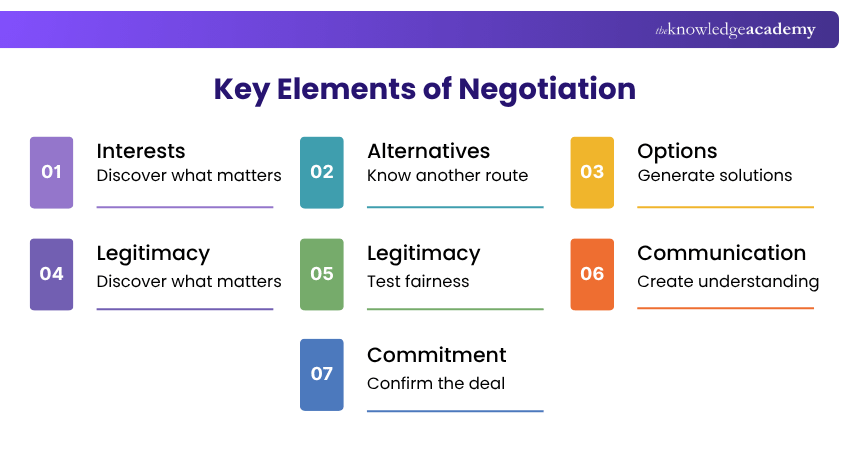
1) Interests: Interests are the underlying needs, concerns, motivations, and priorities that influence what each party wants from the Negotiation. Understanding interests helps negotiators move beyond stated positions and identify possible areas of agreement.
2) Alternatives: Alternatives describe what each party can do if an agreement cannot be reached. A particularly important concept is BATNA, or Best Alternative to a Negotiated Agreement, which represents the best available option if Negotiations fail.
3) Options: Options are the possible agreements or solutions parties can explore during Negotiation. Developing several options can make it easier to identify arrangements that provide value to both sides.
4) Legitimacy: Legitimacy refers to using fair and objective standards when evaluating proposals. Examples include market rates, industry standards, policies, precedents, or independent benchmarks.
5) Communication: Clear communication helps parties explain priorities, ask questions, exchange information, and understand one another's concerns.
6) Relationships: Negotiators should consider how their approach may affect existing or future relationships, particularly in recurring business or professional interactions.
7) Commitment: Commitment refers to the specific agreements parties make regarding what will happen, who will be responsible, and when agreed actions will be completed.
Types of Negotiation
Negotiations can take different forms depending on the interests involved, number of parties, available resources and context of the discussion. Here are some common types of Negotiation:
1) Distributive Negotiation
Distributive Negotiation is a competitive approach commonly used when parties are dividing a fixed or limited amount of value. Each party generally tries to secure the most favourable share or terms for themselves. For example, negotiating the price of an item can be distributive because a higher price benefits the seller on that term, while a lower price benefits the buyer.
2) Integrative Negotiation
Integrative negotiation, also known as win-win negotiation, is a collaborative approach where parties work together to create value and reach mutually beneficial agreements. Instead of competing over limited resources, they aim to expand the available value through creative solutions.
3) Cross-cultural Negotiation
Cross-cultural Negotiations happen when people from different cultural backgrounds negotiate. Differences in values, norms, and communication styles can affect the process and results. Understanding these differences is important for success.
4) Multi-party Negotiation
Multi-party negotiation involves more than two parties working towards a shared agreement. It is often more complex because multiple stakeholders may have different goals, interests, and priorities. This type of negotiation is common in mergers, public projects, and community decision-making.
Trainer’s Insight
A Negotiation can stall even when both parties want an agreement because they may be arguing over positions rather than priorities. When progress stops, ask what each side is trying to achieve and which terms matter most. This can reveal trade-offs that were not obvious at the start.
Improve speaking, listening, and interpersonal skills with our Communication Skills Courses – Join now!
Stages of the Negotiation Process
Successful Negotiation rarely begins at the bargaining table. It develops through a series of stages, from understanding your priorities before discussions begin to confirming what happens after an agreement is reached. Here are six key stages of the Negotiation Process:
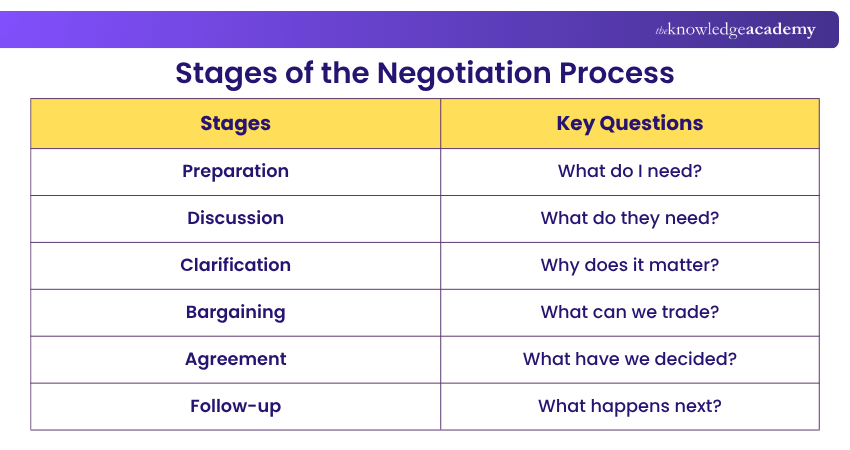
1) Preparation: Know Before You Negotiate
Preparation sets the direction for the entire negotiation. Before discussions begin, define your objectives, priorities, acceptable limits, and alternatives. Gather relevant information and consider what the other party may want from the negotiation.
This is also the stage to identify your BATNA (Best Alternative to a Negotiated Agreement). Knowing your best alternative helps you assess whether a proposed agreement is genuinely worthwhile.
Think Before You Talk: What do I want? What can I compromise on? What will I do if we cannot agree?
2) Opening and Discussion: Put the Priorities on the Table
Once negotiations begin, both sides explain their positions, expectations, and concerns. Rather than rushing towards a solution, use this stage to understand what matters to everyone involved.
Ask open-ended questions, listen actively, and clarify unclear points. A productive opening creates a shared understanding of the issues before bargaining begins.
The goal: Understand first, negotiate second.
3) Clarifying Interests: Discover the “Why”
A position tells you what someone wants; an interest often explains why they want it. Looking beneath stated demands can reveal needs and priorities that are not immediately obvious.
For example, an employee asking for a higher salary may actually prioritise career progression or flexible working. Identifying these underlying interests can reveal alternative solutions and useful trade-offs.
Look beyond: “What are they asking for?” Ask instead: “Why is this important to them?”
4) Bargaining and Problem-solving: Explore the Trade-offs
This is where proposals become possibilities. Parties exchange offers, consider alternatives, make concessions, and explore combinations that could address their respective priorities.
Effective bargaining is not simply about giving up. It involves understanding the relative value of different terms and looking for exchanges where each side can gain something important.
Simple principle: Offer → Evaluate → Trade → Refine
5) Reaching Agreement: Turn Discussion into Decisions
Once the parties identify acceptable terms, they need to confirm exactly what has been agreed upon. Important details should be clarified rather than left open to different interpretations.
Depending on the situation, this may include confirming responsibilities, costs, timelines, deliverables, conditions, or other agreed terms. The aim is to ensure that everyone has the same understanding.
Before saying “Agreed”, ask: Are the terms clear, realistic, and understood by everyone?
6) Implementation and Follow-up: Make the Agreement Work
A successful negotiation does not necessarily end with a handshake. Where appropriate, the agreement should be documented and translated into clear actions.
Confirm who is responsible for each action, when it should happen, and how progress will be reviewed. Following up also gives the parties an opportunity to resolve misunderstandings and maintain a productive working relationship.
Negotiation Journey: Prepare → Discuss → Clarify → Bargain → Agree → Implement
Communicate professionally with Business Communication Course - Register now!
Effective Negotiation Strategies
Negotiation strategy determines how you approach the discussion and make decisions as it develops. Rather than relying on a single tactic, effective negotiators adapt their approach according to the situation, relationship and desired outcome.
1) Set Your Negotiation Range
Decide what outcome you would ideally like, what terms you could reasonably accept and the point at which an agreement would no longer be worthwhile. This creates clearer boundaries for decision-making.
2) Prioritise What Matters Most
Not every term has equal value. Identify which issues are essential, which are flexible and which could be exchanged for something more important.
3) Make Trade-offs, Not One-sided Concessions
When giving something up, consider whether you can receive something useful in return. This turns concessions into exchanges and can help preserve value.
4) Control the Pace
Avoid feeling pressured to respond immediately to every proposal. Taking time to evaluate an offer can help prevent rushed decisions and unnecessary concessions.
5) Reframe Difficult Discussions
When negotiations become stuck around opposing demands, restate the problem around shared objectives or underlying concerns. A different framing can reveal alternative solutions.
6) Know Your Exit Point
An agreement is not automatically better than no agreement. If the available terms are less favourable than a realistic alternative, walking away may be the more appropriate decision.
Examples of Negotiations
Negotiation happens in many professional, commercial and everyday situations. Here are some common examples:
1) Salary Negotiation: An employee or candidate and an employer may discuss salary, benefits, working arrangements, responsibilities or other employment terms before reaching an agreement.
2) Partnership Negotiation: Business partners may negotiate responsibilities, ownership, investment, decision-making authority, profit sharing and other terms before entering a partnership.
3) Trade Negotiation: Governments may negotiate terms affecting trade between countries, including tariffs, market access, standards and other conditions.
4) Budget Negotiation: Project Managers, departments, clients or other stakeholders may negotiate how available funds are allocated based on project requirements and priorities.
5) Political Negotiation: Political parties or governments may negotiate policies, responsibilities, commitments or coalition arrangements when their priorities differ.
Negotiation Checklist
A quick check before a negotiation can help you identify gaps in your preparation before the discussion begins. The checklist below brings together the essential questions to consider before moving forward.
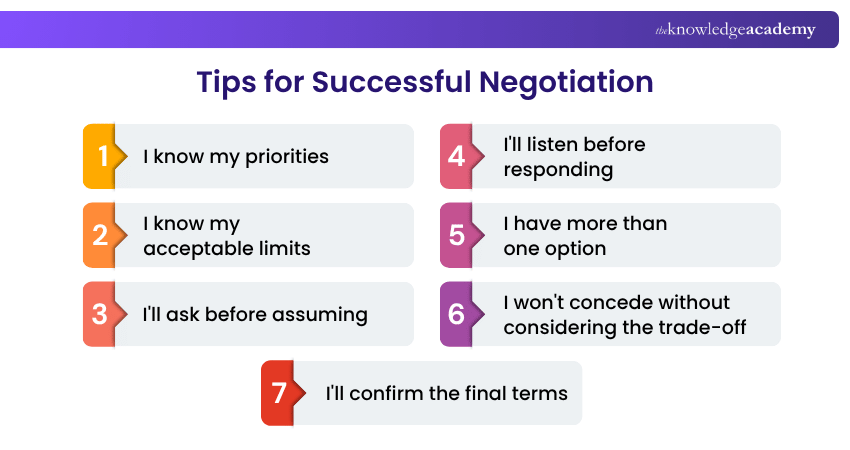
Once you have completed the checklist, pay particular attention to any item you cannot answer confidently. For example, unclear limits may lead to unnecessary concessions, while having only one possible solution can make it harder to find useful trade-offs.
The aim is not to predict every turn in the conversation. It is to enter the negotiation knowing what matters, where you have flexibility, and what you will do if an acceptable agreement cannot be reached.
Pro Tip
Treat the checklist as a readiness test rather than a script. Negotiations can change direction quickly, so prepare your boundaries and alternatives while remaining flexible about how you reach the outcome.

The Knowledge Academy develops accessible learning content across Project Management, IT, Cybersecurity, Data Science, Business Analysis, HR, Accounting and Finance, Leadership and Health and Safety. Its resources combine subject research with clear explanations to help professionals build practical knowledge across a wide range of disciplines.
View Detail

 If you wish to make any changes to your course, please


