




We may not have the course you’re looking for. If you enquire or give us a call on 01344203999 and speak to our training experts, we may still be able to help with your training requirements.
Inside Sales vs Outside Sales: Key Differences Explained
ByShristi RoyLast updated on: 03 October 2026
Inside sales involves selling products through phone, email, etc., whereas outside sales involves in-person meetings with clients. Read this blog to understand the differences between inside sales vs outside sales and find the best fit for your business. We will also discuss the benefits of choosing the right option. Let’s get started!
Inside sales and outside sales are two distinct approaches to selling products and services, each with unique advantages and considerations. Both have their unique benefits, making it very difficult to choose one. However, learning about the differences between inside sales vs outside sales can help you choose the right form of Sales for your business.
Determining which approach is better requires comprehensively understanding their nuances, strengths, and limitations. In this blog, you will learn about inside sales vs outside sales and choose which is better. Also, explore their benefits to choose the one that fits your business needs.
Understanding What is Inside Sales?
Inside sales is a sales approach where sales professionals engage with prospects and customers remotely, primarily using digital communication channels rather than meeting them in person. It is a method of selling that relies on phone calls, emails, video conferences, and other online tools for connecting with potential buyers and closing deals.
However, you should remember that inside sales is very different from telemarketing. Telemarketing is where the salespeople cold-call potential customers from a file and they read from a script. In inside sales there might be some cold calling, but it requires a more creative and strategic approach to carry out selling to Business-to-business(B2B) or Business-to-Customer(B2C).
Trainer Insight
Inside sales is not simply telemarketing. It can involve prospecting, qualification, consultation, relationship building and closing deals entirely through remote channels.

What is Outside Sales?
Outside sales refers to a sales approach where professionals engage with prospects and customers through in-person interactions, typically meeting them at their location or a designated meeting place. Unlike inside sales, which relies on remote communication channels, outside sales involves face-to-face meetings, product demonstrations, and presentations to build relationships and close deals.
Difference Between Inside Sales and Outside Sales
Inside sales and outside sales are two distinct approaches to sales engagement, each with its own characteristics and advantages. Understanding their key differences is crucial for businesses to determine the most suitable strategy for their sales efforts.
The essential difference between Inside and outside sales is the method of contacting the customer. As the name suggests, inside sales uses telephone, social media, and email to reach prospective customers remotely. In comparison, outside sales uses the traditional sales method of reaching out to prospective customers in person to get the job done. Here are their key differences at a glance:
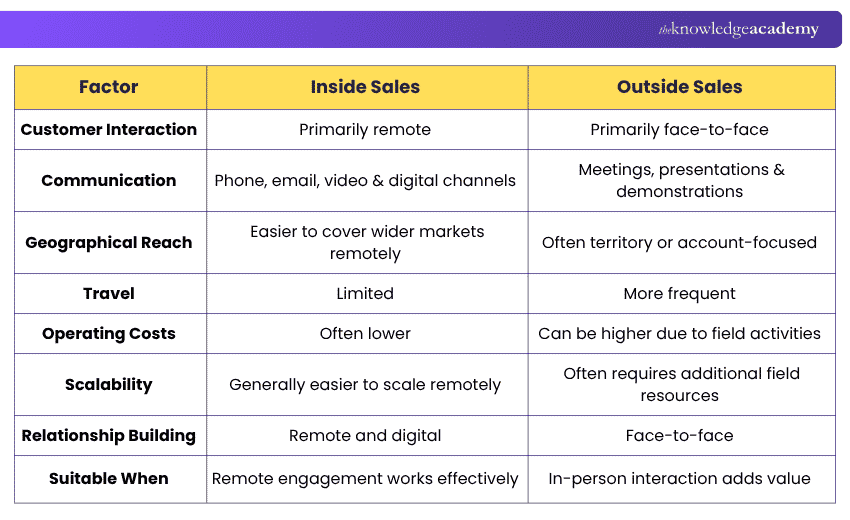
Now, let's explore the primary differences between inside sales and outside sales in detail:
1) Roles and Responsibilities in Inside Sales vs Outside Sales
An outside salesperson is responsible for generating new leads and business opportunities through face-to-face interactions and presentations, while also maintaining relationships with existing clients. Key responsibilities include:
a) Developing and maintaining customer relationships
b) Understanding customer needs and providing tailored solutions
c) Generating new sales through prospecting and lead follow-up
d) Managing a sales territory, assigned accounts, or event-based sales pipeline
e) Achieving monthly, quarterly, and annual sales targets
f) Engaging with potential clients at conventions and events to close deals
g) Delivering in-person presentations and demonstrations
h) Demonstrating a strong understanding of the product or service to match client needs
Inside sales teams focus on generating leads and nurturing them until they can either close the sale or pass it to an outside sales representative or Account Manager. These functions often align with broader Sales Manager responsibilities, especially in guiding strategy and ensuring targets are met. Their responsibilities include:
a) Building relationships with potential or existing customers to inform them about a product or service
b) Qualifying potential customers, identifying their needs, and matching them with the right products or services
c) Answering questions about the product or service
d) Asking questions to understand the customer’s needs
e) Recording and updating customer information in sales software
f) Handling inbound calls from prospects or customers
g) Making outbound calls and following up on new leads
h) Overcoming objections and closing sales
Trainer Insight
Inside and outside sales are not necessarily strict opposites. Different stages of the customer journey can use different interaction methods depending on what the opportunity requires.
Ready to take your sales performance to new heights? Join our Sales Bootcamp Training to equip yourself with the tools, techniques, and strategies for sales success!
2) Inside Sales Skills vs Outside Sales skills
Inside sales professionals require understanding customer needs and pain points, an essential skill. Matching customer needs with the product or service is crucial in closing a sale. Inside sales professionals require creating innovative and effective sales strategies based on multiple factors to improve sales figures. They also require active listening and information-gathering skills, which effectively helps identify the customer's needs.
In contrast, outside sales professionals are required to demonstrate the product's credibility. Outside sales profile demands excellent interpersonal skills to interact with and positively engage the customer. Since outside sales professionals are required to meet the customer in person, it leads to frequent travel to close sales.
Outside sales professionals require having good time management skills to prioritise maximum opportunities. Outside sales professionals also require staying updated with technology to manage the sales pipeline and present the product or service, utilising current technology to create an effective impact.
3) Inside Sales vs Outside Sales Tools
Let's explore the main tools used in inside sale and outside sales
Tools Used in Inside Sales:
Inside salespeople utilise various technologies to facilitate remote selling, including Customer Relationship Management (CRM) systems. Key tools include:
a) A laptop or desktop computer
b) A phone with a reliable internet connection
c) CRM software (such as Salesforce)
d) Sales automation and prospecting software
e) Video chat and screen-sharing tools (Zoom, Teams, Skype)
f) LinkedIn, databases of contacts, and other research tools
g) The telephone is typically the primary means of communication with customers, supplemented by email for follow-ups and sharing product information.
Tools Used in Outside Sales:
Outside salespeople engage directly with potential customers, building a sales pipeline through face-to-face interactions. They use many tools similar to those in inside sales, such as a laptop or computer and a smartphone, along with:
a) A tablet for presentations and filling sales forms with customers
b) A reliable car or good walking shoes for sales appointments and meetings
c) Printed sales presentation materials, such as product brochures and price lists
d) Samples of products (if applicable)
e) Convention stands, banners, and branded goods
f) Business cards to exchange with potential customers
These tools help outside salespeople effectively communicate and present to potential customers.
Pro Tip
Choose sales technology around the team's workflow and customer journey. More tools do not automatically create a more effective sales process.
4) Inside vs Outside Sales Executive’s Salary
Inside sales and outside sales executives' salaries depend on the product the sales executive is dealing with. If the product is of high value, it translates to a higher salary. Usually, outside sales deals with high-value products and commission adds up to a higher salary.
This is why the base salary of sales executives is lower, as the potential for earning more exists through commissions. Let us look at the average salary figures of inside sales and outside sales executives in certain countries:
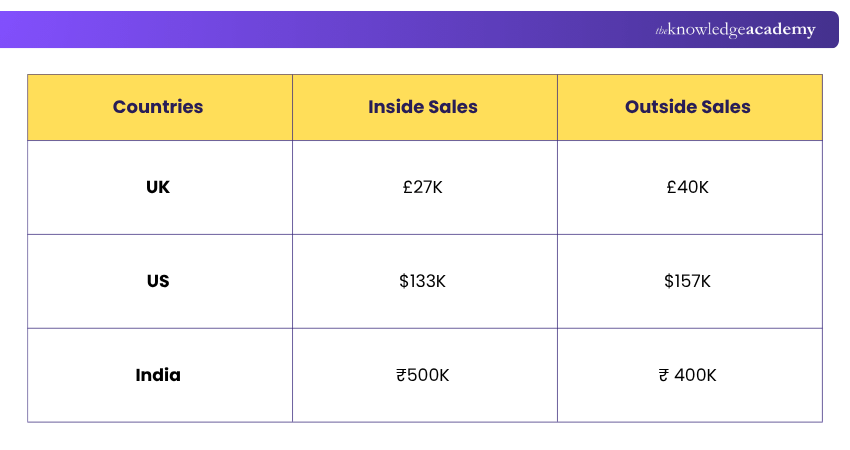
Source: Glassdoor
5) Inside vs Outside Sales Models
Sales executives connect with prospective customers via means such as telephone and email in inside sales. The goal is to acquire the lead to initiate the sales process. Inside sales consists of a faster sales cycle, which typically lasts under 90 days. Inside sales costs less and is a more scalable sales model.
In comparison, an outside sales executive has to travel to meet the prospective client face-to-face. The goal is to build a positive relationship to convert leads. Outside sales model consists of a slower sales cycle, which typically lasts more than 90 days. However, Outbound Sales cost more to operate and are comparatively less scalable.
Inside or Outside Sales in Practice
Scenario 1: A business serves customers across several regions and can demonstrate its offering effectively online. An inside sales approach could support broader remote coverage with less travel.
Scenario 2: A company offers a complex solution that benefits from on-site demonstrations and extensive stakeholder discussions. Outside sales could provide more opportunities for direct engagement.
Ready to master the art of selling over the phone? Dial up your success with our Telephone Sales Training!
Inside Sales or Outside Sales: Which One to Choose?
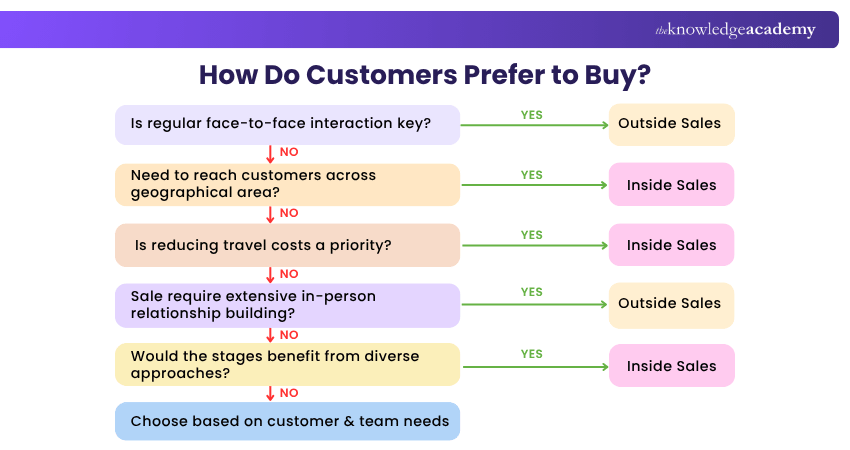
When deciding between inside sales and outside sales, there are several factors that businesses should consider. These factors can help determine the most suitable approach for their specific products, target audience, and market conditions. Let's explore the key factors to consider when choosing between inside sales and outside sales:
1) Nature of the Product or Service
Consider the characteristics of your product or service. Is it complex and requires hands-on demonstrations? Or is it relatively straightforward and can be effectively explained through digital channels? Complex products or services may benefit from outside sales, while simpler ones may be more suitable for inside sales.
2) Target Audience
Understand your target audience and their preferences. Some customers prefer face-to-face interactions and personal demonstrations, while others are more comfortable with remote communication. Aligning the sales approach with the preferences of your target audience can enhance customer engagement and satisfaction.
3) Sales Cycle Length
Evaluate the length of your sales cycle. Outside sales often involve longer sales cycles, requiring more in-depth interactions and relationship-building. Outside sales might be more appropriate if your sales cycle is longer and involves multiple touchpoints. For shorter sales cycles, inside sales can be more efficient.
4) Geographical Reach
Determine the geographical reach required for your sales efforts. Outside sales may be the preferred choice if your target market is local or regional. However, if your product or service has a wider target market across different regions or even globally, inside sales can provide a broader reach more effectively.
Master the art of building genuine connections and leave a lasting impression with our Building Rapport With Customers Training – sign up now!
5) Cost Considerations
Evaluate the cost implications of each sales approach. Outside sales typically involve higher expenses, including travel, accommodations, and other related expenses. On the other hand, inside sales can be more cost-effective, leveraging digital communication channels and eliminating the need for extensive travel.
6) Sales Team Skills and Resources
Assess the sales skills and resources available within your team. Outside sales require strong interpersonal skills, the ability to build relationships face-to-face and proficiency in conducting product demonstrations. On the other hand, inside sales requires engaging and building relationships remotely effectively and excellent communication skills.
7) Market Conditions
Consider the current market conditions and trends. For example, if there are travel restrictions or remote work is prevalent, inside sales may be the more feasible and effective option. Stay updated with the market dynamics and adapt your Sales approach accordingly.
By carefully considering these factors, businesses can make informed decisions when choosing between inside sales and outside sales. It's essential to align the selected approach with the unique product or service requirements, target audience, sales cycle length, geographical reach, cost considerations, sales team skills, and market conditions. A well-chosen sales strategy can significantly impact sales effectiveness and contribute to overall business success.
Learn processes to manage an effective bid and response within the organisation - Join our Bid and Tender Management Skills Course!
Keep This in Mind
1. Inside sales primarily connects with customers through remote communication channels.2. Outside sales focuses more heavily on in-person meetings and field interactions.3. Inside sales can support wider geographical reach without extensive travel.4. Outside sales can be useful when demonstrations or face-to-face engagement are important.5. Businesses can also combine both approaches across different stages of the sales process.

Shristi Roy is a Content Writer with experience in journalism, article writing and web content development. Her experience researching and writing about Business Skills and Accounting and Finance enables her to communicate specialised information through clear, engaging narratives.
View Detail

 If you wish to make any changes to your course, please


