


 Top Rated Course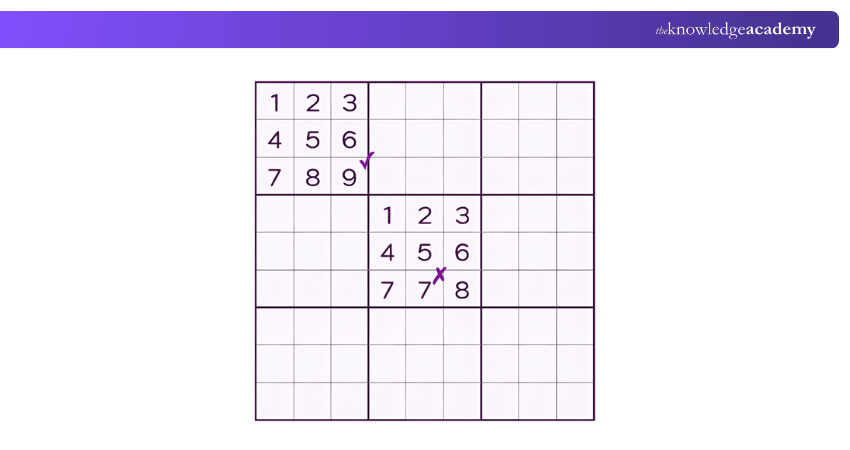


We may not have the course you’re looking for. If you enquire or give us a call on 01344203999 and speak to our training experts, we may still be able to help with your training requirements.
How to Play Sudoku? A Guide to Solving Puzzles
Michael Jones 16 July 2026Sudoku is a logic-based number-placement puzzle. Fill a 9x9 grid with digits 1 through 9, ensuring that each digit appears only once in each row and column. This blog on How to Play Sudoku breaks down the basic rules, solving strategies, expert tips and common mistakes to avoid, for enhancing your gameplay step-by-step.

Training Outcomes Within Your Budget!
We ensure quality, budget-alignment, and timely delivery by our expert instructors.
Table of Contents

Sudoku is the prime example of a fun yet challenging puzzle game. It uses numbers and logic, not mathematics. The goal here is to fill a 9×9 grid so that every row, column, and 3×3 box has numbers 1 to 9 without repeats. If you are new to this game, don’t worry! This blog will show you How to Play Sudoku tips in easy steps. Let’s get started!
Table of Contents
1) What is Sudoku?
2) How to Play Sudoku?
3) The Essential Rules of Sudoku
4) Tips for Playing Sudoku
5) Can Sudoku Improve Your Thinking Capacity?
6) How Long Does it Take to Solve a Sudoku Puzzle?
7) Conclusion
What is Sudoku?
Sudoku is a classic puzzle game where players use logic to fill a grid so that every row, column, and block contains all digits without repetition. Although it uses numbers, it is not a maths game but a logic-based challenge.
The game is designed for one player and comes in different difficulty levels, making it suitable for both beginners and advanced players. It helps sharpen problem-solving skills, patience, and concentration while offering a rewarding sense of achievement when the puzzle is completed.

How to Play Sudoku?
Sudoku is simple to learn but can be tricky to fully solve. With just a puzzle grid and some patience, you can enjoy solving logical patterns that keep your mind sharp and engaged.
1) Grab a Sudoku Puzzle and a Pencil
To begin, you need a Sudoku grid and a pencil, or you can play online. Start with easy puzzles and gradually progress to harder ones as your skills improve. Beginning with tough boards may feel discouraging.
2) Understand the Game Board Structure
The standard Sudoku board is a 9x9 grid divided into 81 cells. It consists of 9 rows, 9 columns, and 9 bold outlined 3x3 blocks. Some cells are pre-filled with numbers that act as clues to solve the puzzle.
3) Know the Basic Rules and Goal
The aim is to fill every empty cell so that each row, column, and 3x3 block contains the numbers 1 through 9 exactly once. Each puzzle has a unique solution, and it can be solved entirely through logic without guessing.
4) Identify Initial Clues to Start Solving Cells
Begin by scanning the puzzle to spot easy placements using the given numbers. Simple strategies like scanning rows, columns, or blocks help in identifying possible numbers for blank cells and give you a good starting point.
5) Continue Filling out the Board
As you solve more cells, the puzzle gradually reveals further solutions. When basic strategies are not enough, apply advanced methods like intersecting lines, matching pairs, or recognising patterns to keep progressing through the puzzle.
6) Solve the Sudoku Puzzle
You complete the puzzle once every cell is correctly filled with the numbers 1 through 9, with no repetition in any row, column, or block. Success comes from logic and persistence, and every puzzle is designed to be solvable.
Rules of Sudoku
Sudoku is a great game, and you need to follow few Sudoku rules. These rules for playing Sudoku are:
Rule 1: Each Column Must Contain the Numbers 1-9 Exactly Once
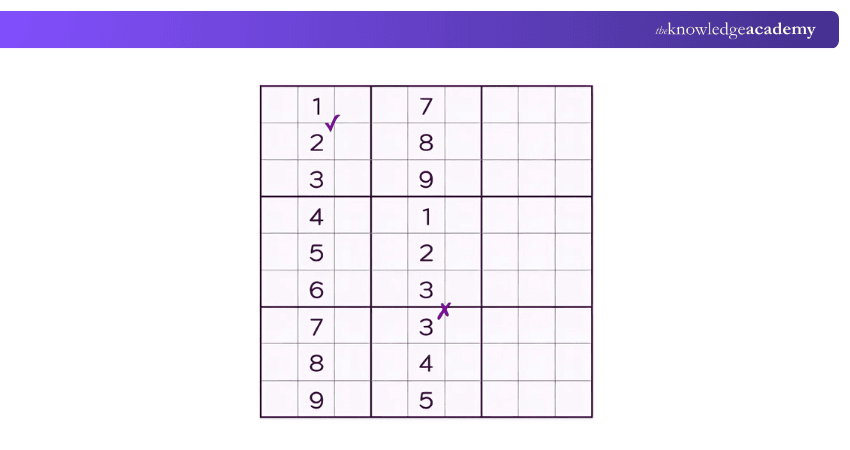
There are nine vertical columns. Each column must include the numbers 1-9 without repeating. Since each column has nine spaces, filling in the numbers correctly means no duplicates.
Rule 2: Each 3x3 Box Must Contain the Numbers 1-9 Exactly Once
The grid is also divided into nine small 3×3 boxes. Each box must contain the numbers 1-9 without repeats.
Rule 3: Avoid Guessing
Sudoku is a game of logic, not guessing. If you don’t know a number, keep looking at the grid. Find spaces where a number must go based on the rules. Do not force a number into a space, Sudoku is about patience, patterns, and careful thinking.
Do you want to understand the major theoretical perspectives on child development? Join our Child Psychology Course now!
Rule 4: Do Not Repeat Numbers
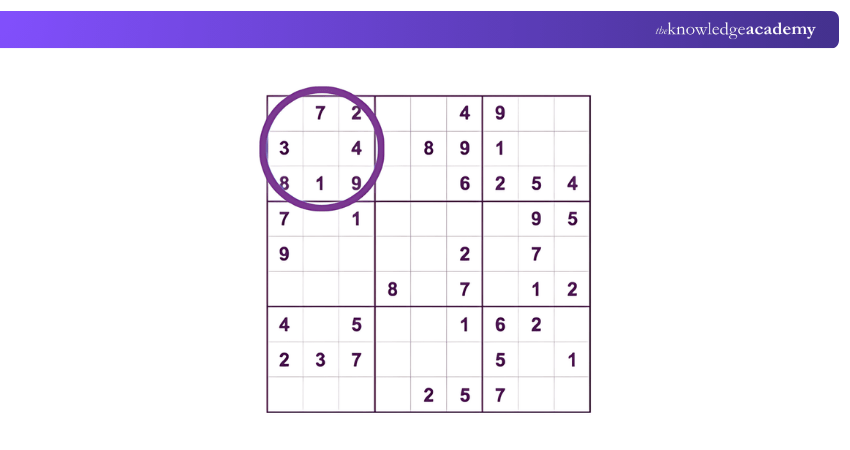
Look at the upper left box (circled in blue). It already has 7 numbers filled in, so only 5 and 6 are missing. By checking which numbers are missing in each row, column, and box, we can use logic to find the right numbers.
For example, in the upper left box, we know we need 5 and 6. But since we can’t yet tell which space they belong in, we should leave this box for now and look for other easier spaces to fill.
Reduce stress and build resilience with our Mindfulness Training – Register today!
Rule 5: Apply Process of Elimination
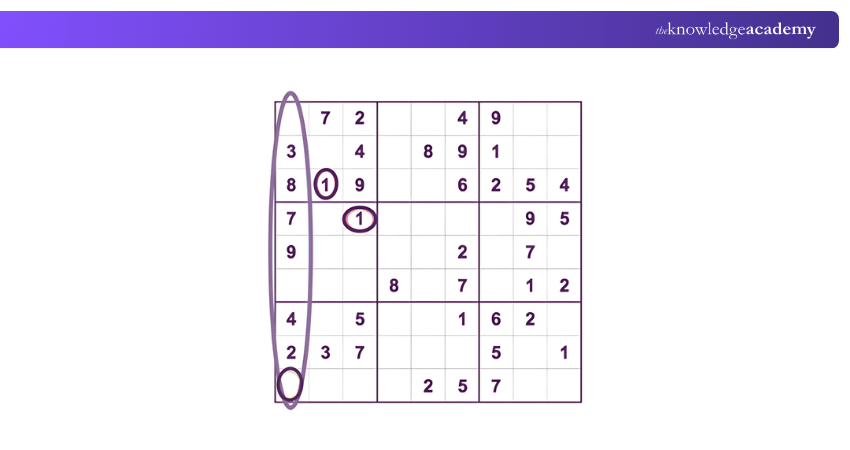
The process of elimination in Sudoku helps identify missing numbers and place them logically. For example, in the far-left column (circled in blue), the missing numbers are 1, 5, and 6. Checking the grid, we see that 1 is already in the top left and centre left boxes (circled in red).
Since only one space is left for 1, we place it there (circled in green). Sudoku has simple rules but endless challenges. Every puzzle follows the same logic, fill in missing numbers without repeating any in a row, column, or box.
Is putting your mind to work becoming stressful? Sign up for our Mental Health Courses to identify conditions!
Tips for Playing Sudoku
Each Sudoku puzzle starts with random numbers already filled in. The fewer numbers given, the harder the puzzle. Here are a few tips that will help you fill the numbers easily.
Start with the Easy Solutions
Some rows, columns, or boxes may have only one or two missing numbers. Check which numbers are missing and place them based on what is already in the grid.
Identify the Missing Numbers
Once you fill in some numbers, it may help you find others. A new number in a box or line can give clues for solving nearby spaces.
Continuously Scan the Entire Puzzle
If you are stuck, don’t focus on one area. Look around the grid for easy numbers to place. A quick scan can help you spot a solution.
Regularly Re-Evaluate the Grid
Every time you add a number, check if it helps solve another part of the puzzle. A new number in one row or box might make another number obvious.
Be Patient and Enjoy the Challenge
Sudoku is a game of logic. If you get frustrated, take a break and try again later. The goal is to enjoy the challenge and keep your brain active!
Can Sudoku Improve Your Thinking Capacity?
Yes! Sudoku helps boost memory, concentration, and problem-solving skills. It trains the brain to think logically and improves pattern recognition. Regular play can enhance mental agility and keep the mind sharp. Some studies suggest that Sudoku may even help reduce cognitive decline as people age.
How Long Does it Take to Solve a Sudoku Puzzle?
The time depends on difficulty and skill level. Easy puzzles take around 5–10 minutes, while medium puzzles may take 15–30 minutes. Hard and expert puzzles can take 30 minutes or more. With practice, players solve puzzles faster by improving their logical thinking and strategies.
Conclusion
Learning How to Play Sudoku tips is all about logic and patience. By following simple rules and using the process of elimination, you can fill in the grid step by step. Keep scanning, stay patient, and enjoy the challenge. With practice, Sudoku becomes easier and more fun to solve!
Learn how to handle your stress and build resilience for a happier life with our Handle Stress And Develop Your Resilience. Join today!
Frequently Asked Questions
Is Sudoku Harder Than Chess?

Sudoku and chess are different. Sudoku is a logic puzzle with fixed rules, while chess requires strategy, creativity, and adapting to an opponent. Sudoku has one solution per puzzle, but chess has endless possibilities. Chess is generally harder because it needs deeper thinking and long-term planning.
What is Sudoku Mistake?
A Sudoku mistake happens when a number is placed incorrectly. This breaks the rule of no repeated numbers in a row, column, or 3×3 box. A mistake can make the puzzle unsolvable. To avoid errors, double-check numbers and use logic before placing them.

Michael Jones


Health and Safety Consultant and Compliance Trainer
Michael Jones is a seasoned health and safety expert with more than 15 years of experience in workplace safety, risk management, and compliance training. He has worked across construction, manufacturing, and corporate sectors, helping organisations meet legal requirements and create safer working environments. Michael’s training and writing are known for being practical, clear, and aligned with UK regulations.
View Detail


 If you wish to make any changes to your course, please


