




We may not have the course you’re looking for. If you enquire or give us a call on +91-181-5047001 and speak to our training experts, we may still be able to help with your training requirements.
Home
 Resources
IT Service Management
How to Add ITIL Certification on Resume: A Detailed Explanation
Resources
IT Service Management
How to Add ITIL Certification on Resume: A Detailed Explanation
Resources
IT Service Management
How to Add ITIL Certification on Resume: A Detailed Explanation
How to Add ITIL Certification on Resume: A Detailed Explanation
ByJyoti TuraLast updated on: 07 October 2026
Are you aiming to land your dream job in IT Service Management? Crafting an impressive ITIL resume is your first step to success. With the right strategies, you can highlight your skills and experience effectively. Read this blog in detail and understand How to Add ITIL® Certification on Resume and stand out in the competitive job market.
Getting Started
Adding your ITIL® Certification to your resume is more than listing a credential. It should clearly show recruiters what you have achieved, who issued the certification, and how the knowledge relates to your IT Service Management skills. A well-placed certification can strengthen your professional profile and make your relevant expertise easier to identify.Start by using the exact certification title, include PeopleCert as the awarding body, add the date earned, and mention relevant ITIL skills where appropriate. If you are still working towards the certification, you can also include the expected completion date.
Have you ever wondered if your resume truly reflects your IT potential? In the current competitive job market, having the right skills isn’t enough; you need to showcase them the right way. That’s where certifications like ITIL come in. They prove you know your stuff in IT Service Management and can make a real impact. But here’s the key - knowing how to add ITIL Certification on resume can make all the difference in getting noticed by recruiters.
In this blog, we will show you exactly where and how to list your ITIL Certification to make your resume stand out. Let’s get started.
Understanding ITIL and Its Certifications
ITIL is an organisational framework for IT employees, outlining policies and procedures to assist businesses with their IT needs. Initially developed for managing government technological systems, ITIL is now a standardised list of IT best practices for organisations of all sizes. By following ITIL guidelines, IT employees can create checklists to accomplish their duties more efficiently.
ITIL® Certifications
ITIL Certifications validate knowledge and capabilities in ITIL best practices, while training courses help candidates prepare for certification. ITIL (Version 5) is the latest version and here are the certifications that you can complete for your professional development:
1) ITIL® 5 Foundation
This is an entry-level certification that introduces core concepts, terminology, and principles of IT service management. It is the starting point for all ITIL (Version 5) pathways.
2) ITIL® 5 Practice Manager (Version 5)
This is achieved by:
1) Completing ITIL® 4 Practice modules (which still remain valid)
2) Completing the ITIL® 5 Transformation module
ITIL® 4 Practice modules are grouped into:
1) Monitor, Support and Fulfil (MSF): It covers service desk, incident management, problem management, service request management, and monitoring and event management.
2) Plan, Implement and Control (PIC): It covers change enablement, deployment management, release management, service configuration management and IT asset management.
3) Collaborate, Assure and Improve (CAI): It covers relationship management, supplier management, service level management, continual improvement and information security management.
3) ITIL® 5 Managing Professional (MP)
Designed for professionals managing digital products and services, this designation develops capabilities across ITIL Product, ITIL Service, ITIL Experience and ITIL Transformation. It focuses on managing products and services across their lifecycles while supporting value, service performance, customer experience and transformation. For new candidates, the pathway comprises ITIL Foundation (Version 5), ITIL Product, ITIL Service, ITIL Experience and ITIL Transformation.
4) ITIL® 5 Strategic Leader (SL)
Aimed at professionals working at a strategic level, this designation focuses on connecting digital product and service management with organisational strategy. For new candidates, the pathway comprises ITIL Foundation (Version 5), ITIL Strategy and ITIL Transformation, covering areas such as strategic direction, governance, transformation and value creation.
Build leadership and governance expertise with the ITIL® 5 Strategy Certification Training – Register today!
5) ITIL® 5 Transformation
ITIL Transformation (Version 5) is a core module forming part of all three designations: Practice Manager, Managing Professional and Strategic Leader. It only needs to be completed once. It focuses on organisational change, digital evolution, and embedding modern ways of working within organisations.
6) ITIL® 5 AI Governance
ITIL® AI Governance (Version 5) is an extension module focused on responsible and scalable AI governance. It covers AI benefits and risks, accountability, governance models, regulatory considerations and responsible AI adoption across products, services and operations.
7) ITIL® 5 Master
ITIL Master is the highest designation in the ITIL qualification scheme. For new candidates, it is awarded after achieving the ITIL Practice Manager, ITIL Managing Professional and ITIL Strategic Leader (Version 5) designations, following ITIL Foundation (Version 5).
Benefits of Earning an ITIL® Certification
While not mandatory for IT positions, earning an ITIL Certification offers various advantages. Here are some key benefits:
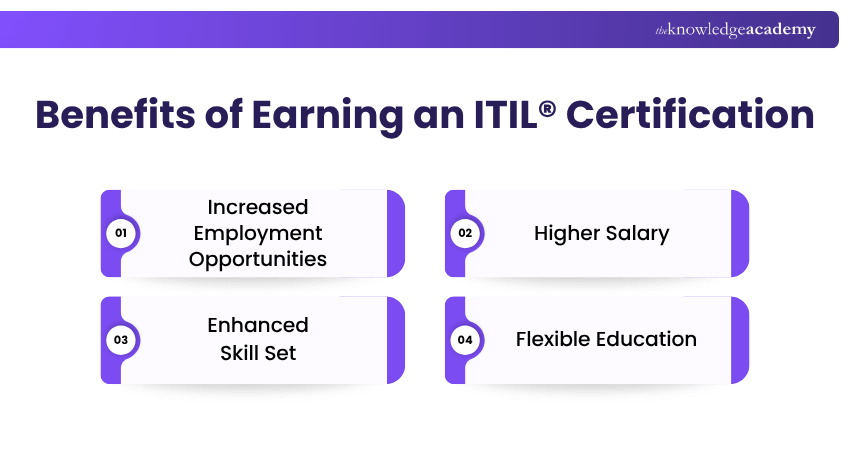
1) Increased Employment Opportunities: Many businesses prefer IT employees with ITIL Certification, enhancing your job prospects. It can also help your resume stand out from other candidates.
2) Higher Salary: ITIL Certification can support professional development and progression into roles that value IT service management expertise, although salary outcomes depend on factors such as role, experience, location and employer.
3) Enhanced Skill Set: ITIL Certification improves your proficiency as an IT employee. The skills learned in these courses can boost your confidence and effectiveness in your daily tasks.
4) Flexible Education: ITIL Certification courses offer the flexibility to complete courses at home or online. This can be beneficial if you have a busy schedule, allowing you to enhance your understanding of IT responsibilities in your free time.
How to Add ITIL® Certification to Your Resume?
Every resume is unique, but there's a commonly accepted format for listing certifications. Here are the steps to efficiently include your ITIL® Certification:
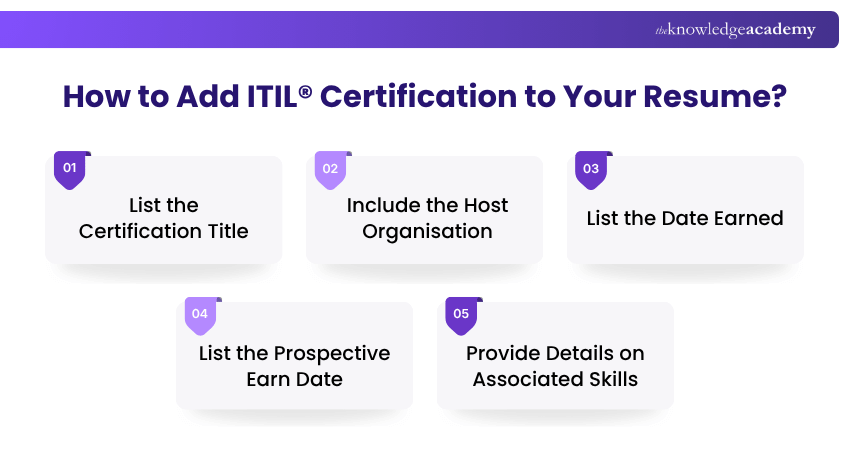
1) List the Certification Title: Use the official certification name shown on your PeopleCert certificate, such as “ITIL® Foundation (Version 5)”, under a dedicated “Certifications” section.
2) Include the Host Organisation: Mention the official examination body that issued your ITIL® Certification. If submitting a digital version, you can add a link to the certification and the issuing body’s website for reference.
3) List the Date Earned: Provide the date you earned your ITIL® certification. ITIL Certifications have a three-year renewal cycle, so you can also include the current renewal/expiry date shown on your PeopleCert credential where relevant.
4) List the Prospective Earn Date: If you are in the process of earning the ITIL® Certification, include the expected award date and an estimate of your progress in the certification process.
5) Provide Details on Associated Skills: If space permits and the skills are relevant, include a brief list of the key skills associated with the ITIL® Certification. This helps clarify its relevance and addresses any questions the reader might have.
Trainer’s Insight: Don’t list the certification in isolation. Add a few relevant skills, such as service management, continual improvement, or stakeholder management, so employers can quickly understand how the certification supports your practical capabilities.
Learn IT service strategies with our Certified IT Service Manager Certification – Sign up now!
How to Add ITIL® Certification to Your LinkedIn?
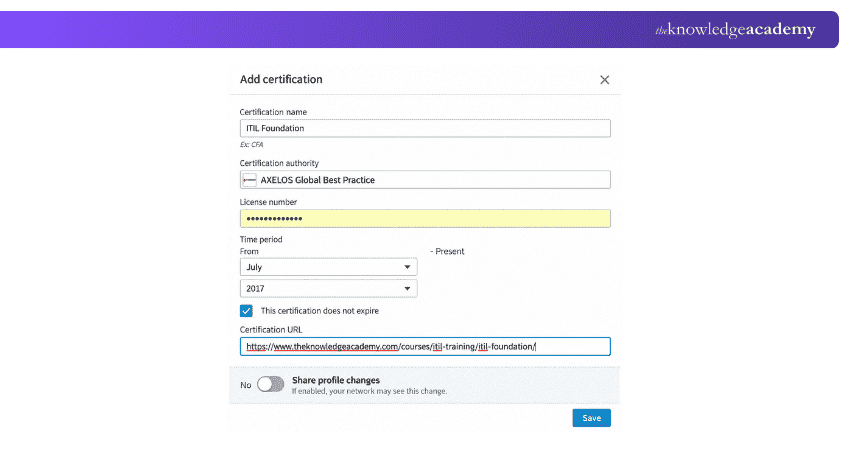
Showcasing your ITIL® Certification on LinkedIn is a great way to highlight your expertise in IT service management and attract potential employers. Follow these simple steps to add your ITIL® Certification to your LinkedIn profile and make your qualifications stand out.
1) Log in to your LinkedIn Account
2) On your profile, scroll down to ‘Accomplishments'
3) Click the ‘plus’ and choose ‘Certification'
4) Fill in the ‘Certification name’. For the certification authority, start to type and then select the certificate issuing body’s name 5) Fill in your license number (you can easily find this on your certificate) and select ‘This certification does not expire'
5) Fill in your license number (you can easily find this on your certificate) and select ‘This certification does not expire'
6) For the ‘Certification URL’, you can add the URL of your ITIL course.
7) That’s it! Click save
Tips for Formatting Your ITIL Resume
Creating a well-formatted ITIL resume is important to catch the recruiters’ and Hiring Manager's attention. Here are a few key tips to help you present your skills and experience in the best possible light.
1) Length: You should keep your resume to 2 pages or less. Recruiters and Hiring Managers don't have much time to read each resume, so brevity ensures they see all the important information.
2) Font and Text: Simplicity is key for a pleasant reading experience. Use a clear, professional font and break up the text with bullet points to make the information easily digestible. Avoid fancy fonts that can be hard to read.
3) Design and Structure: Choose a resume design that is both attractive and easy to read. Clearly separate sections with large headings and dividing borders. Maintain a simple colour scheme and avoid filling the page with too much text or graphics.
4) Photos and Images: Resume conventions vary by country and industry. Check local hiring practices before including a photograph or other personal imagery.
ITIL Professional Resume Template
Here is a resume template, which will help you understand an ITIL professional better. Let’s dive in!
[Your Name]Address: [Your Address], [City], [State], [Zip Code]Phone: [Your Phone Number]Email: [Your Email Address]LinkedIn: [Your LinkedIn Profile URL]Certification: ITIL® CertifiedProfessional SummaryDetail-oriented ITIL Specialist with [X] years of experience in IT Service Management, application configuration support, and process optimisation. Proficient in ITIL V5 processes and lifecycle management. Skilled in automated database reporting tools, project management, and team leadership.Work ExperienceITIL Specialist, [Company Name] Month Year – Presenta) Oversee the IT service desk to ensure timely and adequate resolution of incidents and service requests.b) Create and execute IT Service Management policies, procedures, and standards to maintain consistency and quality.c) Perform regular service reviews with stakeholders to identify improvement areas and align with business goals.d) Manage and observe Service Level Agreements (SLAs) to ensure compliance and find opportunities for enhancement.e) Lead IT projects, ensuring timely delivery and clear communication with stakeholders.f) Maintain a good relationship with vendors and service providers to ensure effective IT service delivery.g) Manage and monitor IT budgets to deliver services cost-effectively and identify potential cost savings.h) Design and enforce IT security policies and procedures to secure the confidentiality, integrity, and availability of IT systems and important data.i) Provide leadership and guidance to IT staff for effective performance management and professional development.IT Support Specialist, [Previous Company Name] Month Year – Month Yeara) Provided technical support to employees, resolving IT issues promptly and efficiently.b) Assisted in developing IT policies and procedures.c) Maintained and updated IT equipment to ensure smooth operations.EducationBachelor’s Degree in Computer Science University of [University Name], YearCertificationsITIL V5 Foundation Certificationa) Authority: PeopleCertb) Date Earned: [Month Year]c) Certification URL: [Link to Certification or Course]Project Management Professional (PMP)a) Authority: Project Management Instituteb) Date Earned: [Month Year]Skillsa) ITIL V3 Processes and Lifecycle Managementb) Application Configuration Supportc) Automated Database Reporting Toolsd) Project Managemente) Excellent Oral and Written Communicationf) Strong Organisational and Presentation Abilitiesg) IT Security Policies and Proceduresh) Vendor and Service Provider ManagementReferencesAvailable upon request.
Learn how to align products with business outcomes through ITIL® 5 Product Certification Training – Join soon!

Jyoti Tura is a Senior Web & UX/UI Manager with 7+ years of experience in front-end development, web development and user-focused interface design. Her technical expertise and managerial responsibilities support her knowledge across IT and Tech, Leadership and Management.
View Detail

 If you wish to make any changes to your course, please


