


 Top Rated Course

We may not have the course you’re looking for. If you enquire or give us a call on 01344203999 and speak to our training experts, we may still be able to help with your training requirements.
Control Statements in C: Types, Syntax, and Examples
The Knowledge Academy 16 July 2026Do you want to learn to manage the program's flow in C Programming Language? Having a grasp of Control Statements is crucial for directing the flow of a program. This blog will explore the Control Statements in the C Programming Language. Also, we’ll know its importance, uses, types, and Goto Statements in C.

Training Outcomes Within Your Budget!
We ensure quality, budget-alignment, and timely delivery by our expert instructors.
Table of Contents

Do you want to build a career in C Programming? Understanding Control Statements is essential for directing program flow effectively, making it more responsive and dynamic. This blog will guide you through the fundamentals of Control Statements in C and show how they optimise code.
These programming tools are indispensable for making decisions using 'if-else' statements. Let's dive into mastering Control Statements and elevate our programming skills.
Table of Contents
1) What Are Control Statements in C?
2) Why Do We Use Control Statements In C Programs?
3) Different Types of Control Statements in C
a) Decision-Making Control Statements in C
b) Loop Control Statements in C
c) Conditional Control Statements in C
d) Goto Statements in C
4) Conclusion
What Are Control Statements in C?
In the C Programming Language, Control Statements enable systems to perform pre-defined logical instructions. They also decide whether to follow the set of statements or not. Control Statements are extremely important for giving the right direction to the program's flow and enabling conditional executions.
Through Control Statements in C, programmers can create responsive and dynamic applications using ‘if-else’ and ‘switch’ statements. These statements also help in decision-making and controlling program sequence, making sure only the right code gets executed. Control Statements give programmers flexibility to create effective and efficient applications.

Why Do We Use Control Statements In C Programs?
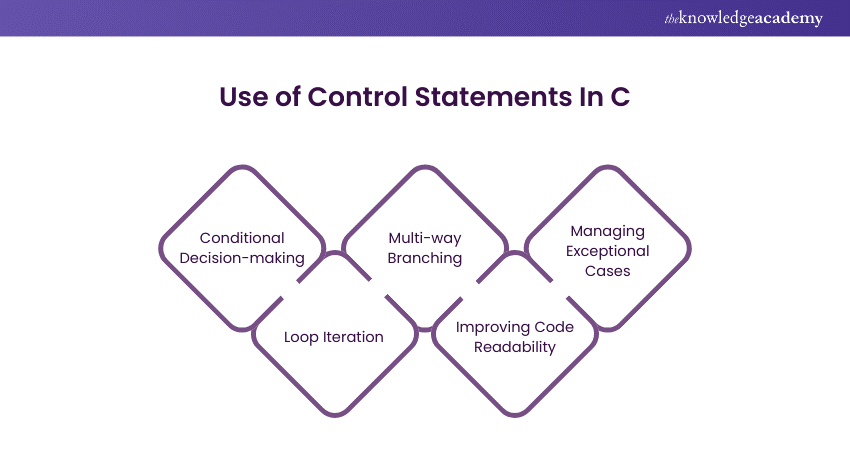
Control structures are vital for the Structure of C Programs. enabling developers to direct the execution flow according to requirements. These expressions are necessary for decision-making, reiterating tasks, and controlling a program's reactions to various scenarios. Here is how Control Statements improve the writing of C programs:
1) Making Decisions with Conditional Control Statements
Conditional Control Statements such as ‘if’ and ‘switch’ allow programmers to determine actions based on certain conditions. These statements provide the option for branching, allowing the program to take different paths based on the condition's result. The capacity to implement logic and generate dynamic behaviour is essential for flexible and adjustable programming.
2) Iterating with Loop Control Statements
Loop Control Statements like ‘for’, ‘while’, and ‘do-while’ are utilised to iterate through a block of code repeatedly until a specific condition is satisfied. These loops are essential for managing tasks that need to be repeated, like handling data sets, input reading, or calculations. By utilising loops, coders can prevent repeating code and simplify processes, enhancing the code's efficiency and adaptability.
3) Multi-Way Branching
The switch statement allows for branching in multiple ways depending on the expression's value. This is especially handy in cases with various possible results where distinct measures are required for each. It streamlines the code and facilitates handling different scenarios.
4) Enhancing Code Readability and Maintainability
Control Statements make the code more readable and maintainable, contributing significantly to the C language. By clearly showcasing the intended logic, these statements make it simple for developers to understand the program's flow. This coherence is essential for debugging and collaborative work; an organised code is easier to follow and modify.
5) Handling Exceptional Cases with Control Statements
Control Statements such as python break and continue statement offer mechanisms to carry out exceptional cases and change the normal flow of execution. They allow programmers to exit loops early, skip specific iterations, or jump to specific parts of the code. This flexibility is vital for sustaining an unusual situation, validating inputs, or implementing error-handling routines correctly.
Control Statements in C are mandatory tools that help developers create more intelligent and efficient program. Thus, ultimately giving better solutions.
Don’t miss out! Sign up for our C Programming Training and build a strong foundation in coding. Register now and get started!
Different Types of Control Statements in C
In C Programming Language, you will find different types of Control Statements. Let’s explore each of these statements in the following sections:
1) Decision-Making Control Statements in C
a) If Statements
The if statement checks a condition and executes the code block inside if the condition is proper.
|
#include int main() { int number = 10; if (number > 5) { printf("The number is greater than 5.n"); } return 0; } |
b) If-Else Statement
The if-else statement provides an alternative path when the if condition is false.
|
#include int main() { int number = 3; if (number > 5) { printf("The number is greater than 5.n"); } else { printf("The number is not greater than 5.n"); } return 0; } |
c) Nested If-Else Statements
Nested if-else statements allow for more complex decision-making by including multiple if conditions within each other.
|
#include int main() { int number = 15; if (number > 10) { if (number < 20) { printf("The number is between 10 and 20.n"); } else { printf("The number is 20 or more.n"); } } else { printf("The number is 10 or less.n"); } return 0; } |
d) Else-If Ladder Statements
The else-if ladder allows checking multiple conditions in sequence.
|
#include int main() { int score = 85; if (score >= 90) { printf("Grade: An"); } else if (score >= 80) { printf("Grade: Bn"); } else if (score >= 70) { printf("Grade: Cn"); } else if (score >= 60) { printf("Grade: Dn"); } else { printf("Grade: Fn"); } return 0; } |
Elevate your coding skills with our C++ Programming Course and become a master- join now!
2) Loop Control Statements in C
Loop Control Statements in C enable programmers to perform a block of code multiple times. Here are some of them:
While Loop
The ‘while’ loop continues if the given condition remains true. The loop may not run if the condition is false initially, as it is checked before each iteration, just like in the Python While Loop.
|
#include int main() { int count = 1; while (count <= 5) { printf("Count is %dn", count); count++; } return 0; } |
Do-while Loop
Like the while loop, the ‘do-while’ loop checks the condition after executing the body of the loop, guaranteeing the loop will run at least once.
|
#include int main() { int count = 1; do { printf("Count is %dn", count); count++; } while (count <= 5); return 0; } |

For Loop
The ‘for’ loop is mainly used when the iterations are precise. It has three parts: initialisation, condition, & increment/decrement.
|
#include int main() { for (int i = 1; i <= 5; i++) { printf("Iteration %dn", i); } return 0; } |
These snippets have demonstrated the use of Loop Control Statements enabling precise management of repetitive tasks, which can help in preparing for C programming Interview Questions.
Start your journey into C language with our C Programming Course today!
3) Conditional Control Statements in C
These statements offer a systematic approach to managing various possible results in a program, improving its adaptability and clarity.
|
#include int main() { int grade = 'B'; switch(grade) { case 'A': printf("Excellentn"); break; case 'B': printf("Goodn"); break; case 'C': printf("Averagen"); break; case 'D': printf("Poorn"); break; default: printf("Invalid graden"); break; } return 0; } |
4) Goto Statements in C
The Goto Statement transfers the control flow to a specific point in a program, making it a type of jump control statement. It directs the program to a labelled section, allowing immediate branching to that part of the code.
|
#include int main() { int number = 3; printf("Checking number...n"); if (number < 0) { goto negative; } printf("Number is positive or zero.n"); goto end; negative: printf("Number is negative.n"); end: printf("End of program.n"); return 0; } |
Explore our detailed blog on Fibonacci Series in C Programming and discover tips and tricks for writing efficient code.
Conclusion
We hope you have learned the Control Statements in C well. These essential tools are crucial for helping your programs' execution flow. You can craft efficient, readable, and maintainable code by mastering constructs like if, else, switch, loops, and jump statements. Following best practices ensures that Control Statements improve your development process rather than complicate it. As with any programming concept, proficiently using Control Statements effectively in C comes with training and experience. To transition smoothly from C to C#, referencing a C Sharp Cheat Sheet can provide quick guidance on how control statements are structured and utilized in C#.
Unlock your potential with our C# Programming Course and expand your skills- Register now!
Frequently Asked Questions
Can You Use 'if' Statements Within a 'for' Loop in C?

You can utilise ‘if’ statements inside a ‘for’ loop. It enables programmers to execute conditional checks during iteration. Thus, complex logic can be used within the loop.
Can Control Statements be Nested in C?
Yes, you can nest Control Statements in C. For example, use ‘if’ statements within the ‘for’ loop to make complex decisions.
How Does the 'Switch' Statement Work in C?
The ‘switch’ statements identify a variable in multiple cases. When it is identified, the code related to it is executed. In case it’s unavailable, the system runs the ‘default’ case.

The Knowledge Academy


Global Training Provider
The Knowledge Academy is a world-leading provider of professional training courses, offering globally recognised qualifications across a wide range of subjects. With expert trainers, up-to-date course material, and flexible learning options, we aim to empower professionals and organisations to achieve their goals through continuous learning.


 If you wish to make any changes to your course, please


