




We may not have the course you’re looking for. If you enquire or give us a call on +44 1344 203 999 and speak to our training experts, we may still be able to help with your training requirements.
What is C Programming: A Comprehensive Overview
ByNilotpal SarmahLast updated on: 10 October 2026
C is a powerful, general-purpose programming language created by Dennis Ritchie at Bell Labs in the 1970s. Known for its speed and efficiency, it was developed largely for implementing the Unix operating system and remains a foundation for modern programming and software development.

The Main Ideas
1. Understand how programs interact with memory and system resources.2. Develop stronger programming logic and problem-solving skills.3. Build knowledge of functions, pointers and data handling.4. Learn how software operates closer to the system level.5. Strengthen core skills that support learning other programming languages.
Ever wondered how the software you use daily is built from the ground up? The answer often lies in a language that's been around for decades yet remains incredibly relevant: C. What is C programming? It's the foundational language that has shaped the digital world as we know it. From operating systems to embedded systems, C's influence is undeniable.
This comprehensive blog will explore C programming, including its history, core concepts and applications. Whether you're a budding programmer or a seasoned developer, understanding C will provide valuable insights into the heart of computer science. Let's dive in!
What is C Programming?
C programming is a high-level, multi-purpose programming language that excels in developing firmware and portable applications. Developed by Dennis Ritchie in the early 1970s, C offers low-level access to memory and a straightforward set of keywords.
This combination of features makes C an ideal choice for system programming. Over the decades, C has become one of the most widely used programming languages, influencing many modern languages such as C++, C#, and Java.
C programming offers a balance between high-level abstraction and low-level control, making it a versatile language. Its core syntax is relatively straightforward to learn, while features such as pointers and memory management provide the low-level control needed for complex system software. This versatility and efficiency have cemented C's place as a fundamental programming language in the field of computer science and software engineering.

The Evolution of C Programming
The history of C programming dates back to the early 1970s, when Dennis Ritchie developed C at Bell Labs as an evolution of the B programming language, largely to support the development of the Unix operating system. The result was C, which quickly became an important language for system programming.
In 1978, the release of "The C programming language" by Kernighan and Ritchie, often referred to as K&R, documented the language and contributed significantly to its widespread adoption. The book became an influential reference for C programmers and helped establish many widely followed conventions and practices.
During the 1970s, Unix was largely rewritten in C, demonstrating the language's portability and suitability for system programming. C's influence continued to grow during the 1980s. In 1989, the American National Standards Institute (ANSI) formalised C, creating the ANSI C standard. This standardisation helped improve consistency and portability across different implementations of the language.
C has continued to evolve through later standards, including C99, C11, C17 and C23. As of 2026, C23 (ISO/IEC 9899:2024) is the current published C standard, while work on the next revision is ongoing.
Features of C Programming
C programming is renowned for several features that contribute to its enduring popularity:
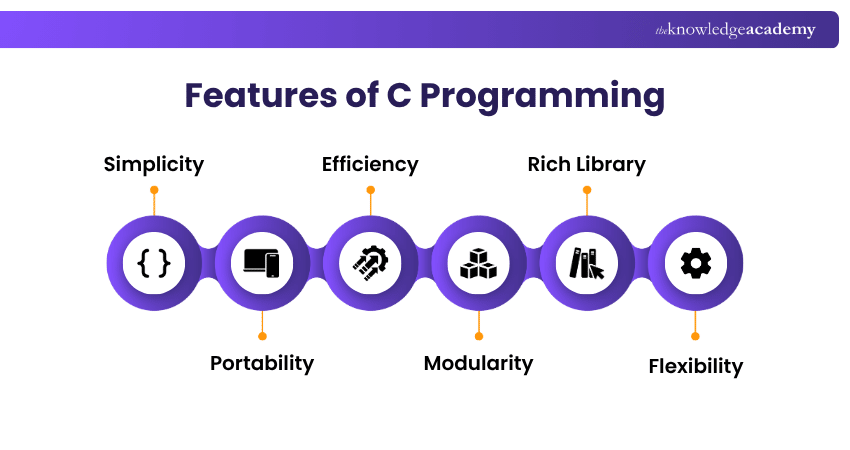
1) Simplicity
C has a relatively small set of keywords and a concise syntax. Its core syntax can be straightforward to learn, although mastering areas such as pointers and memory management requires deeper understanding. The language's concise syntax allows for writing clear and readable code.
2) Portability
Programs written in standard C can often be moved between systems with minimal changes, provided they avoid platform-specific dependencies. This portability makes C a useful choice for developing cross-platform software. By following standard C and avoiding platform-specific dependencies, developers can improve portability across different systems and compilers.
3) Efficiency
C provides low-level access to memory and hardware, making it highly efficient for system-level programming. The language's minimal runtime overhead can help programs run quickly and use resources effectively. This efficiency is crucial for developing performance-critical applications such as operating systems and embedded systems.
Trainer Insight
Choosing C does not automatically make a program fast. Performance also depends on factors such as algorithm choice, memory use, compiler optimisation and the way the code is implemented.
4) Modularity
C supports functions, allowing code to be organised into reusable components. This modularity promotes code reusability and maintainability, enabling developers to build complex systems from smaller, manageable components.
5) Rich Library
C has a standard library that provides functions for common programming tasks, including input/output, string handling and memory management. These functions extend the language's capabilities and reduce the need to implement common operations from scratch.
6) Flexibility
C can be used for a broad range of applications, from system software to game development. Its flexibility and power make it suitable for developing various types of software, including operating systems (OS), embedded systems, network applications, and more.
Understand memory management to enhance code performance with our C++ Programming (C Plus Plus) Training – Join now!
Applications of C Programming
C programming's versatility makes it suitable for various applications across different domains. Here are some notable examples:
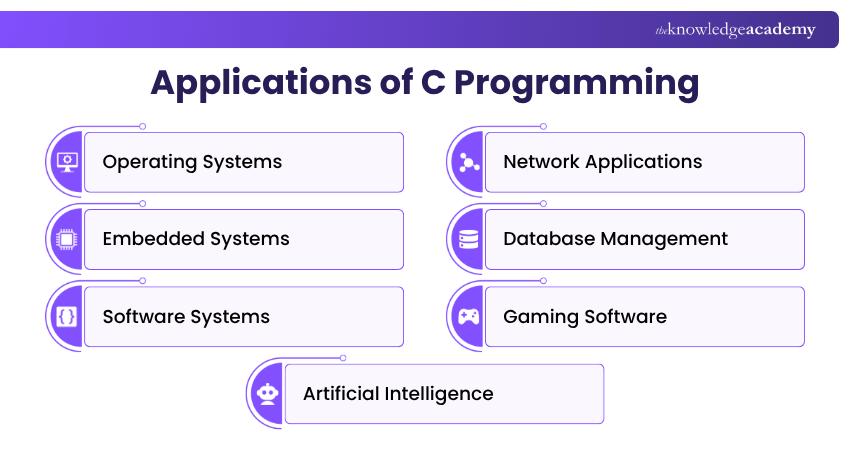
1) Operating Systems
C is widely used in operating systems and systems programming because of its efficiency and low-level capabilities. It allows developers to work closely with memory and system resources, making it suitable for writing efficient operating system components.
Unix, one of the earliest and most influential operating systems, was largely rewritten in C during the 1970s. Other Operating Systems (OS) like Linux, Windows, and macOS have core components written in C. The language's efficiency and control over system resources are crucial for managing hardware and executing processes reliably.
2) Embedded Systems
Embedded systems are specialised computing systems that perform dedicated functions within larger systems. C is widely used in embedded programming because of its ability to directly manipulate hardware and its efficient use of resources.
Examples of embedded systems programmed in C include automotive control systems, medical devices, consumer electronics, and industrial machines. The language's close-to-the-metal capabilities can help developers build systems that meet performance and real-time requirements.
3) Software Systems
C is used to develop various software systems, including compilers, interpreters, and utility programs. Its efficiency and control over system resources make it a suitable option for building robust and high-performance software infrastructure.
For example, many compilers and interpreters for other programming languages are written in C, leveraging its speed and reliability. Utility programs such as text editors, file managers, and system monitors also benefit from C's efficiency.
4) Network Applications
Networking software often requires efficient and reliable communication protocols. C's speed and low-level access make it suitable for developing network applications such as routers, switches, and firewalls. Many implementations of networking protocols, including TCP/IP stacks, as well as network monitoring tools, are written in C. The language's ability to handle low-level data manipulation and real-time processing is essential for developing robust and high-performance network applications.
5) Database Management
C is used to develop database management systems (DBMS) and related tools. Popular DBMS like PostgreSQL have core components written in C. C's performance and low-level control make it well suited to implementing performance-critical components of database systems.
6) Gaming Software
The gaming industry demands high performance and real-time processing. C has historically been used in game development and remains useful for low-level libraries, platform-specific code and performance-sensitive components. However, many modern game engines use languages such as C++; for example, Unreal Engine primarily uses C++ for programming. C's low-level capabilities can still be valuable in performance-critical software.
7) Artificial Intelligence
While higher-level languages like Python are commonly used in AI research, C can be used to implement performance-critical components and underlying libraries. Applications involving real-time or resource-constrained processing, such as robotics and embedded computer vision, may use C where low-level control and efficiency are important.
Elements of a C Program
A C program consists of several key elements that work together to perform tasks:
C Program at a Glance
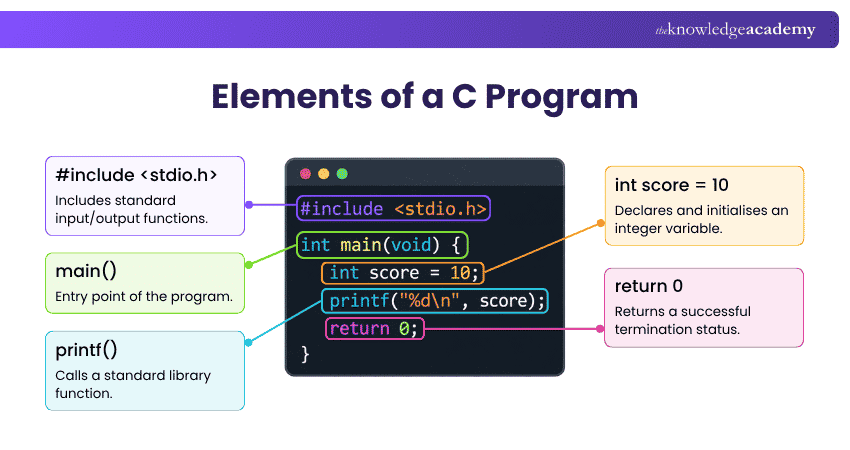
1) Header Files
Header files commonly contain function declarations, macro definitions, type definitions and other declarations shared between source files. They are included using the #include directive. Common header files include stdio.h for standard input/output functions, stdlib.h for general utilities, including memory allocation, and string.h for string-handling functions.
2) Main Function
In a hosted C program, execution begins with the main() function. It typically contains the core logic of the program and calls other functions as needed. In a hosted C program, main() returns an int, which can communicate the program's termination status to the execution environment.
3) Variables
Variables are used to store the data that can be manipulated by the program. They are defined with a specific data type and can hold different values throughout the program's execution. Variables provide a way to store and manipulate information dynamically.
4) Data Types
C supports various data types, including int, float, char, and double, to define the type of data stored in variables. These data types allow for representing different kinds of information, such as integers, floating-point numbers, characters, and more.
5) Operators
C provides a broad range of operators for performing arithmetic, logical, and bitwise operations, including various operators in C programming that allow for efficient manipulation of data. Arithmetic operators include +, -, *, and /. Logical operators include && (logical AND) and || (logical OR). Bitwise operators include & (bitwise AND) and | (bitwise OR). Operators enable various computations and manipulations within the program.
6) Control Statements
Control statements like if, else, while, for, and switch are used to control the flow of the program. They allow for making decisions, repeating actions, and branching the program's execution based on certain conditions. Control statements in C provide the ability to create complex and dynamic behaviour in the program.
7) Functions
Functions are blocks of code that execute specific tasks. They can be user-defined or provided by libraries. Standard library functions such as printf() and scanf() provide commonly used functionality. User-defined functions allow developers to create reusable and modular code, improving the program's structure and maintainability.
8) Pointers
Pointers in C are variables that store memory addresses, playing a crucial role in dynamic memory allocation and the manipulation of arrays and strings.
Pro Tip
Build a clear understanding of memory addresses, dereferencing and pointer validity before moving to dynamic memory allocation. A strong foundation here can help prevent common pointer-related mistakes.
Understand the working of embedded systems with our Introduction of Embedded C Programming Training – Register now!
Advantages and Disadvantages of C Programming
C programming offers efficiency, flexibility and low-level control, but it also comes with certain limitations. Let's explore its key advantages and disadvantages to understand these trade-offs:
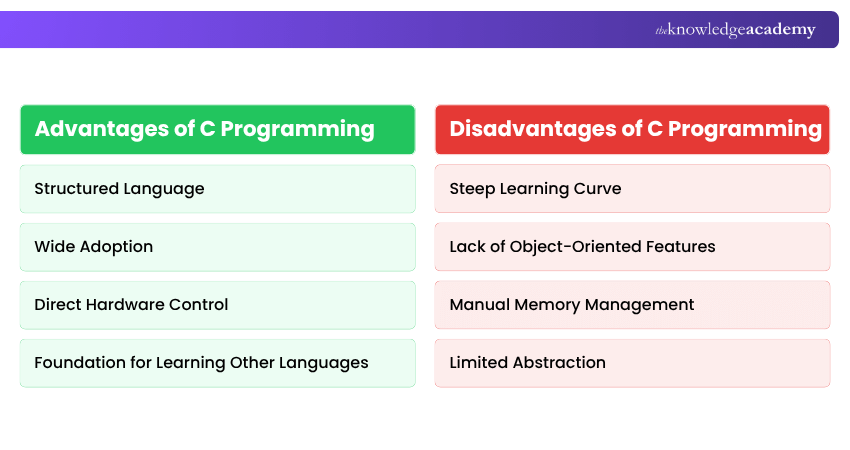
Advantages
a) Structured Language: C supports structured programming through functions and control structures. This approach encourages clear and organised code, making programs easier to understand, debug and maintain.
b) Wide Adoption: C has been widely adopted across industries for decades, leading to a vast ecosystem of tools, compilers, libraries, documentation and learning resources. This extensive support makes development and troubleshooting easier.
c) Direct Hardware Control: C provides low-level capabilities that can enable close interaction with hardware on supported platforms, making it well suited to firmware and embedded systems where precise control over system resources is required.
d) Foundation for Learning Other Languages: Learning C offers a strong foundation for understanding programming concepts such as data types, control flow, functions, pointers and memory management. Its syntax and concepts can also make it easier to understand C-influenced languages such as C++ and Java.
e) Extensive Ecosystem and Resources: C has a mature ecosystem with numerous compilers, libraries, development tools, documentation and open-source projects available to support learning and software development.
Disadvantages
a) Steep Learning Curve: Although C has a relatively compact syntax, concepts such as pointers, manual memory management and undefined behaviour can be challenging for beginners. Programming errors can also lead to issues such as segmentation faults and other unexpected behaviour.
b) Lack of Object-Oriented Features: C does not support Object-Oriented Programming (OOP), making it less suitable for certain applications that benefit from OOP principles, such as inheritance, encapsulation, and polymorphism. Developers often turn to languages like C++ for OOP support.
c) Manual Memory Management: C requires programmers to manage dynamically allocated memory manually, which can lead to issues like memory leaks, dangling pointers and use-after-free errors if memory is handled incorrectly.
d) Limited Abstraction: C provides limited abstraction compared to higher-level languages, requiring more detailed and low-level programming. This lack of abstraction can make code more complex and harder to maintain, especially for large projects.
Common C Mistakes to Watch For
Small mistakes in C can lead to errors or unexpected behaviour. Watch out for:
1. Forgetting semicolons2. Using the wrong format specifier3. Using variables before properly initialising them4. Accessing arrays outside their valid bounds5. Dereferencing invalid pointers6. Forgetting to release dynamically allocated memory7. Ignoring compiler warnings
Acquire proficiency in implementing the components of the C language with our C Programming Course – Join today!

Nilotpal Sarmah is a Senior Content Writer with 11+ years of overall experience spanning engineering, operations and content development. His technical knowledge and extensive writing experience enable him to simplify specialised topics across IT and Tech, Business Skills, Project Management, Health and Safety, and ISO and Compliance.
View Detail

 If you wish to make any changes to your course, please


