




We may not have the course you’re looking for. If you enquire or give us a call on 01344203999 and speak to our training experts, we may still be able to help with your training requirements.
Structure of C Program: Brief Overview
ByNilotpal SarmahLast updated on: 10 October 2026
The structure of C program defines the arrangement of headers, the main() function, and code blocks. A typical C program may include preprocessor directives, the main() function, declarations, statements and user-defined functions.
The Main Idea
1. C programs can contain declarations, definitions, statements and functions.2. main() marks the entry point in a hosted C environment.3. Header files provide declarations needed from libraries or other modules.4. Functions break larger tasks into smaller, reusable operations.5. Source code passes through several stages before becoming an executable.
Learning the basics of C programming requires a fundamental grasp of the structure of C programs. A clear structure helps organise different parts of the code and makes the program easier to understand and maintain. The arrangement of a C program consists of different code blocks, functions, and statements that direct the program's flow.
Different components serve specific purposes in organising the code and supporting its operation. Understanding this format assists in creating structured, coherent, and easier-to-maintain code.
Whether you are new to programming or refreshing your abilities, understanding the structure of the program is a crucial step towards becoming a skilled C Programmer. Let's discover how this framework lays the groundwork for C programming in this blog.
What is the Structure of C Program?
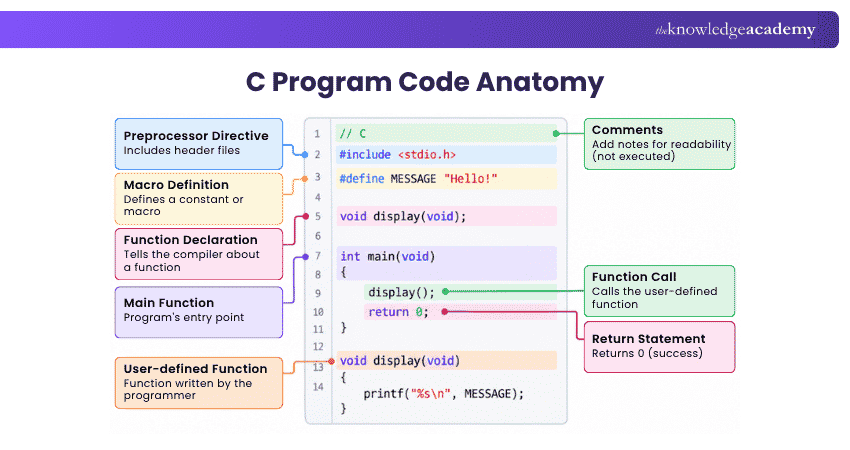
The structure of a C program refers to the way its different components are organised to support clear and logical code execution. A C program may include preprocessor directives such as #include for including header files and #define for defining macros. In a hosted environment, the main() function serves as the designated starting point of the program. Code blocks, statements and control flow constructs help define and control the program's logic.
The main() function may use a return statement to pass a termination status to the host environment. Returning 0 conventionally indicates successful execution.
Pro Tip
Keep each function focused on one clear task. Smaller, well-named functions make C programs easier to test, debug and reuse.

Importance of the Structure of a C Program
Starting with a new programming language can be confusing, especially when it comes to the basic program structure. Without a clear understanding of how statements, variables, functions, braces and parentheses are used, code can become difficult to organise and may lead to errors.
Understanding the language’s structure provides guidance on where and when to use each component, enhancing clarity and maintaining interest. A well-defined structure can help reduce coding mistakes and act as a roadmap, allowing clearer and more organised program writing.
Different Sections of the C Program
For learning purposes, a C program can be organised into six common sections:
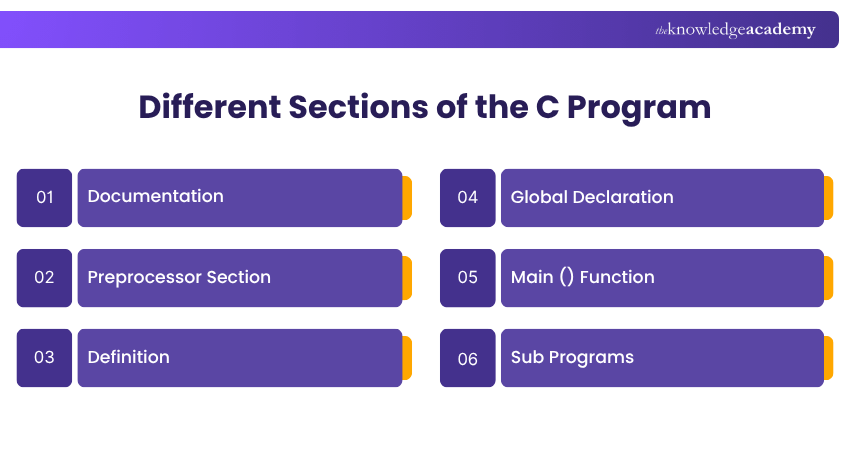
1) Documentation
This section may contain comments describing the program's purpose, author, creation date or other useful information. Comments are not executed and help readers understand the code.
// Description, program name, programmer name, date, time/* Description, program name, date, time */
2) Preprocessor Section
This section may use directives such as #include to include the contents of header files before compilation.
#include#include
3) Definition
Preprocessor directives beginning with # can perform tasks such as defining macros. For example, #define can define symbolic constants or function-like macros.
#define MAX_SIZE 100
4) Global Declaration
This section may contain file-scope variable declarations and function declarations. Where each name can be used depends on its scope and linkage.
5) Main () Function
The main function is the program’s entry point in a hosted environment, where program execution begins. It normally returns an int value representing the program's termination status.
int main(void){return 0;}
6) Sub Programs
User-defined functions may be defined outside the main() function and are executed when called from main() or another function.
int sum(int x, int y){return x + y;}
Grasp the ability to navigate larger programs effectively with our C Programming Training – Register now!
Steps Involved in the Compilation and Execution of a C Program
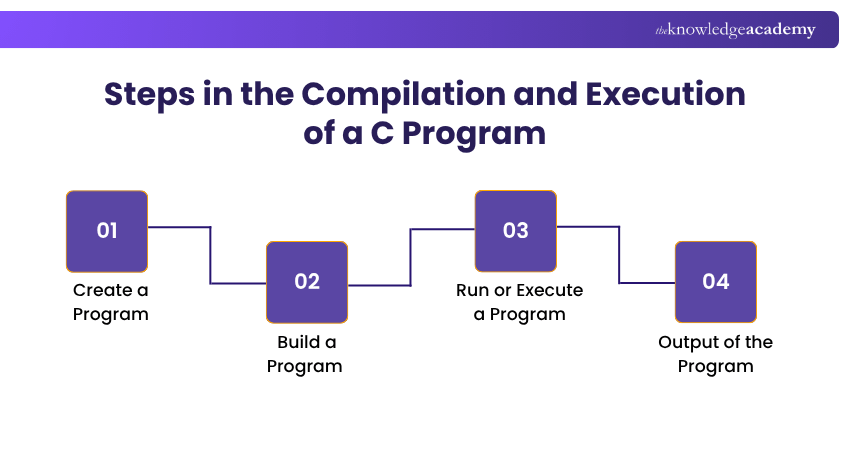
Let's understand the steps involved in the compilation and execution of a C program. Also, understand why it is crucial to turn your code into a functioning application.
1) Create a Program
Start by writing your C code in a text editor or IDE such as Visual Studio. This stage requires developing the logic, functions, and structure of your program.
2) Build a Program
Building a C program typically involves preprocessing, compilation, assembly and linking. During these stages, the source code is processed and translated into an executable form, while the compiler can report syntax and other compilation errors.
3) Run or Execute a Program
Once an executable has been created successfully, it can be run by the system. During execution, the program performs the operations defined by its instructions.
4) Output of the Program
If the program is designed to produce output, the result may be displayed on the screen, written to a file or sent to another destination according to the program's logic.
Understanding these steps complements your knowledge of the structure of C program and explains how source code becomes an executable program.
Common Beginner Mistakes to Avoid
☐ Forgetting required header files☐ Missing semicolons where they are required☐ Using mismatched braces or parentheses☐ Calling functions without appropriate declarations☐ Placing declarations in the wrong scope☐ Using inconsistent indentation
Some elements must be declared before they are used or otherwise made known through appropriate declarations. However, C does not require every program to follow the six sections in a rigid order. What matters is that declarations, definitions and dependencies are organised correctly.
Gain a comprehensive knowledge of how to code for microcontrollers from scratch with the Introduction of Embedded C Programming Training – Join today!

Nilotpal Sarmah is a Senior Content Writer with 11+ years of overall experience spanning engineering, operations and content development. His technical knowledge and extensive writing experience enable him to simplify specialised topics across IT and Tech, Business Skills, Project Management, Health and Safety, and ISO and Compliance.
View Detail

 If you wish to make any changes to your course, please


