




We may not have the course you’re looking for. If you enquire or give us a call on 01344203999 and speak to our training experts, we may still be able to help with your training requirements.
Causal Analysis vs. Root Cause Analysis: Detailed Comparison
ByNilotpal SarmahLast updated on: 24 September 2026
Explore the subtle yet crucial disparities between Causal Analysis vs Root Cause Analysis in this insightful exploration. Discover why these methods, though often used interchangeably, possess distinct purposes and applications. Gain a deeper understanding of how each approach can enhance problem-solving and decision-making in various fields.
When it comes to analysing problems and identifying solutions, two commonly used methodologies are Causal Analysis and Root Cause Analysis. While they share similarities in their approach, the two have distinct differences. So, how does one decide which one’s better to employ? Worry no more. Read this blog to compare Causal Analysis vs Root Cause Analysis. Also, know how these techniques help to identify the causes of problems or undesired events.
What is Causal Analysis?
Causal Analysis, or cause-and-effect analysis, is a systematic approach to understanding the relationships between causes and effects. It involves investigating and identifying factors contributing to a particular outcome or problem. This analysis aims to uncover the underlying causes that lead to a specific event or result.
This method focuses on examining the connections and relationships between various factors to determine their influence on the outcome. Furthermore, it goes beyond surface-level observations and seeks to understand the root causes that drive a specific occurrence.
Causal Analysis is widely used in various fields, including social sciences, economics, business management, and problem-solving. Through this analysis, researchers and analysts can determine the factors contributing positively or negatively to a particular outcome. As a result, it helps predict potential outcomes and understand the implications of interventions or changes in variables.Explore how to do root cause analysis to deepen insights into problem origins and enhance strategic decision-making.

What is Root Cause Analysis?
Root Cause Analysis (RCA) is a systematic process used to identify the primary cause(s) of a problem or issue. It goes beyond the immediate or surface-level causes and delves deeper to find the underlying issues that contribute to the occurrence of a problem.
In RCA, the focus is on investigating the primary cause or causes responsible for the problem. It aims to uncover the core issues that give rise to a particular problem rather than addressing only the symptoms or superficial aspects.
This analysis technique is widely used in industries such as quality management, manufacturing processes, and safety investigations. It is particularly valuable when dealing with recurring problems or issues that require permanent solutions.
By understanding and addressing the underlying causes, individuals and organisations can achieve long-term improvements and enhance their processes and outcomes.
Step into the next ITIL evolution and stay relevant with latest industry practices by joining the ITIL® Version 5 Foundation Bridge Training now!
Causal Analysis vs Root Cause Analysis: Key differences
While Causal Analysis and Root Cause Analysis both methodologies aim to identify the causes of a problem or issue, they have distinct approaches and focus areas. Here are the key differences between the two:
1) Scope and Focus
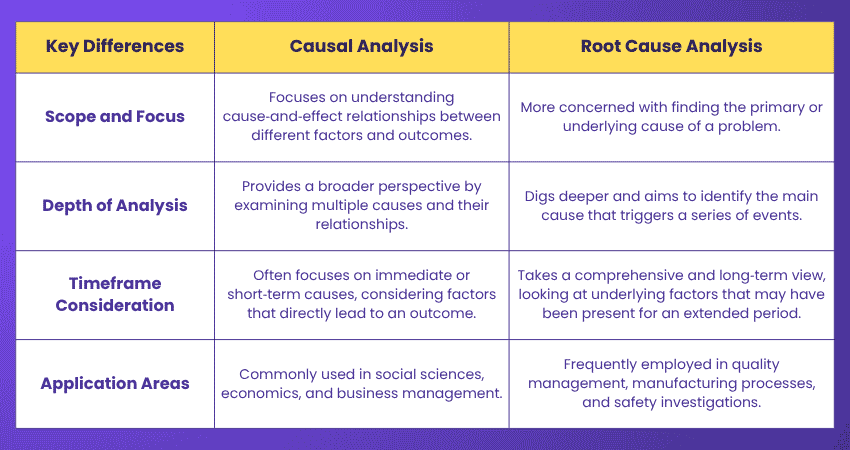
Causal Analysis focuses on understanding the cause-and-effect relationships between different factors and outcomes. It aims to establish connections and identify the reasons behind a specific event or result.
On the other hand, Root Cause Analysis is more concerned with finding the primary or underlying cause of a problem. It goes beyond immediate or surface-level causes and delves deeper to find the underlying issues that contribute to the occurrence of a problem.
Causal Analysis provides a broader perspective by examining multiple causes and their relationships. It considers various factors that contribute to a specific outcome.
In contrast, Root Cause Analysis digs deeper and aim
.s to identify the main cause that triggers a series of events. It focuses on finding the core issues that give rise to a particular problem.
2) Depth of Analysis
Causal analysis takes a broader approach by examining multiple contributing factors and understanding how they are interconnected. It focuses on identifying patterns and relationships between different causes that influence an outcome.
Root cause analysis goes deeper by aiming to identify the primary underlying cause of a problem. It focuses on uncovering the main trigger that sets off a chain of events, enabling organisations to address issues at their source.
3) Timeframe Consideration
Causal analysis often focuses on immediate or short-term causes, considering factors directly leading to an outcome.
While Root Cause Analysis takes a more comprehensive and long-term view, it looks at the underlying factors that may have been present for an extended period and influenced the occurrence of a problem.
Download the Root Cause Analysis Case Study PDF and improve your problem-solving skills!
4) Application Areas
Causal Analysis is commonly used in fields such as social sciences, economics, and business management. It helps to understand the relationships between variables and predict potential outcomes.
Root Cause Analysis is frequently employed in quality management, manufacturing processes, and safety investigations. It is particularly useful when dealing with recurring problems and seeking permanent solutions. Explore effective Root Cause Analysis Tools to enhance problem-solving and deepen understanding of complex issues.
Want to stand out in your interview? Get the top Root Cause Analysis Interview Questions and Answers to help you succeed!
Learn to turn IT challenges into service success stories with the ITIL® Certification – Sign up now!

Nilotpal Sarmah is a Senior Content Writer with 11+ years of overall experience spanning engineering, operations and content development. His technical knowledge and extensive writing experience enable him to simplify specialised topics across IT and Tech, Business Skills, Project Management, Health and Safety, and ISO and Compliance.
View Detail

 If you wish to make any changes to your course, please


