


We may not have the course you’re looking for. If you enquire or give us a call on 01344203999 and speak to our training experts, we may still be able to help with your training requirements.
13 Facilitation Techniques to Improve Team Performance
ByThe Knowledge AcademyLast updated on: 31 October 2026
Discover 13 effective facilitation techniques that help teams share ideas, solve problems and make informed decisions. Explore practical methods such as brainstorming, the 5 whys, dot voting and the world café method to improve participation and collaboration.
At a Glance
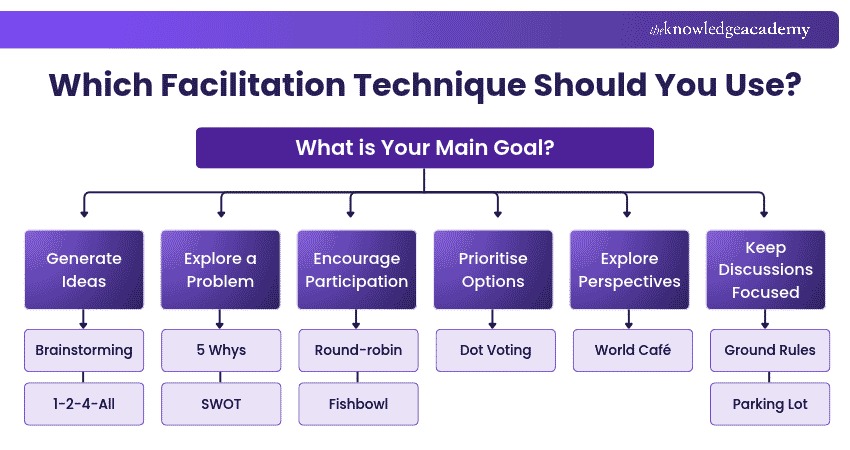
1. Facilitation techniques help teams structure discussions, encourage participation and work towards shared outcomes.2. Brainstorming and 1-2-4-all support idea generation and contributions from different participants.3. The 5 Whys and SWOT analysis help teams investigate problems and assess situations from different perspectives.4. Dot voting supports prioritisation, while the fishbowl and world café methods encourage structured group discussions.5. The right technique depends on the session's objectives, group size and the type of outcome required.
Unproductive meetings and scattered discussions often slow down team progress and decision-making. The key to turning conversations into meaningful outcomes lies in using the right facilitation techniques that encourage participation and keep discussions focused.
In this blog, we explore practical methods that help teams collaborate effectively, generate ideas and reach clear decisions. These 13 facilitation techniques can help facilitators structure discussions, encourage different perspectives and support productive group outcomes. Let's explore them.
Top 13 Facilitation Techniques
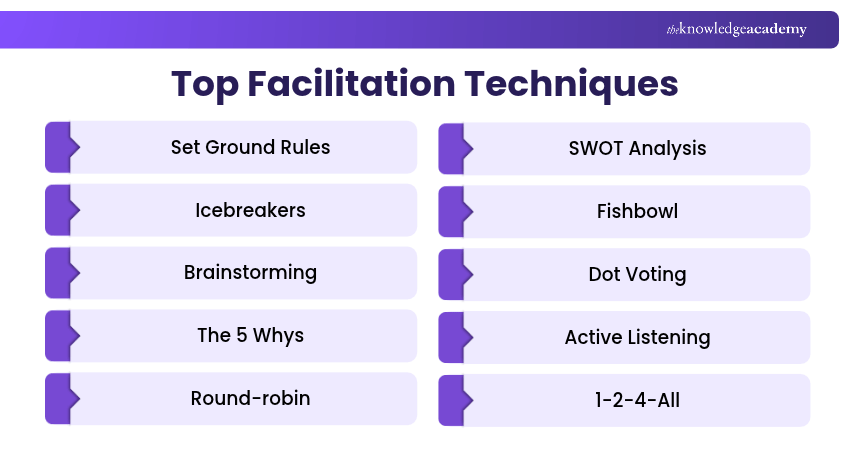
A good facilitation process helps teams remain focused, encourages participation and supports meaningful discussions. The following techniques and approaches can be used in meetings, workshops and collaborative sessions:
1) Set Ground Rules
Setting ground rules helps establish clear expectations about behaviour, communication and participation during a session. They help participants understand how discussions will be conducted and how everyone can contribute respectfully.
For example, a facilitator may encourage participants to avoid interruptions, respect different opinions, stay on topic and share speaking time. These expectations can be agreed upon at the beginning of a workshop.

2) Icebreakers
Icebreakers are short activities designed to help participants become comfortable with one another before a meeting or workshop begins. They are particularly useful when participants are unfamiliar with each other.
For example, a facilitator might ask each person to introduce themselves and share one expectation for the session. This provides an opportunity for everyone to contribute early.
3) Brainstorming
One popular facilitation technique is brainstorming, which encourages participants to generate a wide range of ideas without immediately evaluating or criticising them. The facilitator introduces a clear question and invites participants to contribute possible solutions.
For example, a team exploring ways to improve customer satisfaction might brainstorm possible improvements before assessing their feasibility, costs and expected benefits.
Pro Tip
During brainstorming, give participants time to share ideas before discussing their feasibility. Record suggestions without immediately judging them, then review the options against agreed criteria. This helps prevent early criticism from limiting participation.
4) The 5 Whys
The 5 whys technique helps teams investigate possible underlying causes of a problem by repeatedly asking why it occurred. Each answer forms the basis of the next question. The process may involve fewer or more than five questions, depending on the complexity of the problem.
For example, if a project repeatedly misses deadlines, a facilitator might begin by asking why tasks were delayed. The group then examines subsequent causes, such as unclear requirements, communication problems or resource constraints.
5) Round-robin
Round-robin is a facilitation method in which participants are invited to contribute one at a time, usually following an agreed sequence. This structured approach gives everyone an opportunity to speak and helps prevent a small number of participants from dominating the discussion.
For example, during a planning meeting, the facilitator may invite each team member to share one concern or suggestion before opening the discussion to the wider group.
6) SWOT Analysis
SWOT analysis is a structured framework for examining strengths, weaknesses, opportunities and threats relating to an organisation, project, strategy or proposed decision. A facilitator can guide participants through a four-part SWOT matrix:
a) Strengths: Internal advantages or capabilities.
b) Weaknesses: Internal limitations or areas for improvement.
c) Opportunities: External conditions that may provide benefits.
d) Threats: External factors that could create challenges.
For example, a team planning a new service might identify its technical expertise as a strength, limited resources as a weakness, growing demand as an opportunity and increasing competition as a threat.
7) Fishbowl
The fishbowl method involves a small group discussing a topic in an inner circle while the remaining participants observe from an outer circle. The facilitator introduces a question and invites the inner group to begin the discussion. Depending on the format, observers may later join the discussion or exchange places with participants in the inner circle.
For example, a fishbowl discussion might explore different approaches to managing workplace change, allowing participants to hear contrasting perspectives before contributing their own.
Improve team interaction and unlock collective potential through Facilitation Skills Foundation Training – Register today!
8) Dot Voting
Dot voting is a simple prioritisation technique in which participants allocate a limited number of votes to ideas or options displayed during a session. Each participant receives an agreed number of dots, stickers or digital votes and places them beside preferred options. The facilitator then reviews the results to identify which ideas have the most support.
For example, after a brainstorming session, a team might use dot voting to shortlist potential improvements for further evaluation.
Trainer's Insight
Dot voting reveals which ideas attract the most support, but popularity does not establish feasibility. After voting, ask participants to examine the leading options against the session's objectives, available resources and possible risks before making a decision.
9) Active Listening
Active listening is an essential facilitation skill that helps participants feel heard and encourages clearer communication. Facilitators use it to understand different viewpoints, clarify meaning and support constructive dialogue.
Important active listening practices include:
a) Attentive Listening: Give the speaker appropriate attention without unnecessary interruptions.
b) Clarifying Questions: Ask relevant questions when a statement is unclear or requires further explanation.
c) Summarising: Restate the speaker's main points to confirm understanding and help the group follow the discussion.
Facilitators can also use appropriate non-verbal cues, such as nodding and an attentive posture, while respecting individual and cultural differences.
Listen with purpose, understand with clarity and connect better by joining the Active Listening Training now!
10) 1-2-4-All
1-2-4-All is a structured facilitation technique that encourages participation by gradually expanding discussions from individuals to the whole group. The technique follows four stages:
a) 1 - Individual Reflection: Participants think independently about a question or challenge.
b) 2 - Pair Discussion: Participants discuss their ideas in pairs.
c) 4 - Small-group Discussion: Two pairs combine into a group of four to compare and develop ideas.
d) All - Group Sharing: Groups share important insights with everyone.
For example, a team looking to improve employee engagement might use 1-2-4-All to collect individual suggestions before identifying common priorities.
11) Energisers
Energisers are brief interactive activities used to restore attention and encourage participation during long meetings or workshops. They may involve simple movement, quick questions, short games or light group interactions. The facilitator should choose activities that suit the participants, setting and available time.
For example, after a lengthy presentation, participants might complete a short reflection exercise or answer a quick interactive question before moving to the next topic.
12) Parking Lot
The parking lot technique helps facilitators record important but off-topic questions, concerns or ideas without disrupting the main discussion. When a participant raises an issue outside the session's immediate scope, the facilitator adds it to a visible list for later review. The facilitator should also clarify how and when the recorded items will be addressed.
For example, during a workshop about improving customer support processes, a participant might raise a broader question about organisational budgeting. The facilitator can record it in the parking lot and return to the workshop's main objective.
Turn every challenge into a chance to think smarter with the Problem Solving Course now!
13) World Café Method
The world café method is a structured approach to facilitating conversations through several rounds of small-group discussion. It encourages participants to explore important questions and build on one another's ideas. A typical world café session follows these steps:
a) Set the Context: Identify the purpose of the session and prepare meaningful discussion questions.
b) Create Small Groups: Arrange participants around separate tables or virtual discussion spaces.
c) Begin Conversations: Ask each group to explore the selected question and capture useful insights.
d) Rotate Participants: After each discussion round, participants move to different tables or virtual groups to exchange perspectives. A table host may remain to explain earlier discussions.
e) Share Collective Insights: Bring participants together to identify recurring themes, important discoveries and possible next steps.
For example, an organisation exploring ways to improve workplace collaboration might use several world café rounds to gather perspectives from different departments.
How do Facilitation Techniques Support Innovation?
Facilitation techniques can support innovation by creating opportunities for people to exchange ideas, explore problems and evaluate different perspectives. They contribute to innovation in several ways:
a) Encourage Open Idea Sharing: Create opportunities to explore suggestions before judging them.
b) Promote Diverse Perspectives: Bring together different experiences and viewpoints to challenge assumptions.
c) Structure Creative Discussions: Help groups organise ideas and identify possible next steps.
d) Support Problem-solving: Encourage deeper investigation and exploration of alternatives.
e) Improve Participation: Give more people an opportunity to contribute to discussions.
f) Support Decision-making: Help groups prioritise options and evaluate possible approaches.
However, facilitation alone does not guarantee innovation. Effective outcomes also depend on clear objectives, relevant information, follow-through and the willingness to test ideas in practice.
Strengthen your ability to manage group dynamics with Facilitation Skills Practitioner Training – Join now!

The Knowledge Academy develops accessible learning content across Project Management, IT, Cybersecurity, Data Science, Business Analysis, HR, Accounting and Finance, Leadership and Health and Safety. Its resources combine subject research with clear explanations to help professionals build practical knowledge across a wide range of disciplines.
View Detail

 If you wish to make any changes to your course, please


