


 Top Rated Course

We may not have the course you’re looking for. If you enquire or give us a call on 01344203999 and speak to our training experts, we may still be able to help with your training requirements.
15 Essential Sales Skills to Improve Your Sales Performance
Charlotte Wilson 01 September 2026Discover the key Sales Skills every professional needs to build customer relationships, overcome challenges and achieve better sales results.

Training Outcomes Within Your Budget!
We ensure quality, budget-alignment, and timely delivery by our expert instructors.
Table of Contents

Key Takeaways
1. Sales success depends on a combination of interpersonal, strategic and analytical skills.2. Strong communication and active listening help sales professionals understand customers and explain value clearly.3. Prospecting and discovery skills help identify suitable opportunities and uncover genuine customer requirements.4. Negotiation, storytelling, and business acumen support stronger sales conversations and decision-making.5. Adaptability, curiosity, and problem-solving help professionals respond effectively to changing customer situations.
Customers rarely say:
“Your objection handling was excellent. I’m ready to buy.”
Instead, they say things like:
“That makes sense.”
“You understood exactly what I needed.”
“Let’s go ahead.”
Behind those simple responses are several Sales Skills working together, from knowing when to listen and what to ask to how to respond and when to move the conversation forward. So, what separates an average salesperson from a consistently effective one? Let’s look at 15 Essential Sales Skills that can make the difference!
What are Sales Skills?
Sales Skills are the abilities professionals use to identify potential customers, understand their needs, communicate value, manage objections, negotiate agreements, and maintain productive relationships throughout the sales process.
They include both interpersonal capabilities, such as listening and communication, and practical abilities, such as prospecting, negotiation, objection handling and product knowledge.

15 Essential Sales Skills
Different sales roles require different levels of expertise, but several core abilities are valuable across industries and sales environments. The following skills help professionals manage conversations, opportunities, and customer relationships more effectively:
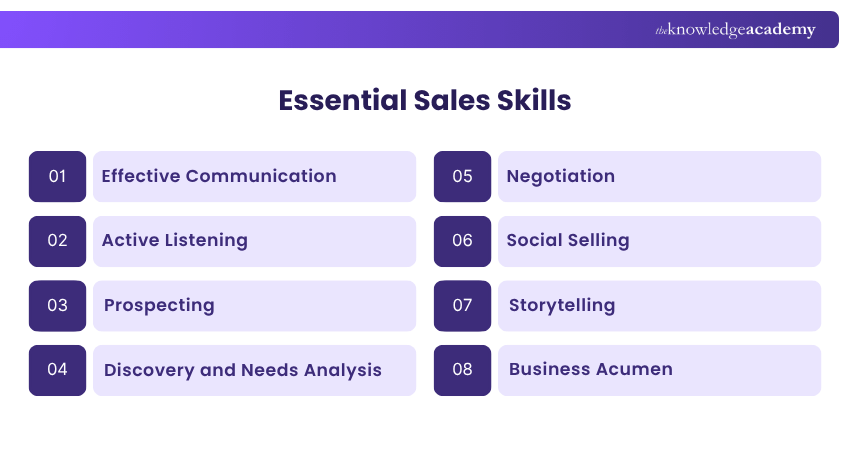
1) Effective Communication
Effective communication helps sales professionals explain ideas, product value, next steps, and commercial information clearly. Strong communicators adjust their language according to the customer, avoid unnecessary complexity, and ensure important information is understood throughout the sales process.
2) Active Listening
Active listening involves giving customers full attention and understanding what they are actually saying before responding. It helps sales professionals recognise priorities, concerns, expectations, and buying motivations that may not emerge through scripted questioning alone.
3) Prospecting
Prospecting is the ability to identify potential customers who may genuinely benefit from a product or service. Effective prospecting involves researching suitable organisations or individuals, selecting appropriate outreach methods, and focusing effort on opportunities that match the intended customer profile.
4) Discovery and Needs Analysis
Discovery involves asking purposeful questions to understand a customer's situation, objectives, challenges, priorities, and decision criteria. Good needs analysis prevents sales professionals from recommending solutions too early and helps them connect their offering to genuine customer requirements.
5) Negotiation
Negotiation helps sales professionals reach agreements that consider customer expectations alongside organisational objectives. It requires preparation, clear communication, flexibility, and the ability to discuss areas such as pricing, scope, delivery, responsibilities, and commercial terms without losing sight of overall value.
Handle objections, influence decisions, and secure mutually beneficial agreements with Sales Negotiation Training – Sign up now!
6) Social Selling
Social selling involves using professional digital platforms to research prospects, build credibility, share relevant insights, and start conversations. Rather than relying on direct promotion, effective social selling focuses on creating familiarity and meaningful engagement before or alongside formal sales activity.
7) Storytelling
Storytelling helps sales professionals explain value in a way that customers can relate to. Practical examples, customer situations, and outcome-focused narratives can make complex products easier to understand and show how a solution may address a real business need.
Create memorable customer interactions that lead to stronger relationships with Storytelling Course – Join now!
8) Business Acumen
Business acumen is the ability to understand how organisations operate and make commercial decisions. Sales professionals with strong business awareness can discuss customer priorities more credibly, understand financial or operational pressures, and position solutions in relation to wider organisational goals.
Remember!
Sales Skills work best together. Combining listening, business awareness, negotiation, and follow-through helps create stronger sales conversations.
9) Problem-solving
Problem-solving helps sales professionals respond when customer needs are unclear, objections arise, or standard solutions are unsuitable. It involves understanding the underlying issue, considering realistic options, and finding an approach that supports the customer's objective without making unrealistic promises.
10) Adaptability
Sales situations do not always follow a fixed pattern. Adaptability allows professionals to adjust their communication, questioning, presentation style, or sales approach according to changing customer needs, market conditions, stakeholder expectations, or new information.
11) Time Management
Time management helps sales professionals balance prospecting, meetings, follow-ups, preparation, administrative work, and opportunity management. Prioritising high-value activities and planning time effectively reduces missed opportunities and supports more consistent sales activity.
Take control of your schedule and achieve greater productivity with Time Management Training – Explore today!
12) Follow-up and Follow-through
Follow-up keeps opportunities moving after initial conversations, while follow-through ensures agreed actions are actually completed. Prompt updates, accurate information, and reliable next steps help maintain customer confidence and prevent promising opportunities from losing momentum.
13) Objection Handling
Objection handling is the ability to understand and respond to customer concerns without being dismissive. It involves listening carefully, identifying the reason behind an objection and addressing it with relevant information or alternatives. Effective objection handling can keep conversations productive and help customers make more informed decisions.
14) Technology Proficiency
Modern sales professionals often work with Customer Relationship Management (CRM) systems, communication platforms, sales intelligence tools, analytics, automation, and digital presentation software. Technology proficiency helps them manage customer information, track opportunities, organise activity, and make better use of available sales data.
15) Collaboration
Sales often require cooperation with other teams like marketing, customer service, finance, product teams, technical specialists, and management. Collaboration helps sales professionals access the right expertise, coordinate customer commitments, and ensure information moves accurately between teams.
Sales Decision Snap
Scenario: A prospect says, “The solution looks useful, but this is not a priority for us right now.”What would you do next?A) Push for an immediate decisionB) Offer a discount straight awayC) Ask what would need to change for it to become a priorityD) End the conversationBest Answer: CThis keeps the conversation open and helps uncover the business conditions that could influence a future decision.
How to Improve Your Sales Skills?
Improving Sales Skills requires deliberate practice rather than relying only on experience. The following approaches can help professionals strengthen specific areas and apply new techniques confidently:
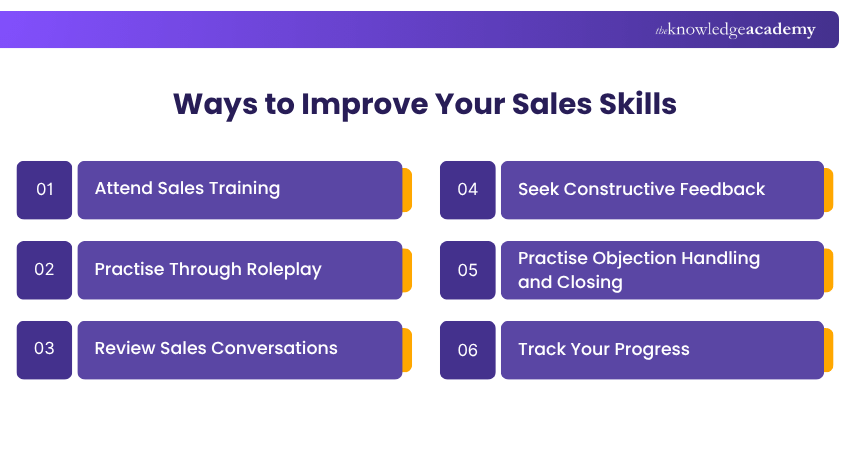
1) Attend Sales Training: Structured training can introduce practical approaches to prospecting, questioning, negotiation, objection handling, and closing. It also helps professionals identify better ways to approach common sales challenges.
2) Practise Through Roleplay: Roleplay provides a safe environment to practise customer conversations before applying techniques in real situations. It can strengthen questioning, presentation, negotiation, and objection-handling abilities.
3) Review Sales Conversations: Looking back at calls, meetings, or written exchanges can reveal patterns that may otherwise go unnoticed. Professionals can assess how effectively they listened, communicated value, and established next steps.
4) Seek Constructive Feedback: Feedback from managers, colleagues, or mentors can highlight strengths and areas requiring improvement. Specific observations about sales behaviours are usually more useful than general performance comments.
5) Practise Objection Handling and Closing: Rehearsing common objections helps professionals respond more calmly and confidently during real conversations. It can also improve their ability to recognise buying signals and guide customers towards appropriate decisions.
6) Track Your Progress: Monitoring selected behaviours and performance indicators can show whether improvement efforts are producing results. Measures such as response rates, meeting conversions, follow-up completion, or discovery quality can provide useful direction.
Turn stronger customer relationships into lasting opportunities through Relationship Sales Training - Register today.
How to Identify Your Sales Skill Gaps?
Sales Skill gaps are easier to address when professionals evaluate specific behaviours rather than judging themselves simply as strong or weak at sales. Reviewing recent opportunities, customer feedback, conversion patterns, missed follow-ups, objections, and areas of discomfort can reveal where additional practice may be most useful.
Sales Skill Gap Check
Use these questions to assess where you may need to improve:
1. Do prospects frequently disengage early?Review your prospecting, communication, and initial value messaging.2. Do customer needs remain unclear after meetings?Strengthen your active listening and discovery skills.3. Do opportunities stall after proposals or discussions?Review your follow-up, negotiation, and next-step management.4. Do objections regularly end conversations?Practise problem-solving, objection handling, and value communication.5. Do you struggle to discuss wider business priorities?Strengthen your business acumen and industry understanding.The purpose is not to improve every skill at once. Identifying one or two priority areas usually creates a clearer and more manageable development plan.
Conclusion
Strong sales performance is rarely built on one skill alone. It comes from combining communication, active listening, negotiation, adaptability and customer understanding throughout the sales process. By recognising your strengths, identifying areas for improvement and continuously developing the right Sales Skills, you can approach customer conversations with greater confidence for long-term sales success.
Improve your ability to connect with customers with Online Sales Training – Explore now!
Frequently Asked Questions
Do Sales Skills Differ Between B2B and B2C Sales?

Yes. B2B sales often involve longer sales cycles, multiple decision-makers and relationship building, while B2C sales usually focus on individual customers and quicker purchasing decisions. However, communication, active listening, adaptability and customer understanding remain important skills in both sales environments.
Are Sales Skills Transferable to Other Careers?
Yes. Skills such as communication, listening, negotiation, problem-solving, relationship management and commercial awareness are useful across many careers. They can support roles in management, consulting, customer service, recruitment, marketing, and business development.
Can Sales Skills be Learned Without Sales Experience?
Yes. Sales Skills can be developed through training, roleplay, observation, feedback, research, and practical exercises before someone enters a formal sales role. Real customer experience can then help strengthen and refine those abilities further.

Charlotte Wilson


Soft Skills and Business Training Manager
Charlotte Wilson is an expert in soft skills development, with over 14 years of experience helping individuals and teams improve communication, productivity and emotional intelligence in the workplace. Her training content is focused on enhancing interpersonal effectiveness and fostering positive, collaborative environments across all levels of an organisation.
View Detail

 If you wish to make any changes to your course, please


