




We may not have the course you’re looking for. If you enquire or give us a call on 01344203999 and speak to our training experts, we may still be able to help with your training requirements.
Top 12 Middle Manager Skills to Strengthen in 2027
ByThe Knowledge AcademyLast updated on: 26 November 2026
From managing daily operations to developing employees and handling competing priorities, Middle Managers take on a wide range of responsibilities. Explore 12 essential skills that support these responsibilities and practical approaches to strengthening them.
At a Glance
1. Middle Managers connect senior leadership with employees by translating organisational priorities into day-to-day activities.2. Communication, problem-solving and decision-making help them address challenges, clarify expectations and keep work on track.3. Empathy, negotiation and conflict management enable them to handle workplace concerns and maintain productive relationships.4. Strategic thinking, adaptability and digital literacy help managers respond to organisational changes.5. Performance management, coaching and effective delegation support employee development and team performance.
Yesterday: You were responsible for your own performance.
Today: You're responsible for an entire team's performance.
Tomorrow: Senior leadership expects you to deliver even better results.
That's the challenge of stepping into middle management. Your responsibilities expand from managing your own work to guiding a team, balancing expectations and delivering organisational goals. To succeed in this role, you need more than technical expertise. Let's explore the key Middle Manager skills and how they can help you become a more effective leader.
Middle Manager Skills for Leading Teams
A Middle Manager acts as a link between senior leadership and employees, ensuring organisational goals are translated into actionable tasks while supporting team performance. To manage these responsibilities effectively, they need a combination of leadership, communication and problem-solving abilities. Here are the key Middle Manager skills for leading teams successfully:
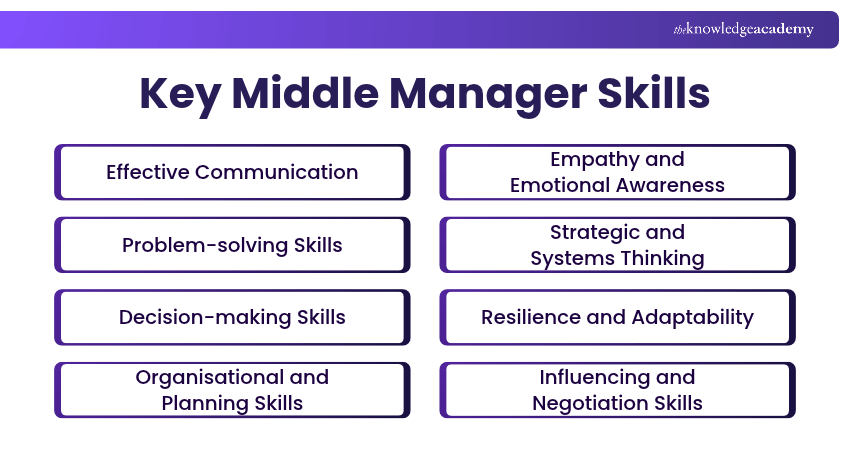
1) Effective Communication
Effective communication helps Middle Managers explain business objectives, establish expectations, and maintain clarity across teams. They need strong verbal and written communication skills to deliver instructions, provide feedback, and communicate progress.
Middle Managers also communicate information in both directions, translating leadership decisions into practical actions, and sharing employee concerns with senior management. Active listening and transparent communication help prevent misunderstandings and strengthen coordination.

2) Problem-solving Skills
Middle Managers regularly encounter challenges involving resources, processes, deadlines, and team performance. Strong problem-solving skills help them identify underlying causes, evaluate possible solutions, and address issues before they affect wider operations.
Rather than focusing only on immediate symptoms, effective managers analyse available information and consider the consequences of different approaches. This helps them resolve operational problems while reducing the likelihood of similar issues recurring.
3) Decision-making Skills
Decision-making is essential for balancing business priorities, available resources, and operational requirements. Middle Managers frequently make decisions about workloads, schedules, resource allocation, and responses to unexpected situations.
Effective decision-making involves assessing relevant information, considering potential risks, and evaluating alternative courses of action. Data-informed decisions help managers justify their choices, respond to changing circumstances, and maintain accountability for outcomes.
Pro Tip
Before making an operational decision, distinguish between facts, assumptions and information gaps. This helps managers avoid decisions based on incomplete or misleading information.
4) Organisational and Planning Skills
Organisational skills enable Middle Managers to coordinate activities, establish priorities, and ensure resources are used effectively. They develop structured workflows, set realistic deadlines, and organise responsibilities according to business requirements.
Strong planning also involves anticipating workload pressures and identifying dependencies between tasks. By regularly reviewing priorities and adjusting plans, managers can maintain operational efficiency without placing unnecessary pressure on their teams.
5) Empathy and Emotional Awareness
Empathy and emotional awareness help Middle Managers understand employees' feelings, recognise their concerns and respond appropriately to different situations. These skills are essential for building trust, maintaining positive workplace relationships and creating a supportive team environment.
Middle Managers with strong emotional awareness can recognise signs of stress, frustration or disengagement and respond thoughtfully. By listening actively, considering different perspectives and managing their own emotions, they can handle sensitive situations, resolve concerns and maintain healthy professional relationships.
6) Strategic and Systems Thinking
Strategic thinking helps Middle Managers understand how departmental activities contribute to broader organisational objectives. Systems thinking extends this perspective by examining how teams, processes, and business functions influence one another.
For example, a change in one department's workflow may affect resource availability, delivery schedules, or another team's performance. Managers who consider these connections can anticipate consequences, coordinate decisions across functions, and align operational improvements with organisational priorities.
7) Resilience and Adaptability
Middle Managers often work in environments where priorities, resources, and business requirements change unexpectedly. Resilience helps them recover from setbacks and remain effective during challenging situations, while adaptability enables them to adjust their approach when circumstances change.
These capabilities are particularly important when implementing new processes, responding to disruptions, or supporting teams through organisational change. Managers who reassess priorities and communicate necessary adjustments can help their teams maintain direction during uncertainty.
8) Influencing and Negotiation Skills
Middle Managers need influencing skills to gain support for initiatives, communicate recommendations and encourage cooperation across different levels of an organisation. Unlike formal authority, effective influence relies on credibility, clear reasoning, and an understanding of stakeholder priorities.
Negotiation becomes important when managers coordinate resources, resolve competing demands, or agree on realistic delivery expectations. By presenting evidence, listening to concerns and identifying mutually acceptable solutions, they can build support without relying solely on their position.
Approach important conversations with greater confidence through our Negotiation Skills Training – Register today!
9) Conflict Management
Disagreements can arise from competing priorities, unclear responsibilities, communication problems, or differences in working approaches. Middle Managers need conflict management skills to address these situations fairly and prevent unnecessary disruption.
Effective conflict management involves understanding the concerns of those involved, identifying the source of disagreement, and encouraging constructive discussions. Managers should remain impartial where appropriate, establish clear expectations and follow relevant organisational procedures when issues require formal intervention.
10) Digital Literacy Skills
Digital literacy skills help Middle Managers use workplace technologies to improve communication, monitor performance and manage daily operations. These skills involve understanding digital tools, interpreting information and adapting to technological developments.
Digitally capable Middle Managers can identify opportunities to improve workflows, support employees in using new technologies and make informed decisions about digital processes. This is particularly valuable as organisations increasingly adopt AI-powered tools and automation.
11) Performance Management and Team Development
Performance management helps Middle Managers establish clear expectations, evaluate progress, and support employees in achieving agreed objectives. It involves setting measurable goals, reviewing outcomes, and identifying areas where additional guidance or development may be required.
Team development focuses on strengthening employees' capabilities through coaching, constructive feedback, and suitable learning opportunities. By addressing performance challenges early and recognising individual strengths, managers can improve team effectiveness while supporting professional growth.
Turn performance goals into successful results with Performance Management Training – Register now!
12) Delegation and Empowerment
Delegation enables Middle Managers to distribute responsibilities according to employees' capabilities, experience, and development needs. Effective delegation involves defining expected outcomes, establishing appropriate authority, and providing the resources required to complete assigned work.
Empowerment goes further by giving employees suitable autonomy in how they approach their responsibilities. Managers should maintain accountability through agreed checkpoints and constructive guidance without unnecessarily controlling every task. This supports individual ownership and allows managers to focus on broader operational priorities.
Trainer's Insight
Delegation becomes more effective when managers clarify the outcome, decision-making authority, and escalation points before assigning responsibility. Employees can then act independently while understanding when additional guidance is required.
How Can You Develop Middle Management Skills?
Developing middle management skills requires a combination of practical experience, regular feedback and targeted professional development. Managers can strengthen their capabilities by applying structured approaches to everyday leadership challenges.
Here are some effective ways to develop these skills:
1) Seek Constructive Feedback: Ask employees, peers and senior managers for feedback to identify leadership strengths and areas for improvement.
2) Practise Structured Decision-making: Evaluate alternatives, assess risks, and review the outcomes of important operational decisions.
3) Develop Coaching Capabilities: Use regular one-to-one discussions to support employee development and encourage independent problem-solving.
4) Take Responsibility for Cross-functional Initiatives: Participate in projects involving different departments to strengthen collaboration and understand how different business functions work together.
5) Improve Digital and Analytical Awareness: Learn to interpret performance dashboards, use relevant management tools, and evaluate technology-supported decisions.
6) Pursue Management Training: Attend structured leadership and management courses to develop practical skills in planning, performance management, communication and delegation.
Develop the skills to manage teams and drive results with Management Courses – Join now!

The Knowledge Academy develops accessible learning content across Project Management, IT, Cybersecurity, Data Science, Business Analysis, HR, Accounting and Finance, Leadership and Health and Safety. Its resources combine subject research with clear explanations to help professionals build practical knowledge across a wide range of disciplines.
View Detail

 If you wish to make any changes to your course, please


