


We may not have the course you’re looking for. If you enquire or give us a call on +48 221041849 and speak to our training experts, we may still be able to help with your training requirements.
Top 20 Marketing Skills and How to Develop Them
ByAishwarya UnniLast updated on: 24 October 2026
Marketing skills combine creative thinking, communication, research, technology and analytical abilities to help professionals plan and deliver effective campaigns. This blog explores 20 important marketing skills and practical ways to develop them for different marketing responsibilities.
At a Glance
1. Creative and Communication Skills: Clear messaging, teamwork and creative problem-solving help marketers connect ideas with audience needs.2. Strategic Skills: Market research, customer insights and content planning guide relevant marketing decisions.3. Digital Skills: SEO, paid search, social media, websites and email marketing support different stages of customer engagement.4. Analytical Skills: Data analysis and spreadsheet knowledge help marketers evaluate campaign performance.5. Future-focused Skills: Adaptability, responsible data use, AI literacy and automation support evolving marketing practices.
The campaign looked perfect. The results told a different story.
The visuals were impressive. The message was polished. The campaign went live exactly on schedule.
A week later, the marketing team discovered that visitors were clicking on the advertisements but leaving the website without taking the intended action.
Was the message reaching the wrong audience? Was the landing page confusing? Or had the team overlooked something in its research?
An attractive campaign is only one part of marketing. Understanding customers, choosing suitable channels and interpreting results are equally important. So, which marketing skills should you develop to handle these responsibilities? Let's explore these important skills and practical ways to strengthen them.
Top 20 Marketing Skills You Should Develop
Marketing skills help professionals understand customers, plan campaigns, communicate value and evaluate results. These abilities combine technical knowledge, creative judgement, analytical thinking and interpersonal skills. Here are 20 important marketing skills to develop:
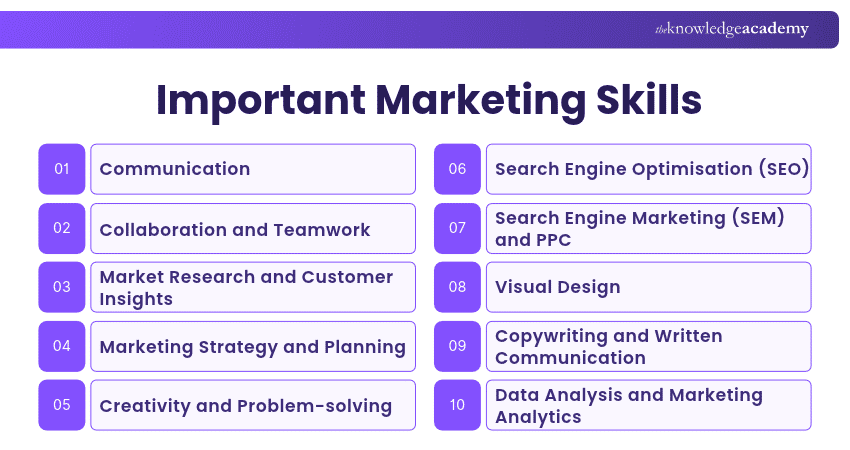
1) Communication
Communication helps marketers express ideas, explain product benefits and share information with different audiences. It involves speaking clearly, listening actively and adjusting messages according to the purpose and context.
Marketers use communication skills when presenting campaign proposals, discussing requirements with clients and explaining performance results to colleagues. Strong communication also helps teams recognise misunderstandings before they affect campaign delivery.
2) Collaboration and TeamworkD
Marketing projects frequently involve people from different departments, including sales, design, product development and customer service. Collaboration and teamwork help these groups coordinate responsibilities and contribute towards shared objectives.
Effective collaboration involves exchanging information, respecting different perspectives and resolving disagreements constructively. For example, a marketing team launching a new product may work with designers on visuals, sales colleagues on customer questions and Product Specialists on technical accuracy.
3) Market Research and Customer Insights
Market research helps marketers understand customer needs, preferences, competitors and market conditions. It involves collecting and examining information through methods such as surveys, interviews, observation and analysis of existing data.
Customer insights emerge when research findings and other relevant evidence are interpreted to identify patterns, understand customer needs and inform marketing decisions. Reliable insights help marketers test assumptions rather than relying solely on personal opinions.
Trainer’s Insight: Look Beyond What Customers Say
Survey responses can reveal preferences, but observed behaviour may tell a different story. Where appropriate, compare customer feedback with evidence such as website interactions or purchasing patterns before drawing conclusions.
4) Marketing Strategy and Planning
Marketing strategy involves identifying target audiences, communicating value and determining how marketing activities support business objectives. It helps marketers establish priorities, select appropriate approaches and allocate available resources.
Marketing planning translates this direction into practical activities, including campaigns, content calendars, channel selection and delivery schedules. For example, a software company may plan educational articles for customers researching a problem before introducing detailed product demonstrations.
5) Creativity and Problem-solving
Creativity helps marketers develop fresh ideas, memorable messages and different approaches to familiar challenges. Problem-solving involves examining obstacles, considering alternatives and selecting practical responses.
These abilities work together when a campaign does not perform as expected. Rather than changing the visuals immediately, a marketer might investigate the audience, offer or delivery channel and then develop an alternative approach based on the findings.
6) Search Engine Optimisation (SEO)
Search Engine Optimisation (SEO) involves improving a website's content, structure and technical accessibility to help search engines understand its pages and make them easier for relevant users to discover.
Marketers use SEO skills to understand search intent, create useful content, organise headings, improve internal linking and work with technical teams on indexing or usability issues. SEO is an ongoing process, and following good practices does not guarantee a particular ranking.
Practical Example
A training provider notices that visitors frequently search for beginner-level courses. Its marketing team creates a clear course guide answering common questions and ensures the page is accessible to search engines.
7) Search Engine Marketing (SEM) and PPC
Search Engine Marketing (SEM) commonly refers to paid advertising on search engines, although the term is sometimes used more broadly. Pay-per-click (PPC) is a pricing model in which advertisers pay when someone clicks their advertisement. PPC can be used for both search and other digital advertising campaigns, while paid search campaigns may use different bidding and payment models.
Marketers working with paid search need to understand campaign objectives, search terms, audience relevance, bidding, budgets and performance measurement. They should also consider whether the landing page provides an appropriate experience for visitors.
SEO vs Paid Search Advertising: What's the Difference?
| Aspect | SEO | Paid Search Advertising (SEM) |
| Main Approach | Improve visibility in organic search results | Place paid search advertisements |
| Main Activities | Content, technical improvements and search optimisation | Campaign setup, targeting, bidding and optimisation |
| Direct Search Placement Cost | No search engine fee for organic placement; SEO activities may still incur costs | Advertising charges depend on the campaign's pricing model, such as cost per click |
| Results | Develop over time and vary | Paid visibility may begin when eligible advertisements are running |
Learn how to create targeted PPC campaigns, manage advertising budgets and optimise ad performance with our Pay Per Click (PPC) Training – Sign up now!
8) Visual Design
Visual design helps marketers organise text, imagery, colour and other elements so that messages are understandable and visually consistent. Basic design knowledge supports collaboration with creative teams, even when a marketer is not a professional designer.
Important considerations include typography, layout, contrast, visual hierarchy, accessibility and brand guidelines. For example, a promotional graphic should make the primary message easy to identify rather than crowding it with competing elements.
9) Copywriting and Written Communication
Copywriting involves creating written messages intended to inform, persuade or encourage a particular response. Marketers use it in advertisements, landing pages, emails, product descriptions and promotional materials.
Strong written communication requires clarity, audience awareness, accurate information and an appropriate tone. Effective copy also reflects where readers are in their decision-making process rather than treating every audience as ready to purchase.
Pro Tip: Write for One Clear Purpose
Before drafting promotional copy, identify who will read it, what they need to understand and which action is relevant. Remove words that do not support that purpose and check that any claims can be justified.
10) Data Analysis and Marketing Analytics
Marketing analytics involves collecting, interpreting and using campaign data to understand performance. Marketers examine relevant measures such as website visits, engagement, leads, conversion rates and campaign expenditure.
Analytical skills help distinguish useful patterns from misleading conclusions. A rise in traffic, for example, is not necessarily evidence of improved campaign effectiveness if visitors are not completing the intended action.
Worked Example: Understanding Campaign Performance
Imagine two illustrative campaigns promoting the same service.
| Metric | Campaign A | Campaign B |
| Website Visits | 1,000 | 600 |
| Enquiries | 20 | 30 |
| Visit-to-enquiry Conversion Rate | 2% | 5% |
Campaign A attracts more visits, while Campaign B produces more enquiries and a higher visit-to-enquiry conversion rate.
This suggests that Campaign B performs better on these particular measures. However, a fuller assessment would also consider advertising expenditure, enquiry quality and eventual business outcomes before deciding which campaign provides greater value.
11) Social Media Marketing
Social media marketing involves using relevant platforms to distribute content, communicate with audiences and support marketing objectives. Different platforms attract different audiences and encourage different types of interaction.
Marketers need to understand platform features, content formats, audience behaviour, community management and performance measures. For example, a professional services business may use LinkedIn to share industry knowledge, while a consumer brand may experiment with short-form video on visually oriented platforms.
12) Website Management
Website management involves maintaining and improving the content, usability and operation of a website. Marketers may use Content Management Systems (CMS) to update pages, publish articles, review navigation and coordinate changes with developers.
Understanding website structure and user experience helps marketers recognise problems that may interrupt customer journeys. For example, a landing page with unclear instructions or a difficult form can discourage enquiries even when its advertising attracts relevant visitors.
13) Email Marketing
Email marketing uses electronic messages to communicate with appropriate audiences about products, services, events or other relevant information. It may involve newsletters, campaign announcements and automated messages based on customer interactions.
Useful skills include audience segmentation, subject-line writing, campaign scheduling, accessibility and performance analysis. Marketers must also understand applicable direct marketing and data protection requirements, including when consent is required, whether an exception applies and how recipients can opt out of marketing communications.
Learn how to create engaging email campaigns and reach the right audience with our Email Marketing Course – Join now!
14) Stakeholder Relationship Management
Stakeholder relationship management involves identifying, engaging and maintaining productive relationships with people who influence or are affected by marketing activities. These may include clients, senior managers, suppliers, agencies and colleagues from other departments.
Marketers use these skills to clarify expectations, discuss campaign priorities, manage feedback and maintain productive working relationships. For example, when stakeholders request conflicting changes to a campaign, the marketer may need to explain the implications and help agree on a workable direction.
15) Leadership
Leadership helps marketers guide activities, support colleagues and make decisions in situations involving shared responsibilities. It is not limited to people with formal management titles.
Marketers demonstrate leadership when coordinating a campaign, establishing clear expectations, encouraging contributions or helping teams respond to unexpected challenges. Effective leadership also involves recognising individual capabilities and providing appropriate support instead of controlling every task.
16) Spreadsheet Skills
Spreadsheet skills help marketers organise information, monitor budgets and analyse campaign results. Common activities include sorting data, using formulas, creating charts and preparing reports.
Understanding functions such as SUM, AVERAGE and IF can support everyday reporting, while pivot tables can help summarise larger datasets. Accuracy remains important because inconsistent formatting or incorrect formulas can lead to misleading conclusions.
Example
A marketer uses a spreadsheet to compare planned and actual campaign expenditure, identify differences and prepare a budget update for stakeholders.
17) Adaptability
Adaptability is the ability to respond constructively when circumstances change. Marketing teams may need to adjust their activities because of shifting customer expectations, new platform features, budget changes or unexpected campaign results.
Adaptable marketers reassess available information and identify what can reasonably change. For example, if a social platform updates how content is distributed, the team can review its results and test different formats instead of assuming that previous methods will continue working.
18) Ethical Marketing and Data Privacy
Ethical marketing involves communicating honestly, treating audiences fairly and considering how marketing activities may affect customers and wider society. It includes avoiding misleading claims, using appropriate evidence and respecting consumer preferences.
Data privacy requires marketers to understand how personal information may be collected, processed, stored and used. Applicable laws differ by jurisdiction, and marketing activities such as email campaigns, tracking and customer profiling may involve specific requirements.
19) Organisation and Time Management
Organisation and time management help marketers coordinate campaigns, meet deadlines and manage competing responsibilities. These skills are particularly useful when several activities depend on shared people or resources.
Marketers can use project plans, task lists and content calendars to identify priorities and monitor progress. For example, planning an event campaign may involve coordinating design approvals, promotional emails, social media posts and website updates before the event date.
20) AI Literacy and Marketing Automation
Artificial Intelligence (AI) literacy helps marketers understand the capabilities, limitations and appropriate uses of AI-powered tools. These tools can support activities such as content ideation, research assistance, campaign analysis and preparation of draft materials.
Marketing automation involves using software to manage repeatable activities, such as scheduled messages, lead-nurturing workflows and campaign follow-ups. Some automation systems use AI, but automation does not always require it.
Developing both skills helps marketers evaluate which tasks may benefit from technology while maintaining appropriate oversight of accuracy, brand consistency and personal data.
Trainer’s Insight: Automate the Process, Not the Accountability
Before introducing AI or automation, define the task, review the information the system will use and decide who will check its outputs. Human review remains important where mistakes could affect customers, compliance or brand reputation.
Learn to build customer satisfaction and brand loyalty in the business environment with our Strategic Marketing Course – Join now!
How to Develop Your Marketing Skills?
Developing marketing skills involves combining structured learning with practical experience. Focus on capabilities relevant to your responsibilities or professional goals rather than attempting to master every discipline at once. Here are five approaches to building your skills:
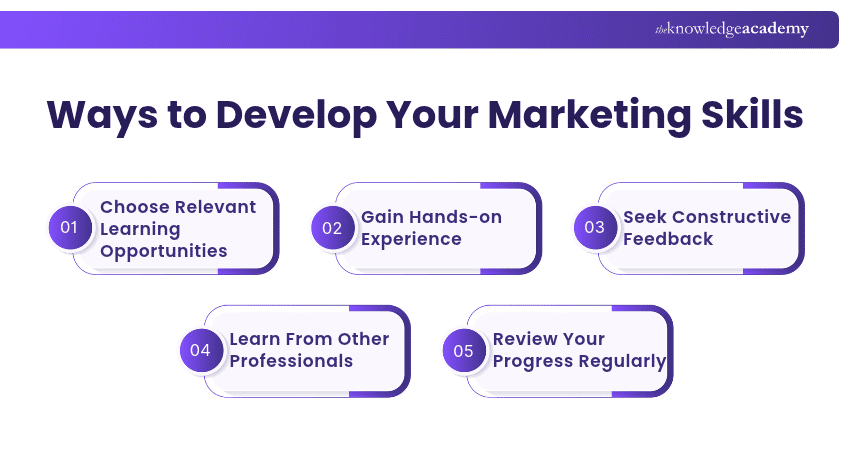
1) Choose Relevant Learning Opportunities: Explore courses, workshops and reliable industry resources related to the skills you want to develop. Select learning that provides opportunities to practise rather than focusing only on theoretical knowledge.
2) Gain Hands-on Experience: Apply your learning through suitable projects, such as preparing a content calendar, analysing website activity, writing advertising copy, conducting competitor research or supporting a small campaign. Practical tasks can reveal challenges that are difficult to recognise through reading alone.
3) Seek Constructive Feedback: Ask colleagues, mentors or experienced professionals to review specific aspects of your work. Feedback on a campaign report, for example, may help you improve how clearly you communicate findings.
4) Learn From Other Professionals: Participate in professional communities, workshops or industry discussions to understand different marketing approaches. Consider how the ideas you encounter apply to your own context.
5) Review Your Progress Regularly: Choose a realistic development goal and evaluate whether you can apply the skill more effectively over time. Use completed work, feedback and relevant outcomes to identify your next learning priority.
Marketing Skills Self-assessment: Where Should You Focus?
Not sure which marketing skill to develop next? Use these questions to identify areas that may need more attention.
1. Struggling to Understand Customers? Focus on market research and customer insights.2. Finding Campaign Results Difficult to Interpret? Strengthen data analysis and marketing analytics.3. Having Trouble Reaching Your Target Audience? Review audience research before exploring SEO, paid search and social media marketing.4. Finding It Difficult to Create Engaging Content? Improve copywriting, creativity and visual design.5. Spending Too Much Time on Repetitive Tasks? Explore marketing automation and suitable AI-powered tools.
Understand market trends and consumer behaviour to strengthen business strategies with our Marketing Courses – Register now!0

Aishwarya Unni is a Copywriter with 2+ years of experience in reporting, web content, blogs, email marketing, and case studies. Her journalism background, combined with her research and writing experience across Business Skills and Human Resources, helps her create clear, engaging content for different audiences.
View Detail

 If you wish to make any changes to your course, please


