


We may not have the course you’re looking for. If you enquire or give us a call on 01344203999 and speak to our training experts, we may still be able to help with your training requirements.
Learning New Skills: Effective Tips and Strategies
ByVidhya NairLast updated on: 29 October 2026
Learning new skills can help you develop practical abilities, adapt to changing requirements and pursue personal or professional goals. This blog explores 12 effective learning strategies, including goal setting, regular practice, active recall and progress tracking, to help you build skills with greater confidence.
Quick Preview
1. Clear and measurable learning goals help you understand what successful skill development looks like.2. A realistic learning plan makes it easier to balance skill development with everyday responsibilities.3. Active recall, spaced practice and real-world exercises can strengthen knowledge retention and practical ability.4. Constructive feedback and reviewing mistakes help identify areas for improvement.5. Learning progress should be assessed through demonstrated skills rather than study hours alone.
Imagine wanting to learn a new language, master Excel or improve your communication skills. You find several tutorials and courses, but after a few days, you are unsure what to study next or whether you are making progress. Sound familiar? Learning a new skill can be exciting, but choosing the right approach makes a significant difference.
Whether you want to advance your career, explore a personal interest or become more confident in everyday tasks, developing skills requires purposeful learning and regular practice. The good news is that you do not need to master everything immediately. With realistic goals, suitable resources and effective learning techniques, you can make steady progress. Let's explore the strategies that can help you develop them.
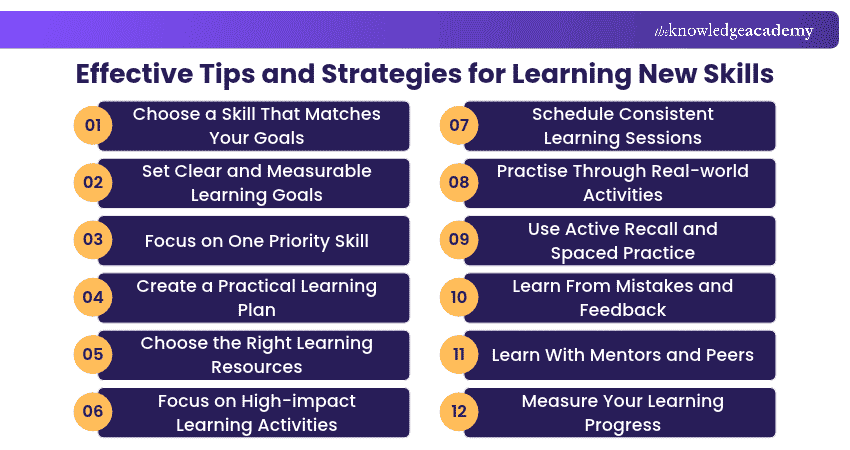
Effective Tips and Strategies for Learning New Skills
Developing a new skill involves more than gathering information. It requires clear objectives, suitable practice methods and opportunities to apply what you learn. The following strategies can help make your learning process more focused, practical and manageable:
1) Choose a Skill That Matches Your Goals
The first step is identifying what you want to learn and why it matters to you. Choosing a skill that supports your interests or professional responsibilities gives your learning a clear purpose. For example, someone working with business reports may benefit from improving their Excel skills, while a professional preparing for a leadership role may prioritise communication or delegation. Here's how you can get started:
a) Identify Your Interests: Consider subjects or activities you genuinely want to explore.
b) Review Your Goals: Think about how the skill could support your personal or professional development.
c) Consider Practical Use: Identify opportunities to apply the skill in everyday situations.
d) Assess Your Resources: Check whether you have sufficient time, guidance and materials to begin.

2) Set Clear and Measurable Learning Goals
Once you have selected a skill, define what you want to achieve. A clear learning goal helps you concentrate on relevant activities and provides a way to evaluate your progress. Instead of setting a broad objective such as "learn Excel", choose a specific outcome such as "create a basic monthly report using formulas and charts". Here's how you can set effective goals:
a) Define an Outcome: Describe what you want to be able to do.
b) Break It Into Milestones: Identify smaller abilities you need to develop first.
c) Set a Realistic Timeline: Allow sufficient time for learning and practice.
d) Establish Success Criteria: Decide how you will demonstrate that you have achieved your objective.
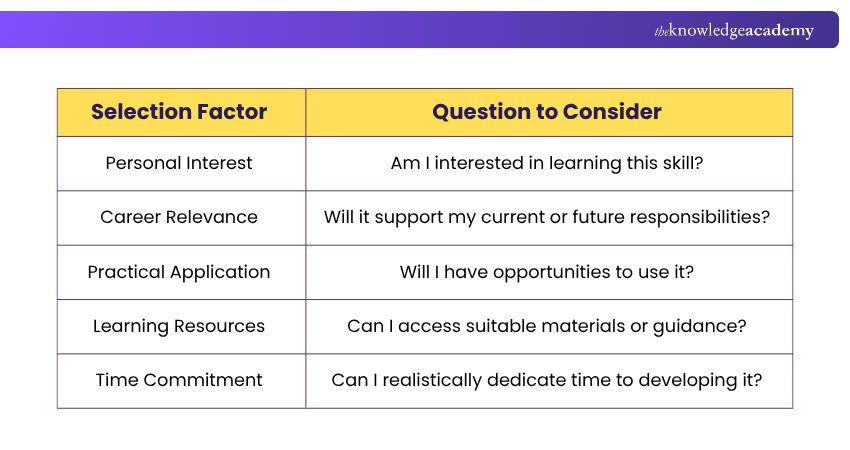
Quick Skill Selection Process
Before choosing a skill, consider its relevance to your goals, your interest in the subject and the time and resources available. The following questions can help you compare different options.
3) Focus on One Priority Skill
Trying to develop several demanding skills simultaneously can make it difficult to allocate enough attention to each one. Choosing a priority skill allows you to direct your learning efforts towards a clear objective.
For example, if you want to improve both public speaking and data analysis, you might focus primarily on one while maintaining occasional practice in the other. This does not mean you must master a skill completely before learning something else. Instead, prioritisation helps you manage your available time and attention.
Here's how to stay focused:
a) Identify the skill that currently needs most of your attention.
b) Choose a manageable number of related topics.
c) Avoid frequently switching between unrelated resources.
d) Review your priorities when your learning objectives change.
4) Create a Practical Learning Plan
A learning plan provides structure by organising what you need to study, when you will practise and how you will measure progress. Without a plan, it can be easy to spend time exploring resources without developing practical ability. An effective plan should include learning objectives, milestones, suitable resources and opportunities for practice.
How to Create Your Plan:
a) Identify the Starting Point: Assess what you already know.
b) Divide the Skill Into Components: Break complex skills into smaller topics or tasks.
c) Select Learning Activities: Choose tutorials, exercises, courses or other relevant resources.
d) Schedule Practice: Allocate manageable periods for developing the skill.
e) Review Milestones: Evaluate whether your activities are helping you achieve your goals.
Practical Example: A Four-week Learning Plan
Consider someone who wants to develop beginner-level Excel skills for workplace reporting.
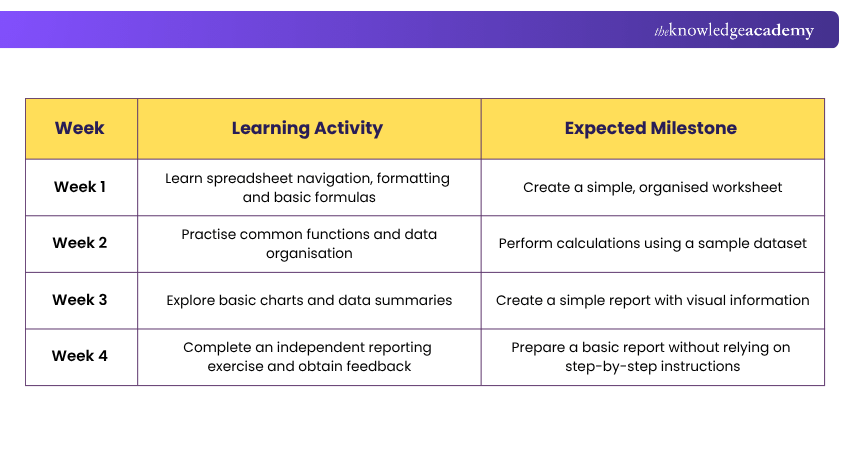
This is an illustrative plan. The pace should depend on your starting knowledge, available time and the complexity of the skill.
Learn practical techniques to prioritise tasks and improve daily productivity with our Time Management Training – Sign up now!
5) Choose the Right Learning Resources
Learning resources influence how you understand concepts and develop practical ability. Suitable materials can provide clear explanations, demonstrations and opportunities for guided practice. Resources may include books, online courses, tutorials, workshops, mentors and interactive exercises. Here's how you can choose suitable resources:
a) Check Relevance: Select materials that match your learning goals.
b) Consider Your Experience: Begin with resources appropriate to your current knowledge.
c) Evaluate Credibility: Look for accurate information and knowledgeable instructors.
d) Include Practical Activities: Choose resources that offer opportunities to apply concepts.
e) Avoid Resource Overload: Use a manageable selection rather than constantly switching between materials.
For example, someone learning graphic design might combine a beginner course with a series of practical design exercises.
6) Focus on High-impact Learning Activities
Not every learning activity contributes equally to your development. Some tasks may be more relevant to your immediate goals than others. The Pareto Principle, commonly called the 80/20 rule, is sometimes used as a prioritisation guideline. However, it should not be interpreted as a guaranteed formula for learning outcomes. The practical lesson is to identify the activities that offer the greatest value for your particular objective.
Here's how you can prioritise learning:
a) Identify the foundational concepts needed for your goal.
b) Focus on commonly used techniques before exploring specialist topics.
c) Spend sufficient time practising important tasks.
d) Review which activities are improving your performance.
7) Schedule Consistent Learning Sessions
Learning new skills requires time, but progress does not necessarily depend on studying for several hours every day. Short, manageable learning sessions can help you maintain consistency alongside work, education and personal commitments. For example, someone learning a language might schedule regular vocabulary reviews and speaking practice rather than relying entirely on occasional lengthy study sessions.
Here's how you can manage learning time:
a) Choose Realistic Sessions: Select a duration that fits your schedule.
b) Limit Distractions: Create conditions that allow you to concentrate.
c) Include Breaks: Avoid studying continuously when fatigue affects your attention.
d) Protect Practice Time: Treat learning sessions as planned commitments.
e) Adjust When Necessary: Modify your schedule rather than abandoning your learning goal when circumstances change.
8) Practise Through Real-world Activities
Reading about a skill or watching demonstrations can build understanding, but practical ability develops through application. Real-world activities allow you to use what you have learned and identify areas that need further improvement. For example, someone learning project management could practise creating project schedules, identifying risks or preparing stakeholder communication plans.
Here's how to practise effectively:
a) Start with manageable exercises that reinforce essential techniques.
b) Gradually increase the difficulty of your activities.
c) Apply the skill in situations similar to where you intend to use it.
d) Complete tasks independently when you are ready.
e) Review your work and identify opportunities to improve.
Trainer Insight: Practise Under Realistic Conditions
When you can complete a task using instructions, try repeating it with fewer prompts or within a realistic time limit. For example, someone learning Excel could build a report from an unfamiliar dataset rather than copying a completed tutorial. This helps reveal which skills need further practice.
9) Use Active Recall and Spaced Practice
Effective learning involves remembering and using information, not simply reviewing it repeatedly. Two techniques that can support knowledge retention are active recall and spaced practice.
a) Active Recall: This involves trying to retrieve information from memory without immediately referring to notes or learning materials. For example, after studying a concept, you might explain it in your own words or answer practice questions without checking the answers first.
b) Spaced Practice: This involves revisiting material across separate learning sessions rather than concentrating all revision into one session. For example, you might review a topic after initial study and return to it at later intervals.
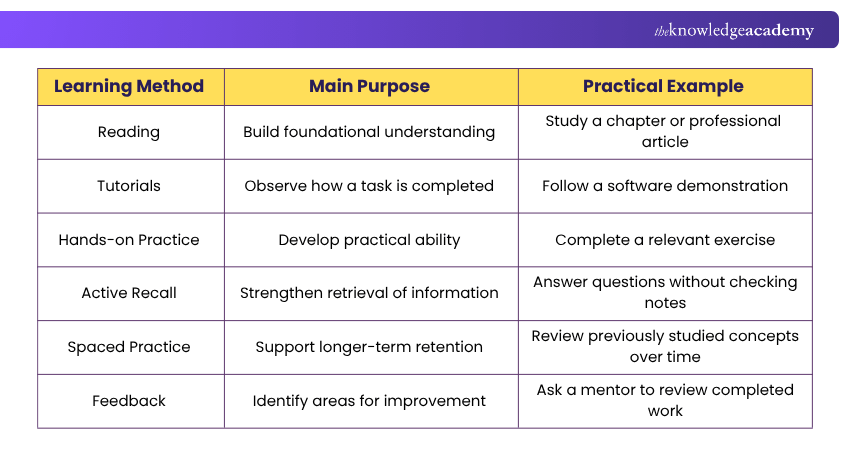
These techniques can help strengthen retention, although practical skills also require appropriate hands-on exercises and feedback. The following table compares common learning methods and the purposes they serve:
10) Learn From Mistakes and Feedback
Mistakes are a normal part of developing new skills. They can provide useful information about what you understand and where additional practice is needed. However, making mistakes alone does not guarantee improvement. Learning requires identifying the cause of an error and adjusting your approach.
For example, someone practising public speaking might notice that their explanations are unclear. Constructive feedback can help them identify whether the problem involves structure, delivery or supporting examples. Here's how to learn from mistakes:
a) Identify the specific error or difficulty.
b) Consider why the problem occurred.
c) Seek feedback from a knowledgeable person when possible.
d) Practise the relevant task again using a revised approach.
e) Check whether the correction improves your performance.
Learn behavioural insights to respond effectively in different situations with our Emotional Intelligence Training – Join now!
11) Learn With Mentors and Peers
Learning does not always need to be an individual activity. Mentors, instructors and peers can offer explanations, feedback and encouragement. For example, someone learning programming might discuss difficulties with an experienced developer or participate in a study group to explore different problem-solving approaches.
Here are the ways to learn with others:
a) Seek Guidance: Ask experienced people for advice on difficult topics.
b) Join Learning Communities: Connect with people developing similar skills.
c) Request Feedback: Share your work and ask for specific suggestions.
d) Discuss Concepts: Explain ideas and listen to alternative perspectives.
e) Build Accountability: Arrange regular progress discussions with a learning partner.
A supportive learning environment can make challenges easier to manage and provide opportunities to learn from different experiences.
12) Measure Your Learning Progress
Tracking your progress helps you understand whether your learning approach is effective. Progress should not be measured only by the number of hours spent studying. A better indicator is whether you can demonstrate the skills you intended to develop. For example, someone learning presentation skills might compare an early recorded presentation with a later attempt, focusing on clarity, structure and delivery.
Here's how you can measure progress:
a) Review Your Goals: Compare your current ability with your original learning objectives.
b) Complete Practical Assessments: Test whether you can perform relevant tasks.
c) Seek Constructive Feedback: Ask others to identify improvements and remaining difficulties.
d) Record Achievements: Keep examples of completed work or demonstrated abilities.
e) Adjust Your Plan: Identify what needs more practice and revise your learning activities accordingly.
Importance of Learning New Skills
Learning new skills can support both personal and professional development. Here are six ways it may help you adapt to change, expand your abilities and explore new opportunities:
a) Adaptation to Change: As technology and industries advance, the skills that were once in demand may become obsolete. Learning new skills can help you adapt to changes in technology and industry requirements, maintain relevant professional capabilities and explore new opportunities.
b) Career Advancement: Developing relevant skills may support career progression by preparing you for new responsibilities, different roles or career changes. Actual opportunities depend on factors such as experience, qualifications and employer requirements.
c) Personal Growth and Fulfilment: Learning new skills is not only about professional development but also personal growth. It can provide a sense of accomplishment, build confidence and create opportunities to explore personal interests.
d) Problem-solving: Many skills involve problem-solving and critical thinking. Developing these abilities can help you approach relevant challenges more systematically, particularly when you have opportunities to apply what you learn.
e) Innovation and Creativity: Learning new skills can encourage creativity by exposing you to different ideas, techniques and perspectives. Combining knowledge from different areas may help you approach problems in new ways.
f) Lifelong Learning: In a knowledge-based economy, the ability to learn and adapt is a valuable skill in itself. Continuing to learn can help you practise adapting to unfamiliar tasks, develop new abilities and remain open to different experiences.
Learning Skills Self-Check: Common Mistakes to Avoid
Before starting or continuing your learning journey, use this checklist to identify habits that may slow your progress.
□ Avoid choosing a skill without a clear purpose or goal.□ Do not rely only on reading or watching tutorials without practising.□ Avoid using too many learning resources at the same time.□ Do not set unrealistic deadlines or attempt to learn everything at once.□ Avoid skipping foundational concepts to reach advanced topics quickly.□ Do not ignore constructive feedback or repeat mistakes without reviewing them.□ Avoid comparing your learning speed with others.□ Do not measure progress solely by the number of hours spent studying.
Learn how to adapt to changes in working routine or environment with our Stress Management Course – Join now!

Vidhya Nair is a Senior Copywriter with 7+ years of experience across copywriting, content writing and communication. Her extensive research and editorial experience supports her ability to present topics across Business Skills and Human Resources with clarity and purpose.
View Detail

 If you wish to make any changes to your course, please


