


 Top Rated Course

We may not have the course you’re looking for. If you enquire or give us a call on 01344203999 and speak to our training experts, we may still be able to help with your training requirements.
Emotional Intelligence Skills and How to Improve Them
The Knowledge Academy 04 September 2026Learn what Emotional Intelligence Skills are and understand why they are important. Discover practical ways to develop and apply these skills in everyday situations.

Training Outcomes Within Your Budget!
We ensure quality, budget-alignment, and timely delivery by our expert instructors.
Table of Contents
Key Takeaways
1. Emotional Intelligence Skills help you recognise, understand and manage emotions in yourself and others.2. The four core areas are self-awareness, self-management, social awareness and relationship management.3. These skills can support communication, conflict resolution, teamwork and stronger relationships.4. Emotional Intelligence can be developed through reflection, active listening, feedback and deliberate practice.5. Small habits, such as pausing before reacting and identifying emotional triggers, can help strengthen these skills over time.
Imagine you’re in a meeting when a colleague suddenly criticises your idea.
You feel the urge to defend yourself. Do you react immediately, or pause and consider what’s really happening?
That moment is where Emotional Intelligence Skills come into play. They help you recognise your emotions, manage your response and understand the other person’s perspective.
But Emotional Intelligence isn’t only useful during difficult conversations. It shapes how you communicate, handle pressure, resolve disagreements and build relationships every day.
So, what separates an emotional reaction from a thoughtful response?
Often, it comes down to how well you use your Emotional Intelligence Skills. Let’s learn more about it in the blog!
What are Emotional Intelligence Skills?
Emotional Intelligence Skills are the abilities that help people recognise, understand and manage emotions in themselves and others. They include being aware of your emotional responses, regulating how you react, recognising the feelings and perspectives of others, and handling interpersonal situations effectively.
These skills are useful in both personal and professional situations. They can help you communicate more thoughtfully, adapt your responses to different circumstances, manage disagreements constructively and build positive relationships with others.
Why are Emotional Intelligence Skills Important?
Emotional Intelligence Skills help people understand and manage emotions while interacting effectively with others. Here are several practical areas where Emotional Intelligence Skills are important:
a) Effective Communication: Helps you recognise emotions, listen actively and communicate with greater awareness of others.
b) Conflict Resolution: Supports calmer responses to disagreements and helps people work towards constructive solutions.
c) Stronger Relationships: Empathy and thoughtful communication can help build trust and positive connections.
d) Leadership and Teamwork: Helps people understand different perspectives, manage reactions and collaborate effectively.
e) Better Decision-making: Encourages you to recognise emotional influences and consider them alongside relevant information before making decisions.
f) Adaptability and Stress Management: Helps you manage emotional responses when dealing with pressure, change and unexpected situations.
What are the Core Emotional Intelligence Skills?
Emotional Intelligence includes several skills that help people understand and manage emotions in themselves and others. These abilities can be grouped into four core areas. Let’s learn about them below:
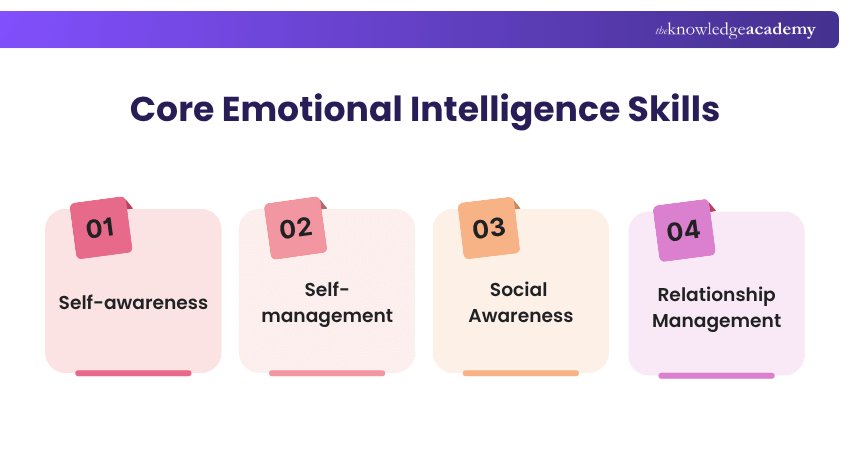
1) Self-awareness
Self-awareness refers to the ability to recognise and understand your emotions, including how they can influence your thoughts and behaviour. It also involves recognising your strengths, limitations and recurring emotional patterns.
For example, if a colleague challenges your idea, self-awareness helps you notice feelings such as frustration or defensiveness before reacting. Recognising the emotion gives you an opportunity to consider your response more carefully.
2) Self-management
Self-management refers to the ability to regulate emotions and impulses constructively. It does not mean ignoring or suppressing emotions; instead, it involves recognising what you feel and choosing an appropriate response.
For example, when receiving critical feedback, self-management can help you remain composed rather than immediately becoming defensive. It also supports adaptability when circumstances change, or situations do not go as planned.
3) Social Awareness
Social awareness refers to the ability to recognise and understand other people's emotions, perspectives and concerns. It involves empathy and paying attention to cues such as words, tone, behaviour and context.
For example, if a normally engaged colleague becomes unusually quiet, social awareness can help you notice the change rather than make assumptions. You can then listen, ask appropriate questions and give them an opportunity to express their perspective.
Trainer’s Insight
Avoid assuming you know how someone feels. Notice their words, tone and behaviour, then ask questions to check whether your interpretation is accurate.
4) Relationship Management
Relationship management involves using awareness of your own and other’s emotions to handle interactions constructively. It supports communication, teamwork, collaboration and conflict resolution.
For example, when two team members disagree, relationship management involves listening to different perspectives, keeping emotions from unnecessarily escalating and working towards a constructive solution rather than simply avoiding the disagreement.
Learn to turn your words into positive influence by joining the Communication and Influencing Skill Training now!
How to Improve Your Emotional Intelligence Skills?
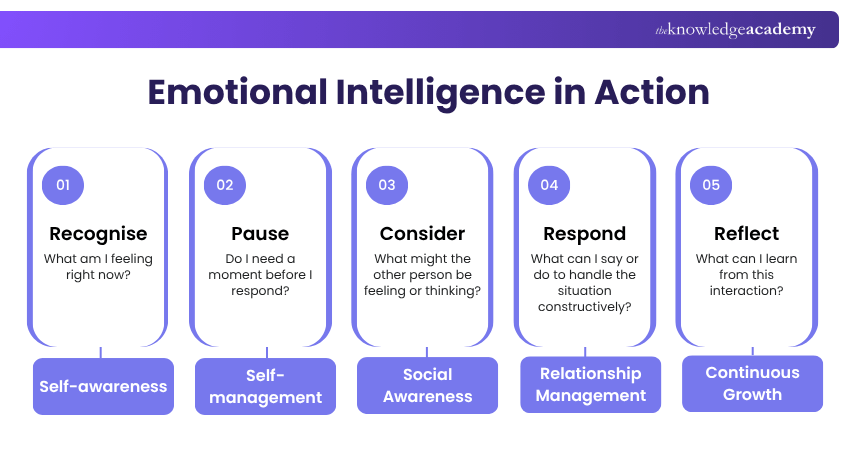
Emotional Intelligence Skills can be strengthened through regular practice and self-awareness. The key is to recognise your emotional patterns, manage your responses and become more attentive to how you interact with others. Let’s look at it more below:
1) Practise Self-reflection
Reflect on situations that trigger strong emotions and consider what you felt, why you reacted that way and how your response affected the situation. Regular reflection can help you recognise recurring emotional and behavioural patterns.
2) Recognise and Label Your Emotions
Try to identify emotions precisely rather than describing yourself simply as “good”, “bad” or “stressed”. Recognising whether you feel frustrated, anxious, disappointed or overwhelmed can help you understand your emotional state and respond appropriately.
3) Identify Your Emotional Triggers
Pay attention to situations that repeatedly cause strong reactions, such as criticism, uncertainty, tight deadlines or disagreements. Recognising your triggers early can give you more time to manage your response deliberately.
4) Pause Before Reacting
When emotions become intense, take a moment before responding. A brief pause can help you assess the situation, regulate your immediate reaction and choose a more thoughtful response, particularly during conflicts or stressful conversations.
5) Practise Active and Empathetic Listening
Give others your full attention and consider their words, tone and perspective before responding. Ask clarifying questions when necessary, rather than making assumptions about what another person thinks or feels.
6) Seek Constructive Feedback
Ask trusted colleagues, friends or family members for specific feedback about your communication and emotional responses. Look for recurring patterns in their observations and use them to identify areas you could improve.
7) Learn From Difficult Interactions
After a disagreement or challenging conversation, consider what went well, what you may have misunderstood and what you could do differently next time. Treating difficult interactions as learning opportunities can strengthen your emotional awareness.
8) Set a Specific Development Goal
Focus on one Emotional Intelligence Skill at a time rather than trying to improve everything at once. For example, you might practise pausing before responding to criticism or listening without interrupting during conversations.
Quick Check: How Emotionally Aware Are You?
Use these questions to reflect on your everyday responses:
Can I recognise and name what I am feeling? Do I know which situations tend to trigger strong reactions? Can I pause before responding when emotions are high? Do I listen to others without immediately judging or interrupting? Do I consider other people's perspectives before making assumptions? Can I handle disagreements without letting emotions take over? Do I reflect on difficult interactions and consider what I could do differently?
Conclusion
Emotional Intelligence Skills help us understand emotions, manage responses and interact effectively with others. Developing self-awareness, self-management, social awareness and relationship management can support more thoughtful behaviour in everyday personal and professional situations.
Turn personal growth into lasting progress with the Personal Development Courses – Join now!
Frequently Asked Questions
What is the Difference Between IQ and Emotional Intelligence?

Intelligence Quotient (IQ) concerns cognitive abilities, whereas Emotional Intelligence concerns abilities related to emotions like recognising, understanding and regulating emotional information. They should not be treated as simple opposites or substitutes; they describe different aspects of human ability.
How can you Demonstrate Emotional Intelligence at Work?
You can demonstrate it by staying aware of your reactions and listening before responding. Adapt your communication to the situation and consider your colleagues’ perspectives. Handle disagreements calmly and manage your emotions under pressure.
Is Empathy the Same as Emotional Intelligence?
No, empathy is an important part of Emotional Intelligence, but it is not the whole concept. Empathy sits within social awareness, while Emotional Intelligence also includes skills involving self-awareness, self-management and relationship management.

The Knowledge Academy


Global Training Provider
The Knowledge Academy is a world-leading provider of professional training courses, offering globally recognised qualifications across a wide range of subjects. With expert trainers, up-to-date course material, and flexible learning options, we aim to empower professionals and organisations to achieve their goals through continuous learning.


 If you wish to make any changes to your course, please


