


 Top Rated Course

We may not have the course you’re looking for. If you enquire or give us a call on 01344203999 and speak to our training experts, we may still be able to help with your training requirements.
Digital Transformation Manager Skills
The Knowledge Academy 29 August 2026Digital Transformation Manager Skills combine strategic thinking, technology awareness and leadership to turn digital initiatives into meaningful business outcomes.

Training Outcomes Within Your Budget!
We ensure quality, budget-alignment, and timely delivery by our expert instructors.
Table of Contents
Key Takeaways
1) Digital Transformation Managers need a balance of technology, business and leadership skills to guide transformation initiatives.2) Strategic thinking helps align digital initiatives with business goals.3) Change Management and stakeholder engagement help build support for digital initiatives and encourage adoption.4) Data literacy helps evaluate performance, identify opportunities and make evidence-based decisions throughout transformation initiatives.5) Focus on the skills that best match your responsibilities, strengths and transformation goals.
Cloud + AI + Automation + Data = Digital Transformation?
Not quite.
Even the best technology can fall short without clear strategy, effective communication and employee adoption. Digital Transformation Managers need the right skills to bring technology, business and people together. So, what does it take to manage these moving parts effectively? Let’s explore the Skills for Digital Transformation Managers in this blog!
Who is a Digital Transformation Manager?
A Digital Transformation Manager helps an organisation plan, coordinate and deliver initiatives that use digital technologies to improve business processes, customer experiences, products or ways of working. Rather than focusing solely on technology implementation, they connect technological opportunities with broader business requirements.
Their responsibilities may involve:
1) Identifying opportunities for digital improvement
2) Developing or supporting transformation strategies
3) Coordinating transformation initiatives
4) Working with stakeholders across different departments
5) Supporting organisational change
6) Monitoring transformation progress
7) Evaluating business outcomes

Key Digital Transformation Manager Skills
Digital Transformation rarely depends on one capability. Managers need to understand the business problem, evaluate technological opportunities, bring people through change and ensure initiatives are delivered effectively. Here are the key Digital Transformation Manager Skills:
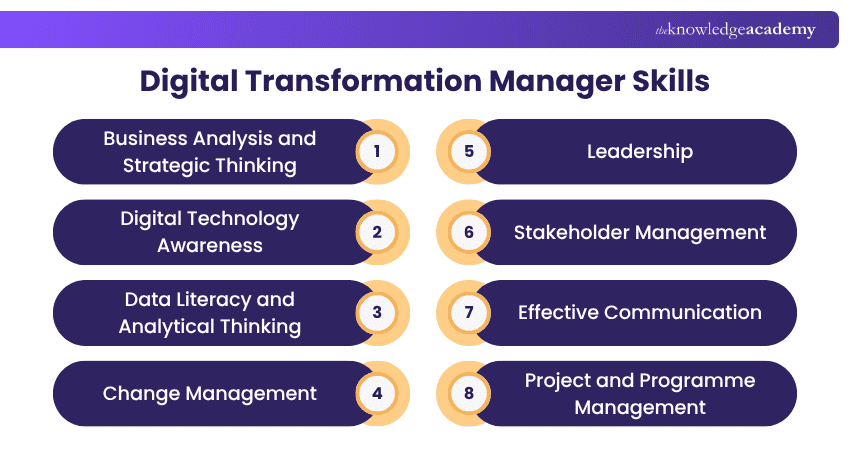
1) Business Analysis and Strategic Thinking
Digital Transformation should support a wider business objective rather than simply introduce new technology. Digital Transformation Managers need to understand existing processes, identify problems and opportunities and determine how digital initiatives can support organisational goals.
This involves the ability to:
a) Analyse existing business processes
b) Identify inefficiencies and opportunities
c) Understand market and customer needs
d) Connect digital initiatives with business objectives
e) Prioritise transformation opportunities
f) Evaluate potential business value
Strategic thinking also helps managers look beyond immediate implementation and consider the longer-term impact of transformation decisions.
2) Digital Technology Awareness
Digital Transformation Managers do not necessarily need to be technical specialists, but they should understand the capabilities and limitations of technologies that could affect their organisation. Depending on the transformation initiative, this could include awareness of:
a) Artificial Intelligence (AI)
b) Cloud Computing
c) Automation
d) Internet of Things (IoT)
e) Data and analytics
f) Digital platforms
g) Enterprise applications
Technology awareness helps managers communicate with technical teams and assess whether proposed solutions support business requirements.
Pro Tip
You do not need to master every emerging technology. Focus on understanding what it can do, where it may create value and what limitations or risks need to be considered.
3) Data Literacy and Analytical Thinking
Transformation decisions should be supported by evidence rather than assumptions. Data literacy and analytical thinking enable managers to interpret information, evaluate performance and understand whether transformation initiatives are delivering the intended results.
Useful capabilities include:
a) Understanding business metrics
b) Interpreting dashboards and reports
c) Identifying trends and patterns
d) Evaluating performance data
e) Using evidence to support decisions
f) Tracking transformation outcomes
Managers should also understand what information is needed before launching an initiative so that progress can be measured meaningfully.
Trainer’s Insight
Define measurable outcomes before implementation begins. Measurable outcomes make it easier to see whether the transformation is delivering real value.
4) Change Management
Introducing a new digital system does not automatically mean people will adopt it. Digital Transformation often changes established processes, responsibilities and ways of working. Managers therefore need to understand how people respond to organisational change.
Change Management skills can help managers:
a) Assess how transformation affects employees
b) Communicate the reasons for change
c) Identify potential resistance
d) Support adoption of new processes or technologies
e) Coordinate training and communication
f) Reinforce new ways of working
Effective Change Management helps bridge the gap between implementing technology and achieving meaningful organisational adoption.
5) Leadership
Digital Transformation Managers often need to guide initiatives involving people from multiple departments without directly managing everyone involved. Strong leadership can help create direction, maintain momentum and keep teams focused on common transformation goals.
Important leadership capabilities include:
a) Creating a clear transformation vision
b) Motivating teams
c) Managing uncertainty
d) Encouraging collaboration
e) Resolving obstacles
f) Supporting informed decision-making
6) Stakeholder Management
Transformation programmes can affect senior leaders, employees, customers, technology teams and external partners. Each group may have different expectations and priorities. Digital Transformation Managers have to identify stakeholders, understand their interests and maintain appropriate engagement throughout the initiative.
Effective Stakeholder Management involves:
a) Understanding stakeholders’ expectations
b) Managing competing priorities
c) Communicating progress
d) Addressing concerns
e) Building support for transformation initiatives
Real-world Scenario
Imagine an organisation introducing a new enterprise platform. The finance team may focus on cost, the IT team may prioritise security and integration, employees may be concerned about new workflows and senior leadership may focus on business outcomes. The Digital Transformation Manager needs to align these perspectives around common objectives.
7) Effective Communication
A transformation strategy can fail to gain support if people do not understand it. Therefore, Digital Transformation Managers need to communicate complex ideas clearly to both technical and non-technical audiences. Communication skills help them:
a) Explain transformation objectives
b) Present recommendations
c) Communicate changes to employees
d) Facilitate discussions
e) Manage stakeholder expectations
f) Translate technical information into business language
Build confidence in presentations, meetings, and everyday conversations with Effective Communication Skills Training – Sign up soon!
8) Project and Programme Management
Digital Transformation often involves several connected projects, teams, dependencies and milestones. Project and Programme Management skills help Managers organise this complexity and maintain progress towards broader transformation objectives.
Important capabilities include:
a) Planning activities and milestones
b) Coordinating resources
c) Managing dependencies
d) Monitoring progress
e) Managing risks and issues
f) Reviewing outcomes
These capabilities become increasingly important as transformation programmes expand across departments or business functions.
Smart Strategy
Break large transformation programmes into measurable stages. Smaller milestones can make progress easier to track and allow teams to adjust direction when necessary.
9) Agile and Product Thinking
Transformation initiatives often evolve as organisations learn more about customer needs, technology and business requirements. Agile thinking can help teams work iteratively rather than waiting for one large final implementation. Product Management skills can also help Digital Transformation Managers:
a) Understand user needs
b) Prioritise requirements
c) Evaluate business value
d) Gather feedback
e) Coordinate product improvements
f) Adapt solutions as requirements evolve
This is particularly useful when transformation involves digital products, platforms or customer-facing services.
10) Problem-solving and Decision-making
Transformation programmes rarely progress exactly as planned. Unexpected technical constraints, changing priorities, resource limitations and stakeholder concerns can require managers to make informed decisions quickly. Strong problem-solving skills help managers:
a) Identify root causes
b) Compare possible solutions
c) Assess risks and trade-offs
d) Use evidence when making decisions
e) Prioritise issues
f) Adapt plans when circumstances change
The aim is not simply to solve individual problems but to understand how each decision affects wider transformation objectives.
11) Customer-centric Thinking
Digital Transformation should ultimately create meaningful improvements for customers, employees or other users. Customer-centric thinking helps managers evaluate transformation from the perspective of the people who will actually experience the change. This involves:
a) Understanding user needs
b) Identifying pain points
c) Gathering feedback
d) Mapping customer or user journeys
e) Prioritising valuable improvements
f) Measuring user outcomes
Keeping users at the centre can prevent organisations from investing in technology without a clear practical benefit.
KEY INSIGHT
A Digital Transformation Manager in the UK can earn an average annual salary of £44K.
12) Risk and Governance Awareness
Transformation introduces risks alongside opportunities. These may involve security, privacy, compliance, operational disruption, technology dependencies or financial investment. Digital Transformation Managers should therefore understand the organisation's governance requirements and consider risk throughout transformation planning and delivery.
This can involve:
a) Identifying transformation risks
b) Establishing clear responsibilities
c) Supporting appropriate decision controls
d) Considering security and compliance requirements
e) Monitoring risks during implementation
f) Escalating significant issues when required
Build employee-centric workplaces through the power of modern tech. Learn how in our Digital Transformation in HR Training - Sign up now!
How to Develop Digital Transformation Manager Skills?
Developing these capabilities does not happen through theoretical knowledge alone. Practical experience is particularly valuable because Digital Transformation requires managers to work across business, technology and people-related challenges. Here are some practical ways to develop your skills:
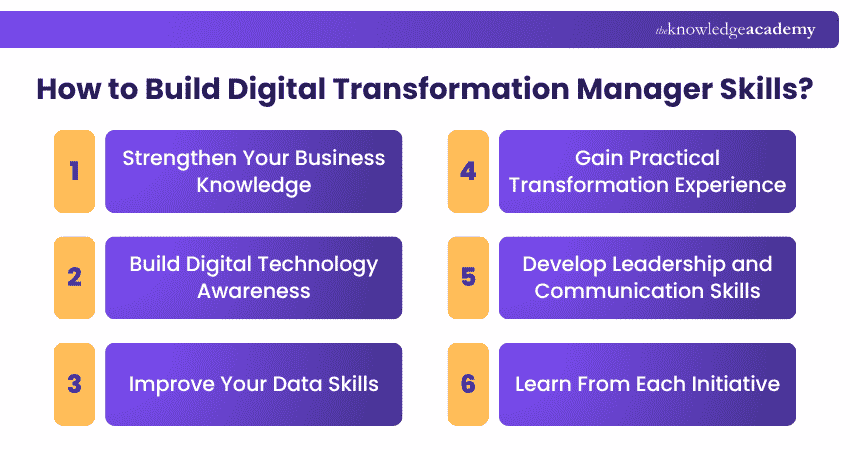
1) Strengthen Your Business Knowledge
Learn how different business functions operate and how they contribute to organisational objectives. Understanding finance, operations, customer experience and strategy can make it easier to identify where digital improvements may create value.
2) Build Digital Technology Awareness
Develop a working understanding of technologies relevant to modern transformation initiatives. Focus on their practical applications rather than trying to become a specialist in every technology.
3) Improve Your Data Skills
Practise interpreting dashboards, metrics and business reports. Learn how to distinguish useful performance indicators from metrics that do not meaningfully demonstrate transformation progress.
4) Gain Practical Transformation Experience
Participate in digital projects where possible. Working on process improvement, system implementation, automation or digital product initiatives can provide valuable experience in managing real transformation challenges.
5) Develop Leadership and Communication Skills
Look for opportunities to lead discussions, present recommendations, manage stakeholders and coordinate cross-functional work. These experiences can strengthen the interpersonal capabilities required for larger transformation programmes.
6) Learn From Each Initiative
After completing a project or transformation stage, review what worked and what did not. Continuous reflection can turn project experience into stronger transformation capability. Consider:
a) Were the expected outcomes achieved?
b) What slowed implementation?
c) How effectively were stakeholders engaged?
d) Did users adopt the change?
e) What should be done differently next time?
Conclusion
Digital Transformation Manager Skills extend beyond understanding new technologies. Successful managers combine strategic thinking, data literacy and digital awareness with leadership, communication and Change Management capabilities. By identifying your key skill gaps and developing the capabilities most relevant to your role, you can become better equipped to guide transformation initiatives.
Transform your business with the power of Digital Transformation. Sign up for our Digital Transformation Training now!
Frequently Asked Questions
Is Coding Required for a Digital Transformation Manager?

Coding is not necessarily a core requirement for every Digital Transformation Manager role. Understanding how digital technologies support business objectives is generally more important, although technical knowledge can be useful when working closely with engineering and technology teams.
Is Digital Transformation a Good Career?
Yes, Digital Transformation can offer strong career opportunities across industries as organisations continue modernising technology, processes and ways of working. Career paths can span transformation management, consulting, Change Management, digital strategy and technology leadership.
How is AI Used in Digital Transformation?
Artificial Intelligence (AI) acts as a core engine for Digital Transformation by automating complex tasks, turning raw data into smart insights, and modernising how organisations deliver value.

The Knowledge Academy


Global Training Provider
The Knowledge Academy is a world-leading provider of professional training courses, offering globally recognised qualifications across a wide range of subjects. With expert trainers, up-to-date course material, and flexible learning options, we aim to empower professionals and organisations to achieve their goals through continuous learning.


 If you wish to make any changes to your course, please


