


We may not have the course you’re looking for. If you enquire or give us a call on 01344203999 and speak to our training experts, we may still be able to help with your training requirements.
Critical Thinking Skills: Examples and How to Develop Them
ByBenjamin WalkerLast updated on: 21 October 2026
Critical thinking skills help individuals analyse information, evaluate evidence, question assumptions and make informed decisions. Learn about the essential skills and practical ways to develop them for better problem-solving and decision-making.
Quick Overview
1. Critical thinking skills help individuals analyse information, evaluate evidence and make informed decisions.2. Essential skills include analytical thinking, open-mindedness, problem-solving, reasoned judgment, reflective thinking, communication, research and decision-making.3. Asking thoughtful questions, gathering reliable information and considering alternative perspectives improves critical thinking.4. Cognitive biases, emotional reasoning, groupthink and insufficient knowledge can interfere with clear and logical thinking.5. Critical thinking can be developed through regular practice, reflection and applying logical reasoning to everyday situations.
Have you ever faced a tough decision, a complex problem, or conflicting information that made it hard to choose the right path? In such moments, critical thinking skills become essential, helping you analyse situations clearly, question assumptions, and make informed decisions with confidence.
Developing these skills can help you approach challenges more thoughtfully, consider different perspectives and make decisions based on reliable information rather than first impressions. So, let’s get started and learn about the essential critical thinking skills!
Essential Critical Thinking Skills
Critical thinking involves a range of skills that help individuals assess information, approach problems logically and make well-reasoned decisions. Each skill plays a distinct role in improving how we interpret situations and evaluate different perspectives. Here are the key critical thinking skills to develop:
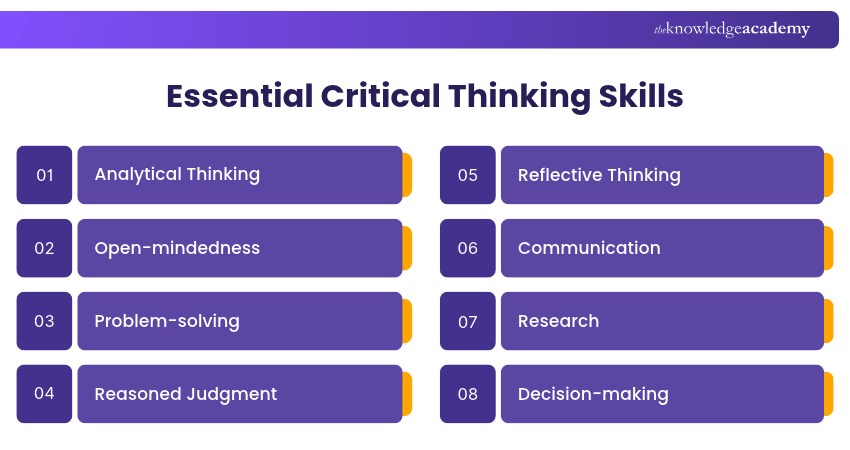
1) Analytical Thinking
Analytical thinking involves breaking down complex information into smaller parts, identifying patterns and examining relationships to draw logical conclusions. It helps individuals understand problems systematically and evaluate the evidence behind different arguments. Analytical thinkers excel at:
a) Identifying patterns and trends
b) Breaking down intricate problems into manageable parts
c) Recognising cause-and-effect relationships
d) Assessing the validity of arguments and evidence
Example: A Data Analyst interprets sales figures to identify patterns that guide marketing strategies.

2) Open-mindedness
Open-mindedness is the readiness to consider new ideas, arguments, and perspectives without prejudice. It encourages unbiased analysis and decision-making by acknowledging multiple viewpoints. Key traits include:
a) Willingness to explore alternative ideas
b) Suspending judgment until evidence is evaluated
c) Accepting constructive feedback
d) Flexibility to revise beliefs based on new information
Example: A Team Leader welcomes unconventional suggestions during a product development meeting, resulting in an innovative solution.
3) Problem-solving
Problem-solving is integral to critical thinking, enabling individuals to identify issues, generate solutions, and implement effective strategies. This skill is particularly valuable in management and entrepreneurship. Steps include:
a) Clearly defining the problem
b) Gathering relevant information
c) Brainstorming and evaluating solutions
d) Selecting and implementing the best option
e) Reviewing outcomes to refine future approaches
Example: A School Principal investigates low student engagement by gathering student feedback and reviewing classroom practices. Based on the findings, they introduce targeted improvements and monitor whether engagement increases.
Turn every challenge into an opportunity to solve with the Problem Solving Course - Register today!
04) Reasoned Judgment
Reasoned judgment includes making thoughtful decisions based on logical analysis and careful consideration of alternatives. It requires:
a) Objectively evaluating evidence and arguments
b) Assessing the credibility and relevance of information
c) Considering diverse perspectives
d) Drawing conclusions through logical reasoning
Example: A Science Teacher evaluates experimental results, considers possible sources of error and draws conclusions based on the available evidence.
5) Reflective Thinking
Reflective thinking is the process of evaluating one's own thoughts, actions, and decisions to learn and improve. It fosters continuous development and better problem-solving. Key traits of reflective thinkers are:
a) Critique personal assumptions and biases
b) Integrate insights from diverse experiences
c) Apply lessons to enhance future actions
d) Continuously refine their thought processes
Example: A community organiser evaluates a recent public event. They identify areas of success and opportunities for improvement.
6) Communication
Effective communication is important for articulating ideas clearly and persuasively. It supports teamwork, leadership, and knowledge-sharing. Strong communicators can:
a) Convey complex ideas with clarity
b) Actively listen and comprehend diverse viewpoints
c) Tailor their style to suit different audiences
d) Construct persuasive arguments
Example: A manager introduces a new policy to their team, addressing concerns and ensuring clarity about its implications.
7) Research
Research skills enable critical thinkers to gather, assess, and synthesise information from credible sources. This is essential in academic and professional fields requiring ongoing learning. Key aspects include:
a) Identifying trustworthy and relevant sources
b) Evaluating bias and reliability
c) Synthesising findings into coherent conclusions
d) Recognising knowledge gaps
Example: A Journalist cross-checks information from multiple credible sources before reporting on a controversial issue.
8) Decision-making
Decision-making is the culmination of logical thinking and critical thinking skills, involving logical reasoning, risk assessment, and selecting the best course of action. Key elements include:
a) Defining criteria for evaluation
b) Considering short-term and long-term outcomes
c) Balancing logic with intuition
d) Managing uncertainty and risk
Example: A homeowner weighs costs, benefits, and future implications before investing in solar panels.
Trainer's Insight
Critical thinking skills rarely work in isolation. Analytical thinking helps you examine information, open-mindedness encourages you to consider alternative perspectives, and reasoned judgment helps you evaluate the evidence. Together, these skills support better decision-making.
Learn to turn tough choices into thoughtful decisions by joining our Decision Making Course now!
How to Develop Critical Thinking Skills?
Improving critical thinking skills involves a combination of practice, reflection, and learning. Here are some effective strategies to help you enhance your thinking abilities:
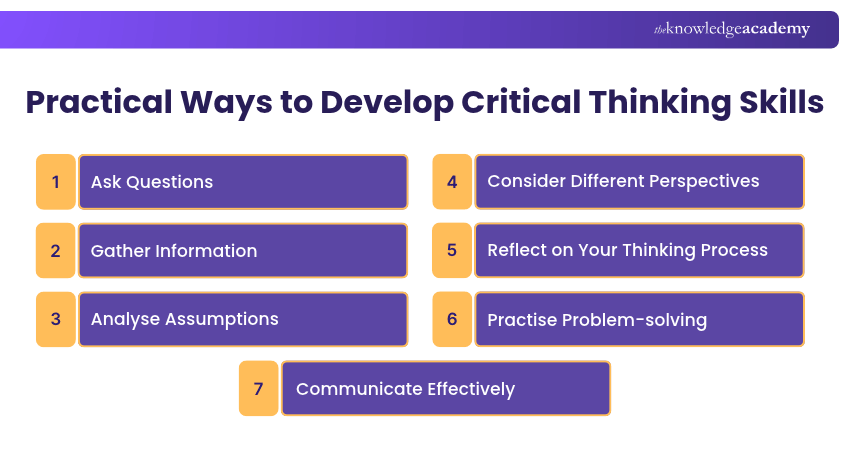
1) Ask Questions
Asking questions is the first step in developing critical thinking. By questioning “why,” “how,” and “what if,” you gain a deeper understanding of a topic. It also helps you avoid assumptions and encourages curiosity-driven learning.
2) Gather Information
Before forming an opinion, it is important to collect information from multiple reliable sources. This can help you develop a more accurate and balanced understanding, reducing the risk of relying on incomplete or misleading information.
3) Analyse Assumptions
Critical thinking requires you to identify and question assumptions, including your own. Recognising biases and challenging pre-existing beliefs allows you to think more objectively and make better decisions.
4) Consider Different Perspectives
Looking at different viewpoints helps you understand a situation more clearly and objectively. Engaging with diverse opinions broadens your thinking and can reduce the risk of one-sided conclusions and biased judgment.
5) Reflect on Your Thinking Process
Reflection helps you evaluate how you think and make decisions. By reviewing your reasoning and learning from past mistakes, you can continuously improve your thought process over time through deliberate practice.
6) Practise Problem-solving
Regularly solving problems helps strengthen analytical thinking. Whether through real-life situations or activities like puzzles, applying logic can help you practise evaluating options and making reasoned decisions.
7) Communicate Effectively
Clear communication is an essential part of critical thinking. It involves expressing your ideas logically and listening carefully to others, allowing you to assess different arguments before forming conclusions.
Quick Check: Fact or Assumption?
A manager notices that team productivity has declined and concludes that employees are not working hard enough.
Question: Is the manager's conclusion a fact or an assumption?Answer: An assumption. Lower productivity may result from several factors, including unclear expectations, insufficient resources or technical difficulties. A critical thinker would investigate the underlying causes before drawing conclusions.
Barriers to Critical Thinking
Barriers to critical thinking limit clear and logical thinking, affecting how decisions are made. Let's look at the key barriers in detail:
a) Cognitive Bias and Personal Assumptions: Cognitive biases are systematic tendencies that can influence how people interpret information and make judgments. Pre-existing beliefs and assumptions may also lead individuals to favour information that supports their existing views.
b) Emotional Reasoning: Letting emotions like fear or frustration influence decisions instead of facts. Recognising emotional reactions and examining the available evidence can support more balanced judgments.
c) Lack of Knowledge: Insufficient or unreliable information leads to poor conclusions. Continuous learning and checking sources are essential.
d) Overreliance on Authority: Accepting claims solely because they come from an expert or senior professional can limit independent evaluation. Critical thinkers consider relevant expertise while also assessing the evidence supporting a claim.
e) Groupthink and Social Pressure: Pressure to agree with a group can discourage individuals from expressing different opinions or questioning assumptions. This may reduce the quality of discussions and increase the risk of overlooking alternative solutions.
f) Time Pressure and Workload: Rushed decisions and heavy workloads reduce deep analysis. Proper time management and prioritising the most important evidence can support better decision-making under pressure.
g) Poor Communication Skills: Unclear expression or misunderstanding of ideas affects analysis. Strong communication supports effective thinking.
Recognising these barriers is an important part of developing critical thinking skills. Being aware of them does not eliminate their influence entirely, but it can help you approach situations with greater care and openness.
Bridge the gap between thinking and understanding with the Effective Communication Skills Training - Join now!

Benjamin Walker develops practical content that helps managers guide teams, make informed decisions and respond to organisational change. His writing supports leaders in improving individual performance while contributing to sustainable organisational progress.
View Detail

 If you wish to make any changes to your course, please


