




We may not have the course you’re looking for. If you enquire or give us a call on 01344203999 and speak to our training experts, we may still be able to help with your training requirements.
What is ITIL Release Management?
ByJyoti TuraLast updated on: 26 September 2026
ITIL Release Management helps organisations make new and changed services and features available for use in a controlled and coordinated way. This blog explains its purpose, key activities, release workflow, success indicators and the responsibilities commonly involved in managing releases.
Quick Snapshot
1. Release Management helps plan and coordinate releases effectively.2. Releases should align with business and service requirements.3. Testing, communication and preparation help reduce release-related risks.4. Release activities often involve multiple technical and business teams.5. Reviews and feedback support continuous improvement.
Are you ready to streamline your IT service deliveries and ensure smooth transitions for your software updates? Discover the world of Information Technology Infrastructure Library (ITIL) release management, where meticulous planning and execution meet to create a seamless flow from development to production.
In this blog, we'll explore the essentials of ITIL release management, from planning and scheduling to deployment and review. Whether you are an IT professional or new to this field, this overview provides essential knowledge to manage releases effectively in your organisation. Let’s dive in and explore how mastering ITIL release management can transform your ITIL service management and elevate your organisation’s performance.
What is Release Management in ITIL?
Release Management is an ITIL practice focused on making new and changed services and features available for use in line with organisational policies and agreements with service consumers.
It involves coordinating release-related activities so that new or changed functionality becomes available at the right time and supports the expected outcomes. Release Management works closely with practices such as Change Enablement and Deployment Management, but they perform different roles.
Change Enablement focuses on assessing and authorising changes, while Deployment Management focuses on moving components into live, testing or staging environments. Release Management coordinates the broader release so that the required services or features are ready for use.

Why is Release Management Necessary?
There are plenty of cases where companies lose money, users and credibility when expected timelines for software updates or releases aren’t met. This is where release management comes in. Its primary objective is to optimise the deployment of IT services and updates to the live environment. Release management is about planning, scheduling and controlling the deployment process or the “release” of IT services.
Pro Tip
Don’t think of release management as simply moving software into production. Focus on coordinating the people, activities, information and resources needed to make new or changed services available successfully.
Release Management Process
There are seven steps in the ITIL release management process, and different companies might have slightly different processes based on their team, project size and requirements. However, these seven steps are essential and the most common process.
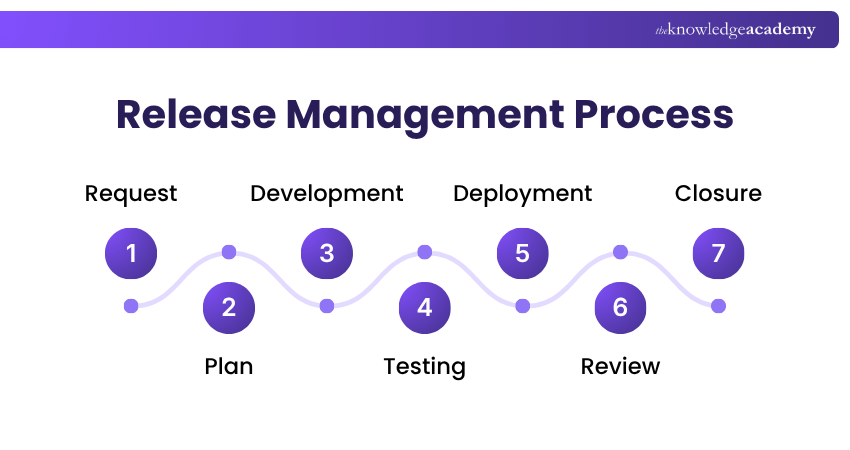
1) Release Request
ITIL release management begins with feature requests or modifications to current features. It is not guaranteed that every request will result in a future release. Every request should be assessed for its explanation, sustainability, and potential for fulfilment through the reconfiguration of the production version of the application.
2) Release Plan
This is the most essential stage in the development of a release. The structure of the release is specified here. In order to plan and prioritise releases in accordance with business needs and strategic objectives, the Release Manager works with other stakeholders. This includes creating and reusing the scope and establishing goals, milestones and responsibilities. It also includes setting deadlines and assigning resources necessary for a successful release’s implementation.
3) Release Development
The development stage entails the actual process of designing and building the release components, including software applications, configurations, and documentation. This stage aims to issue work orders and purchase requests so that the release components can be developed in-house or bought from outside vendors. When the development is done, the release components are ready to go into the testing phase.
Enhance your ITIL skills with the ITIL® 4 Practitioner: Release Management Training - Join now!
4) Release Testing
At this stage, the release components are thoroughly tested in various environments, including development, testing, and staging, to identify and correct any defects or issues. This includes, among other things, Functional Testing, Integration Testing, Performance Testing, Security Testing, and User Acceptance Testing (UAT). This stage is about extensive testing, Quality Assurance (QA), and validation of the release components to ensure they meet the specific needs and are ready for deployment.
5) Release Deployment
The release components are deployed into the live environment after passing all the required tests and meeting the defined quality criteria. The Release Manager ensures that the release is deployed per the defined schedule and plans and works with various teams, such as operations, infrastructure, and support. This process aims to ensure a smooth deployment with minimal impact on the live environment and users.
6) Release Review
Following the deployment of the release, a review is performed to measure the success and to identify any issues or lessons learned. This stage entails reviewing Key Performance Indicators (KPIs), customer feedback, and incident reports to assess the effectiveness of the release and identify areas for future improvements.
The Release Manager and other stakeholders assess the release’s performance and impact on the live environment, business operations, and customer satisfaction, and any lessons learned are recorded for future projects. This feedback is used to continuously improve the release management process and ensure that releases are delivered with high quality and the least risk.
7) Release Closure
At this stage, the release is closed, and relevant documentation is updated once it has been successfully deployed and reviewed. This includes making changes to release notes, configuration records, and knowledge articles to reflect the changes.
It also involves conducting a final review of the entire process to capture and document any learning, best practices, and recommendations for future projects. The Release Manager ensures that all related activities, such as communication, documentation, and reporting, are completed, and the release is formally closed. By following the ITIL Framework, organisations can streamline their release management processes.
Indicators of Successful Release Management
Successful release management is crucial for ensuring that software updates and new features are deployed smoothly and efficiently without disrupting business operations. Here are key indicators that demonstrate the success of release management in an organisation:
1) Timely Deployments
One of the most evident signs of effective release management is the ability to release software updates and new features on time. The meeting stated deadlines, which indicates that the release management procedure was well-planned and carried out. Timely deployments reduce interruption and ensure that consumers can utilise the most recent updates and improvements as planned.
2) Minimal Disruption and Downtime
Successful release management ensures that installations have minimal disruptions and delays. This is achieved through thorough evaluation and careful planning. Minimum interruption enables end users to continue working without large interruptions, which is important for productivity and customer satisfaction.
3) High-quality Releases and Fewer Rollbacks
Effective Release Management supports releases that meet agreed quality requirements and perform as expected after becoming available. Thorough testing, validation and readiness checks can help reduce post-release incidents, emergency fixes and rollbacks. Tracking incidents and rollback frequency can therefore provide useful evidence of release quality and stability.
Pro Tip
Don’t limit the post-release reviews to identifying what went wrong. Capture what worked well too, then reuse those lessons to make future release planning and execution more consistent.
4) User Satisfaction
User happiness is an essential measure of the success of release management. Positive user feedback indicates that the released updates and features match their needs and expectations. Surveys, feedback forms, and user interviews can be used to get information about user satisfaction. High levels of satisfaction indicate that the release management process is in accordance with user requirements.
5) Effective Communication and Coordination
Successful release management depends on excellent communication and coordination among everyone involved in the release process. Effective communication helps ensure that every team member understands their duties and responsibilities, as well as that any issues are resolved quickly. Regular updates and progress reports keep all team members up-to-date, resulting in faster deliveries.
6) Compliance With Relevant Requirements
Compliance with organisational policies, legal regulations, and industry standards is an important sign of successful release management. This ensures that the releases follow the relevant privacy, security, and quality requirements, reducing the possibility of noncompliance issues, which could result in legal or financial penalties.
7) Continuous Improvement
An effective release management approach has strategies for continuous enhancement. This involves regularly analysing and changing the release process in accordance with feedback and performance data. Finding and fixing areas for improvement contributes to the efficiency and effectiveness of future releases.
8) Efficient Resource Utilisation
Successful release management ensures that all resources, including time, budget, and employees, are used efficiently. This means that the release process is affordable and adheres to budgets and deadlines. Efficient resource utilisation shows well-planned and executed release actions.
9) Achieving Business Objectives
The success of release management is measured by its contribution to meeting company goals. This includes achieving strategic goals, improving operational efficiency, and improving customer happiness. When release management matches and promotes company goals, it is considered successful.
Common Mistake
Avoid treating release management and deployment management as interchangeable terms. A release involves broader coordination around making new or changed services and features available, while deployment activities concern moving relevant components into target environments.
Drive business growth and shape future-ready IT strategies with the ITIL® (Version 5) Strategy Certification Training – Sign up now!
Roles and Responsibilities of a Release Manager
A Release Manager is important in managing the release of software and IT services. Key roles and responsibilities include:
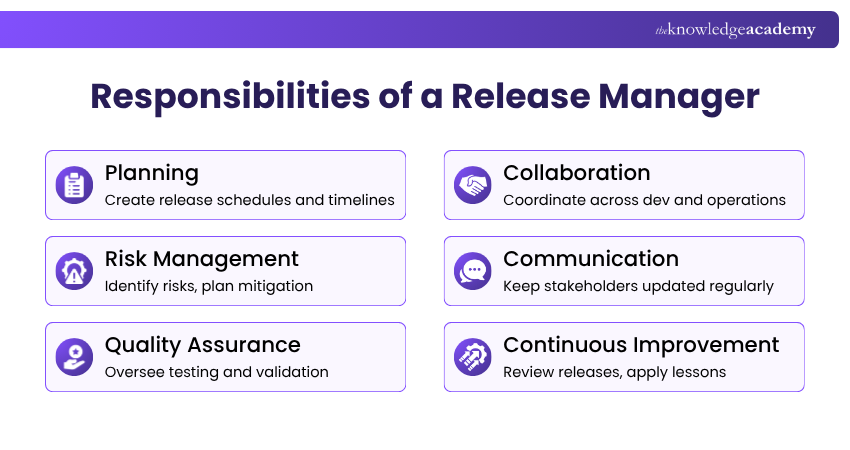
1) Create and organise release plans, timetables, and timelines.
2) Identify possible risks and develop mitigation measures to ensure a smooth implementation.
3) Manage testing and validation procedures to ensure that high-quality requirements are fulfilled.
4) Work with the development, testing, and operations teams to ensure a smooth integration and delivery.
5) Keep stakeholders informed about release progress, issues, and changes via regular updates and release notices.
6) Maintain comprehensive records of release actions to ensure compliance with organisational rules and legal requirements.
7) Distribute and manage resources effectively to support release operations.
8) Conduct reviews to determine the success of the release as well as possibilities for improvement.
9) Use lessons learnt from previous releases to improve future release procedures.
Advance your career in IT with our ITIL® 4 Practitioner: IT Asset Management Training - Sign up today!
Post-release Review Checklist
After a release, check:☐ Were the release objectives achieved?☐ Did any incidents or disruptions occur?☐ Were users significantly affected?☐ Did the release perform as expected?☐ Were any rollback or recovery actions required?☐ What feedback did stakeholders provide?☐ What lessons should be applied to future releases?

Jyoti Tura is a Senior Web & UX/UI Manager with 7+ years of experience in front-end development, web development and user-focused interface design. Her technical expertise and managerial responsibilities support her knowledge across IT and Tech, Leadership and Management.
View Detail

 If you wish to make any changes to your course, please


