


We may not have the course you’re looking for. If you enquire or give us a call on 01344203999 and speak to our training experts, we may still be able to help with your training requirements.
Conflict Management Guidelines: Principles and Best Practices
ByThe Knowledge AcademyLast updated on: 17 September 2026
Conflict Management Guidelines provide a structured way to handle disagreements fairly and constructively. Explore practical principles for addressing conflict, improving communication, reaching workable resolutions, and preventing issues from escalating.
Conflict is a normal part of professional life. Different priorities, expectations, and working styles can create disagreement even within effective teams.
Problems often become harder to manage when concerns are ignored, handled inconsistently or allowed to become personal. Clear Conflict Management Guidelines can help people discuss issues more objectively and decide what should happen next.
This blog explores practical ways to approach disagreements, work towards resolution, and avoid common mistakes.
What are Conflict Management Guidelines?
Conflict Management Guidelines are practical principles that help individuals and organisations respond to disagreements in a fair, consistent, and constructive manner.
They provide direction on how to raise concerns, understand different viewpoints, communicate appropriately, evaluate possible solutions, and determine whether further support is required. Rather than prescribing the same response for every disagreement, they help people choose an approach that reflects the nature and seriousness of the situation.
These guidelines apply to workplace discussions, disagreements, negotiations, and other professional conflicts.

Why are Conflict Management Guidelines Important?
Conflict can become harder to manage when people respond according to assumptions, emotions, or different personal approaches. Guidelines create a shared framework for deciding how concerns should be addressed.
They also encourage proportionate responses. A minor misunderstanding may only require a direct conversation, while a more serious matter may need mediation, management involvement, or a formal organisational procedure.
Clear guidelines can therefore support fairness without treating every disagreement in exactly the same way. They help people understand when informal discussion is appropriate and when additional intervention is necessary.
Did You Know?
Acas Research published in 2025 found that 44% of working-age adults in Great Britain experienced conflict at work during the previous 12 months. Those experiencing conflict most commonly discussed it with their line manager or the other person involved.
Key Conflict Management Guidelines
Effective Conflict Management depends on how people approach the disagreement as much as the eventual outcome. The following guidelines provide practical direction for managing conflict constructively.
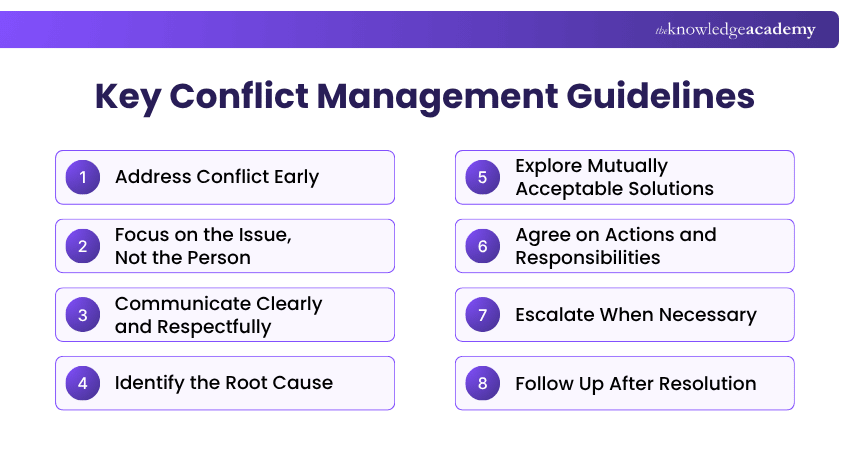
1) Address Conflict Early
Raise concerns while they are still manageable rather than waiting for frustration to accumulate. Early conversations can clarify misunderstandings before they begin affecting wider relationships or responsibilities.
Choose an appropriate time and setting so everyone involved has an opportunity to discuss the matter properly.
2) Focus on the Issue, Not the Person
Keep the discussion centred on specific actions, decisions, expectations, or outcomes. Personal criticism can make people defensive and shift attention away from the problem that needs solving.
For example, discussing repeated delays is more constructive than describing someone as unreliable.
3) Communicate Clearly and Respectfully
Explain concerns directly using calm and specific language. Avoid exaggeration, accusations, interruptions, and statements that make assumptions about another person's motives.
Respectful communication does not mean avoiding disagreement. It means expressing disagreement in a way that keeps the conversation focused and productive.
4) Identify the Root Cause
The most visible disagreement may only be a symptom of a deeper problem.
Look for factors such as unclear responsibilities, competing priorities, limited resources, communication gaps, inconsistent expectations, or unresolved earlier concerns. Understanding the underlying cause helps prevent the same conflict from returning in a different form.
Strengthen your problem-solving approach and tackle workplace challenges with our Problem Solving Course - Sign up today!
5) Explore Mutually Acceptable Solutions
Once the problem is understood, shift attention towards possible ways forward.
Consider the priorities and constraints affecting everyone involved and explore options that are realistic rather than simply trying to determine who should win the disagreement. Compromise may be appropriate where neither side can reasonably achieve everything they initially wanted.
6) Agree on Actions and Responsibilities
Turn the discussion into clear next steps.
Specify what will happen, who will take responsibility, and when any agreed actions should be completed. Important workplace agreements may also need to be documented according to organisational procedures.
7) Escalate When Necessary
Not every conflict should be handled solely between the individuals involved.
Management, HR, mediation, safeguarding processes or formal procedures may be appropriate depending on the nature and seriousness of the issue. Matters involving harassment, discrimination, safety concerns, serious misconduct or safeguarding may require formal support rather than informal resolution.
8) Follow Up After Resolution
Review whether the agreed solution has worked after enough time has passed to assess the outcome.
Follow-up provides an opportunity to address remaining difficulties and confirm whether expectations are now clear. Once the matter has been resolved successfully, avoid repeatedly reopening the original disagreement without a valid reason.
Conflict Management Process
Conflict Management can be easier when people follow a simple structure rather than reacting immediately to the disagreement.
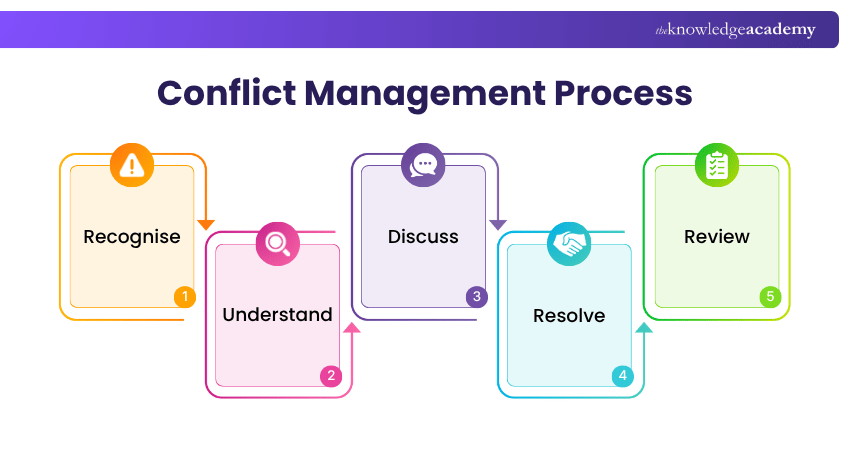
Now, apply this process to a common workplace conflict scenario and see which response best addresses the issue.
Quick Check
Two colleagues repeatedly miss deadlines because each believes the other is responsible for approving a task. What should happen first?
A) Decide who caused the latest delayB) Escalate the matter immediatelyC) Clarify responsibilities and understand how each person interpreted the processD) Separate the colleaguesBest Answer: C – Clarifying ownership addresses the likely cause rather than focusing only on the latest delay.
Common Mistakes to Avoid When Managing Conflict
Conflict can become more difficult when the response creates additional tension instead of addressing the original problem. Some common mistakes and better alternatives include:
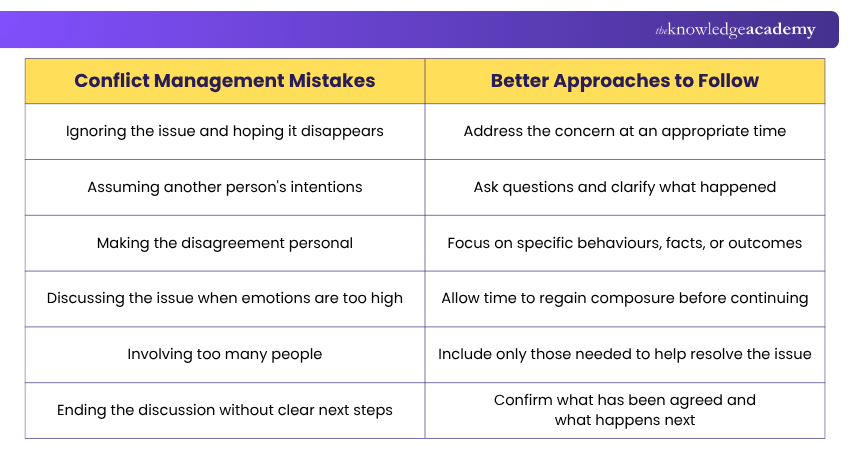
Benefits of Following Conflict Management Guidelines
Using consistent Conflict Management Guidelines can improve both how disagreements are handled and what happens after they are resolved.
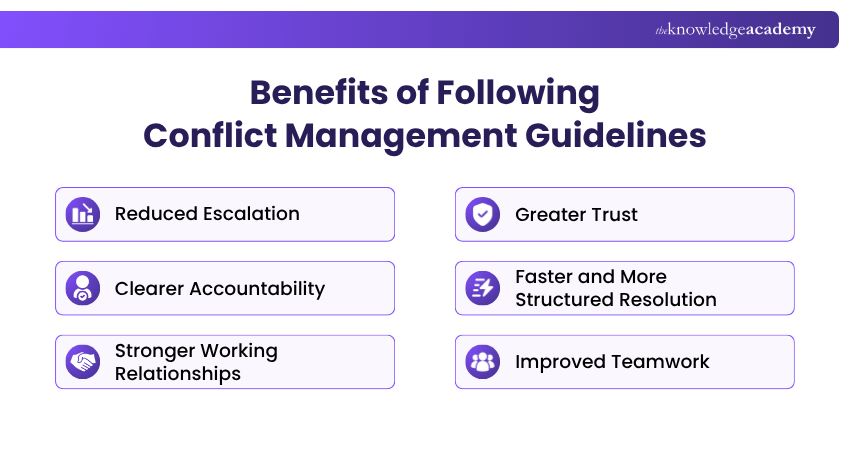
1) Reduced Escalation
Dealing with manageable concerns before positions become entrenched can reduce the likelihood of a disagreement developing into a more disruptive dispute.
2) Clearer Accountability
Agreed actions and responsibilities make it easier for everyone involved to understand what is expected after the discussion and who is responsible for the next steps.
3) Stronger Working Relationships
People do not need to agree on everything to work effectively together. Handling differences professionally can protect relationships even when viewpoints remain different.
4) Greater Trust
A consistent approach gives people greater confidence that concerns will be heard and considered appropriately rather than handled unpredictably.
5) Faster and More Structured Resolution
Clear guidelines reduce uncertainty about how to respond, who needs to be involved, and what should happen next. This can make suitable resolutions easier to reach.
6) Improved Teamwork
Teams that can navigate disagreements constructively are better equipped to coordinate responsibilities, exchange ideas, and continue working towards shared objectives.
Learn effective intervention techniques with our Anti Social Behaviour Management Training and handle difficult behaviour professionally- Join now!

The Knowledge Academy develops accessible learning content across Project Management, IT, Cybersecurity, Data Science, Business Analysis, HR, Accounting and Finance, Leadership and Health and Safety. Its resources combine subject research with clear explanations to help professionals build practical knowledge across a wide range of disciplines.
View Detail

 If you wish to make any changes to your course, please


