




We may not have the course you’re looking for. If you enquire or give us a call on 01344203999 and speak to our training experts, we may still be able to help with your training requirements.
Home
 Resources
Digital Marketing
Search Engine Optimisation Career Path: Roles, Skills and How to Start
Resources
Digital Marketing
Search Engine Optimisation Career Path: Roles, Skills and How to Start
Search Engine Optimisation Career Path: Roles, Skills and How to Start
ByThe Knowledge AcademyLast updated on: 26 November 2026
A search engine optimisation career path can take you from supporting website updates to leading organic search strategy. Explore entry-level roles, specialist routes, and the skills you need to progress. See how to build a portfolio that shows employers how you research, prioritise and measure SEO work.
At a Glance
1. Career Progression: Progress from entry-level SEO roles to specialist or leadership positions.2. Specialist Routes: Explore content, technical, local and e-commerce SEO, analytics and outreach.3. Core Skills: Develop keyword research, technical optimisation, analytical and communication skills.4. Starting Your Career: Learn SEO fundamentals, gain practical experience, build a portfolio and apply for relevant roles.
‘Why are fewer people finding this page?’
An SEO Analyst might check whether searches for the topic have dropped. A Content Strategist might look at whether the page still answers what people want to know. A Technical SEO Specialist might check whether a recent site update made the page harder for search engines to find.
Which investigation would you start with? Your answer can help you work out which part of SEO you’d enjoy. In this blog, we’ll explore the different search engine optimisation career paths, the roles that suit your interests and the skills you’ll need to get started. Let's begin!
Search Engine Optimisation Career Path by Level
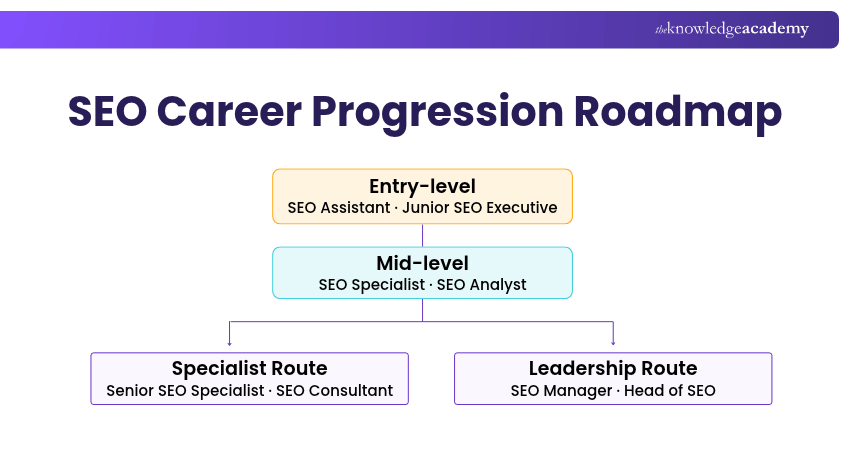
As you progress, you typically move from carrying out assigned tasks to diagnosing problems, choosing priorities and taking responsibility for results. Job titles vary across employers, and experienced professionals can pursue senior specialist or management roles. Let's check the levels below:
1) Entry-level SEO Roles
Roles such as SEO Assistant, Junior SEO Executive and SEO Coordinator involve researching keywords, updating page content and monitoring search performance. You’ll typically work under the guidance of more experienced colleagues.
Ask an experienced colleague to talk to you through one change they made to your work and why. Apply that feedback to your next assignment and see whether your recommendation is easier to act on.

2) Mid-level SEO Roles
SEO Specialists, SEO Analysts and SEO Executives often manage projects more independently. They investigate performance changes, conduct website audits and recommend improvements based on their findings.
Try a project outside your usual area to see which problems hold your interest. If you mainly work on editorial content, spend time with an e-commerce team during a seasonal campaign. Seeing how stock changes and short sales windows shape their decisions can help you decide whether you’d enjoy working on retail websites.
3) Senior Specialist SEO Roles
Senior SEO Specialists, Technical SEO Leads and SEO Consultants handle more complex projects, develop strategies and guide less experienced colleagues. They may specialise in areas such as technical, international or e-commerce SEO.
Look for a recurring problem you’d like to understand in more depth. If you work in international SEO, for example, investigate why visitors in different countries sometimes land on the wrong regional page. Comparing how that issue arises across several sites will help you recognise when a familiar fix applies and when the site needs a different approach.
4) SEO Management and Leadership Roles
SEO Managers, Heads of SEO and SEO Directors oversee search strategies, coordinate teams and align SEO priorities with business goals. Their responsibilities may also include managing budgets, resources and performance reporting.
Try mentoring a colleague before pursuing a management role. Pay attention to which parts of the experience you enjoy, such as coaching someone through an unfamiliar task or helping them build confidence in their decisions. If you find the specialist work more rewarding, you can continue developing your expertise through a senior individual contributor role.
Develop the skills to decode search performance and discover growth opportunities with the Google Search Console Training – Join now!
SEO Career Specialisations
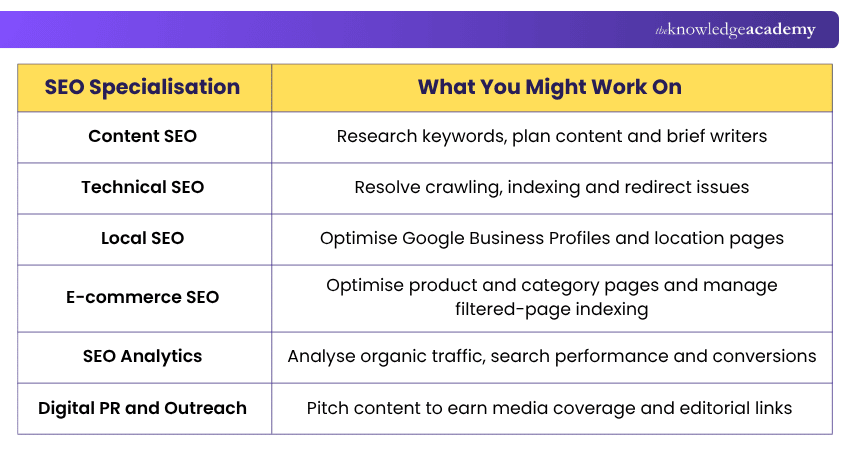
Once you’ve worked across a few SEO tasks, look at the problems you would enjoy solving repeatedly. These specialisms can form a dedicated role or sit within a broader SEO job. Let's look at them in the table below:
Essential Skills for an SEO Career
SEO combines investigation, measurement, and communication. Start with skills you can demonstrate on a single website or a small group of pages. It includes:
a) Keyword Research and Search Intent Analysis: Identify relevant search terms and examine the results to work out whether people want an explanation, a comparison, a product or a nearby service. Use that evidence to decide which type of page to improve or create.
b) On-page Optimisation: Write descriptive page titles and headings, organise information so it is easy to scan and add internal links where they help readers take the next step.
c) Technical Troubleshooting: Understand how search engines discover pages and add them to their index. Learn to check redirects, spot broken links, and use Google Search Console’s URL Inspection tool to investigate a specific page.
d) Performance Analysis: Use Google Search Console to see which queries and pages earn impressions and clicks. Where website analytics are available, check what visitors do after arriving, such as submitting an enquiry or making a purchase.
e) Prioritisation and Communication: Explain who is affected, how many pages are involved and what a fix requires. Give writers and developers enough detail to act and agree on how you will verify the change.
Trainer Insight
AI-powered search features, such as Google’s AI Overviews and AI Mode, are changing how people discover information. Focus on developing skills in original content research, technical optimisation and performance analysis alongside an understanding of emerging search technologies.
How to Start a Career in SEO?
A small project gives you something concrete to discuss in an interview. Use a personal site, a volunteer organisation’s site with permission or an approved project at work. Let's look at some practical ways below:
a) Learn SEO Fundamentals: Understand how search engines crawl, index and rank pages. Develop your knowledge through SEO courses, online resources and practical exercises.
b) Choose One Page and One Goal. For example, help people find a community repair café’s upcoming session. Decide what a useful visit looks like, such as someone opening the schedule or following the booking link.
c) Audit the Page. Check the page title, heading, navigation links and mobile view. If you have access to Google Search Console, look at which queries already bring people to the page and record the starting figures.
d) Make and Document a Change. Add the missing location or schedule details, clarify the heading and link to the page from a relevant part of the site. Keep a note of what you changed, when you made the update and why you chose it.
e) Build a Short Case Study. Show the original issue, your evidence, the changes and how you checked them. If the site has too little data to judge a change in traffic, report what you could verify or what Search Console’s URL Inspection tool reports about the page’s indexing status.
f) Apply for Roles That Fit Your Evidence. Look at SEO Assistant and Junior SEO Executive vacancies, as well as digital marketing roles with SEO responsibilities. Tailor each application around a task in the job description and an example that shows how you handled it.
SEO Career Readiness Checklist
□ Understand crawling, indexing and ranking□ Conduct keyword and search intent research□ Perform a basic SEO audit□ Use Google Search Console and analytics tools□ Document a practical SEO project□ Build a portfolio with supporting evidence□ Prepare for entry-level SEO job applications
Explore the Digital Marketing Courses to see how SEO works alongside content, paid media, and analytics - Join today!

The Knowledge Academy develops accessible learning content across Project Management, IT, Cybersecurity, Data Science, Business Analysis, HR, Accounting and Finance, Leadership and Health and Safety. Its resources combine subject research with clear explanations to help professionals build practical knowledge across a wide range of disciplines.
View Detail

 If you wish to make any changes to your course, please


