


 Top Rated Course

We may not have the course you’re looking for. If you enquire or give us a call on 01344203999 and speak to our training experts, we may still be able to help with your training requirements.
Top Salesforce Roles: A Complete Guide
The Knowledge Academy 03 September 2026Salesforce Roles cover a wide range of career paths, from platform administration and application development to consulting, DevOps, project delivery and solution architecture.

Training Outcomes Within Your Budget!
We ensure quality, budget-alignment, and timely delivery by our expert instructors.
Table of Contents
Key Takeaways
1. Salesforce roles span administration, development, consulting, DevOps, product management, project delivery and architecture.2. Salesforce Administrators focus mainly on configuration and platform management, while Developers create customised functionality.3. Consultants and Product Owners connect business requirements with Salesforce capabilities.4. DevOps Engineers help improve development, testing and deployment processes.5. Choosing the right Salesforce role depends on your interests, existing skills, technical depth and preferred type of work.
Picture a growing e-commerce company during its busiest sales season. Customer enquiries are pouring in, promising leads are getting buried and marketing campaigns are running across different channels. Meanwhile, important customer information is scattered across spreadsheets, making it difficult for the team to see the bigger picture.
The company turns to Salesforce to bring everything together. But the platform alone is not the whole solution:
A Salesforce Administrator keeps the system organised and running smoothly.
A Salesforce Developer builds custom functionality around the company's needs.
A Salesforce Consultant ensures the technology supports its wider business goals.
What was once a maze of disconnected information gradually becomes a more connected and manageable operation.
This is where Salesforce Roles make a real difference. From Administrators and Developers to Consultants and Architects, each Salesforce professional contributes a different piece to the bigger picture.
What are Salesforce Roles?
Salesforce Roles are professional positions involved in implementing, configuring, developing, managing or improving solutions built on the Salesforce platform. These roles can vary considerably. Some focus on technical development, while others concentrate on platform administration, business requirements, product priorities or project delivery.
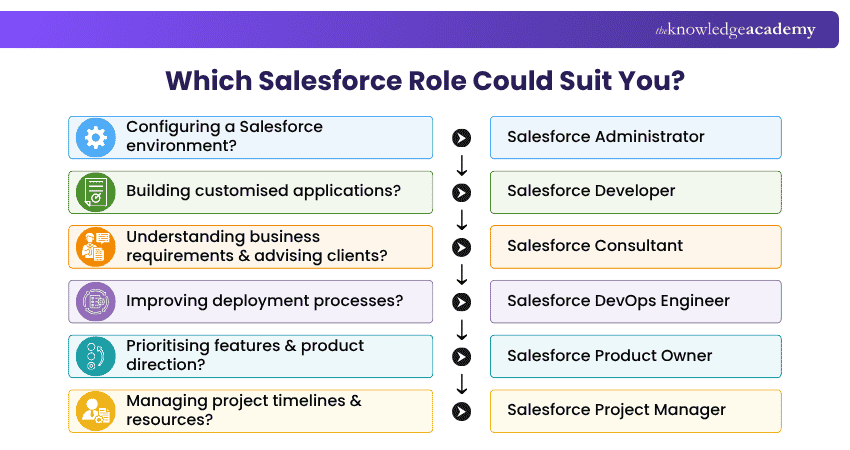
For example, Salesforce Administrators manage areas such as users, permissions, data and configuration. Developers create customised functionality, while Consultants work with stakeholders to understand business requirements and recommend suitable solutions. Here’s a quick glimpse of these roles:

Top Salesforce Roles to Explore
Salesforce offers diverse career opportunities for professionals with technical, business and management skills. Here are some popular Salesforce Roles to explore:
1) Salesforce Administrator
A Salesforce Administrator manages and maintains an organisation's Salesforce environment. The role typically involves user management, security settings, data management, configuration and supporting people who use the platform.
Administrators can also work with Salesforce automation and reporting capabilities to help organisations improve how the platform supports business processes.
Salesforce Administrators will:
a) Create and manage users, roles and permission sets
b) Configure objects, fields, layouts and record types
c) Import, export and maintain data
d) Support users and troubleshoot platform issues
e) Gather requirements from stakeholders
f) Monitor the Salesforce environment
g) Review new Salesforce functionality and determine its relevance to the organisation
2) Salesforce Developer
A Salesforce Developer designs, develops, tests and maintains customised functionality on the Salesforce platform. Unlike Administrators, who primarily use configuration and declarative capabilities, Developers work more extensively with programmatic tools when requirements need customised functionality.
Their work includes:
a) Developing customised Salesforce functionality
b) Implementing business logic
c) Creating and maintaining Salesforce components
d) Writing and testing code
e) Integrating Salesforce with external systems
f) Supporting deployments
g) Reviewing code
h) Troubleshooting technical problems
Pro Tip
For a Salesforce Developer, knowledge of Apex, Visualforce, Lightning Web Components (LWC), SOQL, HTML, CSS, JavaScript and APIs are among the most relevant technical skills.
3) Salesforce Consultant
A Salesforce Consultant helps organisations understand how Salesforce can support their business requirements. Rather than concentrating exclusively on development, Consultants often work between business stakeholders and implementation teams. They gather requirements, assess business needs and recommend appropriate Salesforce solutions.
Salesforce Consultants may:
a) Gather and analyse business requirements
b) Recommend Salesforce solutions
c) Assist with configuration and optimisation
d) Support data migration and integration activities
e) Advise stakeholders on implementation approaches
f) Support user adoption and training
g) Identify opportunities for improvement
Learn to create custom apps and deliver seamless user experiences with our Salesforce Platform App Builder Training – Sign up now!
4) Salesforce DevOps Engineer
A Salesforce DevOps Engineer focuses on making Salesforce development and deployment processes more controlled, repeatable and efficient. The role connects development and operations activities and can involve source control, automation, testing, release processes and environment management.
Pro Tip
Do not focus only on individual deployment tools. Build a broader understanding of Git, testing, CI/CD, environments and the complete Salesforce development lifecycle.
Salesforce DevOps Engineers are involved in:
a) Managing version control processes
b) Creating and maintaining CI/CD pipelines
c) Automating build, test and deployment processes
d) Managing deployment issues
e) Supporting environment management
f) Establishing development standards
g) Improving release workflows
5) Salesforce Product Owner
A Salesforce Product Owner helps determine what should be built and why. They represent product and user needs by defining priorities, maintaining the product backlog and helping delivery teams understand expected outcomes.
The role can suit professionals who enjoy connecting business objectives, user requirements and technology without necessarily concentrating on hands-on development.
A Salesforce Product Owner will:
a) Define product goals and priorities
b) Maintain the product backlog
c) Prioritise user stories
d) Define acceptance criteria
e) Work with development and business teams
f) Review completed work
g) Gather user feedback
h) Communicate progress to stakeholders
Did You Know?
The salary of a Salesforce Product Owner in the United Kingdom can range from £43K to £66K.
6) Salesforce Project Manager
A Salesforce Project Manager focuses on successfully planning, coordinating and delivering Salesforce projects. While a Product Owner concentrates primarily on product value and priorities, the Project Manager is generally concerned with areas such as timelines, resources, risks, budgets, dependencies and overall delivery.
Salesforce Project Managers will:
a) Develop project plans and schedules
b) Coordinate project resources
c) Manage risks and dependencies
d) Track milestones and deliverables
e) Manage budgets
f) Coordinate project teams
g) Facilitate User Acceptance Testing (UAT)
h) Manage change requests
i) Report progress to stakeholders
7) Salesforce Solution Architect
A Salesforce Solution Architect designs end-to-end Salesforce solutions that meet business and technical requirements. They work with stakeholders, analysts and technical teams to understand requirements and determine how different Salesforce capabilities, integrations and data components should work together. Their responsibilities can include:
a) Designing end-to-end Salesforce solutions
b) Producing architecture and technical documentation
c) Guiding implementation teams
d) Supporting integration and data migration
e) Identifying architectural risks
f) Considering security, scalability and performance
g) Evaluating integration requirements and third-party applications
8) Salesforce Technical Architect
A Salesforce Technical Architect focuses on the deeper technical architecture behind complex Salesforce implementations. This role requires extensive technical experience and involves making architectural decisions across areas such as integrations, security, data, scalability and platform design.
A Technical Architect may also provide technical leadership across multiple teams and help ensure that different parts of a complex Salesforce solution work together effectively.
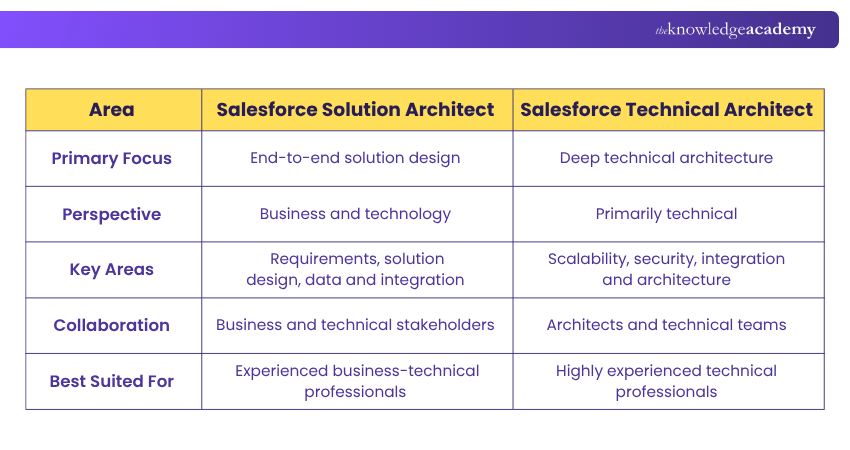
While both have the term “Architect” in them, here are the key differences between a Salesforce Solution Architect and a Salesforce Technical Architect to consider:
Skills Needed for a Salesforce Career
Different Salesforce Roles require different expertise. However, several core skills can support a career across the Salesforce ecosystem:
1) Platform Skills: Build knowledge of Salesforce configuration, data management, security and automation. These skills are particularly useful for Administrators and Consultants.
2) Development Skills: Learn technologies such as Apex, Lightning Web Components (LWC), SOQL and APIs. These are essential for Salesforce Developers.
3) DevOps Skills: Develop experience with Git, CI/CD, deployment processes and environment management to support Salesforce DevOps activities.
4) Business Skills: Strengthen requirements analysis and business process understanding. These skills are especially valuable for Consultants and Product Owners.
5) Project Skills: Learn project planning, risk management, resource coordination and delivery practices for Salesforce Project Management roles.
6) Architecture Skills: Build expertise in integration, scalability, security and solution design when progressing towards Solution or Technical Architect roles.
7) Soft Skills: Communication, collaboration and problem-solving are valuable across virtually all Salesforce Roles.
Conclusion
Salesforce Roles offer career options for people with different strengths, from platform configuration and development to consulting, DevOps, project delivery and architecture. Understanding what each role actually does can help you choose a direction that matches your interests. Focus on building relevant Salesforce knowledge alongside the technical, business and communication skills required for your chosen path.
Keep customers coming back for more with expert CRM skills. Sign up for our comprehensive range of CRM Courses now!
Frequently Asked Questions
Which Salesforce Role is Best for Beginners?

Salesforce Administrator is one possible starting point because it introduces important platform concepts such as users, data, permissions, configuration and automation. However, the best starting role depends on your existing experience and career goals.
Do All Salesforce Roles Require Coding?
No. Coding is particularly relevant to roles such as Salesforce Developer. Roles including Administrator, Consultant, Product Owner and Project Manager can place greater emphasis on configuration, business analysis, product management or project delivery.
What is the Difference Between a Salesforce Administrator and Developer?
A Salesforce Administrator generally focuses on configuring, managing and supporting the platform. A Salesforce Developer works more extensively with programmatic technologies to create customised functionality.
Can a Salesforce Administrator Become an Architect?
A Salesforce Administrator can develop towards architecture, but it usually requires building broader experience in areas such as solution design, integrations, security, data modelling and platform architecture. Career progression can vary considerably between professionals.

The Knowledge Academy


Global Training Provider
The Knowledge Academy is a world-leading provider of professional training courses, offering globally recognised qualifications across a wide range of subjects. With expert trainers, up-to-date course material, and flexible learning options, we aim to empower professionals and organisations to achieve their goals through continuous learning.


 If you wish to make any changes to your course, please


