


 Top Rated Course

We may not have the course you’re looking for. If you enquire or give us a call on 01344203999 and speak to our training experts, we may still be able to help with your training requirements.
Business Analyst Job Description: Roles, Skills, Salary & Template
William Brown 05 September 2026A Business Analyst identifies business needs, clarifies requirements and supports effective change across processes, systems and services. Discover the role's responsibilities, essential skills, qualifications, UK salary expectations and a practical Business Analyst Job Description template.

Training Outcomes Within Your Budget!
We ensure quality, budget-alignment, and timely delivery by our expert instructors.
Table of Contents

Key Takeaways
1. Business Analysts turn business and user needs into clear requirements and practical recommendations.2. Their role can include process improvement, stakeholder collaboration, documentation and change support.3. Strong analytical and communication skills are essential, while tools vary by role and industry.4. UK Business Analyst salaries vary by experience, location, sector and specialist expertise.5. A strong job description should clearly define the role without overlapping with Project Management or development responsibilities.
Two vacancies can carry the title Business Analyst and describe surprisingly different working days.
One professional might map an inefficient customer journey, while another facilitates requirements for a new digital service or assesses the impact of organisational change.
The environment may vary, but the purpose remains consistent: understand the problem, identify what the business and its users need, and support informed decisions about change. A clear Business Analyst Job Description helps candidates understand these expectations, and organisations define the role accurately.
Who is a Business Analyst?
A Business Analyst (BA) investigates business problems, opportunities and needs to help an organisation identify effective changes or solutions. The role focuses on understanding the wider situation, including people, processes, data, technology and user needs.

Business Analysts also identify areas for improvement, define business and user requirements and assess the impact of change. Their work helps ensure that proposed products, services or process improvements support organisational goals.
A Business Analyst does not automatically treat a requested solution as the requirement. They first investigate the underlying problem, affected users, and desired outcome before recommending an appropriate change.
The resulting recommendation could involve new technology, process redesign, better information, changed responsibilities or a combination of these.
Quick Check
A stakeholder says: "We need a new customer portal."
A solution-led response starts discussing portal features.
A Business Analysis response first asks:
1. What problem should the portal solve?2. Who are the users?3. What do they need to accomplish?4. What evidence shows the existing experience is inadequate?5. What would success look like?
The difference is important: a requested solution is not always the same as a clearly understood requirement.
Business Analyst Roles and Responsibilities
A Business Analyst's exact responsibilities depend on the organisation, seniority, industry and delivery model. However, the role generally centres on understanding needs, analysing change and creating enough clarity for informed decisions and successful delivery.
1) Requirements Elicitation and Analysis
Requirements work begins by establishing what stakeholders and users actually need. Business Analysts may collect information through:
a) Stakeholder interviews
b) Workshops
c) Observation
d) Existing documentation
e) Process analysis
f) Surveys
g) User research findings
h) Data and reports
The BA then analyses, clarifies, validates and prioritises that information. Depending on the project, requirements may be expressed through problem statements, business requirements, functional and non-functional requirements, epics, features, user stories or acceptance criteria.
The Government Digital and Data framework specifically includes eliciting, analysing, validating and prioritising business and user needs as part of Business Analysis capability. Business Analysts identify inconsistencies, challenge assumptions, and help stakeholders distinguish between what they want, what they need, and what will create value.
2) Business Process Analysis and Improvement
Business Analysts frequently examine how work currently happens and where improvements could be made. This may involve documenting an as-is process, identifying bottlenecks or duplicated effort, determining root causes, and designing a more effective to-be process.
Typical activities can include:
a) Mapping the current workflow
b) Identifying problems, delays or unnecessary steps
c) Investigating their causes
d) Assessing alternative approaches
e) Evaluating risks, costs and benefits
f) Recommending improvements
g) Defining how success will be measured
Process modelling can make complex workflows easier for stakeholders to understand and discuss. Importantly, process improvement is not simply about making activities faster. A proposed change may also need to improve quality, customer experience, compliance, control, usability, or the organisation's ability to adapt.
3) Stakeholder Communication and Collaboration
Business Analysts often work between groups with different priorities, terminology and levels of technical knowledge.
Stakeholders can include:
a) Business leaders
b) Operational teams
c) Customers or users
d) Product Managers or Product Owners
e) Project Managers
f) Developers
g) Designers
h) Testers
i) Data specialists
j) Suppliers
k) Compliance or governance teams
A BA may facilitate workshops, clarify decisions, explain requirements, resolve conflicting interpretations, and ensure that important stakeholder perspectives are considered. Communication is therefore not a separate administrative task. It is part of the analysis itself.
For example, a technical team may need highly specific acceptance criteria, while an executive stakeholder may need a concise explanation of the expected business benefit, risk and cost. The Business Analyst must adapt the same underlying information appropriately for both audiences.
4) Documentation and Solution Support
Business Analysts create and maintain information that helps teams understand the problem, requirement, decision or proposed change.
Common documentation can include:
a) Business requirements
b) Process maps
c) User stories
d) Acceptance criteria
e) Use cases
f) Business rules
g) Data requirements
h) Options assessments
i) Gap analyses
j) Requirements traceability information
k) Decision records
The required documentation should reflect the project rather than becoming paperwork for its own sake. In an Agile environment, for example, concise user stories, acceptance criteria and ongoing collaboration may be more appropriate than producing one large requirements document before delivery starts.
Business Analysts may also work alongside Designers, Developers, Architects, and other specialists while potential solutions are developed. Their role is typically to ensure that proposed solutions continue to address the agreed business and user needs, rather than to perform every specialist design or technical task themselves.
Advance your analytical expertise with our Business Analyst Black Belt Course and tackle complex business challenges confidently- Sign up today!
5) Testing, Change and Continuous Improvement
Business Analysts may continue supporting a project after requirements are documented by helping define test scenarios, confirm acceptance criteria, support User Acceptance Testing (UAT), and assist teams through implementation and change.
Business Analysts may also assess:
a) Whether the organisation is ready for a change
b) How employees or users will be affected
c) Whether business benefits are being realised
d) Whether the implemented solution meets the original need
e) Whether further improvements are required
The Government Digital and Data framework includes change, benefits and adoption analysis within the Business Analyst skill set, reinforcing the role's contribution beyond initial requirements work.
Trainer's Insight
A Business Analyst supports a project by focusing on business problems, requirements, processes, stakeholders and the impact of change, while a Project Manager typically oversees schedules, resources, governance and overall delivery.
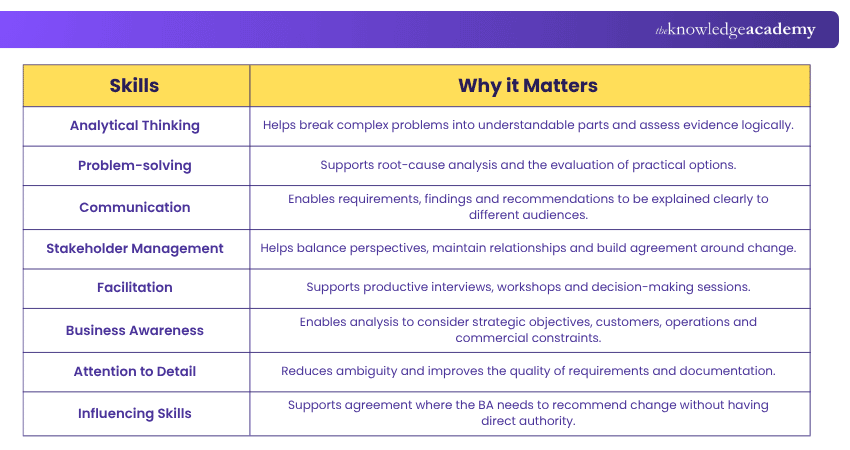
Key Skills for a Business Analyst
Successful Business Analysis combines structured thinking with the ability to work effectively with people. Knowing a particular software platform can be useful, but tools alone do not make someone an effective BA.
Common Tools and Techniques
There is no universal list of software that every Business Analyst must know. The relevant tools depend on what the organisation uses and the type of work involved.
Examples include:
|
Purpose
|
Examples
|
|
Documentation and collaboration
|
Microsoft 365, Confluence
|
|
Requirements and backlog management
|
Jira, Azure DevOps
|
|
Process modelling
|
BPMN tools, Microsoft Visio and similar modelling platforms
|
|
Data analysis
|
Microsoft Excel, SQL
|
|
Data visualisation
|
Microsoft Power BI, Tableau
|
|
Workshops and visual collaboration
|
Digital whiteboards and collaborative workspace tools
|
A candidate who understands why and how to model a process, for example, can usually adapt to a new modelling application more easily than someone who knows a particular platform but does not understand process analysis.
Common Business Analysis techniques can include:
1) Stakeholder analysis
2) Process mapping
3) Requirements elicitation
4) Root-cause analysis
5) User stories and acceptance criteria
6) Gap analysis
7) Options analysis
8) Workshop facilitation
Employers should therefore distinguish between a necessary capability and familiarity with their preferred software.
Business Analyst Qualifications and Experience
There is no single academic route that every Business Analyst must follow.
Candidates can enter Business Analysis through university study, apprenticeships or direct application. Relevant degrees may include Business Information Systems, Business Management, Computing, or Computer Science.
Relevant experience may come from roles involving:
1) Business operations
2) Process improvement
3) Data analysis
4) Project delivery
5) Product development
6) Customer experience
7) Change management
8) Systems implementation
9) Industry-specific work
Professional Business Analysis qualifications can demonstrate structured knowledge but are not essential for every role. Common options include BCS qualifications and IIBA certifications such as ECBA, CCBA, and CBAP.
Entry-level roles may place more emphasis on analytical ability and transferable experience, while senior positions may require stronger practical experience, leadership, domain knowledge, or relevant certifications.
Business Analyst Salary in the UK
Business Analyst salaries in the UK can vary depending on experience, location, industry, specialist knowledge and the organisation. Current UK base-pay data provides the following general salary range:
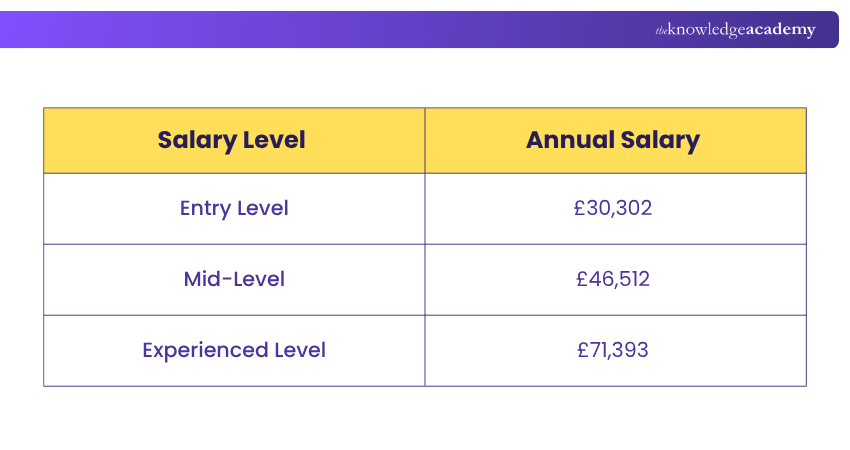
Source: Indeed
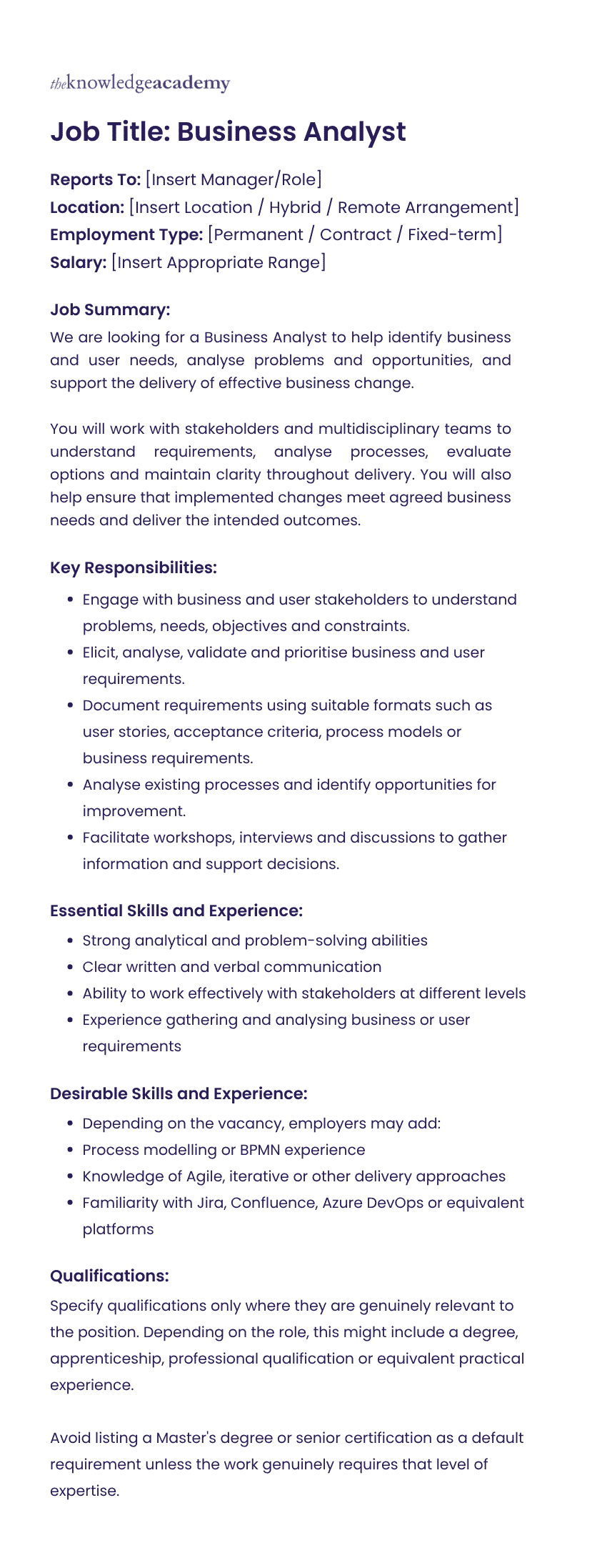
Business Analyst Job Description Template
The following template can be adapted for an organisation's industry, delivery model and seniority requirements.
Hiring Checklist
Before publishing a Business Analyst vacancy, check:
1) Seniority: Does the description match an entry-level, experienced or senior BA?
2) Ownership: Is it clear what the BA owns and what belongs to Project, Product or technical roles?
3) Requirements: Are mandatory skills genuinely essential?
4) Tools: Have you avoided making internal software unnecessarily restrictive?
5) Domain Knowledge: Is industry experience essential, or could the successful candidate learn it?
6) Outcomes: Does the advert explain what the BA is expected to improve or enable?
7) Practical Details: Are salary, location and working arrangements stated clearly?
Conclusion
A strong Business Analyst Job Description does more than list tasks. It makes the purpose of the role clear, sets realistic expectations and helps distinguish Business Analysis from neighbouring project, product and technical responsibilities. We hope this blog helps candidates understand the career and employers define the role with greater precision.
Develop practical analysis skills with our Business Analyst Green Belt Course and support smarter business decisions confidently- Join now!
Frequently Asked Questions
How Does an Entry-level Business Analyst Job Description Differ from a Senior Business Analyst role?

Entry-level Business Analysts usually work with greater guidance while developing core analytical and stakeholder skills. Senior BAs typically handle more complex initiatives, influence decisions and may mentor other analysts.
What is the Difference Between a Business Analyst and a Business Development Analyst?
A Business Analyst focuses mainly on business needs, requirements, processes and change. A Business Development Analyst is generally more focused on commercial growth, market opportunities, partnerships and revenue development.
What Should Candidates Highlight when Applying for a Business Analyst Role?
Candidates should highlight examples of requirements gathering, process analysis, stakeholder collaboration, problem-solving and change support. Showing measurable outcomes or improvements can make this experience more convincing.

William Brown


Senior Business Analyst and Strategic Advisor
William Brown is a senior business analyst with over 15 years of experience driving process improvement and strategic transformation in complex business environments. He specialises in analysing operations, gathering requirements and delivering insights that support effective decision making. William’s practical approach helps bridge the gap between business goals and technical solutions.
View Detail

 If you wish to make any changes to your course, please


