


 Top Rated Course

We may not have the course you’re looking for. If you enquire or give us a call on 01344203999 and speak to our training experts, we may still be able to help with your training requirements.
What is Sourcing: Types, Process and Benefits
The Knowledge Academy 05 February 2026Sourcing involves identifying and choosing suppliers to obtain quality goods and services at the best cost, improving efficiency and strengthening the supply chain. It helps organisations maintain consistency and reduce operational risks. Effective sourcing also improves long-term value and supports strategic business growth for organisations.

Training Outcomes Within Your Budget!
We ensure quality, budget-alignment, and timely delivery by our expert instructors.
Table of Contents

The process of correctly selecting suppliers is a crucial factor for effective operation in companies. It has an effect on the price, the standard, and the overall performance of the business in the long run. In this manual, we provide an answer to the question What is Sourcing and go into detail about the main steps, the methods and the advantages that come with it.
Table of Contents
1) What is Sourcing?
2) Importance of Sourcing in Business
3) Different Types of Sourcing
4) The Sourcing Process
5) Benefits of Sourcing
6) How to Improve Sourcing Strategies?
7) Challenges in Sourcing
8) Procurement vs. Sourcing
9) How Does Effective Sourcing Impact Business Growth?
10) Conclusion
What is Sourcing?
Sourcing is the process of finding, evaluating, and engaging suppliers for different goods and services for the organisation. This involves the identification of reliable suppliers, negotiation of contracts, and ensuring that the buying of the products or services is of high quality at the best possible price.
Sourcing isn't just buying; it's relationship-building, cost-optimising, and maintaining a steady supply chain. This is a very important strategy that often leads to an organisation's success, and it will directly affect production efficiency, cost management, and product quality.

Importance of Sourcing in Business
Effective Sourcing is essential in the process of cost optimisation, quality, risk management, competitive advantage and efficient operations. Sourcing adds strategic value to organisations by enhancing their supply chains, raising the standards of products, and ensuring flexibility in a dynamically changing market.

1) Cost Saving
Strategic sourcing focuses on getting your supplier base optimised to cut costs by reducing spending, better contract terms and reductions in system costs. This ends up in expansion of financial performance and profit margins as well as facilitating it towards longer term Supply Chain Management objectives
2) Good Product Quality
It is possible to focus on reliable suppliers so that they guarantee consistency and quality products. Tough sourcing practices add value through quality management and better supplier performance, which leads to the ability to build a better brand image and customer satisfaction.
3) Risk Mitigation
Spreading the suppliers and applying comprehensive evaluations ensures that there is no single-source dependence on the business and protects against contingencies, such as natural catastrophes or geopolitical problems. These plans make the supply chain more robust.
4) Competitive Advantage
Strategic sourcing helps a business to get better prices, innovation, and faster response rates. This differentiation puts organisations ahead of their competitors.
5) Operational Efficiency
Optimisation of sourcing processes will cut lead times, eliminate rogue expenditure, and enhance coordination within the business. This strengthens procurement efficiency and total excellence in operations
Different Types of Sourcing
There are many kinds of Sourcing activities, each of which fits a particular need and business goal. Some common types are listed below.

1) OutSourcing
OutSourcing involves contracting outside suppliers to undertake a certain business function or services, usually done in the firm. This enables a firm to focus on key competencies while taking advantage of specialised skills, resources, or lower costs of third-party providers. The most common areas for Outsourcing include IT services and manufacturing. and Customer Service Outsourcing.
2) InSourcing
Contrary to OutSourcing, which involves farming out processes or finding internal resources to perform work that has been outsourced, InSourcing brings the work inside. This approach allows organisations to have more control over the process and can result in better communication and a more integrated approach to doing business. Companies consider this strategy when quality control, protection of intellectual property, or rapid responsiveness is paramount.
3) Near Sourcing
Near Sourcing refers to "the process of relocating business processes or production to a location closer to the home market of a company, typically within neighbouring countries." This reduces shipping costs by streamlining supply chains through proximity and time zones. Therefore, Near Sourcing is particularly appealing to those companies that must balance the advantages of OutSourcing with quicker turnarounds and greater supervision.
4) Single Sourcing
Single Sourcing refers to the organisation of dependent relationships based on one source or one supplier of some specific product or service. This will provide one with strong partnerships and better negotiation powers but also tends to carry risks such as disruptions in supply chains or depending on one provider. Companies go for Single Sourcing in instances when a supplier is providing something quite unique or highly specialised.
Learn the essential principles of international trade with our Import Export Course – Join now!
5) Global Sourcing
Global Sourcing is defined as buying goods and services from international markets for better cost efficiencies, new technologies, or high-grade products. It thus allows firms to tap into a wider pool of suppliers around the world. It can yield substantial cost savings. However, it also means dealing with regulatory environments that vary across countries, cultural diversity, and increased logistical complexities.
6) Joint Ventures
A joint venture involves a collaboration in Sourcing wherein another company jointly supplies resources, expertise, or technology to create goods or services. This Sourcing option allows firms to leverage their combined strengths, share risks, and even enter new markets. Most Joint Ventures exist in industries that either require heavy investments or specialised knowledge, such as manufacturing automobiles or pharmaceuticals.
7) Strategic Sourcing
Strategic Sourcing refers to a value-driven structured process of procurement, which is more than mere purchasing. It entails spend analysis, market trends, and positive relations with suppliers. The aim will be to change the sourcing decisions from business goals, the lowest cost, and generate long-run value instead of being simply the lowest price.
The Sourcing Process
Sourcing is comprised of several steps to ensure effective and efficient procurement of goods and services. Let us explain each stage in detail:

1) Needs Assessment
Sourcing initiation begins with the identification of needs related to the organisation's needs, thereby understanding the product or service required, specification, and desired outcomes. A well-conducted needs assessment helps define the scope of the Sourcing activities and lays out the foundational structure for the selection of the right suppliers.
2) Identifying Suppliers
The second step, after the needs have been identified, is to select potential suppliers who could provide such needs. This covers market research on suppliers' capabilities, cost, quality, reliability, and reputation. It is important that a pool of potential suppliers be created to enable competitive bidding and negotiation.
3) Request for Proposal (RFP)
The request for proposal requires that the suppliers provide their proposals that include how they are going to meet organisational needs. An RFP should therefore contain scope of work, dates of completion, requirements of evaluation, and other special needs. This step is absolutely crucial for the evaluation of supplier capabilities and determining competitive offers.
4) Evaluating Proposals
Following the receipts of the proposals, it would have to be evaluated, that is obtained, against set criteria such as cost, quality, experience, and delivery timelines. A scoring system may be used as part of the selection procedures, interviews, and visits to the facilities of the suppliers. This would point to the selection of the supplier best fitting the needs and goals of the organisation.
5) Negotiating Contracts
Once selected, attention turns to negotiating the contract terms: price, delivery schedule, payment terms, and other conditions. Successful negotiation here will ensure both parties understand what each can expect, with optimal terms for the organisation.
6) Contract Execution
The contract execution stage is where the finalisation and signing of the contract by the contracting party with the selected supplier take place. This is a written contract that legally sets terms, conditions of the relationship, and most definitely establishes the delivery of goods or services. Proper management of the contract should be undertaken to minimise the risks identified and ensure that the agreed terms comply with.
7) Monitoring Performance
This is the final stage of the Sourcing process, where the performance of the supplier is monitored to ensure that their contractual agreement is met. In this regard, it involves tracking KPIs, reviews, and resolving issues as they occur. Continuous monitoring of performance maintains quality, optimises cost, and ensures good relations between the suppliers and buyers.
Elevate your Logistics Management expertise by joining our Logistics Management Training today!
Benefits of Sourcing
Sourcing, if carried out efficiently, has several benefits that add value to the success of an organisation. This includes:
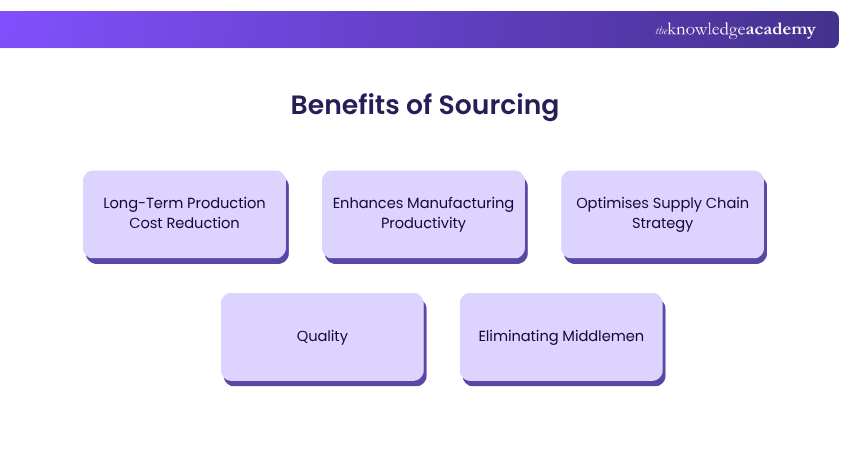
1) Long-Term Production Cost Reduction
The most significant benefit of Sourcing is the cost savings that are long-term. There is a lot to be said about production costs saved by companies because, through strategic Sourcing, these companies identify suppliers offering competitive pricing and adhere to the quality standards over time. This will make sure that a firm optimises its spending on the products and allocates the resources in the best possible manner.
2) Enhances Manufacturing Productivity
Sourcing proper materials and services plays a crucial role in holding the production processes together. Good suppliers will guarantee companies access to various vital components, besides assuring fewer production disruptions and delays. This enhances the overall productivity of manufacturing, thus granting companies a better avenue to meet customer demands more effectively.
3) Optimises Supply Chain Strategy
Sourcing effectively will optimise the chain so that every link in the chain will be strong and reliable. Effective souring creates a robust network of suppliers, reduces lead times, and improves overall flow throughout. The bottom-line impact of such a supply chain strategy will be operational efficiency and a stronger market position.
4) Quality
Businesses need quality control. Local sourcing provides more visibility to production, which allows for greater control. Nonetheless, high-quality outcomes might also be achieved through international sourcing when a company successfully keeps good relations with each of its suppliers and regularly conducts quality assurance checks during the supply process.
5) Eliminating Middlemen
Eliminating middlemen through direct sourcing helps businesses reduce costs and increase profit margins. By buying directly from manufacturers, companies gain better pricing, greater control over quality, and improved communication, making the overall supply chain more efficient and responsive to market needs.
Unleash your product potential! Our Product Management Courses will equip you with the skills to drive innovation. Start your journey today.
How to Improve Sourcing Strategies?
The improvement in Sourcing strategies involves several steps that may be characterised by proactive motives and continuous improvement. Briefly, the improved Sourcing strategy may be underlined as illustrated below.
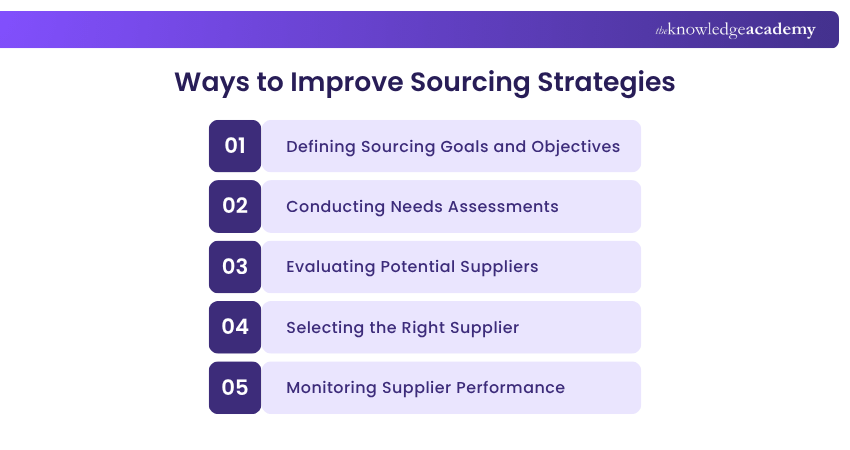
1) Defining Sourcing Goals and Objectives
The first step to improving Sourcing strategies will be to clearly define your goals and objectives. Whether it is cost reduction, quality improvement, or supply chain resilience, having a clear vision helps guide Sourcing decisions and align them with the overall strategy of the organisation.
2) Conducting Needs Assessments
Needs assessments are done periodically, thereby aligning Sourcing activities with the dynamic needs of an organisation. This analysis helps analyse gaps, refine the specifications, and make necessary adjustments in the Sourcing strategy to meet business needs effectively.
3) Evaluating Potential Suppliers
Thorough evaluation is required to choose the right partners. This involves assessment of their financial stability, their performance in the past, and their capacity to meet your requirements. A well-conducted selection process minimises risks and brings success to a supplier relationship.
4) Selecting the Right Supplier
The selection of a supplier does not end with the price only. The quality standards, timely delivery, and the organisation's values that a supplier can assure are some key concerns that need to be focused on for selecting a supplier. Strategic selection enables the building of a strong and long-term partnership.
5) Monitoring Supplier Performance
Monitoring of the suppliers is done on a continual basis to control the quality and address issues arising. Regular reviews of performance, feedback mechanisms, and certain performance metrics have provided assurance that suppliers will keep meeting expectations and continue with the success of the organisation.
Stay ahead of the curve. Upgrade your skills with our Industry Training - Register now!
Challenges in Sourcing
Sourcing is important to procurement cycle and supply chain management in view of the rest of the supply chain. Nevertheless, organisations in most cases experience various issues which have the capacity to influence supplier performance as well as cost control and quality of services. The only way to overcome these challenges is to take a strategic mentality and to conduct a consistently high level of supplier review.
1) nreliable Suppliers
An alliance that cannot perform to standard, regularly, and on time with its suppliers may be a very disruptive venture. To reduce risk, it is necessary to do due diligence to evaluate suppliers, track and observe performance, and set alike expectations.
2) Price Negotiation
Putting price competition at bay is a fundamental showdown of sourcing. A powerful negotiator requires market research, preparation, and proper communication. Their absence can potentially lead to organisations paying too much or signing off arrangements which are not in agreement with financial goals.
3) Lack of Visibility into Suppliers' Operations
Poor visibility into the supplier processes may lead to communication loopholes and failure to cooperate. The absence of visibility makes the information about the possibility of disruption and its subsequent compliance unpredictable, which ultimately influences the stability of the supply chain as well as the decision-making process.
4) Limited Sourcing Options
In certain markets, particularly niche markets, the sources available of sufficient suppliers may be very limited. This limitation may reduce bargaining level and flexibility. The challenge can be addressed by expanding the supplier networks and considering the global sourcing options.
Procurement vs. Sourcing
Sourcing is aimed at finding and choosing suppliers whereas procurement would include the whole process, the sourcing, purchase of those suppliers, payments to those suppliers, and management of those suppliers. These functions are mostly merged with small businesses but in big organisations they are separate entities of the overall Supply Chain Management system.

How Does Effective Sourcing Impact Business Growth?
With proper sourcing, companies can avoid incurring costs and, at the same time, receive a steady supply of quality goods and services. Hence, it becomes a money-saving tactic and also a guarantee for the quality of goods and services the company deals with.
Thus, it provides support for operations to run more easily and to be more stable for a longer time. Besides, by pairing suitable suppliers with the company's objectives, effective sourcing not only beats the supply chain but also increases the company's competitiveness, and thus, the whole business becomes more sustainable through growth.
Conclusion
Gaining insights into the selection and management of suppliers is crucial for creating a robust supply chain. Good sourcing practices enhance quality, cost management, and enduring efficacy. By precisely stating What is Sourcing, companies will be in a position to make favourable decisions that foster the company's eco-friendly expansion.
Elevate your Career in Facilities Management! Unlock Expert Skills and Strategies with our Facilities Management Training —Start now!
Frequently Asked Questions
What is the Role of a Sourcing Manager?

A Sourcing Manager is responsible for identifying, evaluating, and negotiating with suppliers to secure quality goods or services at the best value. They develop sourcing strategies, manage supplier relationships, assess risks, and ensure alignment with business and supply chain goals.
What is the Role of Sourcing?
The role of Sourcing is to secure the best suppliers for a company’s needs, ensuring cost-effectiveness, quality, and reliability. It involves evaluating supplier options, negotiating contracts, and managing relationships to support the organisation’s strategic goals and operational requirements.
What are the Other Resources and Offers Provided by The Knowledge Academy?
The Knowledge Academy takes global learning to new heights, offering over 3,000+ online courses across 490+ locations in 190+ countries. This expansive reach ensures accessibility and convenience for learners worldwide.
Alongside our diverse Online Course Catalogue, encompassing 19 major categories, we go the extra mile by providing a plethora of free educational Online Resources like Blogs, eBooks, Interview Questions and Videos. Tailoring learning experiences further, professionals can unlock greater value through a wide range of special discounts, seasonal deals, and Exclusive Offers.
What is The Knowledge Pass, and How Does it Work?
The Knowledge Academy’s Knowledge Pass, a prepaid voucher, adds another layer of flexibility, allowing course bookings over a 12-month period. Join us on a journey where education knows no bounds.
What are the Related Courses and Blogs Provided by The Knowledge Academy?
The Knowledge Academy offers various Industry Courses, including the Product Management Training, and the Facilities Management Training. These courses cater to different skill levels, providing comprehensive insights into Production Planning.
Our Business Skills Blogs cover a range of topics related to Sourcing, offering valuable resources, best practices, and industry insights. Whether you are a beginner or looking to advance your Sourcing Skills, The Knowledge Academy's diverse courses and informative blogs have got you covered.

The Knowledge Academy


Global Training Provider
The Knowledge Academy is a world-leading provider of professional training courses, offering globally recognised qualifications across a wide range of subjects. With expert trainers, up-to-date course material, and flexible learning options, we aim to empower professionals and organisations to achieve their goals through continuous learning.

Upcoming Business Skills Resources Batches & Dates
Date
 Product Management Training
Product Management Training
Fri 17th Apr 2026
Product Management Training
Fri 17th Jul 2026
Product Management Training
Fri 9th Oct 2026

 If you wish to make any changes to your course, please


