




We may not have the course you’re looking for. If you enquire or give us a call on +44 1344 203 999 and speak to our training experts, we may still be able to help with your training requirements.
What is Persuasion: The Art and Science of Influence
ByVidhya NairLast updated on: 24 September 2026
Persuasion is the process of influencing attitudes, beliefs, decisions, or behaviours through communication. Discover the key rhetorical appeals, principles of influence, persuasive communication components, and practical examples across leadership, education, negotiation, sales, and marketing.
What You Should Know
1. Understand what persuasion means and how it works2. Explore Ethos, Pathos, and Logos appeals3. Learn Cialdini’s seven persuasion principles4. Identify key persuasive speech components5. See persuasion across real-world situations6. Understand how credibility, emotion, and logic influence decisions
Why do some messages influence decisions while others fail to make an impact? Persuasion involves using communication, reasoning, credibility, and emotional appeals to shape how people think, feel, or respond. Its effectiveness can depend on the message, the communicator, the audience, and the situation.
Research also shows that the way information is presented can affect persuasion. In a study involving a fictional phone, weak product facts received higher ratings when presented as a story rather than a list. However, strong facts were rated more favourably when presented as a list, showing that storytelling does not always make a message more persuasive.
In this comprehensive blog, you will delve into what is persuasion, its fundamental types, real-world examples, and more. Let’s immerse ourselves in this riveting persuasion analysis.
What is Persuasion?
Persuasion is the science of convincing others to perform a specific action. This includes purchasing a product/service or doing something deliberately. There are an abundance of ways in which individuals persuade others and create a psychological impact on them. It can influence attitudes, beliefs, intentions and behaviours apart from one's actions or purchases.
Effective persuasion often involves understanding the audience, presenting clear reasoning, building credibility, and using emotional or logical appeals appropriately. When used responsibly, persuasion can help people communicate ideas more effectively, resolve differences, encourage positive decisions, and influence behaviour without relying on force or pressure.

Modes of Persuasion
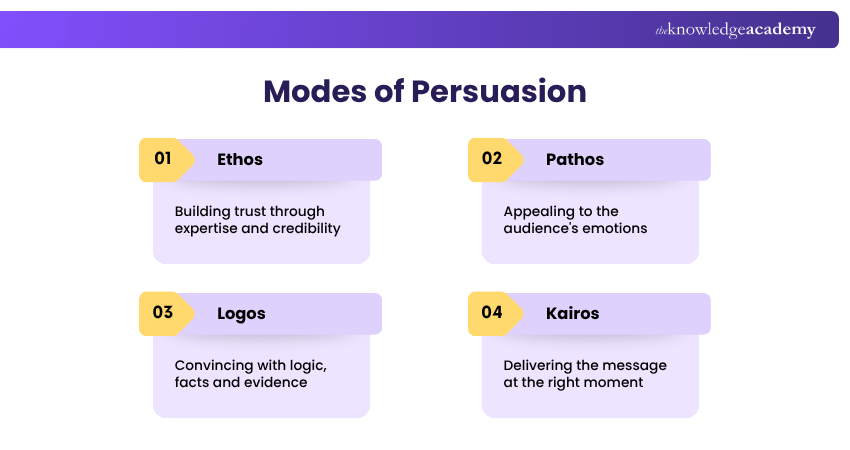
Persuasion includes four rhetorical appeals: Ethos, Pathos, Logos and Kairos. These are classical Greek terms associated with Aristotle’s rhetoric. Let’s explore each mode in detail.
1) Ethos (Credibility)
Ethos is a persuasive appeal based on the credibility, character, and trustworthiness of the communicator. People may be more receptive to a message when they consider its source knowledgeable, experienced, or reliable.
For example, a toothpaste advertisement featuring a qualified dentist explaining its benefits uses Ethos because the dentist’s professional expertise adds credibility to the message. Customer reviews or the number of people using a product, however, are better examples of social proof.
2) Pathos (Emotion)
Pathos is a persuasive appeal that seeks to influence an audience through emotions, values or personal experiences. It may evoke feelings such as happiness, fear, compassion, hope or concern to make a message more relatable and memorable. This persuasion technique can work well for audiences who value personal stories and human experiences over pure logic and data-driven arguments.
Let’s take the same example to understand this. To advertise the toothpaste, the advertiser would say, “Give your family the confidence to smile without worrying about cavities.”
3) Logos (Logic)
Logos is the art of using scientific evidence, logic and data-driven facts to convince others. It is a way to instil trust in others logically. To understand it better, let’s take toothpaste as an example.
If we used the Logic technique, we would advertise by saying that it contains fluoride, which prevents tooth decay and strengthens enamel (scientific evidence highlighted here).
4) Kairos (Timing)
Kairos focuses on delivering a message at the right or most appropriate moment. The idea is that even a strong argument can become more persuasive when it is presented at a time when the audience is most receptive to it. It considers the situation, context, urgency, and circumstances surrounding the message.
For example, a toothpaste brand may promote a sensitivity-relief toothpaste during winter, when some people experience greater tooth sensitivity due to cold temperatures.
Develop persuasive communication techniques with Communication and Influencing Skill Training – Register today!
Bonus Tip:
Lead with the appeal your audience values most, then support it with a second one rather than forcing all four into every message.
Seven Principles of Persuasion
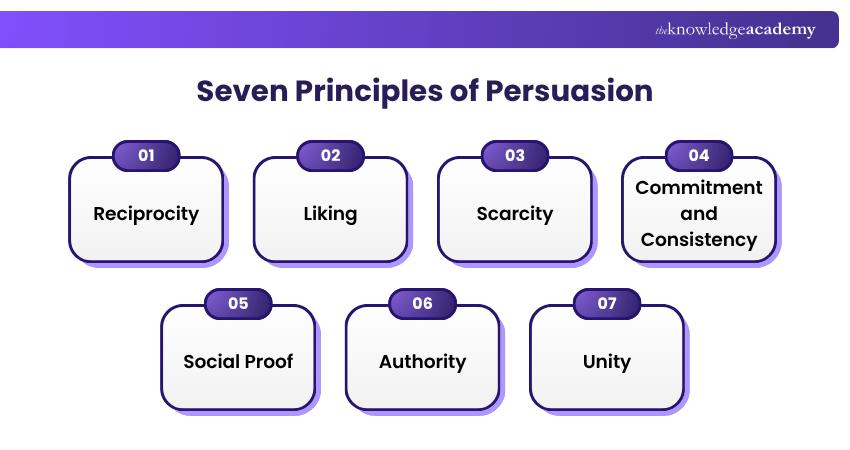
Persuasion principles explain the psychological triggers that influence decisions. The most widely cited set comes from psychologist Robert Cialdini, who identified seven core principles. Those principles are discussed below:
1) Reciprocity
Reciprocity deals with convincing customers to return the favour in an indirect manner. Many top brands have successfully utilised these techniques to sell their products and deliver profitability.
For instance, a toothpaste brand sends free samples to potential customers. The individual who has received this sample will be pleased with the company’s gesture. Receiving the free sample may make the customer more willing to consider or purchase the product.
2) Liking
People are often more receptive to messages from individuals or brands they like, trust, or relate to. Shared interests, friendliness, familiarity, and positive relationships can make communication more persuasive.
For instance, the same toothpaste if promoted by celebrities like Warren Buffett or Sylvester Stallone could result in more purchases and profitability.
3) Scarcity
Scarcity is a way of creating urgency among the targeted customers. This is a more psychological aspect where customers, after learning that the promoted product has a limited supply, are more likely to purchase it.
Taking toothpaste as an example, the brand might introduce the product as a ‘Limited Offer’ or ‘Limited Availability.’
4) Commitment and Consistency
Commitment and consistency, also a key principle in psychology, says that once individuals commit to their decision or behaviour, they are more likely to follow through and adhere to that commitment.
For example, when toothpaste brands introduce a 30-day challenge, participants who engage in this challenge are more likely to continue using the product beyond the initial period. This is because they have made a public or personal commitment, and the desire to remain consistent with that commitment drives them to stick with the product.
5) Social Proof
People may look to the behaviour or opinions of others when deciding what to choose, particularly when they are uncertain. Reviews, testimonials, ratings, and customer numbers can help people feel more confident about a decision, particularly when they are uncertain.
For instance, if someone learns that the same toothpaste is used by their neighbours, friends, or family members, they will most probably purchase that toothpaste. Such principles are commonly implemented by brands worldwide by highlighting the customers’ testimonials on their product descriptions.
6) Authority
Authority includes delivering authenticity in terms of their products. Such techniques utilise the recommendation of credible persons in this domain, such as a professional who designs and engineers a particular product.
For instance, a toothpaste brand might feature a qualified dentist explaining relevant dental-health information or recommending the product.
7) Unity
Unity focuses on a sense of shared identity or belonging between people. Individuals may be more receptive to someone they perceive as part of the same meaningful group or community. For example, a toothpaste brand could promote its product with a message such as, “Made for families like yours who want to protect every smile at home.”
Enhance your emotional resilience with Emotional Intelligence Training – Sign up soon!
Persuasive Speech Components
A persuasive speech is a powerful tool used by persuaders to influence their target audience. It requires careful consideration of both the content and the delivery. To be able to remain effective, the speech must engage the listeners, appeal to their emotions, and present logical arguments that resonate with their values. Here are the crucial components of persuasive speech.
1) Establishing Credibility
Credibility is about convincing your audience about your trustworthiness and knowledge of the specific product or topic. For this, the speaker needs to demonstrate expertise, provide evidence, and speak confidently. When people believe the speaker knows the topic very well, they are more likely to be persuaded by the message the speaker gives.
For instance, a dentist starting their speech on dental health will first mention their qualifications and experience to gain the trust of the audience.
2) Knowing Your Audience
Understanding your audience’s needs, interests, and values is key to crafting a persuasive speech. When you tailor your message to address their concerns and speak in a way that resonates with them, your chances of persuading them increase significantly.
For example, if you are talking to parents about children's toothpaste, you would focus on safety and health benefits, which align with their concerns for their children’s well-being.
3) Effective Communication
Effective communication involves using clear language, proper tone, and engaging delivery to ensure the message is understood and well-received. This includes using appropriate body language, voice modulation, and visual aids to retain the audience's interest and reinforce your points.
For example, a speaker discussing the benefits of eco-friendly toothpaste might use vivid visuals showing environmental impact, maintaining eye contact, and varying tones to keep the audience engaged.
Persuasion Real-world Examples
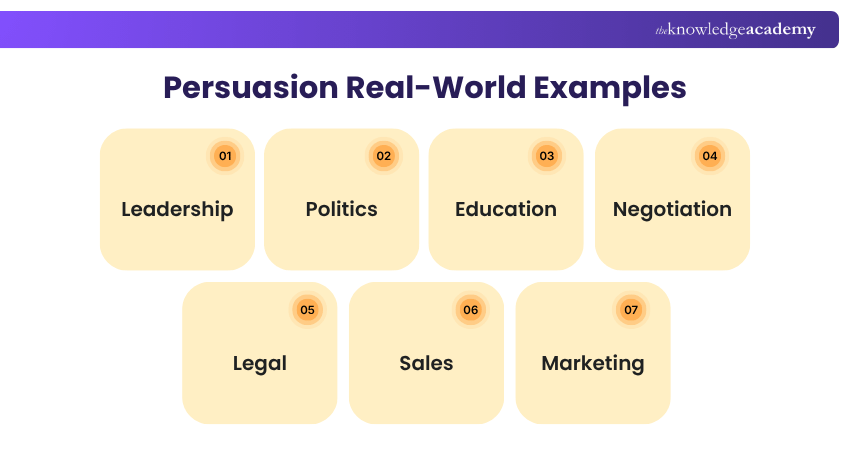
Persuasion plays a crucial role in shaping the behaviour of the persuadee and empowering decisions across diverse sets of domains. From encouraging people to adopt healthier lifestyles to increasing consumer loyalty, persuasion techniques have profound impacts when used effectively. Here are real-world examples of persuasion.
1) Leadership
In leadership, persuasion is used to inspire and motivate teams. A good leader uses persuasive techniques like establishing credibility (Ethos), presenting logical plans (Logos), and appealing to team values or emotions (Pathos).
For example, a CEO convincing an employee to adopt a new strategy would emphasise the long-term benefits (logic), share a personal commitment to the plan (credibility), and appeal to the shared goal of company success (emotion).
2) Politics
Politicians often use persuasion to gain public support for policies or campaigns. They establish credibility by highlighting their experience, using facts and statistics to present logical arguments, and tapping into voters' emotions by addressing concerns such as safety, economy, or national pride.
For instance, a candidate may use emotional appeals when discussing healthcare reforms and showing personal stories of families in need.
3) Education
In education, teachers and educators persuade students to engage with learning. A teacher may persuade students to study harder by showing how education leads to better future opportunities (logic), sharing personal experiences or success stories (credibility), and creating an inspiring classroom environment (emotion). This combination encourages students to stay motivated.
4) Negotiation
In negotiations, persuasion is about achieving a win-win solution. A negotiator might use logical reasoning to show the advantages of an agreement, establish credibility through expertise, and appeal to the other party’s needs or emotions to reach a final compromise. For instance, in business negotiations, showing how both parties will profit ensures buy-in from all sides.
Strengthen influence, communication, and negotiation techniques with our Negotiation Skills Training
5) Legal
Lawyers use persuasion in legal cases by presenting evidence logically, building trust through their legal expertise, and appealing to the emotions of the jury or judge. A lawyer defending a client may use logical arguments backed by evidence while also tapping into the jury’s sense of justice or empathy for the client.
6) Sales
In sales, persuasion is key to converting leads into customers. A salesperson persuades by showing the logical benefits of a product (e.g., saving money), building credibility by demonstrating expertise or brand trust, and tapping into emotions like excitement, fear of missing out (scarcity), or desire for improvement.
For example, a car salesman might emphasise fuel efficiency, their years of experience, and the joy of driving a new car.
7) Marketing
Marketing campaigns heavily rely on persuasion to influence consumer behaviour. Brands utilise logical appeals by showing product benefits, building trust through brand reputation or testimonials, and tapping into emotions like happiness, nostalgia, or fear.
For example, a toothpaste brand may use social proof by showing endorsements from dentists while also highlighting the health benefits of using their product and appealing to the consumer’s desire for a bright, confident smile.
Enhance negotiations in high-stakes meetings - Sign up for Managing Difficult Conversations Training now!

Vidhya Nair is a Senior Copywriter with 7+ years of experience across copywriting, content writing and communication. Her extensive research and editorial experience supports her ability to present topics across Business Skills and Human Resources with clarity and purpose.
View Detail

 If you wish to make any changes to your course, please


