


We may not have the course you’re looking for. If you enquire or give us a call on 01344203999 and speak to our training experts, we may still be able to help with your training requirements.
What is CeMAP? Exams, Salary, and Career Scope
ByAkhil KLast updated on: 06 October 2026
CeMAP is a UK FCA-recognised Mortgage Adviser qualification, covering law, regulation, and practice, proving competence to advise clients. It serves as the industry standard for Mortgage Advisers in the UK. CeMAP also acts as a career gateway, opening up opportunities in banks, mortgage brokerages and independent financial advisory firms.

Quick Snapshot
1. CeMAP stands for Certificate in Mortgage Advice and Practice.2. It develops knowledge relevant to mortgage advice, regulation and mortgage products.3. The qualification consists of three modules covering five compulsory units.4. CeMAP can support progression into mortgage advice and related roles.5. Once completed, the qualification does not require periodic exam resits, although industry knowledge should remain current.
Imagine sitting across the table, glossy property brochures spread out, eyes filled with excitement yet tinged with uncertainty. Someone asks, “Which mortgage is right for me?” and you have the confidence to guide them with clarity and trust. That is the power of the Certificate in Mortgage Advice and Practice (CeMAP).
CeMAP is your passport to delivering FCA-recognised advice and helping people make some of the biggest financial decisions of their lives. Whether you dream of guiding families into their first homes or stepping into a respected role within financial services, CeMAP can open that door. This blog explores What is CeMAP in detail to help you take the vital steps to success. So read on!
What is CeMAP?
CeMAP is a key qualification for anyone entering the world of mortgage advice. It reflects a strong understanding of the mortgage market, its regulations, and the ethical standards required to serve clients responsibly. CeMAP meets the FCA’s examination standards and is listed as an appropriate qualification for mortgage advice.
CeMAP in One View
Start CeMAP↓Module 1Financial Services, Regulation and Ethics↓Module 2Mortgages↓Module 3Assessment of Mortgage Advice Knowledge↓Complete the Qualification↓Build Relevant Workplace Competence↓Progress in Mortgage Advice
The purpose of CeMAP is to equip future Mortgage Advisers with the knowledge and skills needed to give accurate, trustworthy guidance. It covers essential topics like mortgage products, application processes, interest rates, and ethical practices. At its core, CeMAP aims to promote high standards across the industry and ensure clients receive clear, confident, and compliant advice.

Who Needs a CeMAP?
Wondering if CeMAP is right for you? If you're aiming for a role in mortgage advice or financial services, it’s probably your next best step. Here’s who benefits most:
a) Future Mortgage Advisers: CeMAP is one of the recognised qualifications that can meet the FCA’s examination requirements for mortgage advice.
b) Bank Staff Eyeing Promotions: It’s a great way to move into advisory positions.
c) New Entrants to Financial Services: Just getting started? CeMAP gives you a solid foundation.
d) Career Changers: Looking for something new and rewarding? CeMAP opens real opportunities.
e) Mortgage Professionals Seeking Further Progression: CeMAP can support progression into mortgage advice roles, although independent practice also requires the appropriate regulatory arrangements and workplace competence.
Three levels, one qualification, endless career potential. Sign up for our CeMAP Course (Level 1,2 and 3) today!
How Many CeMAP Exams Are There?
CeMAP consists of three modules, each with its own exam:
a) Module 1 Financial Services, Regulation & Ethics (FSRE): It covers the fundamentals of Financial Services regulation. It’s composed of two units: FRE1 and FRE2. Each unit has a 1-hour exam, with 40 multiple-choice questions (including 15 linked to case studies).
b) Module 2 Mortgages (MORT): It focuses on the mortgage application process and the various available products. This module contains two units. MRT1 is assessed through a 1-hour exam with 50 multiple-choice questions, while MRT2 has a one-hour exam with 40 multiple-choice questions.
c) Module 3 Assessment of Mortgage Advice Knowledge: This module merges case-study and applied assessments. You’ll consolidate knowledge from Modules 1 & 2 and also cover basics of protection (life, income, etc.). This module is assessed through a 2-hour exam containing six case studies, with 10 linked multiple-choice questions for each case study, giving a total of 60 questions.
Your Study Journey
Plan → Set a realistic study schedule↓Learn → Work through each module↓Practise → Review concepts and questions↓Assess → Complete the required exams↓Progress → Complete all three modules
Benefits of Obtaining CeMAP Certification
Several advantages come after getting the CeMAP Certification, especially for people who want to pursue a career as Mortgage Advisers. Let’s look at some of them below:
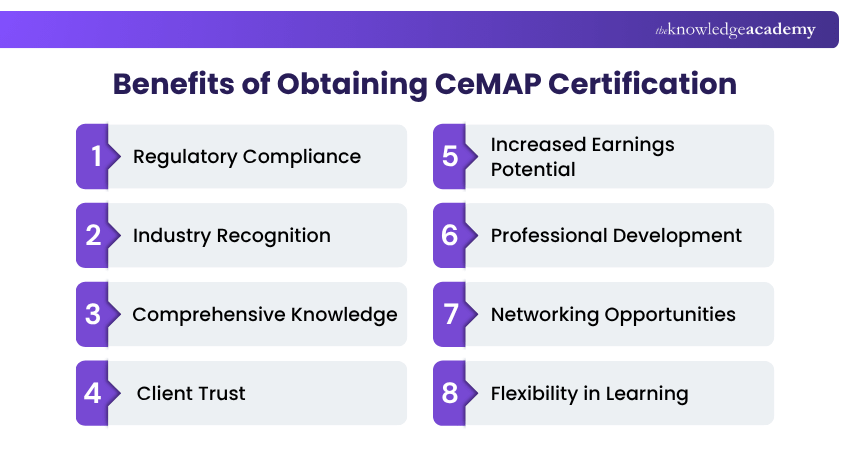
a) Regulatory Compliance
CeMAP meets the FCA’s examination standards for relevant mortgage advice activities. Completing the qualification supports the technical qualification requirement, but advisers must also meet employer, competence, and regulatory requirements applicable to their role.
b) Industry Recognition
This certification is one of the most popular, especially in the financial sector. Receiving this certification helps Mortgage Advisers in the UK receive industry recognition, which propels their professional careers further and helps them attract clients.
c) Comprehensive Knowledge
CeMAP Certification covers various topics, including financial regulations, mortgage law, and other practical skills. These skills help the candidates increase their financial advising skills.
Trainer’s Insight
CeMAP is specifically focused on mortgage advice. It may complement wider financial-services careers, but broader roles such as investment or wealth advice can involve different qualification and competence requirements.
d) Client Trust
Being a certified CeMAP professional automatically increases your client’s trust. This certification shows your credibility as a professional and increases your chances of being referred to a broader clientele.
e) Increased Earnings Potential
It also shows that professional Mortgage consultants usually earn more than non-certified consultants. Certification may result in promotion to a better job ranking, a change in remuneration to higher scales, and other incentives based on performance.
Become a pro at handling the numbers behind smart property investments - Sign up for our Real Estate Financial Modelling Training now!
f) Professional Development
CeMAP provides a structured foundation in mortgage regulation, products, and advice. After qualifying, professionals should continue keeping their knowledge current as regulations, products, and industry practices change.
g) Networking Opportunities
Becoming a CeMAP-certified professional means that you have peers, and you can especially look forward to gaining advice from leaders in the field. This can also help you create your professional network and shape your career.
h) Flexibility in Learning
CeMAP training has different modes, including online and in-person training, offering flexibility to learn according to your own schedule and fit your studying in between other responsibilities. You will be equipped with the necessary knowledge and skills to advance in the mortgage sector.
Pro Tip
Build your study plan around the time you can consistently commit each week rather than trying to complete CeMAP as quickly as possible.
What Salaries Can CeMAP-Qualified Professionals Earn?
Salary after completing CeMAP can vary significantly depending on the role, experience, employer, location, commission arrangements and whether someone is employed or self-employed. Here are the average salaries for some CeMAP-certified roles:
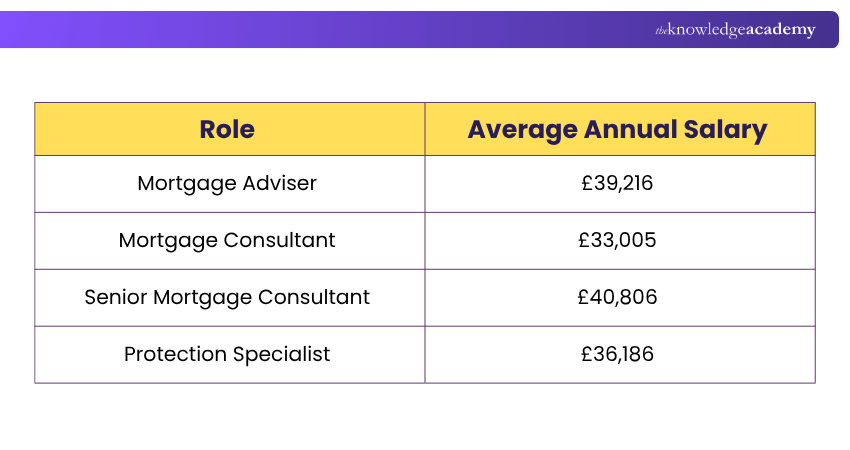
Source: Indeed
Jobs to Pursue with CeMAP
A CeMAP qualification can lead to a range of roles, including the following:
1) Mortgage Adviser
A mortgage adviser helps clients understand suitable mortgage options based on their financial circumstances and requirements. Typical responsibilities include:
a) Assessing clients’ financial circumstances and borrowing needs
b) Explaining suitable mortgage products and repayment options
c) Comparing lenders and mortgage criteria
d) Supporting clients through the mortgage application process
e) Maintaining accurate client and compliance records
f) Keeping knowledge of mortgage products and regulations current
2) Mortgage Broker
A mortgage broker works with clients to identify suitable mortgage products from the lenders available through their brokerage or panel. Typical responsibilities include:
a) Understanding clients’ property and borrowing requirements
b) Researching available mortgage products and lender criteria
c) Recommending suitable mortgage solutions
d) Preparing and submitting mortgage applications
e) Communicating with lenders, solicitors, and clients
f) Supporting clients from application through to completion
3) Mortgage Consultant
A mortgage consultant supports clients with mortgage-related decisions and application processes, often within banks, building societies, brokerages, or other financial services organisations. Typical responsibilities include:
a) Discussing clients’ mortgage requirements
b) Explaining available products and lending criteria
c) Reviewing financial and property information
d) Supporting mortgage applications and documentation
e) Maintaining records in line with organisational procedures
f) Providing ongoing support throughout the mortgage process
4) Mortgage Administrator
A mortgage administrator provides operational support throughout the mortgage application process. CeMAP knowledge can be useful for understanding mortgage products, terminology, and regulatory requirements. Typical responsibilities include:
a) Preparing and checking mortgage documentation
b) Updating application and client records
c) Liaising with lenders, advisers, and clients
d) Tracking application progress and outstanding requirements
e) Organising supporting financial and property documents
f) Helping maintain accurate compliance records
5) Mortgage Case Manager
A mortgage case manager coordinates mortgage applications from submission through to completion, helping ensure that cases progress efficiently. Typical responsibilities include:
a) Reviewing submitted mortgage cases and supporting documents
b) Monitoring application progress with lenders
c) Resolving outstanding documentation or information requests
d) Communicating updates to advisers and clients
e) Coordinating with solicitors, lenders, and other parties
f) Maintaining clear and accurate case records
6) Protection Adviser
CeMAP can provide useful mortgage-related knowledge for professionals who also work with protection products. However, advisers must meet the relevant competence and regulatory requirements for the products they recommend. Typical responsibilities can include:
a) Assessing clients’ protection needs
b) Explaining life, critical illness, and income protection options
c) Recommending suitable cover within their authorised scope
d) Maintaining accurate advice and compliance records
e) Reviewing existing protection arrangements
f) Keeping product and regulatory knowledge current
7) Mortgage Advice Business Owner
Experienced mortgage professionals can progress towards running their own mortgage advice business, subject to the appropriate regulatory arrangements and competence requirements. Responsibilities can include:
a) Choosing an appropriate FCA regulatory route
b) Establishing compliance and record-keeping processes
c) Managing client relationships and mortgage cases
d) Overseeing business operations and service standards
e) Building relationships with lenders and industry partners
f) Maintaining professional competence and regulatory compliance
How long is CeMAP Valid for?
Once you complete the CeMAP exams, the qualification is valid for an indefinite period. You do not need to resit your examinations every few years. However, you are expected to keep your knowledge up to date because regulatory rules, mortgage products and industry practices evolve.
Strengthen your financial decision-making and planning skills with the Financial Management (FM) Course – Register now!

Akhil K is a Copywriter and Video Editor with experience in content creation, visual storytelling, advertising and brand communication. His background in journalism, research and audience-focused communication strengthens his ability to create clear and engaging Business Skills content.
View Detail

 If you wish to make any changes to your course, please


